by Ethan Faverino | May 25, 2026 | Must Read, News
By Ethan Faverino |
The Republican Study Committee (RSC) held a fraud roundtable last week, led by Representative Brandon Gill (TX-26), calling for aggressive action and criminal prosecutions in response to a major Medicaid fraud scheme in Ohio uncovered by investigative reporting.
The event follows a Daily Wire investigation by reporter Luke Rosiak, which revealed how convicted felons and foreign nationals established 288 shell companies to fraudulently bill taxpayers for home health services that were never even provided.
The scheme defrauded Ohio’s Medicaid program of approximately $250 million. One single building in Columbus reportedly housed 94 fake companies that billed out $66 million.
Rosiak exposed the operation in about two months by analyzing publicly available data that state Medicaid officials had allegedly overlooked for four years.
Rep. Gill, who chairs the newly formed House Oversight Committee Task Force on Defending Constitutional Rights and Exposing Institutional Abuses, announced that the task force will launch a formal investigation equipped with subpoena power to pursue accountability and issue criminal referrals.
“Whenever you bring in infinity third worlders into American society from low trust countries, you kind of expect low trust behavior, and that’s what we’ve seen here,” stated Gill. “The American people want to know that their tax dollars are actually being used for the American people, not for foreigners, not for fraudsters. Our job is to stop it, to get the bad guys in jail by issuing criminal referrals.”
The roundtable aligns with broader Republican efforts to combat waste, fraud, and abuse in federal healthcare programs. These initiatives build upon the White House Fraud Task Force established by President Donald Trump and Vice President JD Vance, which has already deferred billions in Medicaid reimbursements from non-compliant states and imposed a hold on new hospice and home health care licenses until integrity requirements are met.
RSC Vice Chair Ben Cline (VA-06) emphasized the impact on legitimate beneficiaries: “Fraud is not a victimless crime. Fraudsters steal money from innocent people who are meant to benefit from these programs, Medicare, Medicaid, home health. One of the main weapons that we have is transparency.”
Additional remarks from members in attendance included:
- Rep. Michael Cloud (TX-27): “It’s unfortunate when people come to this country, have no intent in helping build this country, but are just simply here to defraud the American citizens who are here and working to build this country. The waste, fraud, and abuse is turned into a money laundering scheme for leftist organizations.”
- Rep. Laurel Lee (FL-15): “We are not providing federal funding for the purpose of subsidizing negligence, incompetence, or corruption. Every dollar that is stolen is $1 that is no longer available for vulnerable Americans who actually need these services.”
- Rep. Tim Burchett (TN-02): “We found over a trillion dollars in duplication and increased bureaucracy. Every time the Democrats holler and say, ‘Oh, you’re cutting this program,’ you’re damn right. We’re cutting the waste, abuse, and fraud.”
- Rep. Mike Kennedy (UT-03): “This criminal behavior is enriching filthy individuals who deserve to be in jail. If there are doctors on the tape, they should do the perp walk and go to jail. Their license should be taken and never returned.”
- Rep. Abe Hamadeh (AZ-08): “This is not just going to be hearings after hearings. It’s going to be arrests and prosecutions. We have to end this now. What we’re uncovering is criminals.”
Republicans characterized the Ohio Medicaid scam as a stark example of systemic vulnerabilities in federal healthcare programs that deflect critical resources away from the people who depend on these services.
The roundtable highlighted the GOP’s commitment to greater transparency, aggressive enforcement, and criminal prosecutions to protect taxpayer dollars and restore integrity to these programs.
Ethan Faverino is a reporter for AZ Free News. You can send him news tips using this link.
by Staff Reporter | May 8, 2026 | News
By Staff Reporter |
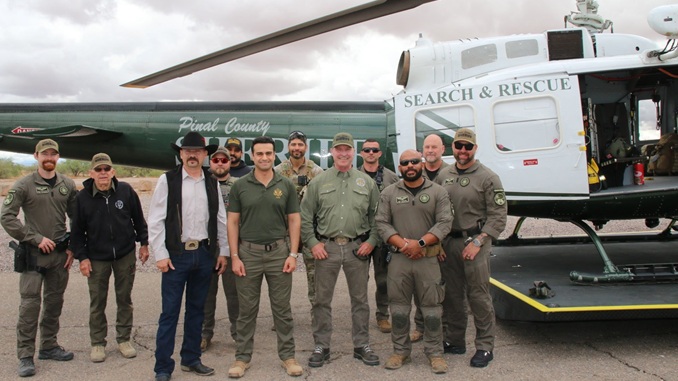
Rep. Abe Hamadeh (R-AZ-08) reportedly assisted with the capture of three illegal aliens while tagging along on a border security sweep.
Hamadeh traded the suit and tie preferred on Capitol Hill for military fatigues during a ride-along with Border Patrol on Tuesday. The congressman thanked the Pinal County Sheriff’s Office for arranging his participation in their immigration enforcement work.
The Pinal County Attorney’s Office and Board of Supervisors have been sparring over the former’s decision to enter into an agreement assisting Immigrations and Customs Enforcement with deportations. The board sued the county attorney, Brad Miller, over the agreement.
The Pinal County Superior Court issued a temporary restraining order on that agreement in February prior to the case’s transferral to the Maricopa County Superior Court, where it remains pending.
As part of that court-ordered halt, Miller agreed to not engage with ICE beyond information sharing.
Separately, a federal court ruled last month in favor of state laws enabling state and local police to arrest illegal aliens for immigration violations. The case was decided by the Fifth Circuit Court of Appeals on the fate of a Texas law (Texas Senate Bill 4); the Biden administration initiated that lawsuit, but the Trump administration dropped it recently.
The court dismissed the case after determining that the one county and two civil rights groups that remained as the sole challengers to the Texas law lacked standing.
That appeals court decision gave the green light to the Arizona Border Security Act, or Proposition 314, which was passed by Arizona voters in 2024. Gov. Katie Hobbs attempted to terminate that legislation through veto, but a majority of Arizona voters proved to support the measure.
The Texas and Arizona laws, and others like them, will likely face challenges for the foreseeable future. Civil rights groups filed a lawsuit to stop the Texas law on Monday.
A hearing is scheduled for May 15 at 9 am before Maricopa County Superior Court Judge Michael Gordon.
Southwest land border encounters have declined steeply since President Donald Trump took office. Border encounters went from all-time highs of several million per fiscal year (over 2.4 million in fiscal year 2023, and over 2.1 million in fiscal year 2024) to one-fourth previous totals (over 400,000 in fiscal year 2025).
At this point in the last fiscal year, southwest land border encounters were approximately 380,700. For this fiscal year, there have been just over 63,700 encounters: approximately one-sixth the total from the same point in time the last fiscal year.
U.S. Customs and Border Protection fiscal years run from October of the previous year to September of the current year (fiscal year 2026 runs from October 2025 to September 2026).
While Arizona’s Republican elected officials in Congress have offered their support for immigration enforcement, Democratic representatives have worked to slow or halt immigration enforcement.
Congresswomen Adelita Grijalva (D-AZ-07) and Yassamin Ansari (D-AZ-03) have both dedicated significant taxpayer resources to assisting illegal aliens and opposing ICE.
AZ Free News reported last week that nearly half of Grijalva’s press releases since taking office have concerned a defense of illegal aliens or opposition to ICE. Nearly one-third of her X posts since taking office were defenses of illegal aliens, demands to abolish ICE, or opposition to immigration enforcement. Three of her 14 non-recognition remarks on the congressional record were focused on opposing ICE and immigration enforcement.
Grijalva and Ansari, along with Rep. Greg Stanton (D-AZ-04) and Democratic Sens. Mark Kelly and Ruben Gallego, have made multiple trips to immigration detention centers, independently and as a group. The Democratic officials have referred to illegal aliens as their constituents.
Last week, Grijalva, Ansari, and Stanton introduced legislation to limit detention periods of illegal aliens to 12 hours.
AZ Free News is your #1 source for Arizona news and politics. You can send us news tips using this link.
by Ethan Faverino | May 1, 2026 | News
By Ethan Faverino |
Congressman Abraham Hamadeh (R-AZ-08) introduced Kayleigh’s Law, a landmark federal legislation designed to provide survivors of dangerous crimes with permanent, lifelong protection from their convicted abusers by requiring courts to issue no-contact injunctions that remain in effect for the rest of the offender’s life.
Named after Kayleigh Kozak, an Arizona mother and prominent victim advocate who was sexually abused as a child by her teacher, the bill aims to end the repeated “legal tug-of-war” that forces survivors to return to court multiple times to maintain basic safety protections against their predators.
Kayleigh’s Law would mandate that federal courts impose lifetime no-contact injunctions against individuals convicted of federal sex crimes and violent felonies when requested by the victim or the government at sentencing.
The legislation builds directly on successful state-level reforms. Kayleigh’s Law has been enacted in Arizona and Wisconsin since 2022, where it has provided critical relief to survivors. In its first year alone in Arizona, the law enabled over 1,000 victims to secure lifetime protective orders against their abusers.
“As a former prosecutor, I know how vulnerable victims can be, how determined their predators often are, and how judges can frequently fail victims of crime. That is why we must require federal courts to impose these lifetime injunctions when requested by the government or the victim during sentencing,” stated Congressman Hamadeh. “I have seen what victims go through as the predator’s adjudication process plays out, and I know how important it is for the victim’s healing process to begin. That process cannot be interrupted by their predators simply because our courts fail to take crime seriously and fail to impose lifetime injunctions.”
Kayleigh Kozak, whose personal experience drove the creation of the original state law, emphasized the lifelong impact of sexual violence.
“The harm caused by sexual assault is not temporary. It is lifelong,” stated Kayleigh. “The protections for those who have been sexually violated should be lifelong too. No survivor should have to repeatedly return to court just to request the continuation of a protective order from the person who was convicted of sexually violating them. Kayleigh’s Law ensures no victim ever has to endure the nightmare of continuously justifying their need for safety. When I was a little girl, I could not protect myself from the teacher who sexually abused me at school – but I can fight now to protect myself, other innocent children, and every victim.”
Under the federal proposal, the lifetime injunction would prohibit all forms of direct or indirect contact with the victim and would remain enforceable even after the offender completes prison, probation, or supervised release.
Original cosponsors of Kayleigh’s Law include Representatives Brian Babin (TX-36), Andy Biggs (AZ-05), Tim Burchett (TN-02), Juan Ciscomani (AZ-06), Eli Crane (AZ-02), Troy Downing (MT-02), Mike Ezell (MS-04), Brandon Gill (TX-26), Paul Gosar (AZ-09), David Joyce (OH-14), Nancy Mace (SC-01), Dan Meuser (PA-09), Barry Moore (AL-01), Gary Palmer (AL-06), Chris Smith (NJ-04), David Schweikert (AZ-01), Greg Steube (FL-17), Marlin Stutzman (IN-03), David Taylor (OH-02), and Delegate Kimberly King-Hinds (MP).
Congressman Juan Ciscomani (AZ-06) stated, “Kayleigh’s Law originated in Arizona and will uplift thousands of victims of unspeakable crimes. I’m proud to join my colleagues in supporting this commonsense legislation to ensure victims of dangerous crimes can obtain lifetime protections against their abusers. Survivors should not be faced with uncertainty about those who have harmed them. Kayleigh’s Law will close critical gaps in federal law by strengthening protections, enhancing enforcement, and ensuring lasting safety for victims.”
Congressman Marlin Stutzman (IN-03) added, “Victims of violent crime and sexual assault deserve to have permanent, basic safety protections without having to repeatedly face their attacker in court. The emotional and psychological toll of these legal proceedings is high. Kayleigh’s Law gives victims one less thing to worry about by removing the fear and dread of reliving these experiences. I am proud to cosponsor Congressman Hamadeh’s bill to ensure these criminals hold no power over their victims.”
The bill mirrors key elements of Arizona Statute (A.R.S. 13-719), which applies to dangerous offenses, serious/violent felonies, and specific sex offenses under Chapters 14 and 35.1. Injunctions issued under the law are effective immediately upon sentencing and do not expire for the predator’s natural lifetime.
Kayleigh’s Law is being introduced during Sexual Assault Awareness Month, underscoring its focus on empowering survivors and closing critical gaps in federal protections for victims of sexual assault and violent crimes.
Ethan Faverino is a reporter for AZ Free News. You can send him news tips using this link.
by Ethan Faverino | Apr 27, 2026 | News
By Ethan Faverino |
Congressman Abraham Hamadeh (R-AZ-08) announced that he has begun work on the BRRRRT Act (Bolstering Recognition, Resurgence, Retention, and Remembrance of the Thunderbolt) to ensure U.S. troops on the front lines continue to receive the most effective and lethal close air support available.
The legislation aims to reinforce the iconic A-10 Thunderbolt II, also known as the “Warthog,” whose distinctive sound has long provided reassurance to ground forces under fire. Hamadeh quoted one soldier, who called it, “One of the most terrifying yet beautiful sounds ever heard.”
Earlier this week, at the request of President Donald Trump and Defense Secretary Pete Hegseth, the Secretary of the Air Force announced that the Air Force will extend the A-10 Thunderbolt II through 2030. The service plans to keep two squadrons flying through that date: one active-duty squadron at Moody Air Force Base and one reserve squadron at Whiteman Air Force Base.
Congressman Hamadeh’s BRRRRT Act would build upon and strengthen this extension by:
- Reinforcing the 2030 timeline and increasing the minimum number of A-10s required in the operational inventory.
- Supporting robust training and sustainment pipelines for the platform.
- Requiring that certain retired A-10s be preserved in rapidly recoverable conditions at the AMARG boneyard in Arizona to enable future surge capacity.
- Directing an evaluation of retaining additional A-10s in Air Force Reserve and Air National Guard wings.
- Examining the feasibility of selling or transferring A-10s to foreign partners, including through shared sustainment arrangements.
The bill would also mandate a comprehensive report to congressional defense committees on the A-10’s combat legacy. The report will cover the aircraft’s employment from Operation Desert Storm through current operations and analyze lessons learned for future close air support doctrine. Topics would include pilot training, weapons integration, battlefield communications, and air-ground integration.
Specifically, the legislation directs the Air Force to assess how elements of the A-10 mission set, command-and-control methods, and operational experience could inform emerging close air support concepts, such as human-machine teaming, autonomous collaborative aircraft, counter-drone operations, AI-enabled mission planning and targeting, digital battlefield communications, and distributed air-ground integration.
“As a former U. S. Army Intelligence officer, I know that the arrival of the A-10 creates the most beautiful sound ever heard by troops under fire on the battlefield,” stated Congressman Hamadeh, who oversees fighter platform programs on the House Armed Services Committee Subcommittee on Tactical Air and Land Forces. “For too long, the military industrial complex has pushed newer, not better, leaving our troops at risk by retiring the great Warthog. The A-10 is proof that newer isn’t always better and price has nothing to do with performance.”
Ethan Faverino is a reporter for AZ Free News. You can send him news tips using this link.
by Ethan Faverino | Apr 25, 2026 | Economy, News
By Ethan Faverino |
Congressman Abraham Hamadeh (R-AZ-08) announced his letter to Secretary of Veterans Affairs Doug Collins to adopt common-sense reforms to the VA Home Loan Guarantee Program.
The goal is to eliminate outdated bureaucratic hurdles, reduce unnecessary costs, and better align the program with today’s competitive housing market so more young veterans can achieve the American Dream of homeownership.
In a formal letter to Secretary Collins, Congressman Hamadeh highlighted the Trump administration’s strong progress in refocusing the Department of Veterans Affairs on its core mission: delivering timely benefits, expanding access to quality care, slashing the claims backlog, and eliminating waste. Building on that momentum, Hamadeh expressed confidence that practical improvements to the home loan program will receive serious consideration.
“As my fellow veteran and Committee member, Congressman Van Orden said in our hearing on the subject, we must find ways to eliminate the unnecessary administrative costs of the VA Home Loan program and better align it with other Federal housing programs,” said Congressman Hamadeh. “My family is in real estate. I am very familiar with housing, and I know the unintended consequences of bureaucratic policies that have little to no protective value and ignore the realities of the marketplace.”
Congressman Hamadeh’s recommendations focus on four key areas where the VA Home Loan program lags behind other federal housing programs, such as FHA and USDA loans:
Ending Origination Fee Stacking: VA rules cap lender origination and administrative fees at 1% of the loan amount, intended to cover all lender labor and overhead. However, veterans report lenders charging the full 1% while adding separate itemized fees for processing, underwriting, and other services. This practice amounts to an unfair cash grab that increases costs for veterans and should be strictly enforced.
Modernizing Underwriting Process: The VA continues to rely heavily on manual underwriting, resulting in average closing times of about 10 business days. In contrast, the FHA has implemented semi-automated systems that can approve straightforward loans in as little as 2 to 7 days. The Mortgage Bankers Association has testified that automated underwriting would accelerate the process and help reduce the perception that VA loans are slower and more cumbersome.
Raising the Seller Concessions Cap: The VA currently limits seller concessions to 4% of the home’s reasonable value. Both FHA and USDA programs allow up to 6%. In competitive markets, this 2-percentage point difference can mean the difference between a veteran’s offer being accepted or denied.
Addressing Appraiser Shortages Through Reasonable Certification Requirements: The VA has identified 436 counties in 31 states facing appraiser shortages that delay loans and drive up costs. A major contributor is the VA’s stringent experience requirement of 3 to 5 years for certification, compared to just 12 to 18 months for FHA and USDA programs. Aligning standards would increase the pool of qualified appraisers, shortening waiting times and lowering fees.
These targeted reforms would remove barriers without compromising program integrity, helping young veterans secure homes more efficiently and affordably. By modernizing the program, VA can better fulfill its promise to those men and women who have sacrificed for our country.
Ethan Faverino is a reporter for AZ Free News. You can send him news tips using this link.
Page 1 of 2712345678910...20...»Last »