by Matthew Holloway | Feb 28, 2025 | News
By Matthew Holloway |
A series of posts to X on Tuesday sparked a firestorm of controversy when Merissa Hamilton of Strong Communities Action-EZAZ.org made a bombshell allegation that Maricopa County Election officials were made well aware of the potential for printing and supply issues during the 2022 statewide elections. Hamilton alleged that county officials moved forward without addressing the issues, citing a series of emails detailing the Maricopa County GOP raising concerns to then-Recorder Stephen Richer and Maricopa County Board of Supervisors’ Election Manager Scott Jarrett.
The post gained national attention when it was shared by X owner and de facto head of the Department of Government Efficiency Elon Musk.
In the initial post Hamilton wrote, “Remember in 2022 when the nearly 70% of voting centers in Maricopa County failed on Election Day causing massive, long lines and voter disenfranchisement resulting in @KariLake and @AbrahamHamadeh barely losing? Maricopa County knew in advance their Election Day plan was set up for failure, and THEY LET IT FAIL!”
Hamilton noted that the emails were obtained for Strong Communities Action by The Gavel Project and civil rights activist and Arizona election attorney Ryan Heath saying, “Without his legal muscle we wouldn’t have secured it!”
In the thread that followed, Hamilton released several emails from then-Chairwoman of the Maricopa County Republican Committee Mickie Niland to Richer and Jarrett saying, “I remember hearing from Scott (Jarrett) at some point after the primary that there was a problem during the primary with some tabulators not reading correctly due to low ink. How long does it take you to get paper or ink to them if they run out? Is there a process for the voting locations to report when they are half out of paper? How far are the restocking trucks from the voting centers? Are you using the length of the lines to help you determine when more supplies are brought to the centers?“ She also asked if there was any way she could help.
Jarrett responded, “We’ve been monitoring turnout and are prepared,” adding that there was plenty of ballot paper and normal paper to print control slips as well as “sufficient toner and printer drums.”
Hamilton explained, “Several days ahead of Election Day, the Maricopa County GOP leadership warned Maricopa County that their Election Day plan would fail and disenfranchise voters. The Maricopa County BOS Election Director Scott Jarrett insisted everything would be fine saying he was ‘confident.’”
Niland, representing the Maricopa County GOP, even followed up with an email warning, “Trust is low and voting in person is the topic everyone wants to discuss with us. To us if you are basing your decisions off of history, we think things are different now.” Niland added, “Please consider this email the official raising of that flag.”
According to an investigation of the 2022 Maricopa County Election, former Arizona Supreme Court Chief Justice Ruth McGregor found that “many of the Oki B432 printers were not capable of reliably printing 20-inch ballots on 100-pound paper under election-day conditions.”
McGregor added, “The combined effect of the heavy paper, longer ballot, and intermittent burst of print demand pushed the printers to perform at the very edge of or past their capability, so that any decrease in fuser performance in an individual printer could result in problems.”
Replying to the post by Musk, Hamilton thanked the X owner for “bringing attention to this vital matter!” She also raised allegations that Maricopa County Board of Supervisors Chairman Thomas Galvin has blocked newly elected County Recorder Justin Heap from accessing “the IT staff and responsibilities assigned to him in AZ law to secure and run our elections!”
Later in the afternoon, Maricopa County published a post to X that outlined the October 2024 agreement, which demarcated the election responsibilities of the Board of Supervisors and the Recorder’s Office. Galvin shared the post as well.
Matthew Holloway is a senior reporter for AZ Free News. Follow him on X for his latest stories, or email tips to Matthew@azfreenews.com.
by Corinne Murdock | Jan 23, 2024 | News
By Corinne Murdock |
The Maricopa County Superior Court has denied an attempt by Secretary of State Adrian Fontes to bar the release of Maricopa County’s absentee ballot envelopes from the 2022 election.
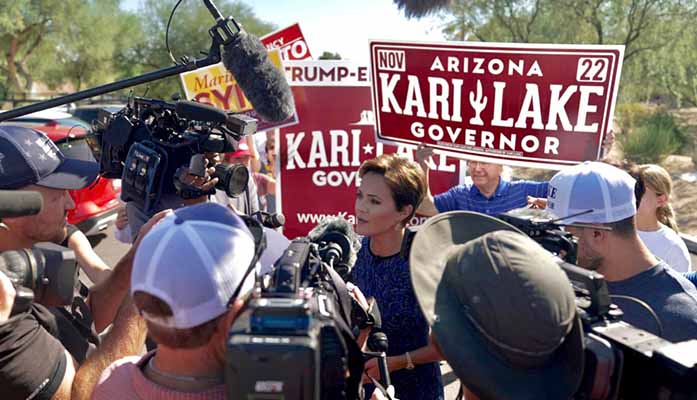
Last Thursday, Judge John Blanchard denied Secretary of State Adrian Fontes’ motion to dismiss the request for the ballot data made by election integrity activists: We the People Arizona Alliance (WPAA), represented by failed gubernatorial (now Senate) candidate Kari Lake’s counsel challenging the 2022 election results, Bryan Blehm.
Blanchard ordered Fontes to work on a solution with WPAA and, at minimum, provide a sworn affidavit of the difficulties his office would have in providing the envelopes. The judge also gave WPAA permission to resolve these difficulties with Fontes or bring suggested remedies to the court.
“[T]he parties have not had a meaningful opportunity to discuss, test, and explore the stated technological and practical reasons why [the secretary of state] cannot comply with the public records request,” said Blanchard. “[T]he parties shall meet and confer regarding the Secretary of State’s reasons for refusing to produce the data that is responsive to [the request].”
During last week’s hearing on the case, Kyle Cummings with the attorney general’s office claimed that election officials would have to pull each individual voter file in order to access the ballot envelopes. Cummings said that such an undertaking would be far too time-intensive and costly for the secretary of state.
“The secretary [of state’s] folks who manage their database and their systems said that, ‘Hey, we can’t produce this, it would have to be done individually, we cannot just gather it all together,’” said Cummings. “The secretary’s office does not have the time, resources, or manpower to pull at least one million individual entries for the request[.]”
Blehm countered that a database administrator could “easily” pull that data and consolidate it into one electronic file. He noted that the database lead for the secretary of state’s office should be made to testify on why that isn’t the case.
“If they’re going to continue to take the approach that they have to run an individual query for each of these five things of data for over a million voters, I would like the opportunity to depose their database administrator or data manager to dive into this,” said Blehm.
Lake said the ruling was “great news.”
Absentee voting remains the primary method of ballot casting in Arizona. As of Monday, Fontes reported over 4.1 million registered voters in the state, with Republicans wresting the majority from independent voters: about 1.42 million Republicans and over 1.41 million independents.
Over 1.2 million voters registered as Democrats, over 32,400 registered as libertarians, over 25,900 registered as No Labels Party, and just over 2,500 registered as Green Party.
Corinne Murdock is a reporter for AZ Free News. Follow her latest on Twitter, or email tips to corinne@azfreenews.com.
by Corinne Murdock | Dec 3, 2023 | News
By Corinne Murdock |
The Maricopa County Superior Court is refusing to facilitate any further investigations into the 2022 election by former gubernatorial candidate Kari Lake.
On Thursday, Judge John Hannah ruled in Lake v. Richer against Lake’s petition to obtain all Maricopa County ballot envelopes from the 2022 election; despite their status as public record, Hannah expressed concern over the potential harm that could occur to voters, including future voter fraud, harassment of voters, and identity theft.
“The ballot affidavit envelopes from the 2022 election include the signatures of some 1.3 million Maricopa County voters, each conveniently presented with the voter’s name, address, and telephone number on the same page,” said Hannah. “Disclosure of the ballot affidavit envelopes therefore would create a risk of widespread fraud where none exists at present.”
Hannah cited testimony from two voters who had strangers appear at their homes to question the 2022 election. The judge also said that the perception of potential identity theft would dissuade voters from casting early mail-in ballots.
The judge further rejected Lake’s claim that voters lack a privacy interest concerning their ballot affidavit envelope signatures. He pointed out that Lake had failed to identify cases in which Maricopa County Recorder Stephen Richer had wrongly verified an individual ballot using a faulty signature match.
“An individual has a privacy interest in his or her signature precisely because the signature serves as a badge of personal identification for legal documents and in commercial transactions,” stated Hannah.
Hannah concluded with a comparison of Lake’s petition to the famed Aesop Fable about the goose who laid the golden egg. The judge said that Lake had overlooked democratic self-governance in an effort to vindicate her cause.
“Ms. Lake regards the electoral process much like the villagers in the famous fable regarded the goose that laid the golden egg, except that her goose failed to lay the egg she expected. She insists that something must have gone wrong. If only she could cut open the electoral process and examine each of its 1.3 million pieces, she says, she would be able to figure out what happened and show that the prize has been there waiting for her all along. And even if she doesn’t find what she’s looking for, she suggests, the act of disassembly will strengthen everyone’s confidence that the machinery produces reliable outcomes. We will know it lays the right eggs.”
Richer said that Thursday’s ruling was vindication for his opposition to Lake’s investigatory attempts. Richer had testified that release of the ballot envelopes would lead to reduced voter participation and even disenfranchisement.
“After six hours on the witness stand… I was right on the law. Again,” said Richer.
Lake’s campaign indicated that the ruling prioritized prospective safety over transparency.
“Silly us. We thought transparent elections were in the best interest of our state,” said the campaign.
Though she has continued her challenge of the 2022 election, Lake announced last month that she is running for Senate in 2024.
Corinne Murdock is a reporter for AZ Free News. Follow her latest on Twitter, or email tips to corinne@azfreenews.com.
by Corinne Murdock | Jun 4, 2023 | News
By Corinne Murdock |
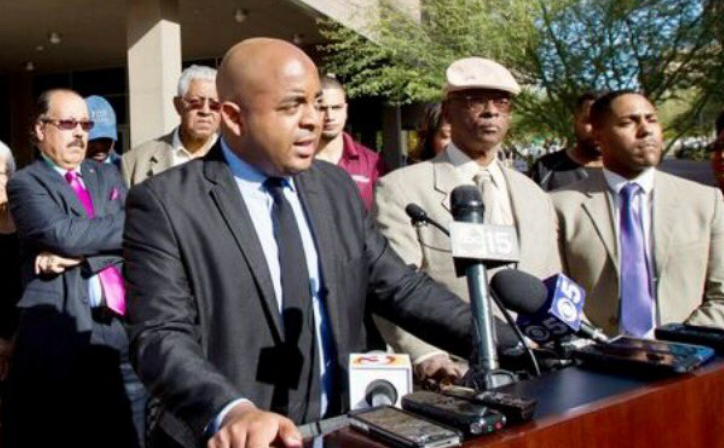
Arizona civil rights activist Jarrett Maupin, Jr., characterized the 2022 attorney general election contest as the “civil rights issue of our time.”
Maupin referenced the allegations of disenfranchisement, which he claimed would bring American society back to a time where Black citizens couldn’t vote under the Democratic Party.
“Without the right to vote and to have every vote counted, we will return to the dark days of the Democrats of the Old South. If you cannot vote, you are a slave,” said Maupin. “Period.”
Maupin has run multiple times for different offices, including Congress and Phoenix mayor.
Republican attorney general candidate Abe Hamadeh is challenging the validity of Kris Mayes as the elected attorney general. The Mohave County Superior Court granted oral arguments earlier this month. As AZ Free News reported, Judge Lee Jantzen expressed interest in the sampling of evidence provided by Hamadeh’s team during the arguments.
Hamadeh’s team focused on evidence of allegedly disenfranchised voters, specifically uncounted votes from undervotes and provisional ballots. Opposition representing Mayes, Secretary of State Adrian Fontes, and Maricopa County argued that too much time has passed since the initial December hearing and swearing-in.
A ruling in the oral arguments is pending but should be made available soon. Jantzen promised a ruling in several weeks’ time; it’s been over two weeks since the hearing.
While the outcome of Hamadeh’s oral arguments remains pending, a nonprofit organization filed a lawsuit against Gov. Katie Hobbs for failing to fulfill a public records request related to the election while in her capacity as secretary of state.
America First Legal (AFL) submitted its public records request 10 days after Election Day last year, on Nov. 18.
AFL requested all emails from Nov. 8-16 sent to and from Hobbs; Hobbs’ former assistant secretary of state and, most recently, former chief of staff Allie Bones; Hobbs’ former communications director as both secretary of state and governor, C. Murphy Hebert; and Hobbs’ former deputy communications director while secretary of state and current deputy communications director, Sophia Solis.
Bones resigned from Hobbs’ office several weeks after AFL filed its lawsuit. Hebert was dismissed in March, just days after Hobbs’ former press secretary, Josselyn Berry, resigned over a tweet indicating a call for gun violence against transphobes. Berry issued the tweet hours after the Covenant School shooting in Nashville, Tennessee, perpetrated by a woman who identified as a transgender male. The Covenant School is a private Christian school; the shooter has an unreleased manifesto corresponding with the murders.
Hebert was hired earlier this month by the current secretary of state, Adrian Fontes.
AFL reported that though Hobbs’ administration never responded to their request, Fontes did. Fontes denied the request on Feb. 1 of this year. His administration claimed that the request covering the emails between four employees over the course of nine days constituted “an unreasonable administrative burden.” The secretary of state’s general counsel, Amy Chan, said the request concerned “many thousands of emails” in her rejection letter.
READ THE LAWSUIT
AFL argued that Fontes’ office failed to fulfill their statutory duty of providing “sufficiently weighty reasons” for denying the request. This includes, according to court precedent cited by AFL — ACLU v. Arizona Department of Child Safety — the resources and time it took to locate and redact the materials, the volume of materials requested, and how much it disrupted the secretary of state’s core functions.
Corinne Murdock is a reporter for AZ Free News. Follow her latest on Twitter, or email tips to corinne@azfreenews.com.
by Corinne Murdock | Mar 23, 2023 | News
By Corinne Murdock |
On Wednesday, the Arizona Supreme Court granted a review to gubernatorial candidate Kari Lake in her challenge of the 2022 election’s validity.
The court dismissed six of the seven issues presented by Lake. The one granted review concerned Maricopa County’s signature verification policies. Chief Justice Robert Brutinel determined that the trial court had wrongly dismissed this issue by interpreting it as a challenge to the policies themselves rather than the application of the policies.
The issue asks:
“Did the panel err in dismissing the signature-verification claim on laches, mischaracterizing Lake’s claim as a challenge to existing signature verification policies, when Lake in fact alleged that Maricopa failed to follow these policies during the 2022 general election?”
Lake alleged that Maricopa County violated A.R.S. § 16-550(A), claiming that a material number of early ballots cast in the election were transmitted in envelopes containing an affidavit signature that election officials accepted despite determining that it didn’t match the signature on that voter’s registration record.
In a press release, Lake characterized the ruling as a win. She called Maricopa County’s signature verification system “completely broken,” and claimed the county was “absolutely terrified” of transparency.
Court watchers say the court has remanded the signature verification issue to the trial court to reconsider the motion to dismiss on grounds other than laches. If the court determines there are no legally sufficient grounds to dismiss, then the court must hold a trial to review the relevant evidence to determine if an outcome determinative number of early ballots were accepted without appropriate signature verification.
While this ruling offers Lake the opportunity to review the signature process, it likely won’t change the outcome of the trial based on the lead in votes by Gov. Katie Hobbs: over 17,100. On the other hand, the court’s signal that it would allow a trial may be favorable for attorney general candidate Abe Hamdeh.
Hamadeh is recorded as losing the election to Democratic opponent, Attorney General Kris Mayes, by just under 300 votes.
Hamadeh appealed the election after the recount discovered that Pinal County undercounted hundreds of ballots, halving Mayes’ original lead from over 511 to under 300.
Mass failures of election machines on Election Day, specifically stemming from the printers, caused long waiting times at vote centers and, in some instances, caused voters to either be discouraged from voting or unable to vote due to time constraints. Those who did stay and were unable to cast a regular ballot due to tabulator issues were forced to cast provisional ballots. Over 17,000 voters filed provisional ballots.
Corinne Murdock is a reporter for AZ Free News. Follow her latest on Twitter, or email tips to corinne@azfreenews.com.