The catalog of Vice President Kamala Harris’s history on energy policy is as thin as the listing of her accomplishments as President Joe Biden’s “Border Czar,” which is to say it is bereft of anything of real substance.
But the queen of word salads and newly minted presumptive Democratic presidential nominee has publicly endorsed many of her party’s most radical and disastrous energy-related ideas while serving in various elected offices — both in her energy basket-case home state of California and in Washington, D.C.
What Harris’s statements add up to is a potential disaster for America’s future energy security.
“The vice president’s approach to energy has been sophomorically dilettantish, grasping not only at shiny things such as AOC’sGreen New Deal but also at the straws Americans use to suck down the drinks they need when she starts talking like a Valley Girl,” Dan Kish, a senior research fellow at Institute for Energy Research, told me in an email this week. “To be honest, she’s no worse than many of her former Senate colleagues who have helped cheer on rising energy costs and the fleeing American jobs that accompany them. She doesn’t seem to understand the importance of reliable and affordable domestic energy, good skilled jobs or the national security implications of domestically produced energy, but maybe she will go back to school on the matter. No doubt on her electric school bus.”
During her first run for the Senate in 2016, Harris said she would love to expand her state’s economically ruinous cap-and-trade program to the national level. She also endorsed then-Gov. Jerry Brown’s harebrained scheme to ban plastic straws as a means of fighting climate change.
Tim Stewart, president of the U.S. Oil and Gas Association, told me proposals like that one would lead during a Harris presidency to the “Californication of the entire U.S. energy policy.” “Historically,” he added, “the transition of power from a president to a vice president is designed to signal continuity. This won’t be the case, because a Harris administration will be much worse.”
But how much worse could it be than the set of Biden policies that Harris has roundly endorsed over the last three and a half years? How much worse can it be than having laughed through a presidency that:
As Biden’s successor for the nomination, Harris becomes the proud owner of all these policies, and more.
But Harris’ history shows it could indeed get worse. Much worse, in fact.
While mounting her own disastrous campaign for her party’s presidential nomination in 2020, Harris endorsed a complete ban on hydraulic fracturing, i.e., fracking. She later conformed that position to Biden’s own, slightly less insane view, but only after being picked as his running mate.
Consider also that while serving in the Senate in early 2019, Harris chose to sign up as a co-sponsor of the ultra-radical Green New Deal proposed by New York Rep. Alexandria Ocasio Cortez. It is not enough that the Biden regulators appeared to be using that nutty proposal and climate alarmism as the impetus to transform America’s entire economy and social structure: Harris favors enacting the whole thing.
As I have detailed here many times, every element of climate-alarm-based energy policies adopted by the Biden administration will inevitably lead the United State to become increasingly reliant on China for its energy needs, in the process decimating our country’s energy security. By her own words and actions, Harris has made it abundantly clear she wants to shift the process of getting there into a higher gear.
David Blackmon is a contributor to The Daily Caller News Foundation, an energy writer, and consultant based in Texas. He spent 40 years in the oil and gas business, where he specialized in public policy and communications.
President Joe Biden’s time in the White House is mercifully coming to an end. He is now officially a lame duck with six months to go.
Biden was a victim here of a corrupt Democratic machine that — along with a complicit media — thought they could pull off a grand election-year deceit, despite his failing cognitive abilities. The Democratic establishment and a compliant media convinced millions of primary voters that Biden was of sound mind and ready to serve four more years. This lust for power put America in danger.
How could they be so unpatriotic?
So, where will Biden stand in the history books? He was not a failed president because of his declining cognitive abilities. It was his policies that wrecked America.
It is hard to point to a single policy that he got right. On the economy, he was catastrophically bad.
The trillions of dollars of debt he rung up bought nothing. He sent inflation to the highest levels in almost forty years.
The average family lost $2,000 of income after inflation during his reign. More people died of COVID during his presidency than Trump’s — despite the availability of the vaccine.
Interest rates rose. Biden declared war on American energy. He put America back into the Paris Climate Accord—and the rest of the world went on using more fossil fuels than ever. By impeding U.S. oil and gas production and pipelines he played into the hands of our enemies — China and Iran.
Gas prices rose. Small business confidence sagged. Poverty rates rose.
Then there was the sheer incompetence. The bungled Afghanistan withdrawal was a national security disaster. The border became a broken dam with millions seeking to illegally enter the country. The government spent $7.5 billion on electric vehicle chargers and only a handful got built.
Biden gave away hundreds of billions of dollars for an illegal and immoral student loan forgiveness program. He put regulators in charge of key agencies even though — or because — they hate business. A majority of his appointees had no business experience. It showed.
When he departs the White House in the months ahead he will leave the nation poorer, weaker, more divided, more in debt, more vulnerable, and less respected than when he entered office.
This was a man who pledged to unite the country and did just the opposite. He deserves to go down in history as one of the five worst presidents of the 20th and 21st century.
Here is my list starting with the worst: 1) Woodrow Wilson; 2) Herbert Hoover: 3) Jimmy Carter; 4) Joe Biden; 5) Barack Obama.
Now the Democrats want to run Vice President Kamala Harris, who was on board with every Biden policy and helped oversee the worst border catastrophe in modern history.
Just when you thought things could not get any worse.
Stephen Moore is a contributor to The Daily Caller News Foundation, visiting fellow at the Heritage Foundation, and a co-founder of the Committee to Unleash Prosperity.
The famous poet and philosopher Ralph Waldo Emerson from the 1800s once quipped, “What you do speaks so loudly that I cannot hear what you are saying.” This is especially true when observing how our elected officials operate our government.
Per several posts on X, voters recently received a text blast referencing Vice President Kamala Harris as the “presumptive Democrat nominee” and chiding her “radical” left election policy positions, including “same-day voter registration, no voter ID, and more federal control of our elections.” The text blast made a policy commitment on behalf of the current Maricopa County Recorder Stephen Richer to protect us from these extreme policies.
How is he going to defend against Kamala's radical policies if he's voting for her!? pic.twitter.com/nplbCEi7d1
— Rep. Alexander Kolodin (@realAlexKolodin) July 29, 2024
But when presented with the opportunity to codify such protections into law, the Maricopa County Recorder’s track record tells a different story.
In the 2022 legislative session, State Representative Jake Hoffman introduced bill HB2237, which would have made same-day voter registration illegal in Arizona.
It was a very simple bill that just stated:
Same-day voter registration is a scheme from the left to overwhelm County Recorders with thousands of registrations on Election Day or during a voting period. This makes it nearly impossible to confirm if someone is actually a legal citizen resident of Arizona before providing them with a ballot.
Currently, throughout the year, but especially at the last minute right before voter registration election deadlines, many groups in Arizona, especially from the left, have generous paid programs to register voters. They often don’t submit completed forms, creating complications for election workers. Jen Fifield from Vote Beat recently reported on the issues caused by this.
NEW: Hundreds of Arizonans who tried to register to vote just before Tuesday’s primary election were blocked from the rolls because of a problem with their paper forms, @VotebeatUS analysis found.https://t.co/Rye0LtDxmV
As the article mentions, these same extreme left groups advocate for same-day voter registration, and many pushed their members and lobbyists to sign in against HB2237 in 2022. Even Katie Hobbs’ Secretary of State Office signed in against the bill, while conservative groups like the Arizona Free Enterprise Club and Heritage Action signed in favor of banning same-day voter registration.
You would think that at such a moment as this bold, simple bill, the Maricopa County Recorder could take a strong stand and defend his employees and the voters from such an insane policy from the left. Unfortunately, neither the Recorder’s Office, his office’s lobbyist, nor the associations for the recorders and counties took a position on the bill. The Maricopa County Recorder didn’t show up to testify for or against the bill either.
Complete silence.
When it comes to voter ID, it gets much worse.
The Arizona Legislature added Proposition 309 to the 2022 ballot, which would have added a voter ID requirement on early ballots. It was a simple proposal that the Recorder’s Office was previously on record as supporting in principle, per public records.
When the bill was brought before the Legislature, the Arizona Association of Counties opposed it. There is no record of the Recorder or his lobbyist associations taking a position on the bill or offering amendments.
When the proposition made it to the ballot, the Maricopa County Recorder not only publicly opposed voter ID for early voting but also used government resources to do so.
The Arizona County Recorders (people who oversee early voting) OPPOSE Proposition 309.
— Stephen Richer—MaricopaCountyRecorder (prsnl acct) (@stephen_richer) October 11, 2022
I found this strange since all my previous interactions with Recorder Richer, from working on his 2019 “election integrity” report to conversations with his office on policy to a coffee meeting I had with him one-on-one in 2021, all indicated that his position was that signature verification alone wasn’t sufficient to secure elections and that some sort of voter ID mechanism was needed to secure early ballots.
It's interesting that you flipped your position on the effectiveness of signature verification, @stephen_richer, because last we met you affirmed that our findings from our election audit report still remained & signature review process is not sufficient to secure our vote pic.twitter.com/rHtEpIzleW
July 23, 2021, @stephen_richer told me at a coffee meeting his department has no way to legitimately verify signatures and the voter rolls were a complete mess
He said he needed at least two more identifiers to confidently confirm voter identity and stop ballot harvesting https://t.co/FXGjnqAvb2
— Merissa Hamilton 🗳 ⛽ 🗽🔥 (@merissahamilton) May 9, 2023
The Arizonans for Voter ID organization sent a letter to the Arizona Attorney General admonishing Recorder Richer for violating the law by using his government office resources to advocate against the ballot referral.
.@stephen_richer did this to voice his feelings on #Prop309 which ensures everyone shows ID, and wrongly claimed unanimous support for his letter, which doesn't exist. We hope @GeneralBrnovich protects our elections from the inappropriate influence of the Recorder's Office. pic.twitter.com/ifbsVfRZkT
The voter ID proposition ended up failing by 18,488 votes and only by 2.5% in Maricopa County.
Fast forward two years. The Maricopa County Recorder’s letter on Prop 309 is scrubbed from the internet now that he’s running for re-election, and text blasts are going out stating he will defend voter ID.
To be clear, the current Maricopa County Recorder not only has multiple associations at his disposal to advocate for or against policy, but he also has his own lobbyist for his office. With all these lobbying resources, his opponent Rep. Justin Heap was recently featured on the Mike Broomhead show as stating that although he’s served on the Legislature’s House Elections Committee for the last two years, he’s never seen the Maricopa County Recorder at the Legislature. Heap says Recorder Richer has been a “hindrance” in passing needed laws, such as those to fight radical left policies.
When it comes to federal laws, as I mentioned in my piece on AZ Free News last week, the current Recorder has also been silent on his award-winning X platform in advocating for the Speaker Johnson-supported SAVE Act to require proof of citizenship for voters in federal elections.
One thing is for certain, while the current Maricopa County Recorder has taken a back seat when it comes to defending voters from radical left policies, Maricopa County voters are certainly desperate for our county recorders to use their resources to give us a stronger voice in standing up for policies that would strengthen the security and trust in our elections.
Merissa Hamilton is the founder and chairwoman of the nonpartisan nonprofit organizations Strong Communities Foundation of Arizona and Strong Communities Action, also known as EZAZ.org, which are focused on making civic education and action as easy as pie. She’s an elected Member at Large of Congressional District 1 for the Arizona Republican Party and previously ran for Mayor in 2020. Merissa is also the Director of Integration and Policy at The R.O.A.R. PAC, which is on a mission to restore our American Republic.
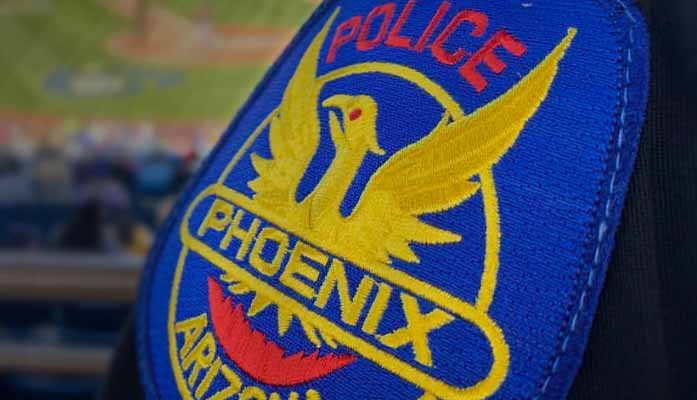
On June 13, 2024, the United States Department of Justice (DOJ) released a critical report following a nearly three-year investigation into the Phoenix Police Department (PPD), alleging misconduct including excessive force, discrimination, and violations of homeless people’s rights. This report has prompted the DOJ to push the City of Phoenix to sign a consent decree, which would subject the PPD to court-ordered monitoring.
The report has stirred considerable debate among Phoenix city officials and residents. The DOJ’s findings have cast a spotlight on the PPD’s practices, while the proposed consent decree has raised concerns about federal overreach and its potential impact on local law enforcement.
Phoenix City Council members have voiced their concerns about the report and the implications of entering into a consent decree. Councilwoman Ann O’Brien emphasized the DOJ’s poor track record and the high costs associated with such agreements. She pointed to Seattle, where violent crime increased by 37% during its 10-year DOJ monitoring period, and Albuquerque, which saw a 53% rise in violent crime since 2015 under federal oversight.
Closer to home, the Maricopa County Sheriff’s Office has incurred nearly $300 million in taxpayer costs since 2015 due to federal monitoring. This undue cost to the taxpayer equates to “defunding the police.”
Consent decrees for police departments began in 1994 with the “Violent Crime Control and Law Enforcement Act,” a legislative response to the nationally publicized police beating of Rodney King. While police brutality is unequivocally unacceptable, there is significant debate over whether federal oversight through consent decrees is the best solution. Critics argue that such measures often lead to increased bureaucracy and hinder effective policing, ultimately harming the communities they aim to protect.
Despite the DOJ’s allegations, the City of Phoenix has taken proactive steps to address issues within its police department. The PPD has implemented significant reforms, including revising use-of-force practices, purchasing body cameras, and adopting a robust accountability program. Additionally, PPD officers are the highest paid in Arizona, a strategy aimed at recruiting and retaining top talent.
The Phoenix mayor and city council, elected by local voters, have demonstrated their accountability to the community through these reforms. They have succeeded in reducing crime while training police officers in modern policing practices. This local control and responsiveness to community needs are seen by many as preferable to federal intervention.
Community support for the PPD is strong. Phoenix residents, who are intimately familiar with their community’s unique needs and challenges, overwhelmingly favor local control over federal oversight. Ronald Reagan’s famous quote, “The most terrifying words in the English language: I’m from the government and I’m here to help,” resonates with many who fear that federal intervention could do more harm than good.
Phoenix has gone out of its way to cooperate with the DOJ, making sweeping reforms on its own. The PPD’s efforts to improve transparency, accountability, and community relations demonstrate a commitment to policing excellence without the need for federal intervention.
The City of Phoenix must now decide whether to voluntarily submit to a consent decree that mandates court-ordered control of the PPD or face the possibility of being taken to federal court by the DOJ. There they will be forced to plead their case to a federal judge.
The debate over the DOJ’s proposed consent decree is not just about police reform; it is also about maintaining local autonomy and ensuring that the residents of Phoenix have a say in how their city is governed. As Phoenix grapples with this issue, the city’s leaders and residents are urging the mayor and council to reject federal overreach and continue striving for safer streets and brighter futures through local control and community-based policing.
As the city moves forward, it remains to be seen whether the DOJ consent decree will be adopted or if Phoenix will be allowed to chart its own course, confident in its ability to manage and reform its police department without outside interference.
Paul Parisi is the Arizona Grassroots Director for Our America.
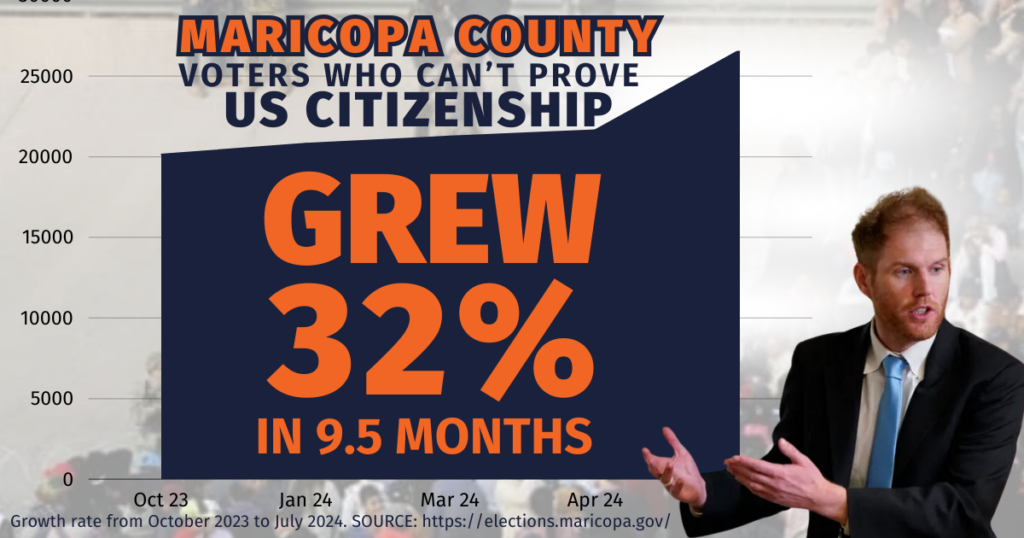
This should be especially alarming since the number of voters who haven’t provided proof of citizenship and cannot be confirmed as citizens has increased by over 32% since last October in Maricopa County. Arizona law requires that voter registrants must provide documentary proof of citizenship. However, these federal-only voters are allowed to register to vote in federal races because a Supreme Court decision from 2013 held that federal law does not allow states to ask for documentary proof of citizenship in federal races such as for Congress and the U.S. Senate. And that may even extend for presidential electors (the issue being litigated right now). For federal races, voters only need to attest to being a citizen by checking a box on the federal voter registration form and signing the form. Only a little over 10,000 votes determined the outcome of the 2020 Presidential Election in Arizona, yet over 26,000 federal-only voters are currently registered to vote in Maricopa County.
The AFL letter went to all 15 Arizona County Recorders as a reminder of their obligation “to remove foreign citizens” from their voter rolls. It outlines additional tools the Department of Homeland Security (DHS) has available, as codified by Congress under 8 U.S.C. § 1373 and 8 U.S.C. § 1644, to assist county recorders in their legal obligations to ensure only U.S. citizens are registered to vote.
According to the letter, Arizona law requires recorders “to consult ‘relevant federal databases to which the county recorder has access to confirm information obtained that requires cancellation of registrations,’” per A.R.S. § 16-165(K).
While it’s a state and federal crime for foreign nationals to register to vote, just making something illegal doesn’t prevent bad actors from breaking the law like other crimes. In fact, under the Trump administration, ICE indicted 19 foreign nationals for voting in the 2016 election illegally.
Since Arizona is a border state, why wouldn’t county recorders in Arizona want to make sure they are utilizing every possible tool to prevent foreign nationals from accessing a ballot in our election? And what more can they do to protect our voting rights and ensure citizens’ votes aren’t effectively neutralized by a foreign national illegally casting a ballot?
AFL brilliantly provides a path by using federal statutes, 8 U.S.C. § 1373 and 8 U.S.C. § 1644, that require DHS to provide the information. It isn’t hard for DHS to get this information through its Person Centric Query System (PCQS) database. As the letter explains:
“[The PCQS database] allows agency employees to look up individuals and quickly and easily verify their citizenship status using only a name and date of birth. This means that, right now, DHS can answer all of your inquiries about the citizenship status of all presently registered voters and all persons attempting to register to vote and do so at no cost. You already have the authority to submit citizenship inquiries about registered voters to DHS, and you can demand immediate responses from DHS.”
There is no additional cost to the taxpayers, and we can protect the voters! Where is the “Sign My County Recorder Up” button for doing his or her job?
There’s another level of required scrutiny that’s also not happening in Arizona, and that’s where the Attorney General comes into play. AFL states that per state law, county recorders are “required to send ‘to the attorney general a list of all individuals who are registered to vote and who have not provided satisfactory evidence of citizenship’” so that the Attorney General may fulfill her obligation “to use all available resources to verify the citizenship status of the applicant[s].’”
Don’t hold your breath that this will happen under the current Maricopa County Recorder regime anytime soon! Stephen Richer’s attorneys replied to AFL’s letter, refusing to take any action.
When asked, he usually shrugs off the concern about foreign nationals on the voter rolls, arguing that federal-only voters are concentrated on college campuses, as if that somehow makes it OK. He’s even gotten to the point of challenging Tesla and SpaceX founder Elon Musk for questioning any voter in Arizona not needing to provide proof of citizenship to vote:
BLUF: Arizona had a documented proof of citizenship law for all voters, but that was invalidated by US Supreme Court in 2012 (Arizona v. ITCA) because it conflicted with federal law. Therefore only applies to state voters.
Longer:
We've done this before a few times… But…
— Stephen Richer—MaricopaCountyRecorder (prsnl acct) (@stephen_richer) July 8, 2024
He also says federal-only voters have lower turnout than average voters, so there is nothing to worry about….
Hi. This is the correct in terms of the fed only voters who participated in the 2020 GE in Maricopa County.
Few points looking at above:
1) It is ILLEGAL to vote in federal elections in all 50 states if you are not a U.S. Citizen. These names are public records. In Arizona,…
— Stephen Richer—MaricopaCountyRecorder (prsnl acct) (@stephen_richer) April 16, 2024
Except the public doesn’t know how many federal-only voters cast ballots, as the number is not reported in the official statewide canvass by the Arizona Secretary of State.
While the current Maricopa County Recorder has published in his campaign communications that he thinks documented proof of citizenship should be required to vote in federal elections, adding that it’s not “an undue burden,” he stated that it’s the job of Congress to change the law.
Hi Stacey!
Great question. Yes, we do count "Fed only" ballots. As does every county in Arizona. Because it is required by federal law.
Hope it helps. Let me know if you have any questions.
Stephen
— Stephen Richer—MaricopaCountyRecorder (prsnl acct) (@stephen_richer) June 18, 2024
This is true. That would certainly help!
In the same campaign email, he stated that he supports Speaker Johnson’s proposal, the SAVE Act, which would require documented proof of citizenship to register to vote for federal elections. Still, he’s never come out on his award-winning X account to support the SAVE Act or Speaker Mike Johnson’s bold support of this game-changing legislation to secure our elections.
Here’s my friendly reminder that this is the same Recorder who was accused of using public resources to advocate against additional security measures for voting by mail. So, he’s certainly not averse to going out of bounds when fighting for or against a policy he favors.
Former President Theodore Roosevelt once said, “I have always had a horror of words that are not translated into deeds, of speech that does not result in action.”
The Maricopa County Recorder’s latest rebuff of AFL’s letter to take steps that clearly aren’t an undue burden on his office to keep the voter rolls clean, his lack of transparency on the issue of federal-only voters’ voting habits, his constant diminishing of concerns from the public, and his lack of public support for the SAVE Act certainly screams the loudest when it comes to where he truly stands on the issue.
If only there were someone who could provide a Diet Coke explainer video to show the current Recorder why Maricopa County citizens deserve election administration in which every possible effort is made to prohibit foreign nationals from accessing a ballot to cast a vote in our elections, maybe we would have a better chance at that “Sign My County Recorder Up” button functioning in Maricopa County.
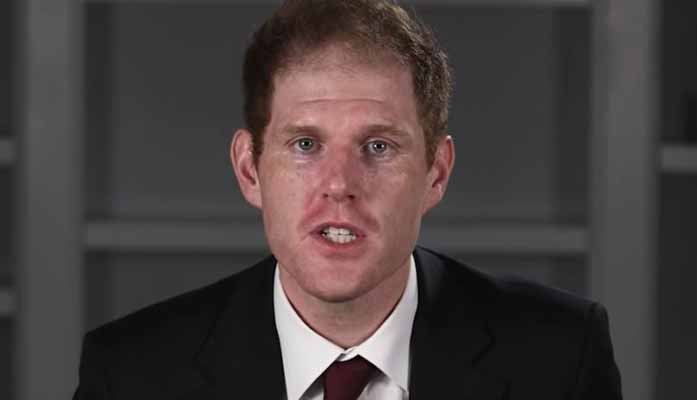
Photo from the Maricopa County Recorder video published on X here.
Merissa Hamilton is the founder and chairwoman of the nonpartisan nonprofit organizations Strong Communities Foundation of Arizona and Strong Communities Action, also known as EZAZ.org, which are focused on making civic education and action as easy as pie. She’s an elected Member at Large of Congressional District 1 for the Arizona Republican Party and previously ran for Mayor in 2020. Merissa is also the Director of Integration and Policy at The R.O.A.R. PAC, which is on the mission of restoring our American Republic.
Obviously, it’s illegal for non-citizens to vote. The real question is whether voters must prove their citizenship prior to voting. This discussion has culminated in the U.S. House passing the SAVE Act earlier this month. But with near unanimous Democrat opposition, a federal proof of citizenship requirement has stalled in Congress.
As both a border and swing state, Arizona is center stage in this national discussion. Even Elon Musk chimed in by sharing an image of our voter registration form that clearly states “proof of citizenship” is not required to vote.
However, Arizona has done far more than any other state to tackle the issue of illegals voting.
In Arizona, if someone registers without proof of citizenship, they are registered as a “Federal Only Voter” and they receive a different ballot with only federal races. This means that: 1) we know exactly who and how many have registered without proof; and 2) they don’t get to influence any of our state or local elections.
In all 49 other states, proof of citizenship is not only not required, but they are all blended onto one list, and they get to vote in every election. So those states have no idea who or how many there even are! Their problem could be far bigger, and they would never know it.