by Mike Bengert | Mar 19, 2026 | Opinion
By Mike Bengert |
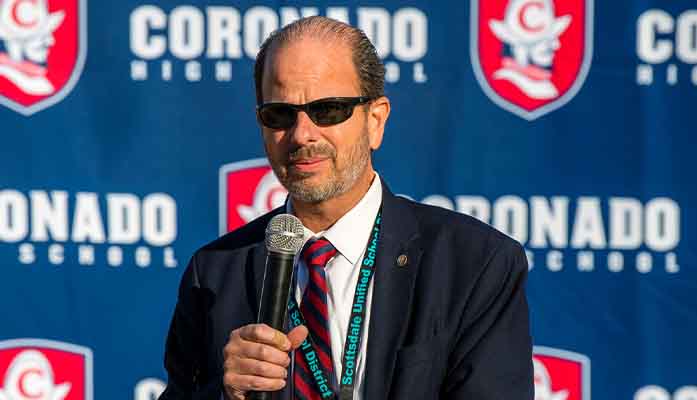
When Dr. Menzel was hired as Superintendent of Scottsdale Unified School District (SUSD), he arrived with a stated goal: to disrupt and dismantle what he believed were systems denying access and opportunity to students of color, students in poverty, and students with IEPs.
But was that truly the reality in SUSD before his arrival?
Regardless, Menzel has moved forward with exactly that approach, disrupting and dismantling the district. His emphasis on initiatives like gender identity and social-emotional learning, often at the expense of academic performance, has produced troubling results: school closures, declining academic outcomes, falling enrollment, record levels of non-classroom spending, teacher layoffs, and increasing staff turnover.
Disrupt and dismantle.
At the November 18, 2025, board meeting, Menzel outlined reductions in FTE staff at the district office over the past three years, arguing that all reasonable cost-cutting measures have been exhausted, leaving school closures as the only remaining option.
But is that really true?
When board members Amy Carney and Carine Werner raise concerns about wasteful spending or request detailed financial information, they are often ignored or told that staff are too busy to provide answers. Meanwhile, the expenditures they question are dismissed as not necessarily wasteful just because they disagree with them.
Not only has Menzel shown little interest in cutting favored programs or non-essential spending unrelated to improving academic performance, but he has also failed to address concerns raised in exit interviews, concerns that could help slow declining enrollment.
Disrupt and dismantle.
At a recent board meeting, it was announced that more than 130 applications had been submitted for the Phase II Design Team. Selections are underway, with the first meeting scheduled for March 26.
Menzel noted that Matt Pittinsky was the only board member to suggest closing more than two schools in Phase II. When asked by Menzel for input from the board about additional closures, Mike Sharkey responded that if the committee recommends closing three schools instead of two, “that’s great”—despite having campaigned on not closing schools. He added that committee members can “feel it out as it goes along” and gauge community reaction afterward.
Carney argued that school closures should be a last resort; Pittinsky disagreed, despite also campaigning against closures. He now claims more schools must be closed to maintain a “quality student experience.” But is this the same “quality” that has coincided with declining enrollment and revenue losses?
Carney pressed for early parent input through surveys, with Werner agreeing that community feedback should come at the beginning, not the end, of the process. Menzel, however, stated surveys would occur only after the committee completes its work, likely in late May or early June. Pittinsky, Sharkey, and Lewis supported that timeline.
While district leadership claims to value community input, their actions suggest otherwise. The committee is not being asked to explore solutions to the budget shortfall; they are being steered toward a predetermined outcome: closing schools.
For those who haven’t followed closely, the public comments from last fall’s board meetings tell the story. Parents from schools like Pima and Echo Canyon described being blindsided by closures, with little to no input. Even some board members indicated they were excluded from meaningful involvement.
According to the district, the Phase II Design Team members will “help inform discussions about enrollment trends, school facilities, and long-term sustainability through respectful, student-centered collaboration.”
But what does that actually mean?
A small group, selected by Menzel and guided by a district-paid consultant, is expected, over just a few weeks, to analyze years of enrollment data, financial trends, and demographic projections, and then “inform” district decisions.
Is that realistic?
So, what will this design team actually do?
In all likelihood, it will just validate decisions that have already been made by Menzel.
Over recent meetings, Menzel has presented Phase II “repurposing solutions.” One proposal involves relocating Cheyenne Traditional School (CTS) to Copper Ridge. He describes this as an opportunity to place a high-demand program in an underutilized facility with room for growth.
However, what goes unaddressed is the likely impact on enrollment. Moving CTS to the northernmost part of the district could drive families away, not attract them. CTS draws students from across the district, many within walking or biking distance of its current location. Relocating it would add significant travel time, potentially up to 20 extra miles per day for some families.
How many parents would make that commute? How many would instead leave CTS or SUSD altogether?
Similarly, how many Copper Ridge families would choose CTS or be willing to move to the Desert Canyon schools, or simply leave SUSD? These are critical questions, but they remain unanswered.
They could be answered now through parent surveys. Instead, feedback is being delayed until after decisions are effectively finalized.
If enrollment drops following a relocation, as seems likely, the result could be the eventual closure of CTS, the district’s last remaining traditional school, which could lead to even further declining enrollment and financial shortfalls for SUSD.
And that would align with Menzel’s stated goal: disrupt and dismantle.
Parents at Phase II schools should make their views known by contacting the Board and Menzel, using Let’s Talk, writing opinion pieces, participating in PTO meetings, and sharing information with parents through newsletters and social media. Don’t wait until decisions are final; speak up now. Community input is important.
Don’t let Menzel continue to disrupt and dismantle SUSD.
Mike Bengert is a husband, father, grandfather, and Scottsdale resident advocating for quality education in SUSD for over 30 years.
by AZ Free Enterprise Club | Mar 16, 2026 | Opinion
By the Arizona Free Enterprise Club |
Katie Hobbs would love nothing more than for Republicans at the legislature to start wheeling and dealing on Prop 123, the roughly $300M per year K-12 funding stream from Arizona’s State Land Trust.
Republicans should not even entertain it.
In fact, negotiating over Prop 123 now would amount to a political self-own of the highest order.
Prior to 2025, the argument for extending Prop 123 was the imminent “funding cliff” for school districts because the distributions from the land trust to K-12, which were temporarily increased for a period of 10 years, were set to expire. But lawmakers addressed this concern when they increased K-12 funding from the general fund a few years ago in the amount districts were receiving from the trust.
Last year, there were discussions about initiating a new 123 enhanced distribution, but only if it included significant education reforms, one of which involved constitutionally protecting school choice programs in the state. Outside of these types of reforms, there is no reason for Republicans to even be discussing any plan that involves dumping hundreds of millions into K-12 with no strings attached.
Yet somehow the conversation has been resurrected…
>>> CONTINUE READING >>>
by Jason Bedrick | Mar 13, 2026 | Opinion
By Matthew Ladner & Jason Bedrick |
It is said that a lie travels halfway around the world before the truth can get its pants on. But when the truth finally catches up, it tends to arrive with receipts.
In recent weeks, anti-school-choice activists have accused Arizona’s popular Empowerment Scholarship Account (ESA) program of having a ludicrously high rate of misspending. That narrative, repeated endlessly despite being repeatedly debunked, has now collided with an inconvenient reality: the Arizona Department of Education’s own data tell a starkly different story, one that exposes the “unaccountable ESA” myth for what it always was: a misleading talking point masquerading as journalism.
On Thursday, the Arizona Department of Education published the results of a random audit of the ESA program, finding very low rates of misspending relative to other publicly funded programs and even less fraud. Less than 2% of ESA funds were spent on unallowed items, and 0.3% of the funds were spent on items considered “egregious” or fraudulent. The department is in the process of recouping those funds.
The department’s audit has punctured the gross distortions of Phoenix-based journalist Craig Harris of Channel 12, who had misrepresented the ESA program as being rife with fraud. The department called Harris’s claims “ridiculous,” “reckless,” and “a total misinterpretation of data provided by [the department] to Channel 12.”
Harris had claimed that 20% of ESA purchases represented misuse of funds based upon an examination of only a small portion of total ESA purchases—384,478 of the 1.8 million total ESA transactions since December 2024, approximately 20% of the total.
But it was not a random sample. The Arizona Department of Education had selected these purchases under a risk-based audit for additional scrutiny, so it was not a random sample that one could use to extrapolate rates of misuse in the ESA program. Instead, the risk-based pool was far more likely to contain misuse than the average purchase.
In other words, among the 20% of ESA purchases flagged for additional scrutiny, the department found 20% to be misspending. Harris, however, extrapolated the risk-based results on to the entire universe of ESA purchases. This represented a blatant distortion because the remaining purchases outside of the risk-based sample were far less likely to involve misspending.
Think of it this way: imagine that a reporter read a study showing that 20% of Americans were obese and that 20% of obese Americans had diabetes, then he ran a story claiming that 20% of all Americans had diabetes. Such a claim would be a complete distortion of the data, a conclusion that is entirely unsupported by the facts.
Harris was warned both publicly and privately that his “analysis” was deeply misleading. Nevertheless, he continued to repeat his “20% misuse” claim on television and social media.
The Arizona Department of Education decided to set the record straight by auditing a random sample of thousands of Arizona ESA purchases. The audit’s conclusion: “About 2% of purchases are unallowable expenses and only 0.3% represent fraud or egregious purchases.”
In short, Harris’s “analysis” on misspending was off by a factor of 10, and his accusations of fraud were off by nearly a factor of 100.
And although Harris made it seem like one in five ESA parents were buying diamond rings, the reality is that egregious purchases represented a vanishingly small percentage of ESA spending. Most of the unallowed items appear to have been innocent mistakes.
The Arizona Department of Education explained the difference between unallowable purchases and egregious purchases/fraud in a press release:
The submission of a purchase that is deemed unallowable does not constitute fraud. Most are innocent mistakes, such as an error in a form that must be resubmitted, or educational items that are not on the allowable list but that the user could have in good faith believed were permitted. Some examples would be backpacks, lunch boxes and water bottles.
A ridiculous figure of 20% fraud has been circulating concerning ESA purchases which resulted from a total misinterpretation of data that we provided to Channel 12.
Cracking down on misspending is important, but so is keeping things in perspective. The rate of improper payments for the Arizona ESA program, at 1.9%, stands far below a variety of programs which ESA opponents support, such as Medicaid (7.4%), food stamps (9.3%), and unemployment insurance (14.4%). Moreover, the Arizona Department of Education actively recovers misspending, and refers serious cases for criminal prosecution to punish criminal activity and to deter fraud.
Indeed, the only reason we know about the miniscule level of unallowed purchases in the ESA program is because it is so transparent—far more transparent than district schools, which do not report transaction-level data to state officials, let alone the public. Given the rash of recent scandals in Arizona’s district school system, one can only imagine what we would find if given access to information about every purchase that district schools have made, as we have for the ESA program.
In the interests of transparency and accountability, state lawmakers should require the district schools provide the same level of information about purchases as ESA families.
Harris has not yet retracted his false reporting. Instead, he has doubled down on his errors, erroneously claiming that the department’s audit was “largely skewed” and based on “a miniscule sample.” This claim is particularly ironic given that Harris erroneously treated a risk-based sample—which is inherently skewed—as though it was representative of the entire population. A random sample, by contrast, is representative of the whole.
Facts are stubborn things. So too, apparently, are anti-school-choice activists who can’t let go of the false narrative they pushed in the face of overwhelming evidence to the contrary.
Matthew Ladner is a Senior Advisor for education policy implementation and Jason Bedrick is a Senior Research Fellow at the Heritage Foundation’s Center for Education Policy.
by AZ Free Enterprise Club | Mar 13, 2026 | Opinion
By the Arizona Free Enterprise Club |
While some legislators are working to keep California-style policies out of Arizona, corrupt municipal leaders in cities such as Phoenix and Tucson clearly haven’t gotten the memo. For years, these cities have subjected businesses to an unfair fee for their own shopping carts being stolen. Rather than targeting theft, homelessness, or law enforcement strategies, this policy shifts blame onto retailers, effectively punishing the victims. A classic California-esque idea infecting our Arizona cities.
Representative Nick Kupper introduced HB2460 this legislative session to combat this insanity and introduce some common sense. This bill prevents local governments from fining retailers over abandoned movable property, such as shopping carts and handheld baskets. Retailers already lose money from cart theft; charging them to reclaim their own stolen property is ridiculous.
This type of policy is the definition of “California-ing Arizona.” California has regulated abandoned shopping carts for decades, with state law dating back to 1992 authorizing cities to penalize retailers when carts are not retrieved from public spaces. Tucson and Phoenix are now following in those footsteps…
>>> CONTINUE READING >>>
by Andy Biggs | Mar 12, 2026 | Opinion
By Arizona State Representative Gail Griffin and U.S. Representative Andy Biggs |
After decades of finger pointing and failed negotiations over the rights and distribution of the Colorado River, the future of the West stands at a crossroads. The stalemate over water scarcity between seven western states threatens America’s economy and national security. It’s the kind of stalemate that only a grand deal and a major investment can break through to save our region.
With the Colorado River under strain, and time running out, America needs a visionary, a builder and a deal maker. Thankfully, we have all three of those in President Donald J. Trump.
For over half a century, the construction of large dams and canals was the mark of a truly great president. Beginning with Teddy Roosevelt, the first major water reclamation project in the West—the Roosevelt Dam—was authorized to provide Arizona with water that expanded our country’s agricultural, industrial, and military base.
That achievement proved Washington could turn big ideas into reality. Following Roosevelt, nearly every U.S. President across the political spectrum championed large-scale water infrastructure projects in the West, building the dams, canals, and reservoirs that allowed western states to grow. In fact, the West would not be what it is today had it not been for great presidents building great water infrastructure.
Calvin Coolidge authorized the Hoover Dam and All-American Canal; Franklin D. Roosevelt approved the Colorado—Big Thompson Project; Dwight D. Eisenhower authorized the Glen Canyon Dam, Central Utah Project, and initial storage units in the Upper Basin; Lyndon B. Johnson authorized the Central Arizona Project; and John F. Kennedy authorized the San Juan—Chama Project.
Our nation’s greatest modern presidents have left their mark through building major water infrastructure projects and the time is right for the next wave of investment to begin. Americans want their leaders to put America first, refocusing federal spending at home.
By building something big and meaningful, President Trump could save the West and leave a lasting legacy for the next 250 years in America. President Trump could “Make American Water Great Again.”
Few political figures have had President Trump’s instinct for sensing when a looming issue is about to explode into a defining national moment—spotting opportunities before others see them and acting decisively when others freeze. That instinct, combined with his willingness to act, has led some to speculate that Trump may already be eyeing a major water play in the West. Trump also understands the value of strategic federal assets—such as the Panama Canal—which advance the nation’s interests on a grand scale.
As a builder, constructing a new water resource would fit perfectly with Trump’s identity. A new dam or canal would be the crown jewel of his American portfolio, a monumental project built not for private business but for the American people, turning big ideas into physical steel, concrete, and—most importantly—water that can sustain America for generations.
And he wouldn’t have to start from scratch. Long-shelved proposals—intended to be built but killed by environmental activists—still loom in the background. Big projects like the Marble Canyon Dam (Arizona), Echo Park Dam (Colorado), and Temperance Flat Dam (California)—assumed to be dead—could be revived at any time. President Trump would have the opportunity to succeed where others have failed.
At the same time, numerous new projects have been proposed that could increase water supplies in the West. Large-scale desalination projects, interstate water pipelines, storage facilities, reservoirs, and advanced water reuse systems have all been proposed and are ready to go. Arizona has taken the lead on developing these projects, but multiple western states would benefit from them if any were constructed. With President Trump’s support and blessing, these projects could be moved from a hope to a real revitalization of American infrastructure.
Building any one of these would make a difference. Building all of them would define an era. All President Trump would need to do is pick one, announce it, and build—instantly taking credit and moving us closer to saving the Colorado River for our nation’s economy and national security. Perhaps one could even be named after him: the Donald J. Trump Imperial Dam.
Such a project would not only grant the President unprecedented negotiating power in the West, but also provide thousands of blue-collar jobs that would help to reinvigorate America’s working class. Over 21,000 workers were employed during the construction of Hoover Dam, which created critical jobs at a time when many Americans felt uncertain about the economy.
America remembers its greatest presidents because of what they built—big, bold projects constructed at a scale worthy of a great nation. President Trump can do the same. If President Trump wants to build a lasting legacy, the path forward is clear: solve the Colorado River crisis by building big, bringing new water resources to the West, and increasing the supply for everyone.
Representative Gail Griffin chairs the Arizona House Natural Resources, Energy & Water Committee and has been a leading voice on water and resource policy in the Southwest. Congressman Andy Biggs represents Arizona in the U.S. House of Representatives and has long advocated for policies that strengthen the economy, protect American resources, and support the future of the West.
by Tiffany Benson | Mar 10, 2026 | Opinion
By Tiffany Benson |
When asked, “What was the original purpose of public education?” A.I. gave this response:
The original purpose of public education in the U.S. focused on fostering a literate, cohesive, and obedient citizenry to support a new democracy, ensure social order, and provide basic religious instruction.
Since at least 1962, public education has been heavily influenced by secularists. As a result, students are not literate or cohesive, and their obedience has been co-opted into secrecy and rebellion against parents. Of course, democracy means mob rule.
How did we get here?
One obvious answer lies in the worldview of secular humanism. The ideologies of this religion threatens to turn innocent children into a godless, genderless, enraged monolith. Secularism is a parasite that causes symptoms of mental illness, moral confusion, and self-induced hysteria. Parasitic infestations have three phases: growth, reproduction, and transmission.
The growth of secularism in K-12 education manifests as:
- Social emotional learning (SEL)
- Evolutionary theory
- Ethnic studies (CRT)
- Diversity, Inclusion, and Equity (DIE)
- Rainbow flags and gay celebrations on campus
- The acknowledgement and acceptance of every religion but Christianity
The reproduction of secularism in K-12 education manifests as:
- Law enforcement protests during educational hours
- Counselors secretly transitioning students’ gender
- Sex education for kindergarteners
- Children judging their peers by skin color
- School officials referring minors to abortion clinics
- Boys invading girls’ sports and private spaces
The transmission of secularism from K-12 education to society manifests as:
- High school graduates with little to no reading, writing, or math skills
- Increased sexual activity, STDs, and unwed pregnancies among youth
- High abortion rates among women in their 20s
- Low IQ citizens who predominantly vote for radical policies
- Emotional immaturity, violence, and lack of personal responsibility
- Suicide and premature death
The average American child, from age 4 to 17, will spend about 14,000 hours in school. Most of these students will undergo secular brainwashing in the form of “academic standards,” “core competencies,” and state testing. Parents have been lulled into a false sense of trust, abdicating their rights and responsibilities to government workers. Even “good” educators (the conservative ones who remain fearfully silent) shouldn’t have unchecked influence over a child’s mental, emotional, or moral development.
The pervasive ignorance of secularism explains why people interpret “separation of church and state” to mean Christians can’t pray, read Scripture, or invoke the name of God publicly. Secularism is also why Americans call the United States a “democracy.” The secularist worldview is so morally inferior that it can only be defended by calling opponents racists, white supremacists, fascists, and homophobes.
The demonization of Christianity, prayer, and Bible reading has only escalated as Arizona lawmakers attempt to pass legislation that fortifies First Amendment rights and parental rights in K-12 education.
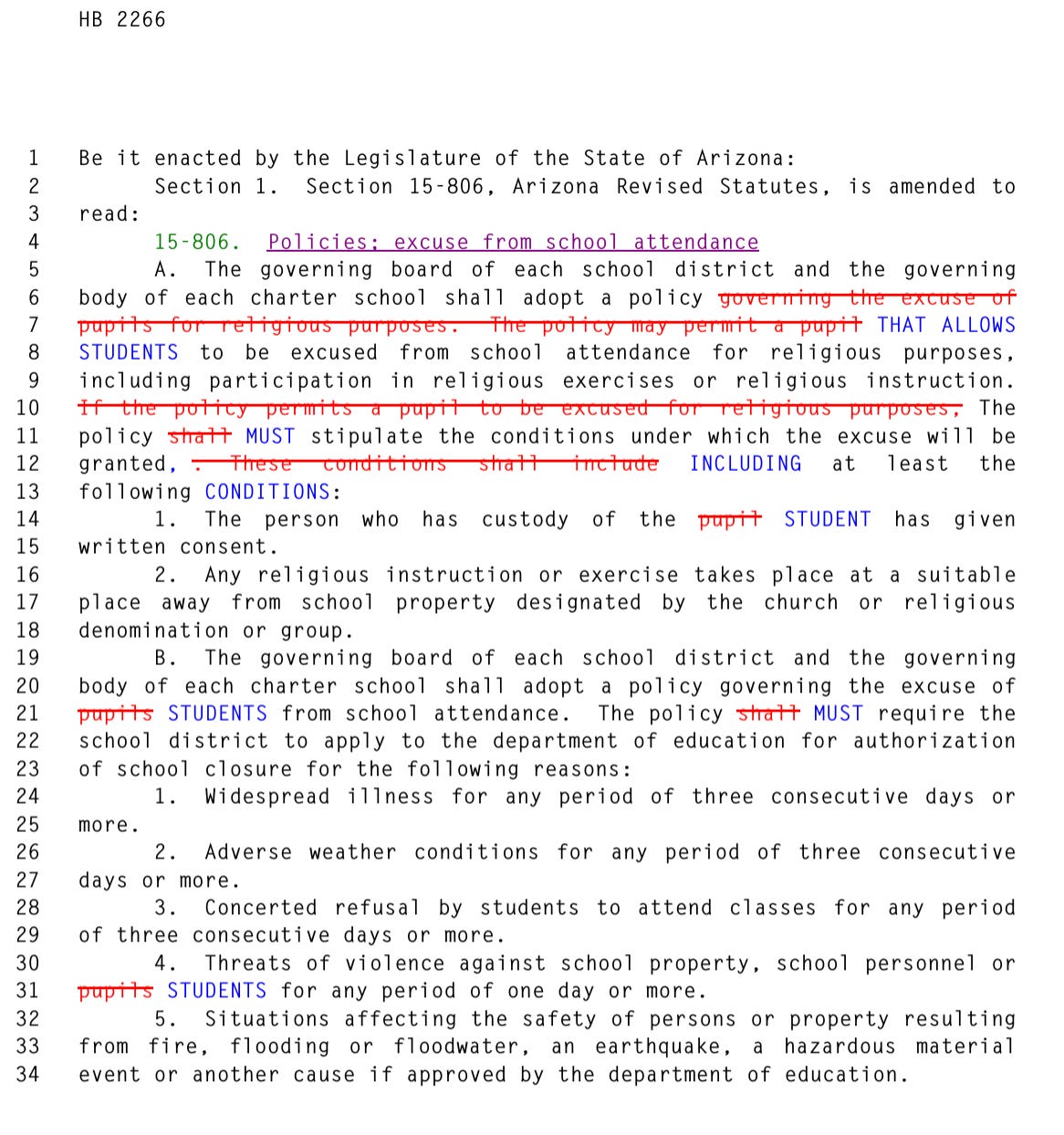
Secularists linked LifeWise Academy—an organization with a mission to offer Bible education to public school students during school hours—to Arizona House Bill 2266. Secularists claim bussing children to nearby churches for Bible studies during the school day is harmful to academic communities. But encouraging kids to walk off campus with “F— ICE” t-shirts during educational hours is okay? Only in the mind of a secularist.
Deer Valley board member and AZ legislator, Stephanie Simacek (D-LD2), called Lifewise “a controversial, far-right, religious instruction program.” Regarding HB 2266, the secularist told her constituents she would “continue to oppose bills that do nothing to serve public education.” Essentially, high moral standards, respecting authority, and taking responsibility for one’s actions have no place in taxpayer-funded, government schools.
The life’s purpose of a secularist boils down to persecuting Christians, opposing common sense legislation, and infiltrating public school systems to spread anti-Christ propaganda through immoral policies and curricula on all grade levels. Secularism is a spiritual, intellectual, and emotional drain on every generation. No child should be entrusted to an institution that’s predominantly run by godless people.
Parents must continue to seek alternative learning methods and regain control over their kids’ education. Don’t let secularism destroy their innocence and corrupt their moral character. Furthermore, taxpayers should keep rejecting bonds and overrides. Don’t incentivize sleazy administrators and weak board members to advance a secular agenda. Let the schools close and the buildings be repurposed. The kids will be fine if more parents and silent educators step up.
Public education—especially in Arizona—is a colossal failure. The lie of “separation of church and state” must be exposed. Steering children back to God is the only way to defeat secularism and defend our Constitutional Republic. Support constitutional legislation like AZ House Bill 2266 and the Empowerment Scholarship Account (ESA). Support Christian organizations like LifeWise Academy. Most importantly, support parental rights in K-12 education for all American families.
Tiffany Benson is the founder of Restore Parental Rights in Education and host of The Myth of Education Podcast. Her commentaries on public education and Christian faith can be viewed at Parentspayattention.com and Bigviewsmallwindow.com. All views and opinions expressed by Tiffany are her own.