by Corinne Murdock | Aug 24, 2021 | News
By Corinne Murdock |
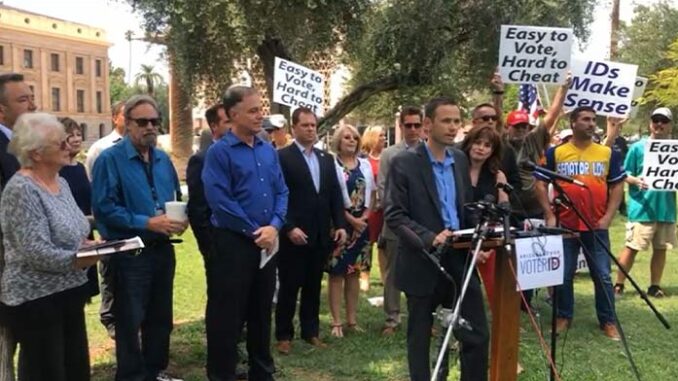
Last week, the Secretary of State’s office received the “Arizonans for Voter ID Act:” a ballot initiative to strengthen ID requirements for in-person and mail-in voting through universal voter ID. The initiative will require ID for mail-in ballots, but will also provide a free voter ID to those registered voters who need it. Voters would also be required to give certain information: their date of birth, as well as either the last four digits of their Social Security Number, driver’s license number, or nonoperating state identification number.
Proponents of the Arizonans for Voter ID Act assert that its voter ID requirement will also deter ballot harvesting. The political committee that filed the ballot initiative, Arizonans for Voter ID, was joined in their efforts by the Arizona Free Enterprise Club, Heritage Action, Honest Elections Project Action, Foundation for Government Accountability, the Goldwater Institute, the Republican Liberty Caucus of Arizona, AMAC Action, and Arizona Women of Action.
As required by law to qualify for the 2022 November ballot, the Arizonans for Voter ID Act acquired at least 237,645 signatures by July 7.
Arizona Free Enterprise Club President Scot Mussi asserted that most Arizonans and all other American citizens support strong voter ID.
“This initiative will ensure that no matter when you vote, where you vote, or how you vote, identification will be required,” said Mussi.
The polls support this claim. Over 60 percent of Arizona voters support voter ID. Nationally, around 80 percent of Americans support voter ID.
In July, U.S. Supreme Court Justice Samuel Alito ruled that Arizona law makes it “quite easy” for individuals to vote. The court case, Brnovich, et al. v. Democratic National Committee, et al., outlined the provisions of Arizona voting law that ease the burden for voters. Alito noted that this included in-person voting on Election Day, 27 days of early in-person voting, and only one application required for mail-in voting which could be extended perpetually through the Active Early Voting List as long as voters vote once within two straight two-year election cycles (rebranded from “Permanent Early Voting List,” or PEVL, through legislation passed earlier this year limiting the system’s perpetuity).
ID plays a role in many mainstream societal transactions, as Arizonans for Voter ID Committee Chair Vicki Vaughn argued.
“Arizonans show identification all the time in their daily lives to purchase alcohol, receive unemployment benefits, make major transactions, and board a plane, among others,” stated Vaughn. “Requiring identification before casting a ballot is necessary for our elections.”
A photo ID or another valid, government-issued ID is also required for the following: obtaining a driver’s license, receiving certain in-patient or out-patient doctor or hospital treatments, receiving certain over-the-counter or prescription medicines, buying guns or ammunition, visiting schools or jails, filing court documents, adopting a child, engaging in parole or probation, receiving auto insurance, donating blood, cashing or paying with checks, pawning items, responding to a traffic stop, obtaining a passport, picking up packages at the post office, buying cigarettes, opening a bank account, renting or buying a house, applying for a mortgage, adopting a pet, renting a hotel room, applying for a hunting or fishing license, establishing a utilities account, and applying for a job.
Learn more about the Arizonans for Voter ID Act here.
Corinne Murdock is a reporter for AZ Free News. Follow her latest on Twitter, or email tips to corinne@azfreenews.com.
by Terri Jo Neff | Aug 24, 2021 | Education, News
By Terri Jo Neff |
Although Arizona is not yet back to pre-pandemic workforce levels, a recent U.S. Bureau of Labor Statistics report shows the state is headed in the right direction, with more than 21,000 jobs added in July, boosting Arizona to fourth place in percentage of jobs recovered post-COVID19.
That means Arizona has restored all but around 20,000 of the 331,500 jobs lost in the pandemic’s aftermath, giving the state at a recovery rate of 93.7 percent. Only three states -Utah, Idaho, and Montana- have a better percentage of recovery than Arizona as of July.
Yet despite the state’s positive trajectory, many small business owners, economists, and job placement officials remain worried about whether Prop 208’s 3.5 percent income tax surcharge will go into effect or not, and whether legislation aimed at blunting any impact will withstand its own legal challenge.
The surcharge was narrowly approved by voters last November to hit Arizonans earning more than $250,000 (single filing) or $500,000 (joint filing) in an attempt to increase K-12 funding. The tax was designed to be on top of the then-existing income tax of 4.5 percent, but last week the Arizona Supreme Court ordered a Maricopa County judge to determine whether Prop 208 tax revenues will exceed the Education Expenditure Limit set in the Arizona Constitution.
If the answer is yes, then the judge must declare Prop. 208 unconstitutional and enjoin state officials from putting the tax surcharge into operation, the justices ordered.
Gov. Doug Ducey signed legislation in June to change Arizona’s individual income tax structure over the next three years and to blunt the surcharge effect. The legislation also provides small businessowners an alternative to the surcharge. But until the Prop 208 legal issue is resolved, there are worries that Arizona’s recovery will slow due to small business owners reducing spending -such as employee compensation and benefits- to cover any additional tax burden.
Others may choose to abstain from hiring or even decide to cut personnel. And that is a point of concern for those trying to get jobs for all Arizonans who want one.
The same Bureau of Labor Statistics report shows Arizona’s rate of unemployment was 6.6 percent in July, ranking 40th in the nation. That ties with Alaska, Louisiana, and Pennsylvania, while Utah, Idaho, and Montana had unemployment rates at 2.6, 3.0, and 3.6 respectively, among the Top 10 lowest percentages for July.
Arizona’s current unemployment rate, however, is a vast improvement from April 2020, when the state had 14.2 percent of work-eligible adults out of jobs, a historical high. In addition, next month’s end of two Arizona Department of Economic Security (DES) unemployment benefit programs is expected to spur many out-of-work Arizonans back into the workforce.
Those programs -Pandemic Unemployment Assistance (PUA) and Pandemic Emergency Unemployment Compensation- are scheduled to expire for the workweek ending Sept. 4. Ducey and DES have created a Back to Work program with several features to help Arizonans transition back to work, including childcare vouchers, educational incentives, and even hiring bonuses for eligible individuals.
by Corinne Murdock | Aug 24, 2021 | News
By Corinne Murdock |
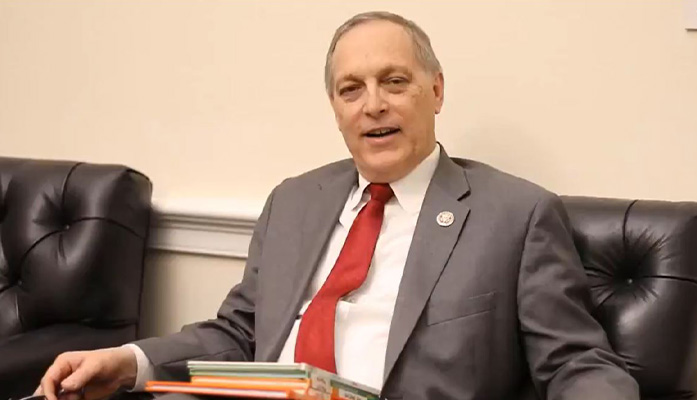
Last month, Representatives Paul Gosar (R-AZ-04) and Andy Biggs (R-AZ-05) voted against expediting visas for Afghans fleeing the Taliban. The Averting Loss of Life and Injury by Expediting SIVs Act (ALLIES) Act applies to Afghans that assisted the U.S. in the war: this includes interpreters, contractors, and security.
The ALLIES Act ensured that Afghans could receive special immigrant visas more quickly by removing certain application requirements, namely the proof that the applicant was currently experiencing or had experienced an ongoing serious threat due to their employment with the U.S. government. Instead, Afghans could apply if they believed there existed the possibility of a serious threat. The act also increased the number of available visas by 11,000.
Gosar explained that he is more focused on bringing Americans home safely. He argued that this should be the first and only priority, before assisting Afghans.
“How many US citizens are trapped in Afghanistan? I don’t see reliable info on this. It’s critical we get our people out safely,” said Gosar. “It’s not critical to use planes to bring Afghans here. To see our transports full of illegal aliens and not US citizens is immoral.”
Although the ALLIES Act was introduced in a bipartisan manner, 16 House Republicans voted against the measure.
In addition to Gosar and Biggs, “no” votes on the ALLIES Act included Representatives Lauren Boebert (R-CO-03), Mo Brooks (R-AL-05), Scott DesJarlais (R-TN-04), Jeff Duncan (R-SC-03), Bob Good (R-VA-05), Marjorie Taylor Greene (R-GA-14), Kevin Hern (R-OK-01), Jody Hice (R-GA-10), Thomas Massie (R-KY-04), Barry Moore (R-AL-02), Scott Perry (R-PA-10), Bill Posey (R-FL-08), Matthew Rosendale (R-MT), and Chip Roy (R-TX-21).
Corinne Murdock is a reporter for AZ Free News. Follow her latest on Twitter, or email tips to corinne@azfreenews.com.
by AZ Free News | Aug 24, 2021 | Education, News
The National Education Association’s state affiliate tried to harass and intimidate Rhode Island mom Nicole Solas into silence just for trying to find out what her daughter would be taught in kindergarten by filing a legally baseless lawsuit against her. The union even went so far as to seek emergency relief from the court to circumvent the public records law and prevent Nicole from receiving public information.
Today, the union withdrew its baseless request for emergency relief. Nicole has contended since the union first filed this case that the union has no standing and no legal right to bring the action. The union’s voluntary withdraw of its motion appears to recognize the union’s flimsy legal standing.
Earlier this year, Nicole began making public records requests to find out her daughter’s kindergarten curriculum—doing just as her school district asked her to do. But for making these requests, she was stonewalled and even threatened with legal action. The Goldwater Institute made an additional records request on her behalf—and in response, the South Kingstown School Committee hit her with a $74,000 bill to get the information she sought.
The NEA had asked for a preliminary order from the court that would direct the South Kingstown School Committee to stop responding to Nicole’s public records requests. But today, the union withdrew its extraordinary request, and the School Committee now must still meet its statutory deadlines and other requirements to respond to Nicole’s public records requests.
“Nicole and every parent has every right to know what is being taught in their children’s classrooms,” said Goldwater Institute Director of National Litigation Jon Riches, who represents Nicole. “The union’s reprehensible attempt to harass and intimate Nicole and other parents was seen today for what it is—a legally baseless assault that will not stand.”
>>> READ MORE >>>
by Corinne Murdock | Aug 23, 2021 | News
By Corinne Murdock |
Tucson’s vaccine mandate may be the end of a career for many first responders. The city now requires that all of its employees receive the COVID-19 vaccine by Tuesday – also the deadline for all religious and medical exemption applications. If not, city employees face penalties such as unpaid suspension and are excluded from certain benefits such as leave. The council plans to convene again on September 9 to determine whether they’ll make refusal of the vaccine a fireable offense; this decision is contingent on the amount of employees who get vaccinated.
The vaccine mandate impacts first responders the most. According to city data, firefighters and police officers have the lowest vaccination rates among city employees. City data also notes that these first responders collectively answered nearly 435,000 calls in 2020 – even with stay at home orders and mandated closures.
One legal challenge to the vaccine mandate has already been shot down. Pima County Superior Court Judge Richard Gordon denied a request from the Tucson Police Officers Association (TPOA) for a restraining order against the city policy. Gordon said that TPOA and those who testified failed to show that they would suffer irreparable harm from the mandate.
Tucson City Council asserts that strict measures should be taken for those who don’t get vaccinated – even termination. Councilman Steve Kozachik suggested that the city fire all employees who don’t become fully vaccinated by the end of September.
“If left to me, I’d set a date [or] a deadline and terminate anyone who doesn’t get vaccinated,” stated Kozachik. “The ordinance should say ‘get vaccinated by September 25 – fully vaccinated – or you forfeit your employment as a city worker.’”
Tucson’s mandate comes as health officials are urging booster doses of the vaccine, following reports of more breakthrough cases and a spike in the Delta variant.
In an executive order published two weeks ago, Governor Doug Ducey clarified that vaccine mandates were outlawed by statute. The governor noted that any violations of this law would be considered a class 3 misdemeanor and subject to legal action.
In relation to Ducey’s remarks on the legality of vaccine mandates, Attorney General Mark Brnovich announced last week that his office was investigating Tucson’s vaccine mandate.
The Department of Justice (DOJ) published an opinion last month arguing that emergency use authorization-only vaccines could be mandated.
State Representative Jake Hoffman (R-Queen Creek) told AZ Free News that this mandate was a politicized move that threatens public safety. The representative assured that the state legislature would mete out proper justice if Tucson doesn’t retract its mandate.
“Tucson has gone full communist with its latest threat to fire employees who make the individual choice to hold off on taking the COVID vaccine at this time,” stated Hoffman. “The fact that Tucson’s partisan politics would sacrifice public safety to promote an unlawful, anti-science, forced vaccination policy is a bridge too far. If the far-left politicians in Tucson refuse to follow the law, the legislature will have no choice but to address their lawlessness come January.”
Similarly, Alex Kolodin, the attorney for the biology teacher suing Phoenix Union High School District (PXU) for its mask mandate, said that Tucson’s mandate is a means of catching the President’s attention.
“Firing first responders during the public health emergency just so that they can suck up to Joe Biden by flouting the law seems like a really bad move,” assessed Kolodin.
Corinne Murdock is a reporter for AZ Free News. Follow her latest on Twitter, or email tips to corinne@azfreenews.com.
by Terri Jo Neff | Aug 23, 2021 | News
By Terri Jo Neff |
On Monday afternoon, Dale Henson and his attorney are slated to appear before a federal magistrate in Phoenix to argue why Henson, a Chandler resident, should be released from detention to await trial on 58 counts related to financial crimes, including money laundering and defrauding two government agencies.
Dale Henson and his wife Zoila Villa Henson were arrested Aug. 18 after a 17-month FBI investigation into $1.2 million of allegedly falsified medical billings to the Arizona Health Care Cost Containment System (AHCCCS). The investigation also found allegedly illegal activity connected to the couple’s use of $150,000 in COVID-19 Economic Injury Disaster Loans from the Small Business Administration.
Court records show Dale Henson was ordered at his initial court appearance to be held by the U.S. Marshals Service until a formal detention hearing on whether he poses a flight risk, as Assistant U.S. Attorney Monica Klapper contends. That is what U.S. Magistrate Deborah Fine will decide Monday.
Zoila Henson’s name does not appear on the court’s detention hearing calendar this week, possibly because of her status as a Mexican citizen.
The arrest of the Hensons, both age 53, was announced Aug. 20 by the U.S. Department of Justice. However, AZ Free News is aware of several search warrants executed last fall in connection to the Hensons and those they did business with. Some of the searches were conducted at commercial locations while others took place at residences across Arizona.
According to the Aug. 3 indictment, Henson Family Services LLC and Henson Holdings LLC were hired in 2019 by a behavioral health facility in Mesa to handle the facility’s medical billing. But the Henson entities are alleged to have billed and received payment from AHCCCS on 25 occasions from August 2019 through April 2020 for services which were not rendered to the facility’s patients.
In addition to the 25 AHCCCS fraud counts, the indictment includes 25 counts of aggravated identity theft for using names and birthdates of the facility’s clients on the fraudulent billings, 6 counts of money laundering, and 2 counts of wire fraud. The wire fraud is related to the alleged misuse of two COVID-19 government loans issued to the couple’s businesses.
It is unclear how AHCCCS approved the couple or their businesses to work with Arizona healthcare companies given that the State of Nevada terminated a contract with Henson Family Services, Dale Henson, and Zoila Henson in January 2019. A Nevada Office of Inspector General report also shows three-year sanctions against all three by the Nevada Medicaid system.
But by mid-2020, the couple was actively engaging new clients in Arizona. Arizona Corporation Commission (ACC) records showed Zoila Henson as statutory agent for 24 businesses, the majority of which appear to be healthcare related.
Among the businesses are Chandler-based Mountain View Residential LLC, Apache Health LLC in Apache Junction, and Cypress Health and Wellness Spa.
ACC records show Cypress Health was owned by Dale Henson, Amber Scott, and the late-Kacey Bowers. Bowers also co-owned Babbitt Bowers Behavioral Health Services LLC with Kristy Babbitt, another business which lists Zoila Henson as statutory agent.
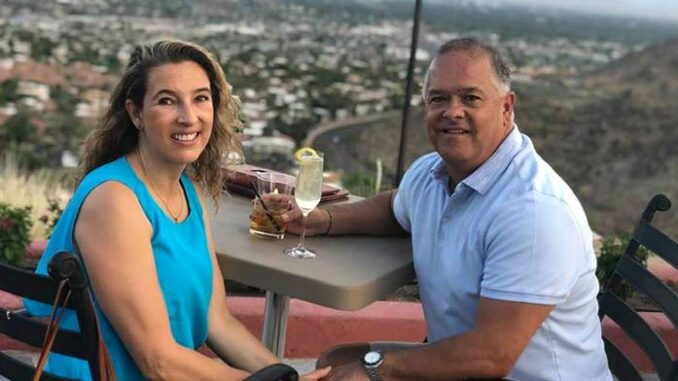
In March 2020, Dale Henson uploaded several photographs of his Chandler residence to his Facebook page. That same month, the couple issued a $309,103 cashier check to Great American Title, which is one of the six acts of money laundering charged in the criminal indictment.
Three of the other transactions involve more than $312,000 in checks written to the Wisconsin-based Lutheran Indian Ministries. The other two money laundering charges relate to $11,390.73 paid to Nordstrom department store in February 2020 and a $15,000 check written to “K.B.” in March 2020, according to the indictment.
Dale Henson will be represented at Monday’s detention hearing by Michael Kimerer. Among the arguments put forth by Klapper of the U.S. Attorney’s Office is that pretrial detention “is appropriate when the United States demonstrates either flight risk or danger to the community.”
Such a risk is posed by Dale Henson, according to Klapper, in part because of recent real estate transactions by the couple, including the $1.3 million purchase of a home last year which they recently sold.
“The Hensons also purchased five other pieces of residential or commercial real estate in the Phoenix metropolitan area, valued at millions of dollars – all of which was recently sold,” Klapper wrote to the court, adding that the couple have “few remaining connections to Arizona and have many connections to Mexico, where Zoila Henson is a citizen.”
The proceeds of those sales have been captured by state authorities pending forfeiture, according to the U.S. Attorney’s Office. The capture appears to be related to a separate state investigation into healthcare fraud.
A review of Dale Henson’s Facebook page reveals a public post in which he notes having a brother-in-law who is a captain with Aeromexico. Information on Zoila Henson’s attorney was not available as of press time.