by AZ Free News | Sep 15, 2021 | News
Phoenix, AZ – The initial maps for Arizona’s redistricting process were approved on September 14, 2021, by the Arizona Independent Redistricting Commission (IRC). The approved grid maps are of equal populations for the congressional and legislative districts as required by the state constitution.
Arizonans are encouraged to become involved with this next phase by utilizing the online mapping system and or by attending the public hearing sessions. Information can be found at irc.az.gov.
“We welcome the involvement and voices of all interested individuals and groups to become part of this critical process that will remain in place for the next ten years,” said Erika Neuberg, Chairwoman Independent Redistricting Commission. “With the approval of scheduled dates, times and locations, for the next round of public hearing, we will follow the State of Arizona’s COVID guidelines but also encourage those who choose not to participate in person to please go online and submit comments and maps.”
The following is the schedule of in-person public meeting sessions:
Tuesday, September 21 4:00 pm (MST) 5:00 pm (MDT)
Main location:
Red Mountain Multigenerational Center
7550E. Adobe St.
Mesa, AZ 85207
Satellite locations:
Yuma Civic Center
1440 W. Desert Hills Dr.
Yuma, AZ 85365
Navajo Nation Training Center (limit 25 participants onsite) Masks Required
Morgan Blvd. Bldg. #2740
Window Rock, AZ 86515
Thursday, September 23 12:00 pm ( MST)
Main location:
Scottsdale Center for the Arts
7380 E. 2nd St.,
Scottsdale, AZ 85251
Satellite locations:
Radisson Hotel
777 N. Pinal Ave
Casa Grande, AZ 85122
Sierra Suites
391 E. Fry Blvd.
Sierra Vista, AZ 85635
Saturday, September 25 10:00 am (MST)
Main location:
Desert Willow Conference Center
4340 E. Cotton Center Blvd.
Phoenix, AZ 850401
Satellite location:
Embry-Riddle Aeronautical University
3700 Willow Creek Road
Prescott, AZ 86301
Wednesday, September 29 4:00 pm (MST)
Main location:
Cactus Shadows Fine Arts Center
33606 N. 60th St.
Scottsdale, AZ 85266
Satellite location:
Tucson Convention Center
260 S. Church Ave.
Tucson, AZ 85701
Thursday, October 7 4:00 pm (MST) 5:00 (MDT)
Main location:
The Vista Center for the Arts
15660 N. Parkview Pl.
Surprise, AZ 85374
Satellite locations:
High Country Conference Center
201 W. Butler Ave.
Flagstaff, AZ 86001
Cesar Chavez Cultural Center
1015 N. Main St.
San Luis, AZ 85349
Kayenta Township Town Hall (limit 25 participants onsite) Masks required
100 N. Highway 163
Kayenta, AZ 86033
Individuals attending the in-person sessions at the main and satellite locations will have the opportunity to speak and give public comments on the grid maps. They can also complete their mapping comments online before the public meetings.
The link for the adopted grid maps is: https://redistricting-irc-az.hub.arcgis.com/
There will be an opportunity to observe each meeting on live streaming and that information will be listed on the website: https://irc.az.gov/
by Corinne Murdock | Sep 14, 2021 | News
By Corinne Murdock |
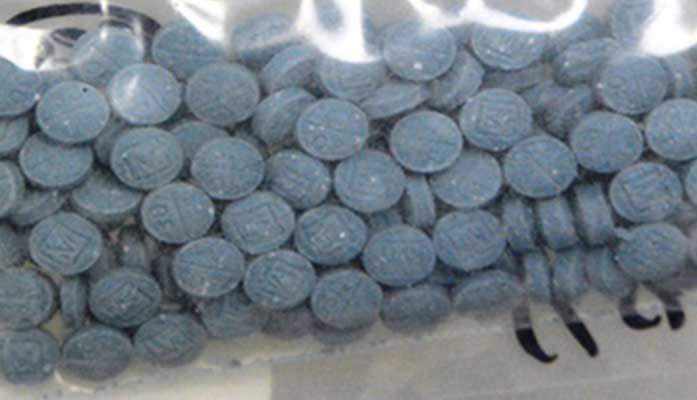
So far this year, Pinal County police have seized over 1.1 million M30 fentanyl pills. “M30” is a stamp on pills sometimes used to disguise a synthetic drug as the painkiller oxycodone, manufactured by pharmaceutical companies. The Drug Enforcement Administration (DEA) reported last year that a majority of fentanyl comes from the Mexican border.
Pinal County Sheriff Mark Lamb summarized the significance of these drug seizures. Lamb explained how the number of M30 fentanyl pill seizures jumped from zero in 2018, to around 700 in 2019, and over 200,000 in 2020.
Lamb explained that meth and fentanyl are being trafficked in pill form because people, especially kids, are more likely to take a pill than a needle in the arm.
“Not only are we dealing with the human trafficking issue, we’re also dealing with drug trafficking into this country. What the cartel has started doing is producing synthetic drugs, like methamphetamine and fentanyl. They can produce them in a lab 24 hours a day, 7 days a week,” explained Lamb. “Folks, this is a problem. What starts in my backyard today will be in your front yard tomorrow.”
In the post, Pinal County Sheriff’s office added that most of their deputies had never seen a fentanyl pill three years ago.
https://twitter.com/PinalCSO/status/1437458063821213697
Fentanyl was one of the key drugs found in George Floyd’s system after his death. Floyd had approximately 11 nanograms per milliliter (ng/ml). Fatalities may occur at around 7 ng/ml of fentanyl when one or more other drugs are used conjunctively.
Floyd also had 19 ng/ml of meth in his system. The initial autopsy report added that deaths have been determined due to fentanyl at levels as low as 3 ng/ml.
Fentanyl is a synthetic opioid drug that is 50 to 100 times more potent than its most comparable drug – morphine. This drug accounts for the majority of opioid overdose deaths in the United States, according to the National Institute of Health (NIH).
Since President Joe Biden took office, reports of increased drug trafficking have coincided with the historic surge of illegal immigrants. The situation worsened to the point where non-border states were lending their law enforcement to the southern border; South Dakota recently brought their National Guard home after Texas gained a handle on their end of the crisis.
Corinne Murdock is a reporter for AZ Free News. Follow her latest on Twitter, or email tips to corinne@azfreenews.com.
by Corinne Murdock | Sep 14, 2021 | News
By Corinne Murdock |
Last Friday, Congressman Andy Biggs (R-AZ-05) asked Department of Health and Human Services (HHS) Director Xavier Becerra to answer for the thousands of migrant children that were lost upon release from custody. These illegal immigrant youths, classified by the federal government as unaccompanied alien children (UAC), were supposed to be tracked after release from federal custody.
In a letter, Biggs asked Becerra to answer for how many UACs have been placed with sponsors; how many sponsors are illegal immigrants, aren’t the child’s parent, legal guardian, or relative, haven’t responded to HHS communications, have failed to attend Legal Orientation Program for Custodians, and/or have had their sponsor agreement terminated for failure to attend the legal orientation and/or ensuring their UAC attended immigration proceedings; if HHS places conditions on the release of UACs to sponsors; how many follow-up calls to sponsor families have been conducted since January 20, and what protocols are in place for unresponsive sponsors; and how HHC vets its sponsors.
Biggs lambasted Becerra’s HHS spokespersons for essentially shrugging off their department’s failure of oversight. An HHS spokesman told reporters that they didn’t have legal oversight once UACs left their custody.
“This cavalier and dismissive response to questions regarding the Department’s inability to ascertain the whereabouts of UACs whom it has placed with sponsors is appalling,” stated Biggs. “Instead of dismissing questions about whether HHS knows the whereabouts of children that it has placed with sponsors, your spokesperson should be able to provide the American people with assurances that HHS is taking its responsibility for placing children with responsible sponsors seriously.”
Biggs cited HHS policy that requires government personnel to check in on any UACs released to a sponsor within 30 days.
“If sponsors are unable or unwilling to answer the phone when HHS calls, then HHS should not be approving them as sponsors in the first place,” asserted Biggs.
Placing UACs with adequate sponsors has long been an issue for the federal government. An Office of Refugee Resettlement (ORR) policy already urges government workers to place UACs with sponsors as quickly as possible. The historic surge of illegal border crossings only places further strain on that system: U.S. Customs and Border Protection (CBP) has encountered nearly 100,000 UACs to date.
Total UACs for 2019 reached just over 76,000, and then over 30,500 with the 2020 pandemic.
According to a 2018 testimony from Immigration and Customs Enforcement’s (ICE) previous executive associate director, Matthew Albence, nearly 80 percent of UACs go to sponsors that are illegal immigrants themselves or already have illegal immigrants in their homes.
“From our data that we’ve seen just recently, you’re looking at close to 80 percent of the people that are sponsors or household members within these residents are illegally here in the country,” stated Albence.
In his letter to Becerra, Biggs accused HHS of shoddy work jeopardizing UAC safety to keep their number of open cases low.
“HHS appears more focused on releasing UACs to sponsors as quickly as possible and closing the case file than ensuring that sponsors are complying with their agreements and that the children are safe. The concern that HHS is placing UACs with sponsors who are using the children as forced labor or otherwise abusing the children is not hypothetical,” criticized Biggs.
HHS hasn’t issued any press releases in the last month discussing the state of UACs. The last reports issued concerning sexual harassment or abuse involving UACs was released in 2017.
Becerra’s deadline for responding to Biggs’s letter is Friday, September 24.
Corinne Murdock is a reporter for AZ Free News. Follow her latest on Twitter, or email tips to corinne@azfreenews.com.
by AZ Free News | Sep 14, 2021 | News
The Securities and Exchange Commission today charged Phoenix, Arizona-based Voice of Guo Media Inc., New York City-based GTV Media Group Inc. and Saraca Media Group Inc., with conducting an illegal unregistered offering of GTV common stock. The SEC also announced charges against GTV and Saraca for conducting an illegal unregistered offering of a digital asset security referred to as either G-Coins or G-Dollars.
The respondents have agreed to pay more than $539 million to settle the SEC’s action.
According to the SEC’s order, from April through June 2020, the respondents generally solicited thousands of individuals to invest in the GTV stock offering. During the same period, GTV and Saraca solicited individuals to invest in the digital asset offering. The order finds that the respondents disseminated information about the two offerings to the general public through publicly available videos on GTV’s and Saraca’s websites, as well as on social media platforms such as YouTube and Twitter. Through these two securities offerings, whose proceeds were commingled, the respondents collectively raised approximately $487 million from more than 5,000 investors, including U.S. investors. As stated in the order, no registration statements were filed or in effect for either offering, and the respondents’ offers and sales did not qualify for an exemption from registration.
“Issuers seeking to access the markets through a public securities offering must provide investors with the disclosures required under the federal securities laws,” said Sanjay Wadhwa, Deputy Director of the SEC’s Enforcement Division. “When they fail to do so, the Commission will seek remedies that make harmed investors whole, such as an unwinding of the offering and a return of the funds to the investors.”
“Thousands of investors purchased GTV stock, G-Coins, and G-Dollars based on the respondents’ solicitation of the general public with limited disclosures,” said Richard R. Best, Director of the SEC’s New York Regional Office. “The remedies ordered by the Commission today, which include a fair fund distribution, will provide meaningful relief to investors in these illegal offerings.”
Without admitting or denying the SEC’s findings that they violated Section 5 of the Securities Act of 1933, GTV and Saraca agreed to a cease-and-desist order, to pay disgorgement of over $434 million plus prejudgment interest of approximately $16 million on a joint and several basis, and to each pay a civil penalty of $15 million. Voice of Guo agreed to a cease-and-desist order, to pay disgorgement of more than $52 million plus prejudgment interest of nearly $2 million, and to pay a civil penalty of $5 million. The order establishes a Fair Fund to return monies to injured investors. The respondents also agreed to not participate, directly or indirectly, in any offering of a digital asset security, to assist the SEC staff in the administration of a distribution plan, and to publish notice of the SEC’s order on their public websites and social media channels, including but not limited to, www.gtv.org and www.gnews.org.
by Corinne Murdock | Sep 12, 2021 | News
By Corinne Murdock |
An audit revealed that the Arizona Department of Veterans Services (ADVS) failed to fulfill a number of key responsibilities. Major issues included a mismanagement of around $88,000 in funds, as well as violations of conflict-of-interest and open meeting laws. The Arizona Auditor General Lindsey Perry published the report at the end of last month.
Department and Commission met some statutory objectives and purposes, such as providing benefits counseling assistance to veterans and policy advice to the Governor, but Department did not comply with several Veterans’ Donations Fund grant award and monitoring requirements or use Gold Star Family revenues to maintain the Enduring Freedom Memorial and the Commission did not comply with some conflict-of-interest and open meeting law requirements.
The audit found that ADVS had accrued around $43,000 in funds meant to update the Enduring Freedom Memorial, which recognizes Arizona’s service members killed or injured in Operation Iraqi Freedom. According to the report, none of the funds were used. The memorial hadn’t even been updated to reflect all service members’ names since 2013: 3 years after the memorial was established.
Just before the COVID-19 outbreak, State Senator Kelly Townsend (R-Mesa) issued a press release indicating that ADVS wasn’t updating the Enduring Freedom Memorial. Townsend said that the families contacted her in the fall of 2019 about the issue. In response, she pushed for language in the budget that would offer more fund sources for ADVS to update the memorial.
Townsend remarked to AZ Free News that this audit confirmed the Gold Star Families’ suspicions. She added that she was grateful that the budget included her language to provide more funds for the memorial.
“One of the key findings of a just-completed audit of the Arizona Department of Veterans’ Services by the Auditor General confirms that the Department had not used more than $43,000 in Gold Star Family specialty license plate revenues to maintain the Enduring Freedom Memorial,” said Townsend. “Fortunately, I worked hard to make sure language was included in the budget to allow the Department of Administration to use money in the State Monument and Memorial Repair Fund to update the memorial.”
The remaining $45,000 that ADVS mismanaged came from uncollected payments from the Arizona American Legion. ADVS rendered has given veterans’ benefits counseling services to the legion since 2014. According to the audit, ADVS failed to collect $45,000 in payments from 2019.
The audit also found that ADVS made a faulty contract with the Arizona American Legion. ADVS agreed to an indefinite contract, State Procurement Code limits state agency contracts to 5 years unless the department head includes a written justification for an extension. Furthermore, the contract required legion payments to be remitted to the Veterans’ Donation Fund rather than the State General Fund, though the legion payments didn’t qualify by statute as gifts, contributions, or other public donations.
The audit also found that ADVS violated conflict-of-interest law by failing to have all committee members complete a conflict-of-interest disclosure form, and failed to have employees and public offices annually update their conflict-of-interest disclosure forms. ADVS also reportedly failed to offer a process to avoid and remediate any potential conflicts of interest.
As for open meeting law violations, the audit revealed that 4 of the 8 meetings they sampled failed to have minutes posted within 3 working days, and 1 meeting which wasn’t posted about 24 hours in advance.
In summary, the auditor general recommended that ADVS comply with the laws on grant management, conflicts of interest, and open meetings; spend the $43,000 in Gold Star Family specialty license plate revenues to maintain the Enduring Freedom Memorial; and collect the $45,000 owed by the Arizona American Legion while reviewing the need for that contract.
At length, the audit did note a number of other issues. These included inadequate safeguarding and exceeding award limits of relief fund monies; noncompliance with legal requirements for awarding and monitoring large and small Veterans’ Donations Fund grants; failure to retain required, proper supporting documentation for some transactions; and noncompliance with Arizona Strategic Enterprise Technology Office (ASET)-required information technology (IT) policies and procedures.
The audit did commend ADVS for assisting nearly 40,000 beneficiaries in receiving around $56.6 million average in monthly compensation and benefits.
According to the state, Arizona has around 504,000 veterans.
ADVS agreed with the audit findings, and indicated they would comply with the auditor general’s recommendations.
Read the entire report here.
Corinne Murdock is a reporter for AZ Free News. Follow her latest on Twitter, or email tips to corinne@azfreenews.com.
by Terri Jo Neff | Sep 12, 2021 | News
By Terri Jo Neff |
Proposed changes to how federal capital gains and inheritances are taxed would cost Arizona families billions of dollars in lost economic output and investment income over the next decade, not to mention kill thousands of jobs, according to an economic impact analysis released last week.
The report issued Sept. 9 by Committee to Unleash Prosperity examined the direct effects federal legislative proposals like the Sensible Taxation and Equity Promotion (STEP) Act put forth by the Biden Administration would have on financing costs, labor productivity, costs to small and family-owned businesses and farms, and federal non-military spending of new revenue.
U.S. Senator Chris Van Hollen (D-Maryland) is joined by Sens. Cory Booker, Bernie Sanders, Sheldon Whitehouse, and Elizabeth Warren in supporting the STEP Act and other proposed federal legislation also seek to make death a tax realization event and to increase the tax liability of trusts commonly utilized by small businesses, family- and privately-owned enterprises, farm and ranch operations, and others.
And the result over the next decade would hit thousands of Arizonans hard, according to the analysis conducted by Regional Economic Models, Inc. (REMI). The results would include sustained annual job losses in the state from 8,000 to nearly 20,000. That translates to 80,000 to almost 200,000 fewer job-year equivalents over 10 years, the report states.
In addition, the Biden-supported STEP Act and similar legislation would increase the top capital gains tax rate to 39.6 percent, which becomes 43.4 percent if the taxpayer is also subjected to a 3.8 percent net investment income tax (NIIT).
The changes would create $12 billion in private investment losses for Arizonans, a $120 million decline in research & development spending, and a 10-year loss in personal income of about $20 billion in Arizona, the analysis showed. The analysis does not address any further effect attributed to state capital gains, estate, or inheritance taxes.
The negative impact of changing federal tax law is driven by several factors, including increased capital and tax liability costs faced by businesses and farms. In turn, that translates into higher prices for consumer goods and services and makes the domestic private sector less hospitable for new and existing businesses, especially small and family-owned businesses and farms that are often less resilient to economic shocks.
“Higher prices mean that consumers are able to make fewer purchases, slowing demand throughout the economy from retailers to manufacturers to service providers,” the report states. “A less hospitable private sector means that prospective businesses may choose not to open, existing businesses may be forced to downsize or close altogether, and export-focused businesses lose market share to international competitors.”
And despite likely increased federal non-military spending to provide a direct boost to the economy, REMI found the negative impacts “dominate” in the end in Arizona.
Stephen Moore, the Committee to Unleash Prosperity’s co-founder, calls the proposed federal legislation a tax scheme that is “an assault on the American tradition of family-owned and operated businesses being passed on” from one generation to the next.
“Many families will literally have to sell the farm to pay the Biden taxes,” Moore said. “The damage to jobs and the economy would be multiple times larger than any revenue gained for the government from this unfair tax proposal.”