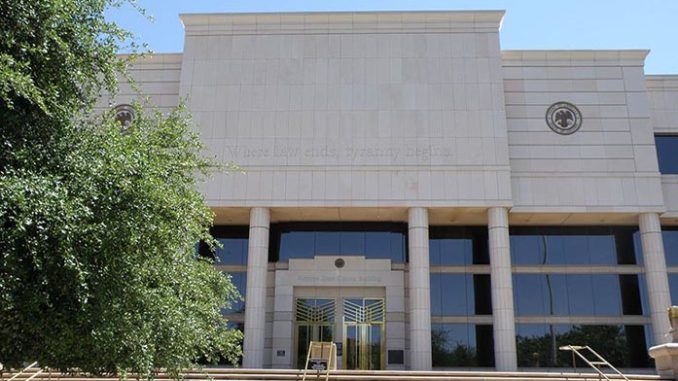
On Tuesday, the Arizona Supreme Court ruled against the state’s mask mandate ban challenged by the Arizona School Boards Association (ASBA). The court noted that while it didn’t agree with the lower court’s reasoning completely, it did concur with the judgment. An opinion will be issued in the near future. Justice Kathryn King recused herself; Court of Appeals Judge Randall Howe took her place. Roopali Desai argued on behalf of the plaintiffs, ASBA, while Attorney General Mark Brnovich’s Solicitor General Beau Roysden argued on behalf of the defense, the State of Arizona.
In September, Maricopa County Superior Court Judge Katherin Cooper ruled that ASBA had standing to challenge the mask mandate ban of SB 1819. The court also ruled that the SB 1819 was entirely unconstitutional and therefore invalid because it contained more than a single subject. In addition to SB 1819, the court also invalidated certain provisions in HB 2898, SB 1824, and SB 1825 on the grounds that they violated the Arizona Constitution’s title requirement: the titles of those bills didn’t accurately reflect the content of the legislation. As a result, 58 provisions of state law were invalidated prior to their start date on September 29.
During the hearing, the judges went back and forth with Roysden over whether the challenged laws truly did violate the single subject and title requirements. Their questions to Desali largely indicated a concern with how they were going to uphold Cooper’s prior ruling without overstepping into their bounds as the judiciary.
Roysden argued that plaintiffs weren’t showing a concrete and particularized injury from SB 1819. Vice Chief Justice Ann Timmer challenged that repeatedly, saying plaintiffs merely had to show they were affected by the issue at hand.
Roysden then argued that the court’s ruling on SB 1819 would be historic because no other laws in state history were struck down based on an interpretation of single subject and title requirements like the superior court gave.
“I think this is a watershed moment in Arizona Constitutional law because I’ve surveyed the case law […] – there is no case in Arizona law where this court has struck down a provision because the substantive provisions were not sufficiently interrelated. This would be uncharted territory by the court,” said Roysden. “What the court has enforced uniformly – going back to 1916 all the way up through the late 1970s cases – is the title requirement, and that is what the court must consider and limit its judicial review. The purpose of the title requirement is a procedural rule to put the public on notice of the potential contents of an act may be.”
Roysden also argued that the questions decided on by the superior court weren’t within the court’s function anyway. He said that the courts could decide whether legislation abided by the single subject and title rules – but not whether the provisions within the legislation were interrelated enough to qualify within those single subject and title rules. Roysden cited the intent of the constitutional convention delegates.
Desai argued that the legislature didn’t offer adequate notice or proper information on legislative content to the public. She characterized the state’s argument as requesting sole discretion on deciding what abides by the title and single subject rule.
“That could lead to some very problematic results. What’s to say the legislature doesn’t say that about every act that they pass?” asked Desai.
Timmer asked how the court could rule on this issue without overstepping their constitutionally-drawn bounds as the judicial branch. Justice William Montgomery echoed that question.
“Just how strict do you expect us to be in this regard? Because this does affect the legislature going forward?” asked Montgomery.
Desai responded that the term “budget reconciliation” was a “term of art” – a narrow, concrete definition – and that the legislature shouldn’t get to decide the standards for satisfying title requirements and the single subject rule. She said that the legislature was “throwing the Constitution out the window.”
“The test is not whether it relates to the budget. The test is whether it’s a budget reconciliation provision,” said Desai. “[B]udget reconciliation is a provision that is necessary to carry out and effectuate the budget.”
Montgomery challenged Desai on this point, asking whether that was what the state legislature did when issuing limitations for use of the budget funds. Desai responded that it wasn’t a budget reconciliation provision.
“In this case, the legislature chose a very narrow title,” asserted Desai. “We have to decide what these things mean. The court doesn’t have to come up with its own definition or adopt the stretch of an argument the state is advocating for because budget reconciliation is a term of art that is clearly understood.”
Desai then further argued that the court shouldn’t attempt to salvage certain provisions of SB 1819 because there was no way of knowing if the legislature would’ve passed them on their own, sans the logrolling. This is something that Chief Justice Robert Brutinel vocalized as Desai was making the argument; her agreement prompted a pleased look and chuckle from Brutinel.
In closing arguments, Roysden clarified that the original purpose and intention of the title requirement was to notify and not intentionally mislead the public. Howe challenged him several times on this argument, stating that Roysden’s position was that it was only for the state legislature to decide what constituted compliance with the constitutional rules on single subject and title requirements for bills.
Roysden urged the judges to not apply their ruling retroactively, but rather to allow the legislature to adjust accordingly in the future.
“The history here is that the legislature in good faith has followed what the court has suggested, and that should continue,” said Roysden.
In a statement after the hearing, Governor Doug Ducey expressed that he was “extremely disappointed” with the ruling.
“There are three separate co-equal branches of government and we respect the role of the judiciary, but the court should give the same respect to the separate authority of the legislature,” stated Ducey.
Nearly $75 billion in federal COVID-19 funds was allocated to the State of Arizona, its local governments, businesses, and individuals between March 2020 and October 2021. Of that, more than $4.4 billion went to improper unemployment insurance claims because anti-fraud measures were not utilized by a state agency, according to a special report issued by the Arizona Auditor General.
The questionable payments by the Arizona Department of Economic Security were from federal funds provided through the CARES Act, one of six Congressional acts and one Presidential memorandum that resulted in $74.9 billion being allocated within Arizona for response and recovery efforts stemming from the pandemic.
For purposes of the special report, the term allocated refers only to funds set aside, not necessarily spent.
The payment of fraudulent claims from the federal COVID-19 funding is not the only concern raised by the Auditor General. Another is the potential future adverse impact caused by the fact the Arizona Department of Administration was 29 days late in submitting a required audit report to a federal audit clearinghouse.
“The late report submission was primarily because State agencies experienced personnel and resource challenges throughout the year responding to the COVID-19 pandemic, including administering the COVID-19 federal program monies and navigating their new requirements,” the report noted.
Federal agencies, the report notes, could “potentially” take action against the State and its three universities due to the late reporting.
The Auditor General’s report also highlights how the overall $74.9 million is split between $43.8 billion available directly to individuals, businesses, local governments, and other non-State programs while $31.1 billion in funds is allocated to the State of Arizona and its agencies.
Of the $43.8 billion in federal COVID-19 funding available directly to individuals, businesses, and local governments, a huge hunk ($18.3 billion) was allocated for individual and family assistance. Almost 95 percent of that has already been distributed in the form of various stimulus payments to individuals.
Another $18 billion is earmarked for business aid, most of which was paid out through the Paycheck Protection Program (PPP) and Economic Injury Disaster loans. The remaining $7.5 billion that was already allocated went to things like public health, transportation, and education (for a combined $4.3 billion) and $3.2 billion to local governments for varied purposes, including COVID-19 mitigation efforts.
The Auditor General’s report also took a close look at $6.3 billion spent or distributed from the State’s allocation between March 1, 2020 and June 30, 2020, the end of Fiscal Year 2020.
“We audited these monies as part of the annual compliance audit of federal monies the State spent and distributed, which we performed in accordance with State law and federal regulations, and in conjunction with our audit of the State’s financial statements,” according to the report, which noted the $6.3 billion was a small part of the overall $26.4 billion of various federal funds spent or distributed by the State of Arizona in FY2020.
Of the $6.3 billion, more than 84 percent ($5.3 billion) was for individual and family assistance, while $352 million was allocated for public health programs. There was also $32 million earmarked for education and another $643 million categorized in the Auditor General’s report as for “miscellaneous” usage.
The report also breaks down how the other $24.8 billion allocated to the State of Arizona and its agencies from July 2020 through October 2021 is designated, with the majority $13.1 billion (about 53 percent) again earmarked for individual and family assistance, including $7.1 billion for unemployment insurance benefits.
While most of the unemployment funding had to be spent by Sept. 6, some allocated funds can be spent as late of Sept. 30, 2025, according to the report.
The next largest chunk of COVID-19 funds to the Arizona state government is $5.7 billion for education, including $643.6 million of a direct allocation for the state’s three universities. Again, some of the fundings can be spent through September 2025.
Another $2.8 billion is categorized as “to be determined use” through Dec. 31, 2024. Examples of how those funds can be spent include COVID-19 mitigation efforts and infrastructure.
As to public health, there was $1.9 billion allocated to Arizona from July 2020 through October of this year. The main area of expenditure for these funds is for various COVID-19 “response.” The majority of that allocation does not have to be spent until July 31, 2024.
That leaves roughly $1.3 billion in miscellaneous funding to be spent on things such as transportation, community services, and business assistance. Much of that allocation can be spent as late as Dec. 31, 2024, according to the report.
Not included in the Auditor General’s report is an estimated $4.8 billion of federal COVID-19 related funding which the Arizona Joint Legislative Budget Committee believes was allocated to tribal governments located wholly or partially within Arizona’s geographical boundaries
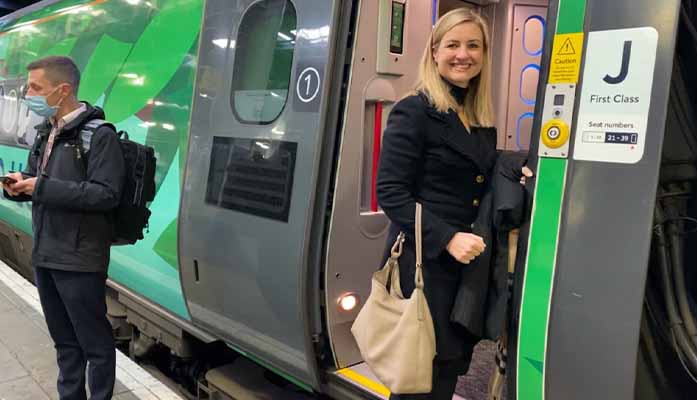
This week, Phoenix Mayor Kate Gallego and Councilwoman Yassamin Ansari are attending the United Nation’s (UN) COP26 Climate Change Conference in Glasgow, Scotland. The conference began Sunday and will last until next Friday. The attendees are meeting with the objective of realizing the Paris Agreement through finalization of the Paris Rulebook and acting on the UN Framework Convention on Climate Change.
Gallego’s spokespersons informed AZ Free News that the city didn’t pay for Gallego’s trip – the C40 Cities Climate Leadership Group paid, a global network of nearly 100 mayors that collaborate on climate solutions. In May, Gallego was elected the vice chair for C40’s steering committee.
Ansari’s spokespersons didn’t respond by press time.
Gallego told Business Journal that she would be networking with companies who may potentially invest in the city. In a statement posted to Twitter, Gallego explained that this conference would bring fresh ideas on climate change initiatives to Phoenix, as well as serve as an opportunity to share some of Phoenix’s initiatives, like their cool pavement installations. “Excited to be attending the UN #COP26 Climate Summit. Phoenix is an innovative leader on climate solutions,” wrote Gallego. “We’ll share our success, and learn about successes from cities around the globe. #TogetherForOurPlanet”
Excited to be attending the UN #COP26 Climate Summit. Phoenix is an innovative leader on climate solutions. We’ll share our success, and learn about successes from cities around the globe.#TogetherForOurPlanetpic.twitter.com/q5GkipooHL
Ansari’s message concerning her attendance reflected more urgency, claiming that lives were at stake. “After spending years working to get elected officials to commit to bold climate solutions, I’m heading to Glasgow for #COP26 proud to represent District 7 in Phoenix,” wrote Ansari. “We just passed our #climateaction plan. Lives are at stake— it’s time to implement.”
After spending years working to get elected officials to commit to bold climate solutions, I’m heading to Glasgow for #COP26 proud to represent District 7 in Phoenix.
Prior to her election to city council, Ansari served as a climate advisor for the UN. She attributed her work as crucial to delivering the Paris Agreement in 2015.
6 yrs ago, I helped deliver the #ParisAgreement. Today, I arrived at the @UN#COP26 summit as an elected official from Phoenix, AZ— once dubbed “the world’s least sustainable city.”
Excited to showcase the work we’re leading now & to bring back lessons from cities everywhere. pic.twitter.com/1goMHS4DJx
The pair will discuss Phoenix’s climate initiatives, including their $2.8 million Heat Response and Mitigation Office. The purpose of the office is to reduce the effects of urban heat, a phenomenon in which urbanization causes higher temperatures. Phoenix is the only city that has an office dedicated to these efforts.
Phoenix’s latest climate action plan was approved last month. The city pledged to certain goals, such as becoming 100 percent carbon-neutral by 2050, eliminating all food deserts, and establishing 100 years of clean and reliable water supplies.
The COP26 conference claims that climate change is the greatest threat facing the world. Two of the goals listed were reaching net zero for emissions and limiting global warming by 1.5 degrees. The UN claimed in their promotional video for COP26 that “Earth is sending a message that we must not ignore.” They showed pictures of various natural disasters, mixed with happy scenes from nature.
“What is COP? The potential threat to the surrounding natural environment, what the UN is calling the world’s first climate change famine,” said the conference promotional video. “Even on our warming planet there are reasons for hope. We need to have the courage to try. There are going to be a lot more jobs created in the economy. Climate change is not the problem, climate change is the expression of the problem.”
Corinne Murdock is a reporter for AZ Free News. Follow her latest on Twitter, or email tips to corinne@azfreenews.com.
On Monday, the U.S. District Court for Arizona held a hearing to determine whether senior nursing students Emily Thoms and Kamaleilani Moreno will be granted an injunction for Maricopa County Community College District’s (MCCCD) vaccine mandate for participation in clinical rotations, necessary for the two to complete their programs.
As AZ Free News reported, Thoms and Moreno have just one week before MCCCD’s vaccination deadline and the start of clinical rotations. Thoms and Moreno are seeking an affirmative injunction against the vaccine mandate; the district court expedited the case due to the timing of the deadline and clinical rotations.
Thoms and Moreno filed their complaint after MCCCD denied their religious exemption requests. The district claimed that offering exemptions would jeopardize their partnership agreements with certain health care providers and place an undue hardship on the district. These claims were rejected by Thoms and Morenos’ lawyer repeatedly in court Monday, citing several health care providers that didn’t require COVID-19 vaccination.
Thoms and Moreno’s religious objections concerned how aborted fetal cell lines were used in the development and testing of the COVID-19 vaccine. Those are lab-grown cells based on the cells derived from aborted fetal remains obtained in the 1970s and 1980s.
Christians believe that God creates a new life at conception, and will cite concepts such as “one flesh” in Genesis 2, God’s formation of man in the womb in Psalm 139, and the recognition of Jesus as alive shortly after he was conceived in Luke 1.
During Monday’s hearing, MCCCD had five lawyers while Thoms and Moreno had only one, Colleen Auer. U.S. District Judge Steven Paul Logan presided over the case – he was appointed by previous President Barack Obama in 2014.
From the get-go, it appeared that Logan was skeptical of MCCCD’s position. Near the beginning of the hearing, Logan asked the defense to clarify if they were forcing students to get a vaccine that wouldn’t protect them or their patients from COVID-19. The judge’s question likely relates to the developing studies on breakthrough infections among the vaccinated – some recent studies show as little as 1 in 5,000 vaccinated individuals experience breakthrough cases, while others show as high as 1 in 100.
The crux of Thoms and Moreno’s argument was that MCCCD’s mandate effectively would require them to either act against their religious beliefs or sacrifice all of their investments and, effectively, careers.
MCCCD claimed that Thoms and Moreno wouldn’t be given failing grades for not complying. Rather, they would receive an “incomplete” grade and would need to resume the unfulfilled portion of their studies later. MCCCD didn’t add that Thoms and Moreno may never be able to complete their studies without the vaccination.
Auer bucked MCCCD’s statements. She claimed that MCCCD either gave Thoms and Moreno no information or misinformation. She emphasized that these nursing programs are difficult to be accepted into, with long wait lists.
“The realities are that it took them very long times to get into these programs,” stated Auer.“ It’s not possible or guaranteed as [MCCCD] claimed that they will ever be able to finish these clinicals in the [near future.]”
MCCCD’s attorneys argued that Thoms and Moreno didn’t qualify for an immediate affirmative injunction because they wouldn’t suffer irreparable injuries. They also claimed that an incomplete grade would only be a “delay by a matter of months,” which wouldn’t have a lasting negative impact on the students. “Plaintiffs will not suffer irreparable injury. They’re not being compelled to take the vaccine, they’re not being given failed grades,” said defense. “What we’re talking about is a slight delay in completing their course work.”
MCCCD’s lawyers also claimed that Thoms and Moreno’s religious freedom arguments were unrelated to MCCCD’s refusal to grant either an exemption. They said it was a neutral policy that applied to all nursing students, made on the basis of a rational basis review via a legitimate government-based purpose. If MCCCD did accommodate Thoms and Moreno, the lawyers argued that such an exemption would cause financial and administrative burdens, as well as cause potential contractual harm.
Auer rejected the characterization of MCCCD’s vaccine mandates as a neutral policy.
“The fact is, this is not a neutral policy. It selects certain folks to get the religious advantage based on the luck of their clinical assignment,” stated Auer. “They were put to the choice: if you want to continue your program and complete it as you contracted for, […] you must sacrifice your religious beliefs or you won’t get that, period. They’re pulling services for which these people paid, for which they’re entitled, with no certainty of what the district says.”
Additionally, MCCCD indicated that there was a public health interest to require vaccinations. Auer questioned which was the greater public health interest – a few vaccinated nurses but a workforce shortage, or plenty of nurses.
“The public is going to lose out on graduating nurses right here right now at a time where they need those nurses,” said Auer. “There’s a shortage of nurses here and across the country. It doesn’t matter if they’re vaccinated or if they’re not – they need them in the COVID-19 wards.”
Judge Logan stated that he would take the briefing under advisement. The order will be issued Thursday by 5 pm.
Corinne Murdock is a reporter for AZ Free News. Follow her latest on Twitter, or email tips to corinne@azfreenews.com.
The Arizona Hispanic Chamber of Commerce highlighted the future of housing during an Oct. 29 celebration of the release of 2021 DATOS: The State of Arizona’s Hispanic Market.
The 2021 DATOS report is the most comprehensive compilation of research on the impact of Hispanics on the Arizona marketplace, providing critical insight through demographic, sociographic, and psychographic data. Nearly 43 percent of Phoenix residents identify as Hispanic or Latino, while Hispanics represent almost 32 percent of Arizona’s population.
In addition, Mexicans represent more than 55 percent of the foreign-born population in Arizona, according to the report edited by Monica Villalobos, president and CEO of the Arizona Hispanic Chamber.
This year’s report also delves into Latino contributions and impact in the housing sector. Key housing findings include the fact that 70 percent of new homeowners between 2020 and 2040 will be Latino, and that the Phoenix – Mesa – Scottsdale area ranks in the top 20 markets with the most mortgage-ready Hispanic millennials.
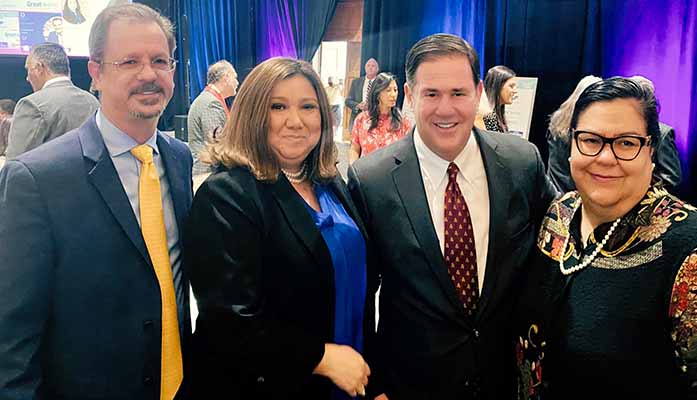
The event, which attracted hundreds of attendees to the Arizona Grand Hotel, was also livestreamed by the Arizona Hispanic Chamber. A panel discussion focused on housing included panelists Amy Schwabenlender of Human Services Campus Inc., Christopher Rodriguez of Ability360, and Gloria Muñoz, chairwoman of the Arizona Housing Coalition.
Gov. Doug Ducey attended and issued a formal commendation recognizing the Arizona Hispanic Chamber’s work and advocacy.
Among the dozens of subjected addressed in 2021 DATOS is the impact of a bill signed by Ducey earlier this year to allow acceptance of Mexican Consular ID cards in Arizona as of Sept. 29.
Jorge Mendoza Yescas, the Mexican Consul in Phoenix, explained that the consular card does more than provide proof of identity, residency, and Mexican nationality. The card “brings certainty to important economic activities such as opening a bank account, engaging in commercial activities, requesting loans, applying for individual taxpayer ID numbers, using rental services and signing up for utilities,” he noted.
It was also noted that if Hispanics were their own economy, they would be the 8th largest economy in the world.
Invest in Arizona – a referendum to reverse the tax cuts passed recently by the Arizona legislature that would negate Prop 208 – reported several million in out-of-state funds in their latest campaign finance report. The National Education Association (NEA) donated over $2.4 million, $30,000 of which Invest in Arizona refunded.
The second-largest source of funds, nearly $2.4 million, came from Stand for Children Arizona, the local chapter of the national education advocacy group, Stand for Children. Stand for Children’s Arizona chapter hasn’t always donated to Invest in Arizona. Up until last July, their national organization headquartered in Portland, Oregon was responsible for those million-dollar donations.
Together, the NEA and Stand for Children Arizona comprised the vast majority of Invest in Arizona’s funds. Individual contributions amounted to just over $16,600, while total funds were reported to be over $4.7 million.
AZ Free News inquired with Stand for Children Arizona about these recent donation patterns: specifically, whether these donations were furnished from their national organization to their local chapter. This was their response:
“Thank you for reaching out! Stand for Children Arizona has a long history supporting families in AZ,” stated Stand for Children Arizona spokesperson Carlos Alfaro. “Our support of Invest in AZ is one piece of that, as indicated by the donation of our 501c4 organization Stand for Children, Inc.”
A majority of the over-$4 million that Invest in Arizona raised went toward operating expenses – signature gathering to submit their two referendums. The top recipients, in order, were: Fieldworks LLC with nearly $4 million alone, Save Our Schools Arizona with $115,000, Arizona Asian American Native Hawaiian and Pacific Islander for Equity (AZ AANHPI For Equity) Coalition with $10,000, Fieldcorps LLC with $75,500, La Machine with $65,000, and Valley Interfaith Project with $29,000.
Invest in Arizona also spent $48,000 in polling from Lake Research, $5,000 for campaign consultancy from Strategies 360, and gave Valley Interfaith Project an additional $49,000 for text messaging outreach, field organizers and coordinators, outreach captains, and travel expenses.
Corinne Murdock is a reporter for AZ Free News. Follow her latest on Twitter, or email tips to corinne@azfreenews.com.