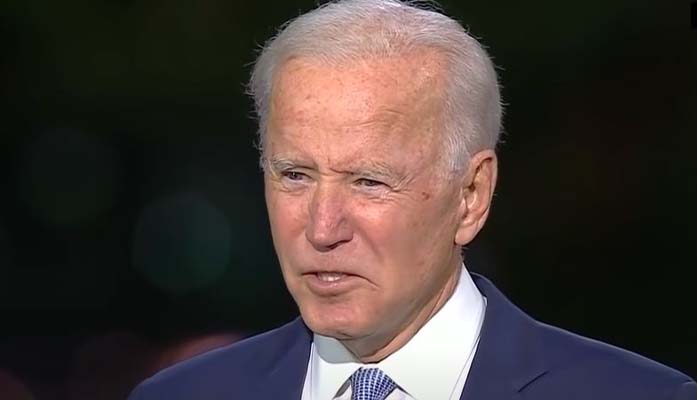
Criticism continues to grow against a sweeping new federal mandate supported by the Biden Administration which requires private employers of 100 or more employees to develop and enforce a mandatory COVID-19 vaccination policy.
The mandate, outlined in a 490-page document, is referred to as an Emergency Temporary Standard (ETS). It establishes a Jan. 4, 2022 deadline for compliance, and requires employees of those companies to be vaccinated or be forced to wear a face covering at work while undergoing regular COVID-19 testing at the employee’s expense.
The Industrial Commission of Arizona (ICA) and the Arizona Attorney General’s Office are pushing back on the mandate which is estimated to cover more than 84 million employees, or about two-thirds of America’s private-sector workforce. OSHA estimates that about 23 million Americans will choose to undergo the vaccination to preserve their jobs.
On Thursday, the ICA issued a statement that Arizona businesses are not bound by OSHA’s mandate unless the commissioners vote to formally adopt a similar policy. Arizona is one of 22 states previously granted federal approval to operate a state plan to address issues typically under the purview of OSHA.
Then on Friday morning, Arizona was one of 11 state plaintiffs in a federal lawsuit filed in the U.S. Eighth Circuit Court of Appeals against President Joe Biden and OSHA to stop the COVID-19 ETS. The petition contends the vaccination mandate “is unconstitutional, unlawful, and unwise” and an attempt to infringe on the States’ powers expressly reserved by the Tenth Amendment.
In addition to Arizona, the attorneys general from Alaska, Arkansas, Iowa, Missouri, Montana, Nebraska, New Hampshire, North Dakota, South Dakota, and Wyoming are plaintiffs.
Also on Friday, State Rep. Steve Kaiser criticized the White House’s support of the workplace vaccine mandate, calling it “an onerous and overreaching policy that will hurt businesses and the people who they employ.”
Kaiser, a Republican who represents LD15 covering north Phoenix and Cave Creek, owns Junk King, a Phoenix area franchise providing removal and hauling services.
“As a small business owner, it’s clear to me that Biden’s policy would force employees to choose between being vaccinated against their will, completing weekly COVID-19 testing (at their own expense), or losing their jobs. That’s wrong,” he said. “It’s more critical than ever that Arizona defend businesses and their employees and ensure their ability to continue making decisions for themselves – instead of liberal politicians in Washington.”
According to Kaiser, state officials are doing the right thing by trying to protect Arizonans who would be harmed by implementation of what he calls a “terrible” mandate. He supports ICA’s position that Arizona -and not OSHA- has had the exclusive responsibility for nearly 50 years for developing and enforcing any occupational safety and health standards within the state.
“Under Arizona’s long-approved state-plan procedures, the Industrial Commission has exclusive authority to decide if, when, and to what extent the State of Arizona will adopt the OSHA vaccination ETS,” the ICA statement reads. “Arizona has a 47-year track record of protecting the safety and health of Arizona’s workers and remains fully committed to this mission.”
The ETS requires employers to determine the vaccination status of each employee, obtain acceptable proof of vaccination, maintain records of each employee’s vaccination status, and maintain a roster of each employee’s vaccination status. It also requires employers to provide employees with a variety of information and literature about COVID-19 and to provide an employee “reasonable time and paid sick leave to recover from side effects experienced following each dose.”
In addition, employers are now mandated to report work-related COVID-19 fatalities to OSHA within 8 hours of learning about them, and work-related COVID-19 in-patient hospitalizations within 24 hours of the employer learning about the hospitalization.
For now, OSHA officials are less confident that smaller employers can implement a mandatory vaccination policy “without undue disruption.” But it appears those smaller businesses could be facing a similar mandate in the future.
“OSHA needs additional time to assess the capacity of smaller employers, and is seeking comment to help the agency make that determination,” it says.
Earlier this month the Arizona Supreme Court agreed with a lower court’s ruling that parts of 4 of the 11 budget bills signed into law by Gov. Doug Ducey this summer are unconstitutional on procedural grounds. The reaction from business owners and community leaders was swift, with many left wondering when and how lawmakers will address the dozens of provisions dropped from those budget bills.
Among those provisions was a prohibition on a county, city, or town from issuing COVID-19 ordinances that impact private businesses, schools, churches, or other private entities, including mask mandates. Other prohibitions would have kept K-12 schools from requiring vaccines with an emergency use authorization for in-person attendance and ensured public universities and community colleges could not mandate COVID vaccines and vaccine passports.
The Arizona Free Enterprise Club (AFEC) describes the Justices’ recent opinion as “devastating” and “a big blow to the people of Arizona.” The organization has drawn attention to the uncertainty and frustration across Arizona at a time when the pandemic impacts are still being felt in the state’s economy, and as individual freedoms are under attack.
As a result, the AFEC is leading the call for the Arizona Legislature and the Governor to immediately address the critical reforms that the Supreme Court struck down.
“They must exhaust every option possible, including special session, to protect Arizonans from more COVID mandates and the bigoted teachings of Critical Race Theory,” according to AFEC. “But make no mistake, while this ruling is devastating, it will not stop the battle over these critical issues. There’s just too much at stake. Because if the uncertainty and frustration caused by these issues are allowed to continue, it would be the most devastating news of all.”
Nearly $41 million has been pledged by Gov. Doug Ducey to provide transitional housing in an effort to reduce homelessness across Arizona, including within Native American communities and for residents with special needs.
“These funds will help families and individuals who are struggling access transitional housing options and equip them with the skills and support needed to secure permanent, reliable housing,” Ducey said Thursday in announcing the funds. “There are a wide range of organizations and programs across the state that help Arizonans succeed — and I’m grateful for all they do to support those in need.”
The Arizona Housing Coalition will be responsible for allocating $10 million of the State Fiscal Recovery Fund funds to organizations which serve those impacted by homelessness. Another $7.2 million will go to Native American Connections for the acquisition of a 58-bed transitional housing facility in the West Valley for youth experiencing homelessness.
The Arizona Coalition to End Sexual and Domestic Violence (ACESDV) will distribute $7.5 million to domestic violence service providers for safe housing options for survivors in need of support. ACESDV will also distribute $4 million to domestic violence providers specifically serving Native American Tribes.
Meanwhile, $5 million has been given to Chicanos Por La Causa to hire personnel who will assist with rental applications and housing relocation, as well as provide referrals to other community resources, while $2.5 million is being provided to Home Matters to Arizona to further the group’s efforts to expand affordable housing options and to support providers that focus on transitional, homeless and domestic abuse shelters.
Habitat for Humanity Tucson has been allocated nearly $1.9 million to create a community-based job training program and to build and repair affordable housing.
Other funding announced by the Governor includes:
$500,000 to one-n-ten to provide safe and reliable housing to LGBTQ+ youth in need of shelter.
$434,276 for Tanner Community Development Corporation to provide more housing options for veterans facing homelessness.
$362,047 for Circle the City to strengthen mental health services for those experiencing homelessness by creating a street outreach team.
$300,000 for Native Americans for Community Action to expand its services that individuals experiencing homelessness utilize.
$250,000 for Primavera Foundation to renovate and expand affordable housing units.
$250,000 for First Place Arizona to offer independent living outreach, health programming, community engagement and mental health coordination to neurodiverse Arizonans.
$250,000 for Southern Arizona Aids Foundation to support counseling and housing programs and those living with HIV/AIDS and LGBTQ+ youth facing housing insecurity.
$250,000 for Tohdenasshai Committee Against Family Abuse to hire personnel to assist with childcare at the shelter in Navajo Nation and to assist with transportation to housing appointments and other services for victims.
$55,000 for Free Arts to provide children in shelters and facilities with art supplies.
$50,000 for Streets of Joy to provide shelter and counseling services to underserved individuals with mental illnesses and inmates recently reentering society, helping them transition to an independent lifestyle.
The governor’s announcement comes on the heels of two other housing related funding opportunities also announced this month. On Nov. 1, Ducey and Arizona Department of Housing (ADOH) Director Tom Simplot announced $197 million to launch the Homeowner Assistance Fund, helping Arizona homeowners struggling financially to pay their mortgage and other home-related expenses.
Then on Nov. 2, the distribution of $15.35 million in federal funding to support programs aimed at combating homelessness throughout Arizona was announced, with emphasis on immediate, transitional options
“Transitional housing is a great steppingstone to helping more Arizonans access permanent housing solutions, and it’s important that our fellow Arizonans have access to those resources. My thanks goes to Governor Ducey for all his work to support the Arizona Department of Housing’s efforts to connect vulnerable Arizonans with safe housing.”
Thursday’s $40.7 million funding announcement is part of $90 million in federal COVID-19 relief funds available to Arizona to address affordable housing, homelessness, and other family issues such as childcare shortages and increased domestic violence made worse by the pandemic.
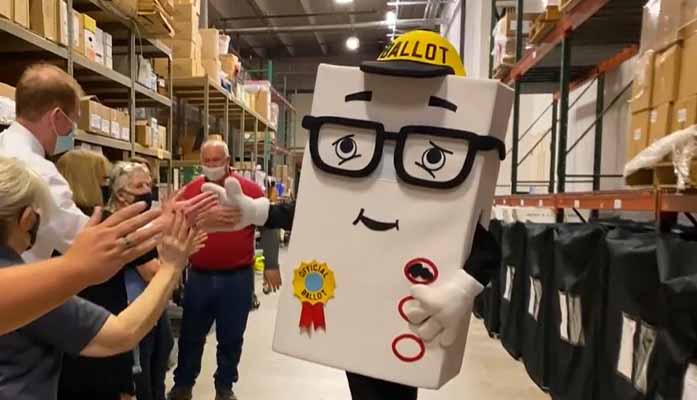
The Maricopa County Elections Department spent $10,000 on two of the same custom ballot mascots last February, according to records. That price is within the normal range of costs associated with custom mascots – they typically cost several thousands of dollars. In a statement to AZ Free News, Maricopa County Elections Department spokeswoman Megan Gilbertson explained that the mascot was necessary to mitigate updates to the elections equipment and the fresh outbreak of the COVID-19 pandemic.
With a new ballot style, new equipment and a global pandemic, Maricopa County wanted a way to ensure voters had the information they needed to successfully and safely participate in elections in 2020. Voter education can help keep polling place lines shorter by providing voters with critical details about election deadlines and important election information. The Elections Department and Recorder’s Office created BeBallotReady. Vote, a customized dashboard where voters can find election information and deadlines, sample ballots, voting locations, information about the new ballot and equipment, and more. Along with the dashboard, the County launched a coordinated campaign to inform voters about the new ballot and equipment as well as direct information about the 2020 elections. The spokesperson of the campaign was Phil the Ballot. The mascot costume was used in all of our videos and graphics during the election and has become a beloved and well liked figure of Maricopa County elections.
The department’s invoice was dated February 27, 2020. At that point, only one case of COVID-19 was discovered in Maricopa County at the end of January: an Arizona State University (ASU) student who’d traveled to Wuhan, China. Additional cases weren’t reported on widely until March, and the first known community spread case wouldn’t occur for over another week.
The county also told AZ Free News that they weren’t going to use the mascot, named “Phil the Ballot,” at any of their polling locations because photography isn’t allowed within 75 feet of any polling location.
Behind the scenes at the Election Department. We're preparing all ballot envelopes dropped off today for signature verification. Thank you to all of our election workers who helped to #BeBallotReady. pic.twitter.com/KZ75ayuf6r
— Maricopa County Elections Department (@MaricopaVote) November 3, 2021
According to the invoice, each mascot cost $4,450. The carrying bag set to hold both Phil the Ballot mascots cost $300, and the cooling system and fan for the costume cost $530 altogether. Shipping totaled nearly $464.
However, the elections department did get a discount of $200 for purchasing two of the same costume. The mascots came from Ohio-based Promo Costumes.
Phil the Ballot appears in instructional or informational videos posted by the department on YouTube. These videos cover various topics, such as how to request a one-time ballot or how to locate a voting center. One of Phil the Ballot’s videos published several weeks before the 2020 presidential election even discussed how Sharpies could be used to mark ballots.
Corinne Murdock is a reporter for AZ Free News. Follow her latest on Twitter, or email tips to corinne@azfreenews.com.
The Arizona Democratic Party paid Colleen Wachenfeld – a Delta Gamma sorority girl and Virginia Democratic Party staffer who posed as a white supremacist at a recent campaign event for Republican gubernatorial candidate Glenn Youngkin, dubbed “Tikigate” – nearly $19,700 to campaign for Mark Kelly over the course of four months last year.
According to the Federal Election Commission (FEC), Wachenfeld was on the Arizona Democratic Party’s payroll from mid-July to the end of November. Though Wachenfeld’s resident city and state for payments were listed as Basking Ridge, New Jersey, social media pictures confirmed she was in Arizona during the months that the Arizona Democratic Party paid her.
The Arizona Democratic Party didn’t respond to multiple requests for comment. As for Wachenfeld: she has not denied or affirmed her involvement in the stunt, though immediately after social media users identified her as a participant she attempted to disguise her identity on Twitter multiple times, rebranding her handle into names such as “rachelanne1776” and adopting random pictures for her profile and header before deleting the account, then reinstating it and ultimately making all of her social media pages private. She appears to live in Arizona currently, as indicated by her updated Twitter bio.
Wachenfeld was admitted into the competitive School of Public Affairs (SPA) leadership program at her alma mater, the D.C.-based American University. In addition to that program, Wachenfeld was an active member of the Beta Epsilon chapter of Delta Gamma, a national sorority.
Students involved in American University like Wachenfeld could expect to pay around $4,000 or more for four years of sorority membership, not including expenses like uniforms, Big-Little gifts, and philanthropies. (The Beta Epsilon chapter claimed their dues were on par with other sororities on campus, and Phi Mu’s dues totaled around $4,000.)
We inquired with Delta Gamma and the Beta Epsilon chapter whether Wachenfeld’s actions were consistent with their goal and motto to “do good,” and what their standards were for admitting women because, as sororities and fraternities often say, membership lasts for a lifetime. Neither responded by press time.
Wachenfeld’s chapter expressed a steadfast commitment to anti-racism following George Floyd’s death last year. They partnered with the Kentucky-based Muhammed Ali Center to reform their chapter based on diversity, equity, social justice, and the like, applying some of funds from those $4,000-odd memberships to pay for the program.
“With the help of the Ali Center in Louisville, Kentucky, we are developing a program that focuses on racial justice, identities of privilege and oppression, positive social change, and building inclusive and equitable communities. Through workshops, active dialogue, and policy creation, we are working to become actively anti-racist. We have allocated a portion of our chapter operating budget to implement this program, and look forward to finding more meaningful ways to support the Muhammad Ali Center and utilize them as a resource throughout the course of our partnership and beyond.”
During the spring of her senior year, Wachenfeld served a short stint as an intern for Democratic New Jersey Senator Cory Booker, who endorsed Terry McAuliffe as Youngkin’s Democratic opponent. Several months later, Wachenfeld graduated magna cum laude from American University with a B.A. in public relations and strategic communication.
One faculty member at American University’s Washington College of Law shares the same surname as Wachenfeld: adjunct professor Margaret Wachenfeld. She didn’t respond to AZ Free News multiple requests for comment, either.
Democratic Party of Virginia Executive Director Andrew Whitley claimed that none of their staff members were involved in the stunt. Whitley appeared to be rebuking those who claimed Wachenfeld’s involvement.
“The Democratic Party of Virginia, along with its coordinated partners and affiliates, did not have any role today in the events that happened outside of the Youngkin campaign bus stop today. What happened in Charlottesville four years ago was a tragedy and one of the darkest moments in our state’s recent memories and is an event not to be taken lightly. For anyone to accuse our staff to have a role in this event is shameful and wrong.” (emphasis added)
Charlie Olaf, Terry McAuliffe’s social media manager, retweeted images of the purported “white supremacists” at the Youngkin event with heavy criticism. As of press time, Olaf’s Twitter profile was set to private. Olaf also updated his bio to read: “I’m sorry,” with his location also set to read, “I’m sorry.”
“Wow. At a campaign stop for Glenn Youngkin this morning, people were holding tiki torches and chanting ‘we’re all in for Glenn,’” tweeted Olaf. “Disgusting reference to the 2017 Unite the Right Rally in Charlottesville.”
Several other McAuliffe staffers tweeted similar condemnations that they later deleted: spokeswoman Christina Freundlich, and communications aide Jen Goodman.
“The Unite the Right rally was one of the darkest days in the Commonwealth’s history,” wrote Freundlich. “This is who Glenn Youngkin’s supporters are.”
“This is disgusting and disqualifying,” wrote Goodman.
The Lincoln Project, a Never-Trump group, claimed responsibility for the stunt. They didn’t name the operatives involved. The FEC didn’t show any payments from the Lincoln Project to Wachenfeld.
“Today’s demonstration was our way of reminding Virginians what happened in Charlottesville four years ago, the Republican Party’s embrace of those values, and Glenn Youngkin’s failure to condemn it,” wrote the organization. “The Youngkin campaign is enraged by our reminder of Charlottesville for one simple reason: Glenn Youngkin wants Virginians to forget that he is Donald Trump’s candidate. We will continue to hold Glenn Youngkin accountable. If he will denounce Trump’s assertion that the Charlottesville rioters possessed ‘very fine’ qualities, we’ll withdraw the tiki torches. Until then, we’ll be back.”
One social media user noted that while both Wachenfeld and another accused of participating in the Tikigate stunt, Camden Layton, were following the Virginia Democrats on Instagram, neither were following the Lincoln Project.
Camden Layton and Colleen Wachenfeld both follow Virginia Democrats on Instagram. Neither follow The Lincoln Project ? pic.twitter.com/sH6JAYx997
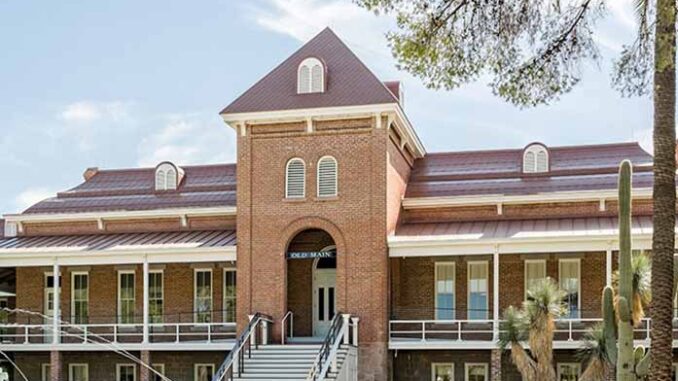
According to the Peace Corps, the University of Arizona (UArizona) ranked sixth in the top ten for institutions offering graduate degree financial aid for returned volunteers. UArizona had a total of 48 students enrolled.
UArizona’s ranking was determined by enrollment in the Paul D. Coverdell Fellows Program: an opportunity for Peace Corps volunteers to receive financial aid for a graduate degree, becoming Coverdell Fellows. Another perk includes the potential to obtain up to three years of an extended noncompetitive eligibility (NCE) status for federal employment, which Peace Corps volunteers normally enjoy for 12 months. NCE status ensures that returned Peace Corps volunteers are given an edge in the hiring process.
Eligible Peace Corps volunteers are those who complete a full two years of service, are given “completion of service” or “interrupted service” status, medically separated, or Response or Global Health Services Partnership Volunteers that complete 12 months of service in a 24-month period.
The other universities ranked in the top ten were as follows, in order: American University, University of Denver, Brandeis University, Middlebury Institute of International Studies, Emory University, John Hopkins University, Carnegie Mellon University, Duke University, and the Teachers College of Columbia University.
In a press release, Peace Corps Acting Director Carol Spahn explained that these universities put Coverdell Fellows on track to continue their volunteer service while obtaining higher education.
“We are grateful to partner with these universities to support our returned volunteers as they work toward their academic goals and continue their commitment to lifelong service,” said Spahn. “A graduate degree, in combination with the perspective and skills gained through Peace Corps service, enables returned volunteers to become and inspire our next generation of global leaders.”
UArizona also achieved a similar distinction last February at the onset of the COVID-19 pandemic, ranking 17 out of the top 20. Over 120 universities and colleges across 38 states accommodate Coverdell Fellows, totaling over 200 programs amounting to over 300 graduate and postgraduate degrees.
Corinne Murdock is a reporter for AZ Free News. Follow her latest on Twitter, or email tips to corinne@azfreenews.com.