Last October, the Arizona Department of Housing published a Notice of Funding Availability which resulted in more than 20 developers expressing interest in sharing $24.5 million which came available to help fund affordable housing projects.
Nine applications came in by the end of January for a total of nearly 1,200 units; all but two of the applications were for projects in Maricopa or Pima counties. One was for a project serving Yuma County, while the other is the long-awaited second phase of an affordable housing complex in Sierra Vista being developed by Walling Affordable Communities, LP.
Glenn and Mary Walling specialize in the development of affordable housing apartment projects across Arizona and have been involved in bring more than 1,500 residential units to the market utilizing tax credits. One of the projects was Casa Del Sol in Sierra Vista, where Mary Walling grew up.
Casa Del Sol – Phase One of the project brough 88 badly needed low income adult housing to the area, which is home to the U.S. Army’s Fort Huachuca. Planning for Phase Two began in 2019 with the use of Federal Low Income Housing Tax Credits as part of the funding mechanism.
But COVID-19 in 2020 and then uncontrolled price increases and labor challenges throughout 2021 put pressure on the company’s plans. Walling turned to the Arizona Department of Housing, which began offering a competitive State Low Income Housing Tax Credit program in further support of bringing as many affordable housing units to market as possible.
ADOH also made available the $24.5 million pool to help provide several projects with some gap financing to address the unrelenting surge in costs. In late February, the Wallings were told by ADOH that underwriting for the Casa Del Sol project could still take another 60 days.
But on March 31, ADOH told AZ Free News that underwriting was completed and the developer has received their award.
“We at the Arizona Department of Housing are proud to help fund this exciting project to bring much-needed affordable housing to Cochise County,” Sheree Bouchee – ADOH Rental Programs Administrator. “We are thrilled to collaborate in creating housing solutions for rural Arizona communities.”
It was welcome news for city officials in Sierra Vista, where there are currently only 503 affordable housing units despite the fact more than one-third of Cochise County’s 125,000 residents live in the area. The presence of Fort Huachuca and the city’s proximity a U.S. Border Patrol station near Bisbee has led local rents outpacing the ability of many non-government employees to afford local housing.
According to Sierra Vista spokesman Adam Curtis, the city staff worked with the Wallings to waive some fees and approve modifications to code requirements to help facilitate and incentivize the project. Those actions were consistent with strategies identified in the City’s voter-approved Vistas 2030 General Plan.
And with the site plan approved and a building permit already issued, city officials are looking forward the announcement of a ground-breaking ceremony.
“The second phase of Casa Del Sol will be a welcomed and much needed addition to our West End,” Community Development Director Matt McLachlan said. “The Wallings have a tremendous track record of building high quality affordable housing in our community and have been a great partner in advancing the City’s affordable housing goals.”
Tucson-based Tofel Dent Construction will serve as general contractor for Phase Two, which encompasses more than five dozen new units and a swimming pool to complement the existing recreation center. The hope now is for construction to begin in late summer with occupancy set for the end of 2023.
In the meantime, the Wallings are already moving forward with plans for Phase Three which could be ready for occupancy by the end of 2024.
News of ADOH’s assistance for the Casa Del Sol project is just one of the recent efforts across the state to address Arizona’s lack of affordable housing.
Last week the Maricopa County Board of Supervisors approved applying $17 million of American Rescue Plan Act (ARPA) funds toward adding more than 600 new units to the Valley’s affordable housing stock. Arizona Housing, Inc. will received $8 million of those funds to convert an existing hotel in central Phoenix into 50 permanent, supportive housing units.
In addition to the living spaces, the property will include on-site case management services to provide residents with employment assistance and social services options. Maricopa County says construction could begin yet this year with estimated completion in Summer 2023.
The remaining $9 million will support the construction of affordable rental projects in the West Valley and in central Phoenix. The Centerline on Glendale will go up at the southeast corner of 67th and Glendale Avenues. The 368-unit project by The Gorman Group will take place in two phases, starting with 186 units.
“It’s going to take awhile to get our inventory where it needs to be, but the addition of nearly 400 new rentals in the heart of Glendale is an example of how we can address our affordable housing shortage one investment and one partnership at a time,” said Maricopa County Supervisor Clint Hickman.
In downtown Phoenix, Ulysses Development is slated to construct a 192-unit affordable rental complex called Salt River Flats. It will be built near Broadway and 14th Street, with an expected opening in Spring 2024. All of the unit figures are estimates.
SB1211, which would require schools to publish curriculum lists on their websites, failed in the House 28-30 on Monday.
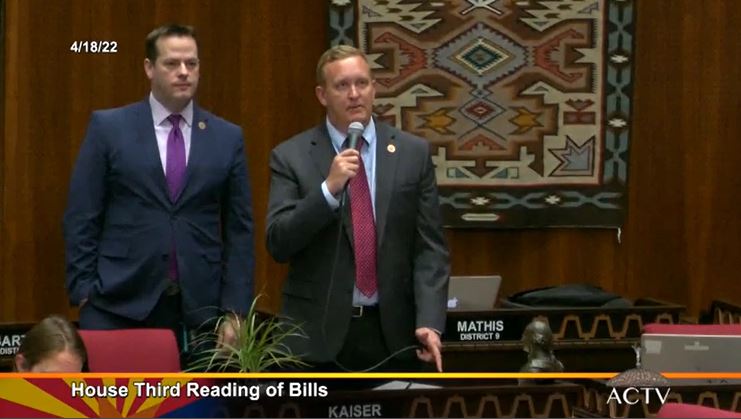
The votes weren’t panning out in the way Republicans hoped, so several legislators voted to kill the bill in order to salvage it for later discussions. State Representatives Joel John (R-Buckeye), Steve Kaiser (R-Phoenix), and Justin Wilmeth (R-Phoenix) voted with Democrats to kill the bill. Kaiser explained during the floor vote that he and Wilmeth did so in order to keep it active and open for discussion.
John, however, argued as a former teacher that the bill was too much of a burden for educators. He characterized the transparency bill as an “unfunded mandate” foisted on those in a “low-paying, thankless job.” John issued the false claim that he was only one of two other educators in the House. Other past and present educators include State Representatives Neal Carter (R-Queen Creek), Shawnna Bolick (R-Phoenix), Michelle Udall (R-Mesa), and Jennifer Pawlik (D-Chandler).
“The laws are quite robust already. I think this bill frankly goes too far and puts too many extra burdens [on teachers], as some of our colleagues have already pointed out,” said John.
Kaiser responded that the laws clearly don’t go far enough because K-12 schools are rampant with transparency issues.
“The reason we need to have a bill about this is because there’s problems happening in schools across Arizona,” said Kaiser. “If you don’t think this is a problem, look at the board [of votes]. This is a direct reflection of what’s happening to parents in schools. ‘There’s not a problem,’ they say. ‘Go home,’ they say. ‘We gave you a thumbnail sketch of what we’re talking about, go home.’ I’m so disappointed in how these votes are turning out.”
Apart from John, teacher perspectives on the bill differed along party lines.
Udall, a current teacher, supported the bill. She suggested that additional funding should be established to help ease the additional burdens of the bill. Udall noted the importance of proactive forms of transparency, rather than retroactive.
Conversely, Pawlik, also a teacher, asserted that educators shouldn’t have to be concerned about posting last-minute tweaks to curriculum or learning materials. Pawlik argued that it would not only inhibit teachers’ flexibility, but ultimately stunt students’ education.
The Senate passed the bill along party lines last month. Left-wing activist organizations celebrated the bill’s rejection.
We are so grateful for all lawmakers who voted today against SB1211, a harmful bill that would have created undue burden, more red tape and onerous requirements for our teachers. AZ teachers deserve support, not additional work, punishments & threats of lawsuits. pic.twitter.com/N38MXfp4my
SB1211 would enable parents access to all curriculum, learning materials, and teacher training at their school, organized by subject, grade, and teacher. Democratic legislators argued that parents should switch schools if they weren’t happy with the transparency at their current schools. They contended further that the legislation would create more red tape and punishment for educators. One legislator went so far as to argue that the bill constituted an effort to control speech.
For now, #SB1211 is stopped in the House. It would have been an unfunded mandate. It would have caused teachers to spend more time on red tape. ⛔ This bill is a sledge hammer that could have bad unintended consequences. #TeachersDeserveRespectpic.twitter.com/tUawQg5Mqb
If the Republican representatives hold to their promise, SB1211 may be resurrected this session in one form or another. As of press time, no exact solution was made apparent.
Corinne Murdock is a reporter for AZ Free News. Follow her latest on Twitter, or email tips to corinne@azfreenews.com.
On Monday, the Arizona Senate passed HB2161, a bill prohibiting state employees, political subdivisions, governmental entities, or any other institution from withholding a minor’s records from parents. Parents may sue any entity or institution that withholds their child’s records in violation of the legislation. It’s likely that HB2161 will most heavily impact school districts.
The bill passed along party lines. State Representative Steve Kaiser (R-Phoenix), the bill sponsor, explained that the legislation would ensure recourse for parents whose rights had been violated.
The bill was transmitted to the State House for review of the amendments made in the Senate. If approved, the version passed on Monday will head to Governor Doug Ducey for his signature.
Democrats’ opposition to the bill focused on the impact on educators. One of the main arguments concerned the fact that educators wouldn’t be able to withhold the sexuality or gender identity of LGBTQ+ minors from their parents.
Must see testimony against HB2161 and how deeply it will harm LGBTQ young people https://t.co/nlTUHIJAeT
— Arizona Senate Democrats (@AZSenateDems) March 16, 2022
Those arguments echo incidents making headlines nationally, in which parents discover that educators or school counselors coached their children into adopting a deviant sexuality or gender identity. Just this past week, it was discovered that a Massachusetts public middle school promoted the gender transitions of a pair of siblings without their parents’ knowledge.
After making waves for accusing a black DJ of blackface, Scottsdale Unified School District’s (SUSD) social justice professionals marched onward with their work. In the week following accusations from Scottsdale Parent Council (SPC) Equity, Diversity, and Inclusion Committee co-chair Jill Lassen and SUSD Equity and Inclusion Committee member Stuart Rhoden against a black DJ for alleged blackface and the school of racism for hiring him, SPC DEI Committee promoted a “Drag Queen Story Hour.”
Although SPC describes itself as an autonomous support organization for SUSD, it collects dues from SUSD parent and teacher groups annually: parent-teacher organizations (PTO), parent-teacher associations (PTA), and association of parents and teachers (APT).
As first reported by the Arizona Daily Independent, Lassen, a school librarian and self-described “community activist,” and Rhoden, an Arizona State University (ASU) professor, accused the Hopi Elementary PTA of racism at a charity earlier this month for hiring a DJ the pair believed to be wearing blackface. The DJ in question was Koko Kim Hunter, a black man. Hunter performed at a disco-themed charity event that raised over $300,000 for the elementary school.
Days later, the SPC Equity, Diversity, and Inclusion Committee promoted a young adult drag story hour. The event occurs next Tuesday at the One N Ten Chandler Satellite Center in Chandler at 6:30 pm.
Rhoden complained about the perceived blackface to both the elementary school PTA and principal. Both informed Rhoden that Hunter was black. However, that revelation didn’t stop Rhoden’s accusations. Rhoden doubled down. He insisted in a Facebook post that he never thought Hunter was a white man committing blackface, and that Hunter, though black, may have committed blackface still. Rhoden attached several photos of Hunter and encouraged readers to judge whether Hunter darkened his skin to look more black. He then accused the parents of “cultural disconnect.”
“Let me be clear, a Black man, apparently in Black face [sic] is an entirely different discussion than a White person. However I did not state that the person was White. It was assumed that was my intent, and perhaps it was, but nonetheless, looking on his Facebook page (photos below), it seems at the very least he is in darker make-up [sic] if not ‘Black face’ [sic] or I am completely mistaken and it’s the lighting of the patio,” wrote Rhoden. “I apologize to [Hunter] for the implication, but the sentiment still stands, Black face [sic] by anyone, in this day and age is problematic. I also apologize to folks who reposted and made other statements based on my assumption. The other images, some of which are still on his FB page, are problematic and speak to the cultural disconnect of the parents at this school. Rather than acknowledge that, they chose to double down on being angry at me rather than trying to understand how one could have made this error. And yes, it was my error.”
Lassen emailed the Hopi Elementary PTA leader, Megan Livengood, with accusations of racism. After Livengood responded with the facts of Hunter’s race and a rebuke of Lassen’s conduct, Lassen replied with an apology.
The accusations reflected Lassen and Rhoden’s perspectives on SUSD parents.
Lassen complained in a promotional video for the drag queen story hour that parents have the amount of influence they do over the district’s activities. In another promotional video, Lassen said that her focus as a parent and educator concerned safe spaces and gender stereotypes.
“I think it is much harder at the school level, as far as the parents having a lot of say and clout with the school district, unfortunately,” said Lassen. “What it means to me as a parent is to provide a safe and nurturing environment for my child to develop their identity as a human, and to always be aware and counterbalance the gender stereotypes that we continually run into as a society. As a librarian, it means providing a safe space for LGBTQ individuals to gather, to learn, and to overall be a part of their community.”
In a Facebook post, Lassen called parents upset about remote learning, “super rich, white ‘Karen’s’,” who she instructed to have “blow [her]” for having concerns about SUSD children’s mental and physical health. She added the explicit hashtag, “#F***MichelleUgentiRita” as an insult to the sitting state senator from Scottsdale.
“You don’t care about them until it’s convenient for you and you pretend to align yourselves with them because suddenly you have the same interests, but when all is said and done and your kids are back in school, you won’t think another thought about them or offer any kind of help or support to the districts or teachers,” wrote Lassen.
Rhoden offered similar sentiments about parents in an August 2020 Facebook post.
“I need a training on training myself to not get exasperated at parents who only care about themselves, who are selfish and who’s [sic] intentions are not socially just,” wrote Rhoden. “Sorry to put this so bluntly, but if another Karen/Becky or Ken ask [sic] one more question on a back to school Zoom call that is only germane to them, I’ma [sic] blow. We are all in this ish [sic] together. Be a team player!”
Currently, there’s a petition calling for the resignation of Lassen and Rhoden. The petition documents the various offenses committed under the oversight of Lassen and Rhoden: promotion of a Drag Queen Story Hour, praise of Planned Parenthood founder and infamous eugenicist Margaret Sanger, and the unfounded blackface accusation made against Hunter.
“One of the organizations that parents have noticed as being problematic is the subcommittee of the Scottsdale Parent Council that is Equity, Diversity and Inclusion. The name implies that kindness and compassion abound, but grievously, the opposite is true. The members of EDI consistently offend and confuse parents and community members with their controversial and divisive rhetoric.
Corinne Murdock is a reporter for AZ Free News. Follow her latest on Twitter, or email tips to corinne@azfreenews.com.
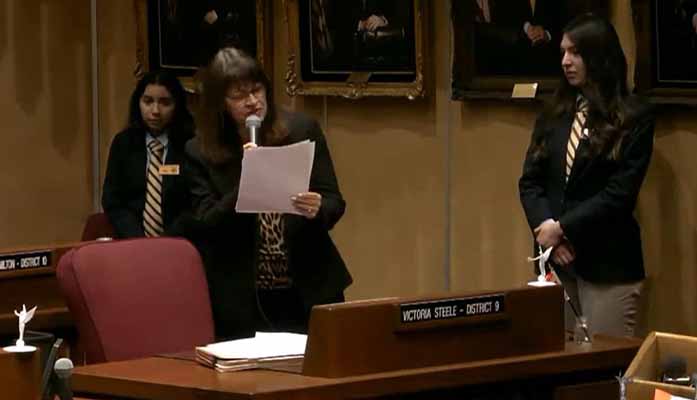
State Senator Victoria Steele (D-Tucson) treated legislators and constituents to poetry and music at the Arizona State Capitol on Wednesday. Steele felt compelled to do so after her fellow Tucson legislator, State Senator Vince Leach (R-Tucson), criticized Judge Ketanji Brown Jackson the day before for Jackson’s inability to define “woman” during her Supreme Court confirmation hearing. Steele considered Leach’s question to be “audacious” and in need of a response. Since it wasn’t feasible for Jackson to speak for herself, Steele stepped up to the plate.
With a giggle, Steele began to recite poet Maya Angelou’s poem, “Phenomenal Woman.” Then, she began to sing the 1971 hit “I Am Woman” by Helen Reddy, which she explained was offered “just in case there was any doubt” about her definition of a woman. Unlike the poem, Steele cut short her song to perform only the first verse and chorus.
“And that, my friend, is a woman,” concluded Steele.
According to the science, Steele’s remarks didn’t answer the question. A woman is an adult female human. A female human is determined by the two XX sex chromosomes that arise at the moment of fertilization. For males, that’s the XY sex chromosomes. According to the greater scope of nature, females have the ability of bearing offspring and/or producing eggs in ovaries. In the case of humans, females produce eggs and have the ability to carry and bear children after reaching sexual maturity.
It appears that Steele prepared a whole day to respond to Leach’s remarks on Tuesday. Leach said it was “troubling” that someone like Jackson was appointed to the highest court in the land.
“What is to be questioned is a system which puts to the bench of the United States Supreme Court someone that can’t answer a simple question: what is a woman?” said Leach.
During a confirmation hearing, Jackson was unable to answer a question from Senator Marsha Blackburn (R-TN) asking her to define the word “woman.” Jackson said she couldn’t answer because she wasn’t a biologist.
Corinne Murdock is a reporter for AZ Free News. Follow her latest on Twitter, or email tips to corinne@azfreenews.com.
Arizona Secretary of State and Democratic gubernatorial candidate Katie Hobbs offered a more definitive stance on abortion limitations last week. In short — none. Hobbs rejected the notion that the law must determine at what point abortions should be restricted. Rather, Hobbs insisted that such a decision should be left between the mother and doctor.
When pressed by AZFamily Political Editor Dennis Welch on where she drew the line, Hobbs reiterated that the decision wasn’t up to her but to each individual. That could mean up until the point of birth. Hobbs later tweeted that the right to unfettered abortion access was a mark of equality for women in society.
“Women deserve action to abortion care. Abortion is health care,” said Hobbs. “Abortion is a personal decision between a woman and her family and doctor. That’s something that needs to be discussed in the medical exam room, not by politicians.”
Not only is the new abortion ban an extreme assault on Arizonans’ reproductive freedom, it takes us a giant step backwards in our decades long fight for equality. pic.twitter.com/0XAFgYcYTx
Hobbs called the latest law banning abortions after 15 weeks a danger to women. Her arguments reflected her exact sentiments from when Governor Doug Ducey signed the abortion ban into law. Hobbs declared that limiting abortion was depriving women of their constitutional freedom.
“Today marks a giant step backward in the fight for equality for women across Arizona and across the country,” said Hobbs. “With Governor Ducey’s signature, our elected leaders have chosen to turn their backs on the overwhelming majority of Arizonans who support the constitutional right to choose. Make no mistake — stripping away women’s constitutional rights won’t stop women from seeking access to reproductive health care. But the passage of this misogynistic law clarifies the very real and dangerous consequences of electing leaders who are willing to throw away our rights and set us back a generation.”
Abortion up until birth would be consistent with Hobbs’ longstanding views on the subject of abortion. During her time as a state senator, Hobbs said that abortion didn’t equal infanticide and that “abortion” wasn’t a bad word.
According to Hobbs’ cumulative 2021 campaign finance report, she received hundreds from Planned Parenthood of Arizona leaders: $250 from lobbyist Jodi Liggett, $500 from president Bryan Howard, and $75 from their external affairs. Planned Parenthood of Arizona also endorsed Hobbs for her races in the state legislature and for secretary of state.
In a 2012 interview with Planned Parenthood for Arizona, Hobbs claimed that pregnancy was just as dangerous as abortion. She also advocated for the controversial curriculum of comprehensive sex education for K-12 schools.
If elected, Hobbs wouldn’t be the only official to oppose the law. The Democratic candidate for Maricopa County Attorney, Julie Gunnigle, pledged to not enforce Arizona’s ban on abortions after 15 weeks.
Corinne Murdock is a reporter for AZ Free News. Follow her latest on Twitter, or email tips to corinne@azfreenews.com.