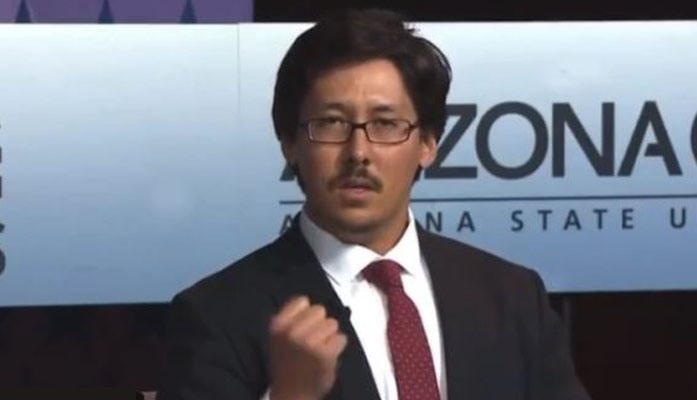
The Republican congressional candidate linked to QAnon’s origins claimed during a debate on Wednesday that the Keystone Pipeline caused Russia to invade Ukraine. The candidate, Ron Watkins, became famous for his controversial online persona offering 2020 election fraud claims and commentary.
“We wouldn’t even be in Ukraine if President Biden did not shut down the Keystone Pipeline on the first day. Because now that that’s shut down, we have to get our oil, and we’re getting our oil from Russia and we’re getting all these problems through the Ukraine and that would not have happened if Biden didn’t shut down the pipeline,” said Watkins. “We’ve got all of this oil coming from Russia to the United States and they wanted a better route to bring the oil through.”
The Arizona PBS segment “Arizona Horizon” hosted the debate featuring Watkins as well as State Representative Walt Blackman (R-Snowflake) and Andy Yates, a “40 Under 40” Phoenix businessman and community leader.
Watkins’ remarks were prompted by host Ted Simons’ question to candidates whether they supported foreign aid to Ukraine. All three candidates supported sending foreign aid to Ukraine. Watkins then claimed that the Keystone Pipeline caused the war.
In response, Blackman criticized Watkins for daring to run for the U.S. Congress with ignorance of the major geopolitical conflict in Ukraine. He then offered Watkins a summarized lesson on the ongoing war.
“You’re trying to work on a national stage and you don’t even know why the war started in Ukraine? It had nothing to do with the Keystone Pipeline. The Keystone Pipeline caused the inflation and the increase in our gas prices,” explained Blackman. “The reason why I went into Ukraine is because Russia wanted Ukraine as they had them pre-World War II and Ukraine wanted to be part of NATO.”
Watkins conceded without further debate.
“He’s right. I made a mistake,” responded Watkins.
One of the most embarrassing gaffes I’ve seen in a debate, ever.
In the GOP primary debate for #AZ02, Q-Anon adjacent activist Ron Watkins blames the invasion of Ukraine on … The Keystone XL Pipeline?
Viral social media posts characterized Watkins’ rhetoric as gaffe-ridden and ill-prepared. The criticism began with his introductory statements.
“If you send me to D.C., you will know that I will be fighting against this evil, and I will make sure we drive them back, and I will make sure that your rights are — are kept,” said Watkins.
Ron’s biggest mistake: thinking his ability to con Trump supporters into believing he was a secret agent would somehow carry over into the real world.
But Ron has the charisma you’d expect from a guy who collects samurai swords & spends all day on 8chan.pic.twitter.com/r2E2IYbWOY
Watkins, Blackman, and Yates are three in a crowded race to represent the second congressional district currently held by incumbent Congressman Tom O’Halleran (D-AZ-01).
In the Republican primary, they’re up against Eli Crane, a veteran and small business owner of “Shark Tank”-famous company Bottle Breacher; Mark Deluzio, a diversified businessman and active local GOP and community leader; Steven Krystofiak, a farmer and small business owner; and John Moore, the mayor of Williams.
Corinne Murdock is a reporter for AZ Free News. Follow her latest on Twitter, or email tips to corinne@azfreenews.com.
On Wednesday, Arizona became the first state to allow patients to access individualized treatments otherwise blocked by the FDA. The bill was dubbed the “Right to Try for Individualized Treatments,” an expansion of original Right to Try law allowing patients with life-threatening illnesses to undergo clinical trials of the treatments of their choosing.
Governor Doug Ducey signed the bill, SB1163, into law. The Phoenix-based Goldwater Institute, a conservative and libertarian public policy think tank, pioneered the original Right to Try law. That law also began in Arizona. It eventually received approval from Congress under former President Donald Trump.
Goldwater Institute President and CEO Victor Riches said that the new law ensured protections for a fundamental right: the right to save one’s own life.
“The right to try to save one’s own life is one of the most precious rights of all,” said Riches. “America doesn’t have to wait for the FDA to reform itself in order to put patients first. States can and should act now to protect all Americans’ fundamental right to try to save their own life.”
Goldwater Institute Executive Vice President Christina Sandefur said that the law provided new hope for Arizonans. Sandefur called the law “Right to Try 2.0.”
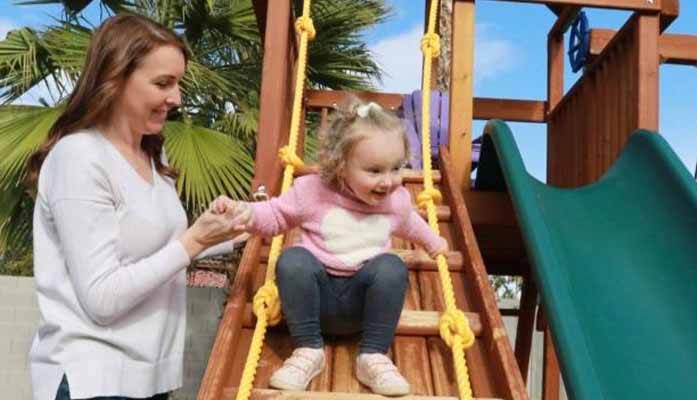
As AZ Free News reported, the bill was inspired by the Riley family in Phoenix. Two of their three daughters, Keira and Olivia, were born with metachromatic leukodystrophy: a sudden, fatal disease that attacks nerves in the brain and spinal cord. Due to FDA restrictions, the Rileys had to seek treatment outside of the country. They were forced to raise tens of thousands of dollars at the height of the pandemic in 2020 in order to relocate to Italy for the five months they needed to access treatment for Keira. The experimental gene therapy was their last hope to save her life.
Olivia couldn’t qualify for the treatment because she was already symptomatic. As of this report, she was transferred to hospice. The average life expectancy for metachromatic leukodystrophy patients is six years.
Kendra Riley, the girls’ mother, spoke with conservative radio host James T. Harris about the bill’s enactment. Riley said that the next step would be to have the rest of the nation pass similar laws.
“You think if your child has one chance in the entire world to live a normal life, we should be able to have access to it in America,” said Riley. “The medicine is there but bureaucracy and insurance shouldn’t be holding it back. Everyone should have the right to a chance at a normal life. I truly hope this helps everyone.”
As they were rallying support for the bill, Sandefur characterized current law as immoral.
“It is unconscionable that an American patient has to travel to another country to Europe in order to be able to get access to a treatment that could save their lives,” said Sandefur.
Corinne Murdock is a reporter for AZ Free News. Follow her latest on Twitter, or email tips to corinne@azfreenews.com.
The sentencing options for several felonies related to child sex abuse, human trafficking, and human smuggling will be significantly restricted in Arizona later this year when new legislation takes effect.
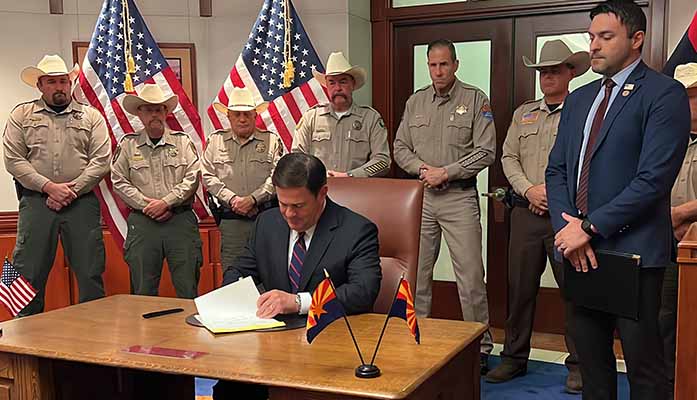
On Thursday, Rep. Leo Biasiucci celebrated the enactment of House Bill 2696 which reforms the state’s sentencing ranges for some of the most horrific crimes against children. It triples the length of prison sentences for some crimes against children under age 15 while prohibiting judges from placing someone on probation instead of in prison for other offenses, including human trafficking and human smuggling.
“I’m proud to have sponsored this important legislation to ensure that anyone convicted of these heinous crimes serves mandatory prison time with no chance of parole,”said Biasiucci, the House Republican Majority Whip. “Iappreciate the strong support of Governor Ducey and my fellow legislators. These new laws will combat these crimes and make Arizona safer for everyone.”
Under HB2696, the sentencing range for the continuous sexual abuse of a child under age 15 changes from 13 to 27 years to 39 to 81 years. And someone who has a prior felony involving various forms of child abuse would have a sentencing range of 69 to 111 years if later convicted of the continuous sexual abuse of someone under age 15.
Judges will also see new restrictions when sentencing a defendant convicted of luring a minor for sexual exploitation if the minor is under age 15, aggravated luring when the minor is under age 15, as well as sexual extortion. Such offenses will become prison mandatory and ineligible for probation, suspension of sentence, pardon, or most early releases from confinement.
Luring involves offering or soliciting sexual conduct with another person knowing or having reason to know that the other person is a minor, while aggravated luring involves the use of an electronic communication device “to transmit at least one visual depiction of material that is harmful to minors for the purpose of initiating or engaging in communication” which offers or solicits sexual conduct with a recipient the sender has reason to believe is a minor.
Although luring and aggravated luring often involve online predators, those crimes are also frequently committed by young adults and teens. In addition, the offense does not require an actual victim who is a minor. A conviction can be obtained on the basis of offers or communications with someone the person have reason to believe is under 15, even if that person is a peace officer.
But HB2696 also targets those involved in criminal activity involving human trafficking and human smuggling. Once effective, the new law will allow prosecutors in the state’s 15 counties as well as the Arizona Attorney General’s Office to charge someone who knowingly or intentionally gets involved in a human smuggling organization or operation.
The bill adds a provision to Arizona Revised Statute 13-2323A making it a crime for someone to knowingly assist a human smuggling organization or operation “by transporting a person, or procuring the transportation for a person” with the intent to conceal the person from a peace officer or to assist the person in fleeing from a peace officer “who is attempting to lawfully arrest or detain” that person.
Several law enforcement officials from across the state attended Thursday’s bill signing by Ducey. During the event, the governor made pointed comments about ongoing border crisis, while praising Biasiucci and the bill’s 32 bipartisan co-sponsors for ensuring anyone who aids illegal human smuggling organizations or operations will be held accountable.
“We’re taking another critical step to fill the void in leadership left by the federal government’s unwillingness to secure the border,” Ducey said. “We have seen a dramatic increase in human smuggling at the border since President Biden took office. I’m hopeful this new law will help to save lives and deter more migrants from making the dangerous journey to our border.”
Biasiucci’s bill was opposed by the Arizona Justice Project, the William E Morris Institute for Justice, and Arizona Attorneys for Criminal Justice. The sentencing requirements do not take effect until later this year and are not retroactive.
Nothing in HB2696 restricts the ability of a governor to commute a sentence in accordance with existing state law.
On Wednesday, the Arizona House approved a Senate bill to repeal the governor’s current executive powers in public health emergencies.
Instead, SB1009 would ensure governors only have the authority to issue a state of emergency for public health emergencies for 30 days. After that, the governor would be limited to extending that state of emergency for 30 days at a time with a limit of 120 days or about four months. Once that time is exhausted, the state legislature must consent to any new state of emergency.
The governor wouldn’t be able to extend the state of emergency more than once without additional reporting requirements. After 60 days of an emergency, the governor must submit a written report to a joint committee of the Senate and House health committees. That committee will assess the report along with a Arizona Department of Health Services briefing and publish a public review of the extension.
SB1009 also empowers the state legislature to extend the state of an emergency for public health emergencies as well. Those extensions would be limited to 30 days, too.
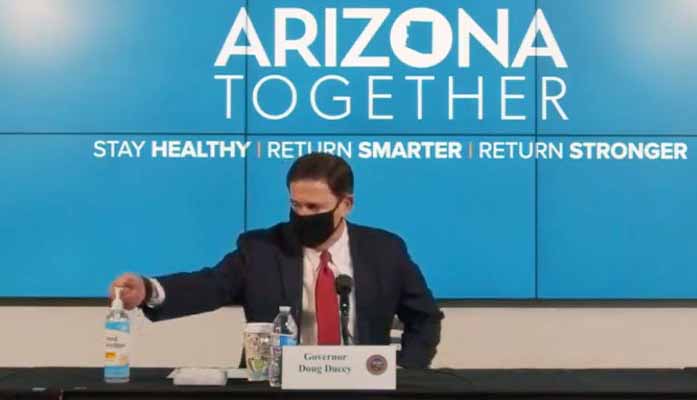
The bill passed along party lines. It now heads to Governor Doug Ducey for final approval.
Ducey only ended the COVID-19 state of emergency at the end of last month: well over two years after the initial state of emergency was issued.
This legislative session covered other changes to Arizona’s state of emergency protocol. Ducey signed HB2507 on Monday, ensuring that religious services would be considered essential during a state of emergency. Over the last two years, other state governments forced the closure of religious buildings and worship gatherings, punishing those who dared to defy their public health orders in order to exercise their religious freedoms.
Corinne Murdock is a reporter for AZ Free News. Follow her latest on Twitter, or email tips to corinne@azfreenews.com.
On Monday, the Arizona legislature approved a bill requiring K-12 schools to implement parental review and notification procedures for school library books.
Specifically, HB2439 requires schools to give parents lists of the books or materials their children borrowed from the library, make available online a list of all books purchased for school libraries, and notify parents of the public review period for the books. Certain schools and school districts were exempted: those without full-time library media specialists and those engaged in agreements with county free library districts, municipal libraries, nonprofit and public libraries, tribal libraries, private schools, and tribal schools.
The Arizona House passed edits made to HB2439 on Monday along a party line vote. The Senate passed their version with amendments last week. One of the major amendments to the bill removed the requirement that school boards review and approve all books prior to their addition to a school library.
State Representative Beverly Pingerelli (R-Peoria) sponsored the bill.
Activists argued that children should have the right to read anything without parental oversight.
On Tuesday, the Gilbert Town Council announced a $289,000 consulting contract for a feasibility study on establishing a commuter rail. The commuter rail, a mode of public transportation at the core of major metropolitan areas like Chicago and New York City, would likely be located somewhere within the Heritage district. The council moved to consider the contract during a later study session.
The proposal comes at a time when transit crime rates have reached an all-time high in areas where they have the most use such as New York City, San Francisco Bay Area, Philadelphia, and Los Angeles. Multiple studies link the presence of public transit such as light rail and commuter rail to an increase in crime and decrease in surrounding property values.
Vice Mayor Aimee Yentes asserted that the goal of the study wasn’t to establish feasibility, but rather to whip up something with “pretty pictures” that would distract from the facts behind commuter rail and inspire public support. Yentes accused Washington, D.C. lobbyists of pushing an agenda for financial gain at the loss of taxpayers and locals, mocking President Joe Biden’s “Build Back Better” campaign slogan as well.
“I think quite frankly we’re taking crazy pills if we think people are going to be excited about commuter rail,” said Yentes. “The complete boondoggle that this will be not just for this community, but for this state. We are literally observing California living this nightmare. I can’t point to a state that Amtrak is not being heavily and deeply subsidized by taxpayers despite 75 percent decline in their ridership. I can’t point to a state where we have a good model that makes any amount of sense for this. We’re going to put the foot on the pedal because we’ve got ‘Build Back Bankruptcy’ dollars that are going to be flooding the jurisdictions?”
Yentes also pointed out that all commuter rails require a local sales tax in addition to all the state subsidies and federal monies they receive. She predicted widespread community backlash.
“I think this is insane,” said Yentes. “I don’t think it’s a matter of timing. There is no good timing for broken 19th-century technology. I think this is a broken model and I think there’s a lot of buyer’s remorse in other states that have gone down this track.”
In addition to commuter rail, the transportation expansion would eventually become transit centers accommodating other types of transit: bus, bicycle, micromobility, and rideshare. Town research explained that such an initiative had been in the works since 1993.
Vice Mayor Aimee Yentes said she has “a lot of problems” with the proposed transit center, specifically the commuter rail, calling it “premature.” Yentes said that the scope of the project for stakeholder involvement wasn’t clear, and that the stakeholders’ work were oriented toward designing and planning rather than community outreach to assess desire and need.
Councilwoman Yung Koprowski insisted that the community at large was aware of the city’s intention to establish a commuter rail based on published documents made available to the community.
Yentes disagreed. She said it was one thing for these initiatives to be laid out in planning documents, but that the reality was the community weren’t involved in them. She said that only an “inner bubble” of the community kept an eye on planning documents.
“I think if I asked 100 of my neighbors if they know a commuter rail is coming to Gilbert, I think approximately zero of those people would be aware,” said Yentes.
Koprowski then clarified that this council decision would be the “first step” to get background and decide whether to move forward with the transit center.
Koprowski owns a transportation planning and civil engineering firm, Y2K Engineering.
Councilman Scott Anderson expressed doubts that the transit center would happen, citing Amtrak’s exclusion of Gilbert as a station location in previous reports and agreeing with Yentes that it was premature. Development Services Director Kyle Mieras revealed that Amtrak recently expressed support for a station location. He added that federal funds would be available to back the project.
“We wanted to show support for this and get ahead so if and when Amtrak or commuter rail does come forward, we’ve at least studied this and in a position where we’re going to come out ahead of it, so we’re skating to where the puck is going not where it’s been,” said Mieras.
Mayor Brigette Peterson added that the Amtrak southwest representative was shocked at Gilbert’s exclusion from viable locations. Peterson divulged that Phoenix Mayor Kate Gallego said that Gilbert was “way ahead” of their city when it came to establishing commuter rail, noting that the town had two areas open for stations, citing Cooley Station as an example.
“If Amtrak comes knocking with those federal dollars, is Gilbert on board to do that?” asked Peterson.
Koprowski noted that the feasibility study would offer some conclusion as to whether commuter rail was feasible and, if not, how the two potential areas could be repurposed. Yentes challenged the council to define its standard of feasibility.
Watch discussion of the transit center below:
Corinne Murdock is a reporter for AZ Free News. Follow her latest on Twitter, or email tips to corinne@azfreenews.com.