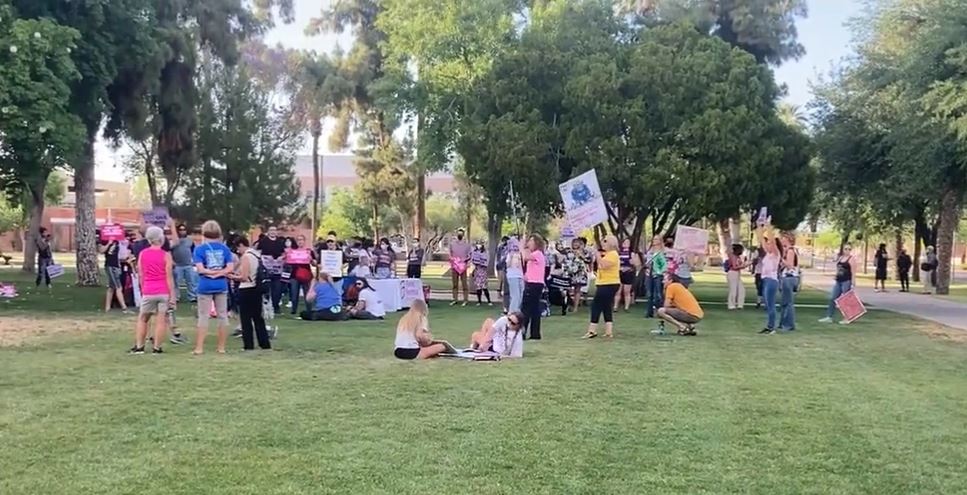
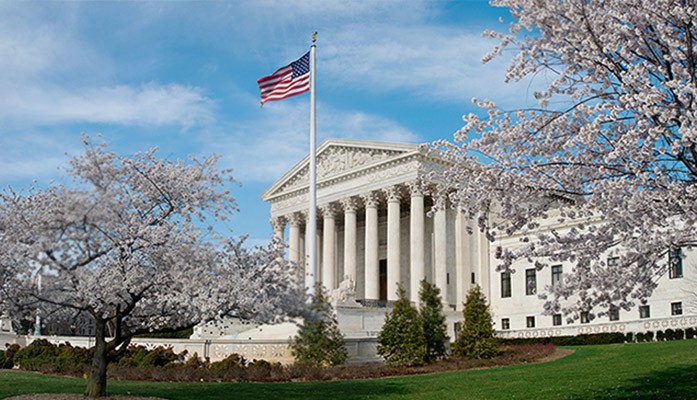
On Wednesday, less than a day after Politico leaked the Supreme Court draft opinion overturning abortion rights, abortion activists protested at the Arizona State Capitol.
Multiple attendees and reporters present estimated that thousands descended on the capitol.
HAPPENING NOW: ‘Ho Ho, Hey Hey, Roe V Wade is here to stay!’
Hundreds outside the Arizona State Capitol rallying for Abortion Rights.
Arizona Department of Public Safety reported that two men were arrested. One allegedly engaged in disorderly conduct, the other allegedly committed an assault.
If the Supreme Court maintains a ruling matching the leaked draft opinion, then Arizona would likely ban abortion completely.
From the time Arizona became a state to the Roe v. Wade ruling, Arizona outlawed abortion completely, excepting life-threatening pregnancies, and punished anyone who performed abortions with prison time. If the Supreme Court overturns the precedents established by Roe v. Wade and Casey v. Planned Parenthood, then the state may return to a total ban. The ban exists still within the Arizona Revised Statutes under Title 13, Chapter 36.
In March, Governor Doug Ducey signed a ban on abortions after 15 weeks’ gestation, SB1164. The law would go in effect 90 days after the current legislative session ends.
Elsewhere, pro-abortion protests turned into riots. In Los Angeles, California rioters attacked policemen and vandalized the city. In Portland, Oregon, riots incited by Antifa broke out.
Ahead of last night’s #Antifa riot in Portland over abortion, they gathered in front of the federal courthouse & created a mini autonomous zone with blockades. At night, they smashed up buildings, businesses & started fires. Video posted by @StanPulliam: pic.twitter.com/vrkG4u42W7
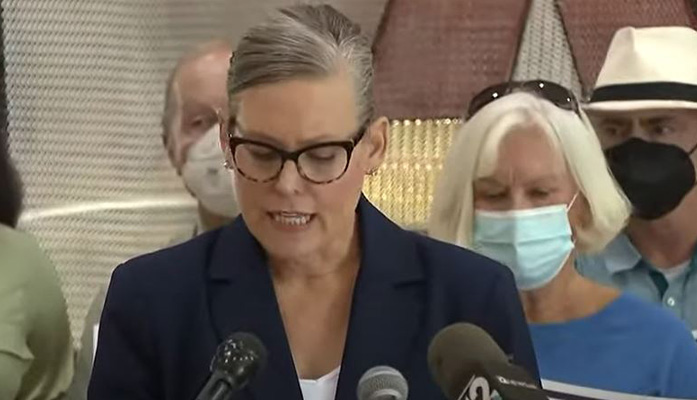
Secretary of State and gubernatorial candidate Katie Hobbs cursed out the country after the leaked Supreme Court draft opinion circulated on Monday night. She capitalized on the incident with a plug to fundraise for her campaign.
“F**k the patriarchy,” said Hobbs. “If you agree, help us defend the right to choose in Arizona.”
State Representative and congressional candidate Walt Blackman (R-Snowflake) criticized Hobbs as not being a serious individual in response.
You are not a serious person.
— Walt Blackman for Congress (@BlackmanForAZ) May 3, 2022
Politico published the leaked opinion on Monday night. Justice Samuel Alito authored the 98-page draft majority opinion, which dated back to February. Justices Clarence Thomas, Neil Gorsuch, Brett Kavanaugh, and Amy Coney Barrett signed onto the opinion.
Tuesday morning, Chief Justice John Roberts confirmed the authenticity of the draft. He ordered an investigation into the leak. Although much speculation abounded following the Politico report, no official suspects have been named.
Roberts assured the country that the leak wouldn’t influence the final ruling.
“To the extent this betrayal of the confidences of the Court was intended to undermine the integrity of our operations, it will not succeed. The work of the Court will not be affected in any way,” said Roberts.
JUST IN: The Supreme Court confirms the authenticity of the draft opinion revealed last night by Politico. The chief justice has ordered an investigation into the leak. pic.twitter.com/XZweHdyhCG
While Arizona’s Republican elected officials acknowledged the draft opinion’s content, their greater focus was on the individual responsible for the leak. Arizona’s Democratic elected officials, however, focused on their disagreement with the opinion. They didn’t address the alleged impropriety of the leak — some appeared to even justify it.
Congressman Andy Biggs (R-AZ-05) said that while he agreed with the ruling, he disapproved of the leak and speculated that someone with pro-abortion views was responsible. Congressman Paul Gosar (R-AZ-04) concurred.
The leaked SCOTUS draft was likely from a far left law clerk who is trying to derail the final decision by creating mass outrage, hoping to scare a Justice to change his or her mind.
Congressman Ruben Gallego (D-AZ-07) argued that the bigger issue at hand wasn’t the fact that someone compromised the process of the highest court in the land by leaking sensitive documents unintended for public consumption. Rather, he argued that the bigger issue was how SCOTUSblog, the independent media blog offering Supreme Court reporting, engaged in “inside ball bulls**t.”
Making women second class citizens I think is a graver sin than your inside ball bullshit. https://t.co/7AaRtS6k1c
Congresswoman Ann Kirkpatrick (D-AZ-02) argued that the draft opinion didn’t reflect the American people’s will. One of the first arguments in the majority draft opinion asserted that both Roe v. Wade and Casey v. Planned Parenthood weren’t based on legal rationale. Rather, Alito wrote that both rulings contained arbitrary, legislation-like rules.
There’s been a lot of horrific long-term damaging news over the past several years, none have hit me like this.
We must vocalize our dissent. This is not the will of the American people. https://t.co/DNjYlpfQza
— Rep. Ann Kirkpatrick (@RepKirkpatrick) May 3, 2022
Both of Arizona’s Democratic Senators Kyrsten Sinema and Mark Kelly didn’t address the leak, just their disagreement with the draft majority opinion.
Vice President Kamala Harris accused the Supreme Court justices of “want[ing] to punish women” by “tak[ing] away their rights to make decisions about their own bodies.” Harris claimed that the ruling threatened the “right to privacy” — a concept not enumerated within the Constitution but contrived in the 1890s by Supreme Court Justice Louis Brandeis.
President Joe Biden pledged to push for legalized abortion on demand legislation, should the draft opinion become the final ruling.
The leak inspired pro-abortion and pro-life activists to turn up at the courthouse.
Amid the worsening inflation crisis, the Republican-led Arizona House is proposing to give the University of Arizona (UArizona) a $30 million grant, effectively funding a partnership with an Israeli company to study drip irrigation.
The bill, SB1564, originally had nothing to do with a grant study. It changed completely through a strike-everything amendment after receiving unanimous support in the Senate. State Representative Tim Dunn (R-Yuma) introduced the amendment; Dunn serves as a member of the House Natural Resources, Energy, & Water Committee.
The current version of the bill would establish the “On-Farm Irrigation Efficiency Pilot Program” for UArizona to study how to reduce farms’ water usage and either minimize or eliminate the use of flood irrigation. UArizona partners with N-Drip for irrigation studies, an Israeli company that created an irrigation system using gravity rather than pumps or filters for water flow. N-Drip wasn’t mentioned in the bill.
N-Drip also partners with the Central Arizona Project (CAP) to cover installation costs for demonstrative projects.
N-Drip enlisted two veteran lobbyists to advocate for the bill: Wendy Briggs and Jeff Sandquist of Veridus. UArizona also sent their lobbyist, Sabrina Vazquez.
Data from the Arizona Department of Water Resources (ADWR) noted that irrigated agriculture uses about 74 percent of Arizona’s water supply.
The bill has received near-unanimous support in the House thus far. It’s on track to be voted on by the entire House soon.
Critics took to Twitter, saying that the grant was ironic given the fact that cost of living has skyrocketed for Arizonans.
Folks can’t afford groceries, gas, rent, tuition but looks like @AZHouseGOP@AZSenateGOP are fast tracking a $30Million taxpayer grant for a “study” on drip irrigation for an Israeli company via #UofA Really? #SB1564 N Drip 💦 pic.twitter.com/RWaIPDsOFk
The legislation would parce out the grant over three years, coming out at $10 million a year.
Sun Devil legislator supporting the Wild Cats at the Arizona Capitol with President Dr Robbins.
This year I supported #sb1564 which gives UofA $30 million over 3 years to create pilot program to incentivize the transition from flood irrigation to more efficient irrigation ways. pic.twitter.com/BOcoponSzq
On Monday, the Arizona House approved the Senate bill appropriating $400 million to widen the I-10 highway between Chandler and Casa Grande.
SB1239 enables the funds to not only be used for construction, but for obtaining federal funds to match the state funds.
The Biden administration has already allocated funds to the I-10 under the president’s infrastructure initiative.
Today the House overwhelmingly passed SB1239, committing $400 million to join with federal infrastructure funds (thanks President Biden!) to widen I-10 near Casa Grande. Leader @reginaldbolding explains the importance of infrastructure investment. #azlegpic.twitter.com/BapBVF0TQa
— Arizona House Democrats (@AZHouseDems) May 2, 2022
The I-10 is the fourth-largest national highway in the country, connecting the southernmost states from coast to coast.
State Senator T.J. Shope (R-Coolidge) sponsored the bill.
By a vote of 55-1, the AZ House of Reps has passed my SB1239 (Appropriation; Widening; I-10). It’ll be transmitted to Gov @DougDucey this afternoon. We will finally have a widened I-10 between Casa Grande & Phoenix! I will have a more formal statement on this later today. #AZLegpic.twitter.com/qiJQxNHwNm
The House and Senate passed it almost unanimously. Only State Senator Michelle Ugenti-Rita (R-Scottsdale) and State Representative Jacqueline Parker (R-Mesa) voted against it.
Ugenti-Rita insisted that the funding wasn’t a wise move fiscally.
“Thank you, Joe Biden”….that is something I will never agree with.
Voting on appropriation bills outside of the budget process is not how you craft a conservative and fiscally responsible budget.
Cities and other government entities which allow their flagpoles to be used by community groups and private organizations cannot prohibit the hoisting of religious-themed flags based on the religious messaging, a unanimous U.S. Supreme Court ruled Monday.
Justice Stephen Breyer authored the main opinion in Shurtleff v City of Boston, holding that the city would not have engaged in the endorsement or support of religion by simply allowing a religious flag to be flown from one of the three flagpoles often used for special events at Boston City Hall.
The case stems from a resident’s request in 2017 to fly a “Christian flag” during a public event at city hall to celebrate “the civic and social contributions of the Christian community” in Boston. City officials denied the request, citing concerns that allowing the flag would be a violation of the Establishment Clause of the First Amendment, which prohibits the enactment of any law “respecting an establishment of religion.”
However, none of the prior 50 or so flagpole requests being denied. And that, according to Breyer’s opinion, put the City of Boston on the wrong side of another provision of the First Amendment – the Free Speech Clause which states governments shall make no law respecting the establishment or free exercise of religion, or abridging the freedom of speech.
“The boundary between government speech and private expression can blur when, as here, a government invites the people to participate in a program,” Breyer wrote, adding that on balance, the Court concluded “Boston did not make the raising and flying of private groups’ flags a form of government speech.”
This meant, Breyer noted, that Boston’s refusal to allow a Christian flag to fly during a special public event abridged the requestors’ Constitutional right of freedom of speech.
According to Breyer’s opinion, there could be times when flying a non-governmental flag could convey a governmental message. Which is why it is necessary to undertake a “holistic inquiry” of the circumstances involved in, he wrote. Such an inquiry in this case, Breyer noted, shows city officials policy allowing third-party flag raisings makes the message private, non-government speech.
And when the government does not speak for itself, it may not exclude private speech based on the “religious viewpoint” of that speech.
Justices Clarence Thomas, Neil Gorsuch, and Samuel Alito agreed Boston officials violated the First Amendment’s freedom of speech by rejecting the Christian flag, but came to that decision using different legal reasoning than Breyer.
Alito, in a concurring judgment, felt Breyer’s review process was overly complicated. The only question to be asked, Alito wrote, is whether the flag represented the city’s speech.
“The ultimate question is whether the government is actually expressing its own views or the real speaker is a private party and the government is surreptitiously engaged in the ‘regulation of private speech,’” Alito wrote.
And in his own concurring judgment, Gorsuch placed blame on a 1971 SCOTUS decision Lemon v. Kurtzman for Boston’s uncertainty with the competing interests of the Free Speech Clause and the Establishment Clause. According to Gorsuch, Lemon “produced only chaos” for years before eventually being abandoned by the Court.
“Our Constitution was not designed to erase religion from American life; it was designed to ensure ‘respect and tolerance,’” Gorsuch wrote, quoting in part a 2019 SCOTUS opinion. “To justify a policy that discriminated against religion, Boston sought to drag Lemon once more from its grave. It was a strategy as risky as it was unsound.”
Justice Brett Kavanaugh authored a short concurring opinion, pointing out the Boston dispute arose because city officials did not understand the Establishment Clause.” He noted that SCOTUS “has repeatedly made clear” that a government does not violate the Establishment Clause merely by treating religious persons, organizations, and speech equally with secular persons, organizations, and speech.
“Under the Constitution, a government may not treat religious persons, religious organizations, or religious speech as second-class,” Kavanaugh wrote.
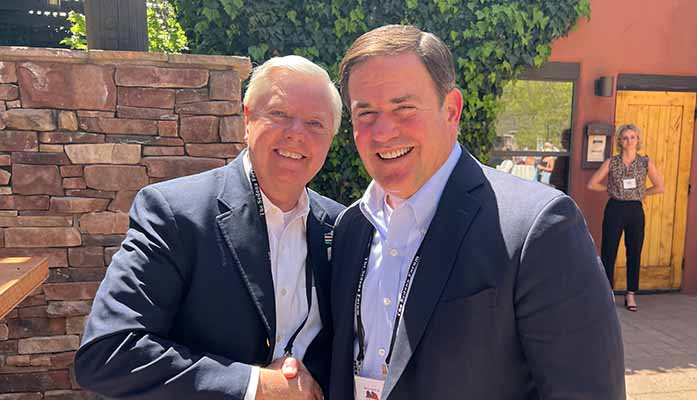
Over the weekend, leaders from across the world convened in Sedona for an annual event dedicated to collectively solving global issues: the McCain Institute’s Sedona Forum. Among them was Governor Doug Ducey.
A recap of the event focused on the word “democracy.” Featured speakers insisted on white supremacy’s hold on U.S. institutions, argued that the significance of 9/11 ended with January 6, lamented distrust in mainstream media, and proposed tactics for increasing aggression against Russia for invading Ukraine.
While at the event, Ducey published a series of tweets declaring that Russia was attacking democracy and freedom by invading Ukraine. He commended the late senator, John McCain, for warning Americans about Russia and Vladimir Putin. Ducey didn’t mention NATO’s role in instigating the war. However, he did post a candid photo of his conversation with former NATO and Ukraine ambassador Kurt Volker.
Though Volker only served as NATO ambassador for one year, 2008 to 2009, he worked on NATO-related assignments beginning in 1998. Volker’s U.S.-Ukraine Business Council (USUBC) Ambassador position incited controversy due to former President Donald Trump’s investigatory attempts into President Joe Biden and Hunter Biden’s business dealings in China and Ukraine.
Volker helped create Arizona State University’s (ASU) Ukrainian campus, American University Kyiv, which stalled at the end of February due to the Russian invasion.
Senator McCain had been sounding the alarm about Russia and Putin. Russia’s unprovoked attack on Ukraine is an attack on democracy and freedom. Arizona stands with the men and women of Ukraine putting up an incredible fight – from President Zelensky to everyday citizens. 2/
ASU President Michael Crow was also in attendance at the Sedona Forum. He co-hosted a panel with Congressman Adam Kinzinger (R-IL-16) and The New Yorker writer Sue Halpern to discuss cybersecurity.
Senator Mark Kelly (D-AZ) was also present at the Sedona Forum.
I'm excited to be opening the @McCainInstitute’s Sedona Forum on strategic competition, a topic where we miss Senator McCain’s voice and leadership as much as ever.
The event had moderators and reporter coverage provided by its “media partner,” The Washington Post — the very publication that doxxed the woman behind “Libs of TikTok,” the popular social media account relied on by parents and politicians for showcasing leftist ideologies and political trends.