Attorney General Mark Brnovich won’t challenge or appeal the pending ruling in the Arizona Republican Party’s (AZGOP) lawsuit to declare no-excuse, mail-in voting as unconstitutional.
Solicitor General Brunn (Beau) Roysden pledged in a court filing to honor the ruling, whatever that may be. The AZGOP filed with the Mohave County Superior Court last Tuesday after the Arizona Supreme Court denied jurisdiction to the AZGOP. The AZGOP then refiled their case with the Superior Court earlier this month.
“[The State of Arizona] agrees to be bound by the outcome of this litigation, including any appeals, with respect to the declaratory and injunctive relief requested,” stated Roysden.
17 defendants were named in the lawsuit: all 15 county recorders, the State of Arizona, Secretary of State Katie Hobbs.
🚨ALERT: The Arizona Republican Party filed a second lawsuit to end the state’s 30-year long no-excuse mail-in voting system, claiming that it violates the state constitution. Their first lawsuit on the same issue was dismissed by the AZ Supreme Court. https://t.co/yb80UcmmN1
— Democracy Docket (@DemocracyDocket) May 18, 2022
In their initial complaint totaling nearly 60 pages, the AZGOP claimed that Hobbs prevented enforcement mechanisms for valid signature verification by not adding those procedures to the Election Procedures Manual (EPM). Additionally, the party claimed that Hobbs lacked legal authority to implement drop box voting.
The AZGOP insisted that Hobbs’ actions were only possible due to a “longstanding deviation” from election procedures outlined in the Arizona Constitution. According to the party, Arizona’s no-excuse, mail-in voting system violates the constitution because several provisions direct voting to take place at the polls.
“Stated simply, Arizona’s ‘early voting’ statutes — which provide for the ‘absentee’ or ‘no-excuse mail-in’ voting — violate the Arizona Constitution, in whole or in part,” claimed the lawsuit. “[I]n-person voting at the polls on a fixed date is the only constitutionally permissible manner of voting.”
The AZGOP requested that the judge compel Hobbs to include the signature verification guide in the EPM, remove mentions of the drop box in the EPM, and cease enforcement of absentee voting laws.
However, should the courts decide that no-excuse, mail-in voting doesn’t violate the state constitution, the AZGOP requested a definitive explanation as to how the constitution permits absentee voting.
Corinne Murdock is a reporter for AZ Free News. Follow her latest on Twitter, or email tips to corinne@azfreenews.com.
Northern Arizona University (NAU) students will have to take a 12-credit general studies program focused on diversity. Following initial reports on their plans, NAU hid the DCCC page behind a university login page. (Archived link here). In doing so, they also blocked access to links leading to the DCCC meeting dates, agendas, and minutes; diversity requirements; how individuals could propose a “Diversity Designation” course; and an outline of their curriculum creation and review processes.
The Arizona Board of Regents (ABOR) approved NAU’s new diversity program last October.
It appears that NAU shielded the DCCC website from the public eye after City Journal reported about the new diversity curriculum. A web cache of the page taken on May 14 allows individuals to see the DCCC website, not an NAU login page. City Journal issued their report on May 24, offering an in-depth assessment on how NAU’s aim for the program was to only include critical theory’s definition of diversity.
NAU also removed DCCC’s notes (archived here) from last September that acknowledged how the level of ambition the undertaking demands. Yet, the DCCC projected that it would cause NAU to take the lead on their competition.
“The 12 credits of diversity requirements are unprecedented and puts [sic] NAU at the forefront of higher education,” read the notes.
"The celebration of diversity helps accelerate our progress toward a more perfect union. I am more optimistic than ever of the potential of our university and the values and support of our community. Happy Juneteenth!" –@naupresidentpic.twitter.com/w8GKrwzTIK
The initiative is the latest from the Diversity Curriculum Committee (DCC) formed by NAU’s Faculty Senate. The committee declared in their proposal that NAU is lacking in diversity requirements. (Archived link here).
The DCC explained that students will be required to take three credits in each of the following areas: U.S. Ethnic Diversity, Global Diversity, Indigenous Peoples, and Intersectionality. Within those areas, there will be focuses catered to the arts and humanities, scientific literacy and methods, and social and political worlds.
More won’t just be required of the students; the DCC proposed that NAU hire a director for the new diversity program; increase hires in Ethnic Studies, Applied Indigenous Studies, and Women’s and Gender Studies; establish retention mechanisms for faculty engaged in “diversity objectives;” create a faculty learning community focused on diversity; create a faculty professional development program on diversity curriculum; hire a Chief Diversity Officer; ensure course releases or other compensation for female and minority faculty; require faculty to engage in more diversity work and challenges; and establish a Diversity, Equity, and Inclusion program within each college in NAU.
NAU plans to initiate a soft launch of their revamped diversity program this fall, with a full launch in fall 2023.
Corinne Murdock is a reporter for AZ Free News. Follow her latest on Twitter, or email tips to corinne@azfreenews.com.
On Monday, Attorney General Mark Brnovich issued a warning about cartels recruiting Arizona teens to traffic illegal immigrants across border.
The cartels recruit teenagers through social media ads. They promise to pay up to $2,000 for each illegal immigrant passenger they transport in vehicles, nicknamed “load cars,” to either Tucson or Phoenix.
Brnovich noted that his office has partnered with local, state, and federal agencies to prevent human smuggling in a task force known as “Operation Safe Streets.” At present, their task force averages two to ten load cars stopped a day.
Additionally, Brnovich reported thousands of smugglers coming to the border.
Load car drivers may face a slew of charges including kidnapping and unlawful fleeing.
In March, the youngest load car driver to date was arrested in Cochise County. The 14-year-old had two illegal immigrants in his car.
Earlier this month, Governor Doug Ducey petitioned the major social media companies — Twitter, Snap, Facebook, and Tik Tok — to take down “load driver” posts.
“Inaction only enables cartels to victimize countless youths and families,” wrote Ducey. “Just as your companies work to protect youth from obscenity and violence on your social media platforms, it’s time to protect them from criminal solicitation as well.”
It doesn’t appear the social media giants have taken action.
Corinne Murdock is a reporter for AZ Free News. Follow her latest on Twitter, or email tips to corinne@azfreenews.com.
A new and innovative tuition-free charter school in Mesa will grant high school students trade certifications along with their diplomas.
American Leadership Academy (ALA) Applied Technologies will offer students the opportunity to earn certifications in automotive technologies, aviation technologies, business and finance, construction technologies, cosmetology, education, first responders, health services, hospitality, or general technology. Each of the 10 programs will have its own lab, workshop, kitchen, or salon to accomplish industry training.
All their trade programs begin junior year, with the exception of Aviation Mechanics and Cosmetology due to certification hour requirements. Transportation to school won’t be provided. ALA estimated that each grade level would have 600 students, or 60 per grade level in each program.
In a recent promotional video, ALA featured one alumna and its emergency medical services (EMS) program.
ALA operates 12 other schools across the valley: nine K-6 schools, and three schools covering the 7th through 12th grades. They are all A-rated schools. The academy operates around the acronym “R.A.I.S.E.” meaning respect, accountability, integrity, service, and classroom; it also aims to instill a “moral and wholesome environment” for students.
According to their latest construction update from last week, the new school has entered its final stages of the building process.
Registration remained open as of press time.
Corinne Murdock is a reporter for AZ Free News. Follow her latest on Twitter, or email tips to corinne@azfreenews.com.
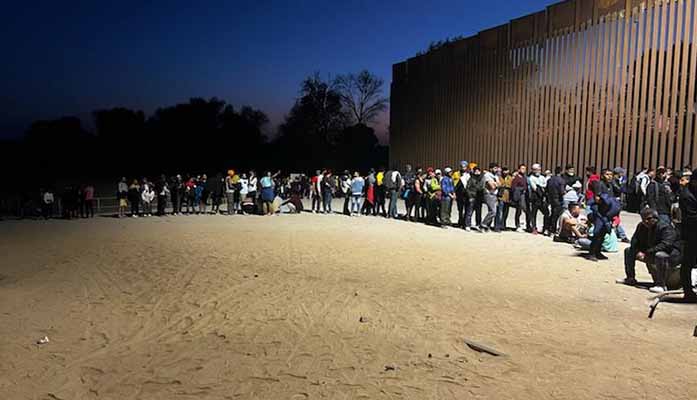
On Wednesday, the entire Republican caucus of the House submitted a legislative proclamation on the floor denouncing the current state of the border under President Joe Biden.
State Representative Gail Griffin (R-Hereford) sponsored the legislation. All 31 Republicans signed onto it.
The GOP proclamation cited the fact that 1.7 million illegal immigrants accounted for a nearly 380 percent increase in border crossings compared to the previous fiscal year. It also noted the spike in drug trafficking: 10,000 pounds of fentanyl, 180,000 pounds of methamphetamine, 86,000 pounds of cocaine, 5,000 pounds of heroin, and 311,000 pounds of marijuana. That’s in conjunction with thousands of violent crimes committed.
Arizona House Republicans Call for Securing the Southern Border, Keeping Communities Safe.
— Arizona House Republicans (@AZHouseGOP) May 25, 2022
The proclamation also touched on a newer trend: cartels recruiting teenagers via social media to be human smugglers for about $1,500 to $2,000 per illegal immigrant, nicknaming the vehicles “load cars” and the teens “load-car drivers.”
I joined my colleagues in denouncing this administration for its failure by allowing the humanitarian, human trafficking, and drug crisis to continue at our southern border. Arizona communities are becoming more unsafe as resources are being depleted by the gross incompetency/ pic.twitter.com/FIUThseekf
— Walt Blackman for Congress (@BlackmanForAZ) May 26, 2022
The proclamation is reproduced below, in full:
Whereas, the United States-Mexico border consists of 1,954 miles of varied terrain, including deserts, rugged mountainous areas, forests and coastal areas; and
Whereas, officially established in 1924 by an act of Congress in response to increasing illegal immigration, the United States Border Patrol has primary responsibility for securing the border between ports of entry; and Whereas, Border Patrol agents patrol international land borders and waterways to detect and prevent the illegal trafficking of people, narcotics and contraband into the United States; and
Whereas, on March 7, 2022, the Western States Sheriffs’ Association unanimously passed Resolution 22-1, which outlines the alarming issues facing our nation due to the unchecked illegal immigration crises at our southern border; and
Whereas, the southern border of the United States is currently experiencing an unprecedented number of people attempting to enter the country illegally, with the past fiscal year seeing a 379% increase of border encounters as compared to the previous fiscal year. These 1.7 million individuals represent 164 countries, including countries with suspected terrorist ties, and 63% of them are from countries other than Mexico; and
Whereas, there has likewise been a major increase in apprehensions, expulsions and “getaways” on the southwest border, with one million encounters and 300,000 getaways between October 1, 2021, and April 11, 2022; and
Whereas, in the past fiscal year, the number of illegal drugs seized has skyrocketed, including 10,000 pounds of fentanyl, 180,000 pounds of methamphetamine, 86,000 pounds of cocaine, 5,000 pounds of heroin and 311,000 pounds of marijuana. Likewise, criminal activity has soared, with law enforcement documenting 60 homicides, 1,178 assaults, 2,138 drug-related or drug trafficking arrests, 825 burglaries, 1,629 DUIs, 336 weapons arrests and 488 sexual assaults; and
Whereas, in a new effort to boost their operations, criminal cartels are using social media platforms as a recruiting tool for human smuggling. Drivers are lured by social media posts promising payment of $1,500 to $2,000 for every migrant a person can transport by vehicle to Tucson or Phoenix. Known as “load-car drivers,” these individuals are mainly young people, some as young as fourteen years old, who are enticed to pick up undocumented migrants at the border and ferry them to their destinations in exchange for money. Arizona Governor Doug Ducey has called on four social media giants to better monitor their platforms and ban these recruitment posts on their sites; and
Whereas, for individuals who are smuggled into the United States by Mexican and South American cartels, their arrival marks the beginning of years of drug distribution, modern-day slavery and sex trafficking to pay back the criminal cartels to which they are indebted; and
Whereas, an estimated 8% of the 1.7 million encounters last fiscal year were unaccompanied minors; and
Whereas, tragically, the prior year saw 162 migrant deaths in Southern Arizona; and
Whereas, an uncontrolled border is a security and humanitarian crisis, and the increased violence and the smuggling of illegal drugs, weapons and human beings poses a direct threat to our communities and innocent Americans; and
Whereas, the current administration has halted construction of a southern border wall, and there are numerous unfinished sections in Arizona; and
Whereas, this administration is not working collaboratively or in good faith with local law enforcement agencies and other state leaders to address the serious issues related to the border; and
Whereas, in April 2021, Arizona Governor Doug Ducey declared a state of emergency at Arizona’s southern border; and
Whereas, in February 2022, Arizona Attorney General Mark Brnovich issued a legal opinion determining that the current crisis at Arizona’s southern border with the violence and lawlessness of cartels and gangs legally qualifies as an “invasion” under the United States Constitution.
Therefore, Representative Gail Griffin and the following members of the House of Representatives of the State of Arizona denounce the continued breach of our nation’s southern border and support safe communities, immediate, decisive action to secure the border and alleviate the security and humanitarian crises associated with illegal immigration.
Corinne Murdock is a reporter for AZ Free News. Follow her latest on Twitter, or email tips to corinne@azfreenews.com.
Arizona state law now prohibits government properties from requiring masks, with the exception of areas with workplace safety and infection control measures unrelated to COVID-19.
Governor Doug Ducey signed the bill, HB2453, last Friday. Its sponsor, State Representative Neal Carter (R-Queen Creek) declared in a subsequent press release that mask-wearing shouldn’t be a prerequisite for accessing the government.
“Citizens should not be required to wear a mask to access government services,” said Carter. “This law prevents policy setting by unelected bureaucrats which, in my own experience, led to the public being denied entry to some county buildings that continued to impose mask requirements long after such mandates had been widely dispensed with or prohibited around the state.”
Opponents of the bill, like the Arizona House Democratic Caucus, insisted that an outright ban on mask mandates contradicted scientific knowledge.
The last two bills HB2453 — preventing government buildings from requiring masks: and HB2616 — parental consent for masks for minors (that’s given when they send their kid to school with a mask), brought to you by the fine folks at #COVID19. Opposed by the fine folks at #Science.
Proponents of the bill argued that masks were a choice derived from personal liberty.
The House just passed Rep. Neal Carter’s bill HB2453 to prevent government entities from imposing mask mandates. A win for personal liberty.#EndTheMandatespic.twitter.com/jdSvyLHtkq