On Wednesday, Maricopa County will open the first 10 of 211 vote centers for the upcoming primary election; in all, double the number operating during the 2020 election. Five of those locations will only serve as vote centers on certain days — otherwise, they’ll only house drop boxes.
Vote centers allow voters to cast ballots at any location rather than an assigned precinct, leading them to be referred to as “vote anywhere” locations.
We'll have over 120 additional voting locations from August 2020. All of them will be "vote anywhere" vote centers. Early voting 27 days before Election Day. We have vote by mail. We have special election boards.
— Stephen Richer—Maricopa Cnty Recorder (prsnl acct) (@stephen_richer) June 2, 2022
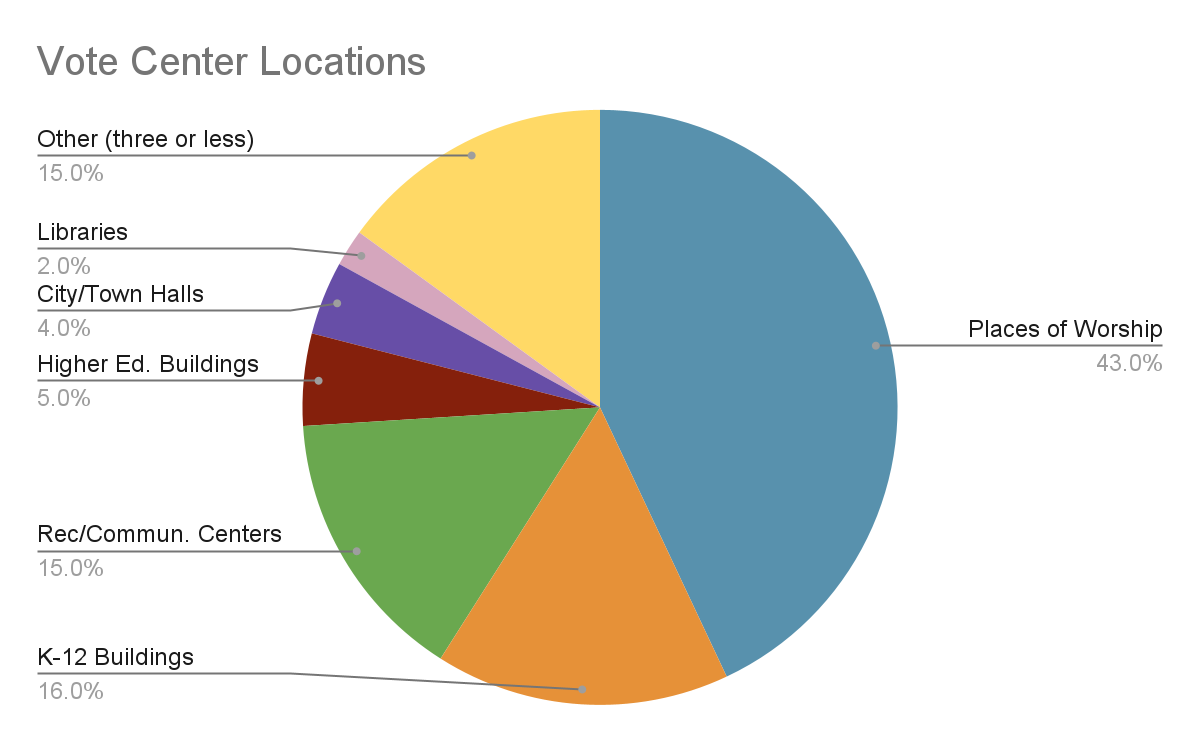
The majority of vote centers were concentrated at places of worship: churches and a few mosques accounted for about 44 percent of all vote centers. About 16 percent were located at K-12 schools or district offices. About 15 percent were located at recreational or community centers.
Another 15 percent were scattered almost evenly across 17 different types of buildings. Of note, there was a vote center at a mortuary, a union, a country club, an airport, and a commercial real estate agency.
The first 10 voting locations open on Wednesday (7/6). I've listed them in the next tweet.
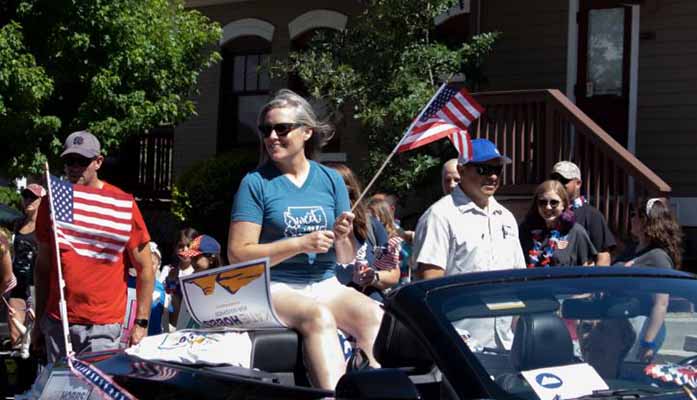
Gubernatorial candidate and Secretary of State Katie Hobbs bowed out of last Thursday’s debate against primary opponent Marco Lopez due to a reported COVID-19 infection, yet was out and about on Monday for Flagstaff’s Independence Day parade.
The CDC recommends that individuals with COVID-19 isolate for five days at least and not travel. If after five days the individual is asymptomatic or there’s no fever for 24 hours, then the CDC recommends that individuals wear a mask for five days when around others. If the COVID-19 illness is severe, then the individual should isolate for a minimum of 10 days.
Hobbs didn’t appear to be masked in the event pictures she posted.
What a great way to celebrate Independence Day — at the Flagstaff 4th of July parade, hearing from voters who care about the future of our state! I look forward to working for you on affordability, education, water and much more. pic.twitter.com/o5ifJa3o5y
It is unclear when Hobbs became infected, but it appears that she recovered completely by Monday.
I'm so happy to see that @KatieHobbs has fully recovered from her sudden case of COVID-19, which was bad enough to prevent her from debating @1marcolopez
Hobbs’ spokeswoman, Sarah Muench, informed The Arizona Republic in a Friday report that Hobbs missed the debate due to COVID-19. Prior to that, Hobbs didn’t issue any public statement mentioning her contraction of COVID-19. She was scheduled to attend other events that would’ve also conflicted with the debate scheduling, but reportedly had to cancel those as well due to her illness.
Lopez didn’t comment on Hobbs’ appearance in Flagstaff, though he was also in Coconino County for July 4 festivities.
Friends, we want our neighbors back. Our communities are longing for hope and leadership. Let's build an Arizona with good jobs, education, respect for rights – an Arizona for ALL. Thank you Coconino for your hospitality! #ArizonaNeedsUs 🇺🇸 pic.twitter.com/bJsY3IxvfF
The state of California will no longer fully fund official travel to Arizona because of laws banning gender transition procedures for minors (SB1138) and biological males from female sports (SB1165). The West Coast state’s attorney general, Rob Bonta issued the announcement on Thursday, the eleventh hour of Pride Month 2022.
California’s wielding of a 2016 law also applies to Indiana, Louisiana, and Utah, for their respective laws banning biological males, who believe they are transgender females, from participating in girl’s and women’s sports.
Bonta claimed in a press release that protections for women and children were solutions in search of a problem. Rather, Bonta asserted that the laws were veiled attacks on transgenderism and that the state would be “putting [its] money where [its] values are.”
“Make no mistake: There is a coordinated, ongoing attack on transgender rights happening right now all across the country,” said Bonta. “Blanket legislation targeting transgender children is a ‘solution’ in search of a problem. It is detached from reality and directly undermines the well-being of our LGBTQ+ community.”
As of press time, Attorney General Mark Brnovich hasn’t responded to California’s proclamation.
Make no mistake: There is a coordinated, ongoing attack on transgender rights happening right now all across the country.
Later on Thursday, Bonta issued a several statements commending members of his staff within the LGBTQ+ community, including his deputy attorney general Lily Weaver, a man who identifies as a “lesbian transgender millennial woman.
Deputy Attorney General Lily’s life experience as a transgender woman inspired her to continue fighting for justice until everyone is free. #PrideMonthpic.twitter.com/SXVDAqVtjh
Arizona’s Democratic leaders and activists are arguing that the legislature’s decision to universalize the state’s school choice program will cause segregation.
After the legislature voted to universalize the Empowerment Scholarship Account (ESA) Program last week, State Senator Martín Quezada (D-Glendale) pronounced that school segregation would return.
“We are codifying segregation in our school system today,” asserted Quezada.
— Arizona Senate Democrats (@AZSenateDems) June 25, 2022
Save Our Schools Arizona (SOSAZ), the anti-school choice activist group, has accused school choice programs of discrimination consistently. SOSAZ also claimed that school choice would lead to segregation.
Similarly, State Representative Andrea Dalessandro (D-Sahuarita) has accused the state’s school choice program of discrimination.
Vouchers in both my current LD 2 and the new and RURAL LD 19 are discriminatory and don't work. https://t.co/hHY9zqrx9N
— Representative Andrea Dalessandro (@Dalessandro4AZ) May 16, 2022
The argument is a long-standing one from Dalessandro and the rest of the Democratic Party: school choice systems discriminate on the basis of race.
Some get up in arms w/ indignation when word "racism" is mentioned but ask yourself these ?. Who is hurt when funding to PUBLIC education is cut? Who is hurt if school vouchers are expanded against voters wishes? Whose voice is silenced if voting suppression laws are passed? https://t.co/BYOglm5RZ0
— Representative Andrea Dalessandro (@Dalessandro4AZ) April 4, 2021
The ongoing narrative incriminates modern school choice systems using its origins story. The first American school choice program was a form of vouchers that enabled white children to attend white-only schools in response to mandated desegregation through the 1954 Supreme Court decision, Brown v. Board of Education. A year later, economist Milton Friedman released “The Role of Government in Education,” proposing a different version of the modern voucher system unrelated to the Supreme Court decision. In the decades following this initial paper, Friedman would champion the private market as a means of empowering parental choice in education, as opposed to leaving families trapped by zip code-determined schools.
FACT: Vouchers are rooted in racism and exacerbate modern segregation. Vouchers were started by opponents of desegregation and became a tool for white flight across the South in the 60s. #AZLeghttps://t.co/4xiERGHkm5
The president of the nation’s largest teacher’s union, Randi Weingarten of the American Federation of Teachers, referred to school choice systems as the “polite cousins of segregation” in 2017, following the appointment of school choice advocate and former Secretary of Education Betsy DeVos.
Although Democrats and mainstream media outlets often refer to the ESA Program as “vouchers,” the two are different. The ESA Program utilizes education scholarship accounts, which allocates funds based on per-pupil spending that can be used for approved educational expenses. By contrast, vouchers allow parents to apply public school funding to the private school of their choice.
Prior to Arizona’s universalization of its ESA Program, those eligible were largely special needs students who relied on the funds to personalize their education. Those also eligible were children in a “D” or “F”-rated school, children whose parents are active military or killed in the line of duty, foster care children, a sibling of an ESA recipient, children of a visually or hearing-impaired parent, or children living on native or tribal lands.
Governor Doug Ducey asserted that universal school choice was the “gold standard” for education. That remark prompted former state representative and withdrawn attorney general candidate Diego Rodriguez to reassert the claim that the program would result in segregation.
We will vote this down again. We wont let you recreate segregation while you kill public schools by draining their resources for your rich friends.
Drew Anderson begs to differ with Democratic leadership’s claims. The South Phoenix Pastor, a registered Democrat, has testified in the Arizona State Capitol and elsewhere repeatedly about how school choice rescued him from failing school systems and a life of crime, dubbed the “school-to-prison pipeline.” The pastor would go on to become a successful NFL player empowered to lift his family out of poverty.
In a statement to AZ Free News, Anderson contended that school choice would actually undo current segregation enforced by a lack of school choice.
“That is truly so false! Many public schools right now are segregated because the kids in a certain zip code are predominately white, black, or brown,” remarked Anderson. “So, school choice isn’t going to lead to segregation, it’s going to lead to competition for seats in the best schools in Arizona.”
Corinne Murdock is a reporter for AZ Free News. Follow her latest on Twitter, or email tips to corinne@azfreenews.com.
Arizonans will pay an average of 17 percent more for their July 4 cookout than last year due to the inflation and supply chain crises. That averages $10 more for 10 people.
Nearly all staples increased by double digit percentages:
2 pounds of ground beef increased 36 percent — $8.18 to $11.12
2 pounds of boneless, skinless chicken breasts increased 33 percent — $6.76 to $8.99
32 ounces of pork and beans increased 33 percent — $1.90 to $2.53
3 pounds of center cut pork chops increased 31 percent — $11.65 to $15.26
2.5 quarts of fresh-squeezed lemonade increased 22 percent — $3.63 to $4.43
2.5 pounds of homemade potato salad increased 19 percent — $2.75 to $3.27
8 hamburger buns increased 16 percent — $1.67 to $1.93
Half-gallon of vanilla ice cream increased 10 percent — $4.69 to $5.16
13-ounce bag of chocolate chip cookies increased 7 percent — $4.03 to $4.31
Certain foods declined in cost: strawberries by 86 cents, sliced cheese by 48 cents, and potato chips by 22 cents.
The data came from the latest American Farm Bureau Federation (AFBF) survey. As of the latest Bureau of Labor Statistics (BLS) Consumer Price Index report from May, inflation in Arizona is at a historic high, rising over eight percent in one year with Phoenix bearing the worst of it at 11 percent.
For last year’s July 4 celebrations, the Biden administration boasted that they helped Americans save an average of 16 cents on cookout foods.
Planning a cookout this year? Ketchup on the news. According to the Farm Bureau, the cost of a 4th of July BBQ is down from last year. It’s a fact you must-hear(d). Hot dog, the Biden economic plan is working. And that’s something we can all relish. pic.twitter.com/7h9qLauIbC
The White House claim was widely criticized, and its corresponding tweet was heavily ratioed: over 23,400 comments and over 17,300 quote tweets, a majority of which were negative, with only over 11,200 likes.
The White House account does not get ratio’d very often but the “we saved you .16 cents on potato chips from last year” has done it.
Critics like Congresswoman Elise Stefanik (R-NY-21) pointed out that gas prices at the time were at a seven-year high, or a 42 percent increase from 2020. At present, gas prices are hitting all-time highs in recent weeks — even with adjustments for inflation.
Apparently, no one at the Biden @WhiteHouse has been to the gas station recently.
The average price for a gallon of gas is $3.15.
This is the HIGHEST price for a gallon of gas since 2014 and a 42% INCREASE from last year.
Additionally, last year’s Fourth of July food costs may not have been as good as the White House claimed. The Washington Examiner pointed out that the White House ignored certain food items that rose in price: hamburger buns, potato salad, chicken breasts, chocolate chip cookies, and strawberries. The report noted that the Department of Agriculture data reflected an overall increase in food prices of 1.4 percent.
Corinne Murdock is a reporter for AZ Free News. Follow her latest on Twitter, or email tips to corinne@azfreenews.com.
Most Arizonans will spend July 4 watching fireworks after spending the day with family and friends appreciating the many freedoms they enjoy compared to citizens of every other country.
But the Tucson Women’s March has announced a “F**k The 4th” event for attendees to “bring their anger” to Reid Park at 7 p.m. The event was promoted Friday morning on Twitter by the Pima County Democratic Party, who quickly deleted the tweet and accompanied flyer.
The tweet, however, was seen and saved by many people, including leaders of the Arizona Democratic Party. And while party leaders insisted they did not agree with the language used to publicize the event, they did not reject the intent behind it.
The Arizona Democratic Party does not agree with the language used to publicize a 4th of July event happening in Tucson. We believe there can be room for both celebration and criticism. That is at the core of American freedom.
— Arizona Democratic Party (@azdemparty) July 1, 2022
In another tweet, the Arizona Democratic Party also supported the event’s “let’s mourn” theme even though attendees are set to arrive at the popular park at 7 p.m. while it will be full of families celebrating the holiday.
We are in solidarity with Arizonans who are grieving right now over the Supreme Court, the loss of freedom for many, and other political turmoil.
— Arizona Democratic Party (@azdemparty) July 1, 2022
By Friday afternoon the Pima County Dems returned to Twitter in a series of tweets which vacillated between an apology and a statement of defiance in support of the “F**k the 4th” event.
“The event was organized to help women in our community grieve for the loss of their bodily autonomy, which we consider an elemental right,” one of the group’s tweets read, while another conceded the graphic nature of the flyer advertising the event “was in poor taste.”
But a third tweet on the subject appeared to take a “the end justifies the means” position.
3/3 Our posting of the graphic upset some people. We urge you to save your outrage for the women in this state who will die of botched abortions. Arizona is not a good place to be a woman right now.
— Pima County Democratic Party (@PimaDems) July 1, 2022
State Senator Michelle Ugenti-Rita expressed disgust at the event being held in conjunction with Independence Day celebrations.
This since deleted tweet by the @PimaDems is disgusting. However, it serves as a reminder of who we are up against this November. Instead of championing ideas and a vision, the Un-American party, aka the Democratic Party, has decided to stoke hate and divisiveness. pic.twitter.com/Qvl1M2i6LN
— Michelle Ugenti-RITA (@MichelleUgenti) July 2, 2022
And Ben Petersen of the Republican National Committee used Twitter to ask if several Democratic Party leaders in Arizona planned to attend the event or intended to denounce it.
The Democrat Party deleted its tweet, but screenshots are forever.