A lawsuit filed this week by several residents, business owners, and property owners within a multi-block “zone” of downtown Phoenix seeks a court order requiring city officials to do something about the unabating homelessness crisis impacting the 19 plaintiffs.
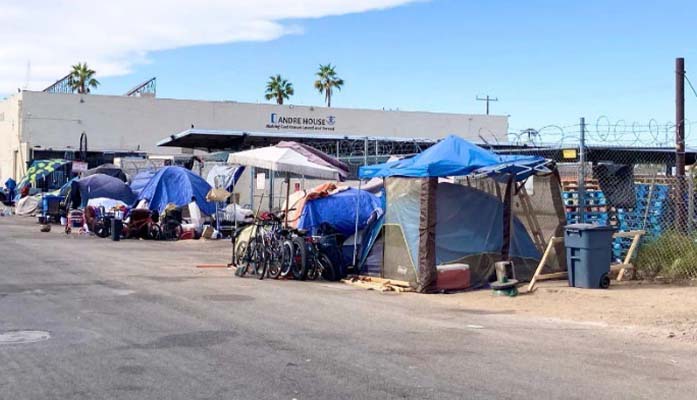
According to the lawsuit, the largest concentration of homeless persons in Arizona has developed on properties owned by or operated by the City of Phoenix in an area between 7th and 15th Avenues and between Van Buren and Grant Streets.
Many of the persons who have constructed semi-permanent tent dwellings on public sidewalks and rights of way are experiencing mental health problems and / or drug and alcohol addiction, but city officials have enacted policies which essentially ignore those issues to the detriment of the community, the plaintiffs allege.
“Not only is the City of Phoenix failing to provide these individuals with housing and needed services, it refuses to enforce in and around the Zone quality-of-life ordinances prohibiting loitering, disturbing the peace, drunken and disorderly conduct, drug use, domestic violence, and obstructing streets, sidewalks, or other public grounds,” the lawsuit contends. “The City’s policies are not rationally designed to address any of the social ills facing the residents of the Zone and are exacerbating rather than alleviating their problems.”
Those policies not only permit illegal conduct on Phoenix-controlled public lands but city officials further encourage problems by directing homeless persons from around the city to the Zone, according to the lawsuit.
“In the Zone and its environs, laws are violated with impunity; residents are subject to violence, property damage, and other criminal and civil violations of laws designed to protect the quality of life of residents; property values have been erased; trash and human waste litter streets and yards; and most tragically, a great humanitarian crisis unfolds as homeless residents of the Zone die on a daily basis,” the lawsuit notes.
The plaintiffs seeking an order from Judge Alison Bachus of the Maricopa County Superior Court that the public encampments in Zone has created a public nuisance for which plaintiffs have a constitutional right to seek abatement of the nuisance
In addition, the lawsuit seeks an order from Bachus prohibiting city officials from taking any further action that will exacerbate the current nuisance and a separate order requiring the city to immediately abate the nuisance.
The lawsuit even points to several options available to city officials, including removal of the encampments to other public lands where they would not constitute a nuisance. Another option permitted by a 2019 federal ruling from the Ninth Circuit Court of Appeals is to create “structured camping grounds” on city property where cleanliness could be maintained along with compliance of laws and ordinances.
A more traditional option would be the availability of enough shelter space so that public camping could be prohibited. However, the lawsuit concedes the Ninth Circuit ruling currently prohibits enforcement of a public camping ban because City of Phoenix officials have failed to provide sufficient resources to address the homelessness issue.
That 2019 ruling requires municipalities to allow homeless individuals to camp on some public lands if there are not enough shelter beds. But nothing in the ruling, Martin v City of Boise, prohibits officials from enforcing quality of life ordinances and criminal laws, the plaintiffs argue.
Those plaintiffs are represented by Michael Bailey, Stephen Tully, and Ilan Wurman. They contend city officials are using the Ninth Circuit ruling “as an excuse to completely wash its hands of this crisis, leaving the homeless individuals and the surrounding neighborhood in an unimaginably horrific situation.”
The lawsuit adds Phoenix officials are entitled to adopt “irrational policies but if its policies create a nuisance and cause damage to the residents, workers, and property owners in the Zone, as they have, then the City is liable for those damages and the court may enjoin the nuisance.”
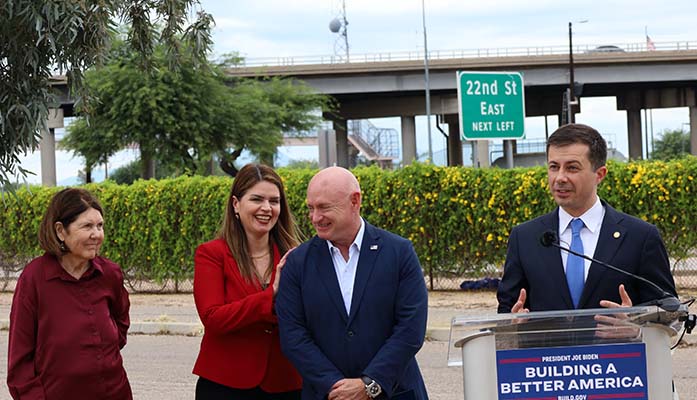
On Thursday, Department of Transportation (DOT) Secretary Pete Buttigieg visited Tucson and Phoenix, announcing over $75.2 million in grant awards for communities throughout the state.
“[These are] improvements that are going to make for better travel and better safety here in Tucson and in Phoenix,” said Buttigieg.
Good morning, Arizona!
Here to announce new funding awards and to see how Tucson and Phoenix plan to use some of the infrastructure dollars coming their way. pic.twitter.com/sEXNKm3SE8
These Rebuilding American Infrastructure with Sustainability and Equity (RAISE) grants were awarded to Navajo County, Phoenix, Tucson, and the Colorado Indian River Tribes.
Over $2.2 billion from 166 RAISE Grants were distributed throughout the country. Arizona communities received five different grants: $261,000 to Navajo County to improve 16 miles of pedestrian and bicycle infrastructure; $25 million to Phoenix to construct a bicycle and pedestrian bridge across the Rio Salado River; $25 million to Tucson to renovate an old bridge; and nearly $25 million to the Colorado Indian River Tribes to reconstruct 10 miles of road.
The DOT characterized this latest round of grants as their largest investment in RAISE Program history.
Congresswoman Ann Kirkpatrick (D-AZ-02) explained in a press release that the Tucson grant will update the 22nd Street bridge to accommodate heavy vehicles like trucks, buses, and emergency medical services — something the bridge was unable to do before, which Kirkpatrick said led to traffic congestion and delays.
“Increasing capacity on 22nd street will reconnect our communities and facilitate a necessary east-west economic and transportation corridor between downtown Tucson and disconnected and underserved areas in the city,” said Kirkpatrick. “This project will help close the gaps in our city’s transportation infrastructure, and support equitable access to resources and opportunities for all Tucsonans.”
Phoenix Mayor Kate Gallego shared that the $25 million for a bridge over the Rio Salado river would connect downtown Phoenix to South Phoenix. Gallego provided a map of the planned bridge location, which revealed that the bridge would span the Rio Salado River and Phoenix Sky Harbor Airport, going from Central Avenue to State Route 143.
Whether you walk, run, or roll: a new $25M grant will build a bike/pedestrian bridge across Rio Salado, linking downtown and South Phoenix! Huge thanks to USDOT @SecretaryPete for celebrating with us today. Thanks also to @gregstantonaz and @reprubengallego for their help! pic.twitter.com/SulGmhspVp
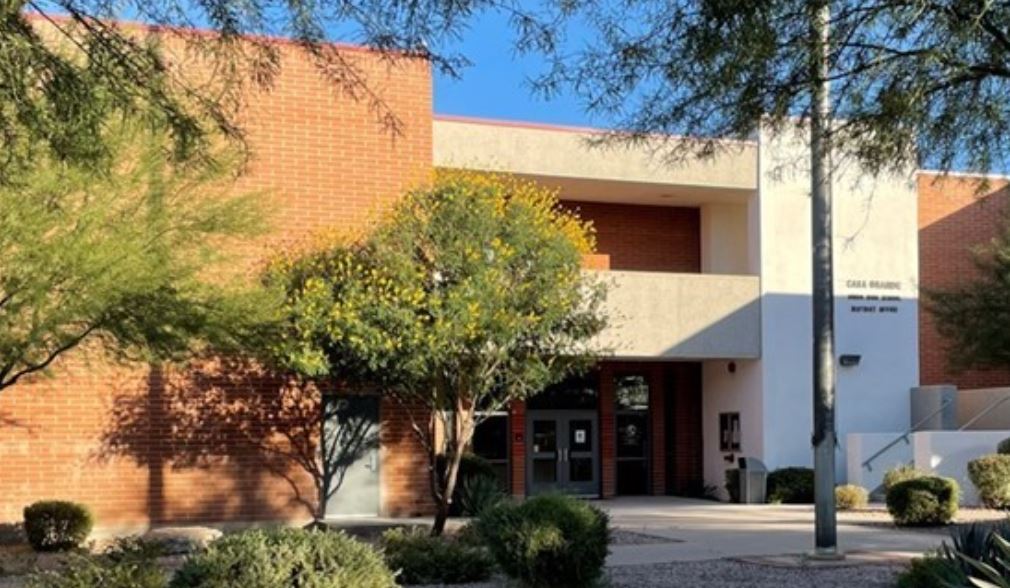
The Casa Grande Union High School District (CGUHSD) is facing critical staffing shortages for its Marine Corps Junior Reserve Officer Training Corps (JROTC) curriculum. A total of three JROTC instructors have resigned since the spring semester ended, with the last resignation occurring on Tuesday. Now one instructor, Gunnery Sergeant Jesus Flores, remains.
The last resignation, that of Major Rob Sherwood, was reportedly due to disagreements over new district administration policies. One Casa Grande Union High School JROTC student, commanding officer Blake Snell, explained that Sherwood found the new grading policies, which whistleblower teachers say granted failing students passing grades, to be egregious. Snell said that Sherwood wasn’t the only instructor bothered by the new policies, reporting that over 100 teachers resigned from the district.
“This is essentially rewarding kids for doing absolutely no work,” said Snell.
CGUHSD Superintendent Anna Battle rejected the characterization of the new grading policies.
Several hundred students participate in the district’s JROTC program; CGUHSD has two of the seven high schools with JROTC programs in the state. Concerned community members, which included student cadets and the local VFW 1677 Post, showed up to Tuesday’s governing board meeting for answers.
State Representative Teresa Martinez (R-Oro Valley) and State Senator T.J. Shope (R-Coolidge) also showed up to support the JROTC students’ fight for their program.
Rep. @TMartinez4AZ and I are attending the CGUHSD Gov Board Meeting in Casa Grande with dozens of veterans and some truly inspirational student cadets. You can watch it live here https://t.co/BuLq9uMm9U as CGUHS Admin & school board, including LD16 Dem Sen candidate Taylor Kerby pic.twitter.com/VzgN2xuV6i
Shope asserted that one of the board members — Taylor Kerby, a Democratic candidate for the State Senate — was partly to blame for the program’s jeopardization.
Battle made it clear at the meeting that the district doesn’t plan on ending the JROTC program. The superintendent had nothing but praise for the JROTC program and its students.
“What educator in his or her right mind would not want to support a program that implements and instills the kind of virtues, qualities, and characteristics that we have seen not only in the Casa Grande Union High School District but around the country?” asked Battle.
Battle promised that the district’s search for quality officials to serve the program was ongoing.
Yet, district officials alluded to a disparity between the positive sentiments surrounding the JROTC program and leadership action to sustain the program.
Vista Grande High School Principal Vance Danzy noted during the meeting that the district hasn’t found solutions to maintain the program over the last few months. Danzy shared that district officials’ meetings following the initial two JROTC instructor resignations at the end of June weren’t fruitful.
Danzy explained that several of Battle’s proposed solutions weren’t feasible, such as transporting students between campuses. That would result in students missing classes, argued Danzy.
“We’ve been behind the eight ball, and this is because we were informed about our instructors leaving around June 28,” said Danzy.
Board member Chuck Wright admitted that the district failed to upkeep the JROTC program properly.
“I believe we just dropped the ball, however slightly, and I’d like to apologize,” said Wright.
According to the latest budget reports, JROTC has a $145,000 budget, leaving well over $24,700 after expenditures of $120,000 for employee salaries and benefits.
Watch the full CGUHSD governing board meeting here:
Corinne Murdock is a reporter for AZ Free News. Follow her latest on Twitter, or email tips to corinne@azfreenews.com.
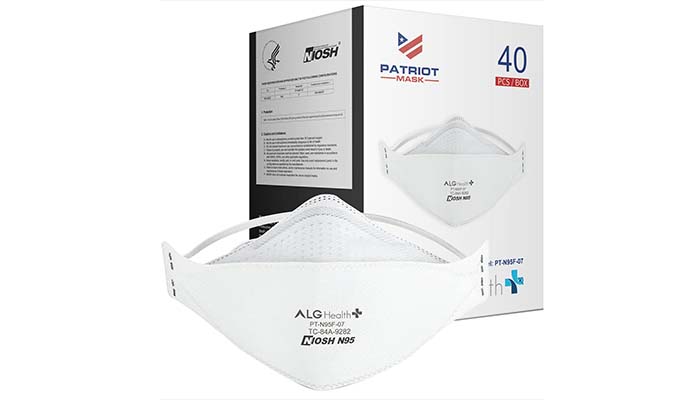
The U.S. Attorney’s Office is seeking a permanent injunction against an Ohio company that sold COVID-19 personal protective equipment such as N95 masks to healthcare workers and first responders across the country as “Made in USA” even though most of the items were manufactured in China.
The complaint filed earlier this month stems from a referral by the Federal Trade Commission (FTC) about Adam J. Harmon and two companies he controls -Axis LED Group, LLC and ALG Health LLC.- accused of violating multiple federal laws by improperly labeling and advertising various products.
The FTC’s referral to the U.S Department of Justice is outlined in the 116-page complaint, one of more than a dozen such federal cases initiated under the COVID-19 Consumer Protection Act against what the FTC characterizes as “COVID predators.”
“As Americans struggle to obtain safe, authentic personal protective equipment, the Commission will use every tool we have to root out false claims and phony labels,” said Sam Levine of the FTC’s Bureau of Consumer Protection. He added that the defendants “slapped the Made in USA label on masks that were made overseas, and now they’re paying the price.”
That price, the FTC says, is a civil penalty of $157,683 due immediately. Another $2.8 million put forth as a redress judgment is currently suspended due to the defendants’ claims of an inability to pay.
“Should the FTC discover that the defendants have misstated the value of any assets or failed to disclose them, the agency will seek to have the suspension lifted and the full judgment due immediately,” according to an FTC press release.
This is not the first time Harmon has run afoul with the FTC. In 2017, the agency closed an investigation into false Made in USA claims involving LED bulbs sold by Harmon’s Axis LED Group to the U.S. Government. The FTC’s Made in USA labeling rules require manufacturers and marketers who promote such claims to prove “all or virtually all” of a product was in fact made in America. The rule also requires Made in USA labeling in mail order catalogues and online to be truthful.
According to current federal complaint, Harmon admitted to FTC investigators back in 2017 that the U.S.-assembled LED bulbs his company sold contained “significant Chinese components.” The complaint alleges that since then, company employees have on occasion peeled “Made in China” stickers off LED products and replaced them with labels reading Made in the United States before shipping to customers.
Then in early 2020, as the COVID-19 pandemic began, Harmon is alleged to have begun selling PPE such as N95 respirators, gloves, and gowns from the ALG Health facility in Defiance, Ohio. Those sales were made consumers throughout the United States.
One of the company’s social media ads even advised customers to purchase American-made PPE “so that our heroic frontline workers do not have their safety put at risk by relying on foreign-made products.” The posting also stated that imported products “are not tested and could be unsafe.”
In reality, according to the FTC, Harmon was aware his company was sending those customers Chinese-made KN95 masks that employees had stripped off the Made in China labels before printing “ALG” and “NIOSH” on the products and then putting into N95 packaging with Made in USA labels.
But this not what Harmon told the National Institute for Occupational Safety and Health (NIOSH), which is part of the U.S. Centers for Disease Control and Prevention (CDC).
NIOSH is responsible for certifying certain respiratory protective devices, such as N95 masks, per U.S. standards. It does not certify masks manufactured in accordance with international standards, such as KN95 masks.
In January of this year, NIOSH published a notice on the CDC website announcing ALG Health voluntarily rescinded all NIOSH respirator approvals and that the company could no longer manufacture, assemble, sell, or distribute masks under those approval numbers.
“Despite this notice, Defendants continued to market certain of the identified products as MUSA and NIOSH-certified N95s, and sell these products to consumers,” the federal filing alleges. “Defendants have engaged in their unlawful acts and practices willfully and knowingly, and Defendants have continued their unlawful activities despite a previous FTC investigation, and investigations by other federal government agencies.”
The agency’s proposed preliminary injunction order seeks to Harmon and his companies from making further deceptive Made in USA claims as well as enforce the civil penalty for the past deceptive claims.
Gannett, parent company to the Arizona Republic, will commence layoffs and diminish salaries following a poor second quarter last week.
Gannett, which also owns half of the Arizona Daily Star, said in a press release that this “significant cost reduction program” would help pay down $150 to $200 million of their debt. The media conglomerate reported a net loss of $53.7 million, or over 7 percent of its margin. Gannett also experienced a 7 percent decrease in revenues, despite digital revenues increasing 1.5 percent to make up 35 percent of total revenues.
The Tucson Sentinel said that its sources confirmed that Gannett tasked managers with layoffs. Poynter sources clarified that salary cuts will have a 10 percent minimum, and that layoffs begin on Friday.
Gannett CEO: $7.74 million Average employee: $48,000
These layoffs will come, despite Gannett’s participation in initiatives like the Big Tech-funded program, Report for America, which supplied and covered portions of reporter salaries at 21 of its papers, including the Arizona Republic. The paper has hired three Report for America reporters so far. Report for America received an undisclosed sum of $5,000 to $50,000 from Gannett.
Report for America covers at least half of its reporters’ salaries the first year, a third of their salaries the second year, and just under a quarter of their salaries the third year, with the offer to cover the remainder of these salaries through fundraising.
The Arizona Republic subscriber base has declined over the years. According to their latest Securities and Exchange Commission (SEC) filing, their daily circulation was just over 109,000, with a Sunday circulation of over 320,200. That’s about 1.5 percent and 4 percent of the total Arizona population, respectively, and marks a decline of over 7,000 from 2020.
In 2019, their circulation numbers fell below 100,000, marking the steepest decline among Gannett papers.
The SEC filing reflected that the Arizona Republic is Gannett’s fourth-largest major news publication, with the third-largest daily and Sunday circulations.
USA Today has a daily circulation of nearly 781,200 and a Sunday circulation of nearly 534,600; Detroit Free Press has a daily circulation of over 83,700 and a Sunday circulation of over 896,600; and the Columbus Dispatch has a daily circulation of nearly 137,800 and a Sunday circulation of over 134,700.
Comparatively, the New York Times reported a $76 million profit for their second quarter despite being a smaller company than Gannett.
Gannett’s report inspired new criticisms from its journalists and their unions across the country. The Media Guild of the West indicated that Gannett’s recent decline occurred because the conglomerate was more concerned with corporate lobbying than sustaining newsrooms.
The guild cited Gannett’s network-wide advertising and editorial campaign in support of the Journalism Competition and Protection Act (JCPA) to remove antitrust restrictions preventing Gannett from being paid for content to appear on the platform feeds of social media giants like Google and Facebook.
Gannett: Gets rid of local journalists, then uses the empty void where the journalism used to be to conduct corporate lobbying that will help enrich its own executives.
A group of Arizonans are suing to stop a California union-backed ballot initiative aiming to render debt collection futile in the state.
The Predatory Debt Collection Act is by the political action committee (PAC), Arizonans Fed Up With Failing Healthcare, or Healthcare Rising AZ. In order to do so, it would cap medical debt interest rates to 3 percent, reduce maximum disposable earnings garnishment from 25 to 10 percent (or 5 percent if garnishment would result in extreme economic hardship), raise home equity protection from $150,000 to $400,000, raise vehicle protection from $6,000 to $15,000 or $25,000 for the physically disabled, raise bank account protection from $300 to $5,000, raise household goods protection from $6,000 to $15,000. All raised protections would also adjust for inflation annually beginning in January 2024.
The PAC markets its ballot initiative as primarily a protection against predatory medical debt collection, though its provisions go much further to encompass all other possible debts.
Healthcare Rising AZ has raised over $7.6 million in funds so far. Over $3.5 million (46 percent) of those funds came from the PAC’s former version of itself, Healthcare Rising AZ, or SEIU-UHW. The latter name refers to the California union, SEIU United Healthcare Workers, from which the current PAC received over $4 million (53 percent) of its funds.
Some Arizonans believe that the ballot measure’s summary language inaccurately reflects its scope, and may cause voters to approve something that would demolish the state’s lending industry, like credit and financing.
Arizonans opposed to the ballot initiative formed a PAC of their own, Protect Our Arizona, which filed a lawsuit against Secretary of State Katie Hobbs and Healthcare Rising AZ in the Maricopa County Superior Court. Judge Frank Moskowitz will oversee the case.
Protect Our Arizona has raised $302,500 so far, 85 percent of which came from the Arizona Creditors Bar Association.
The "Predatory Debt Collection Protection Act" initiative has been challenged in court. Judge Moskowitz assigned:
Protect Our Arizona v. Katie Hobbs, Arizona Secretary of State; Arizonans Fed Up With Failing Healthcare aka Healthcare Rising AZ CV2022-009335
— Arizona Election Law (@azelectionlaw) July 23, 2022
On Monday, the Goldwater Institute filed an amicus brief in the lawsuit. The Phoenix-based public policy research and litigation organization argued that Healthcare Rising AZ made a patently false claim in its description by saying that the initiative wouldn’t change existing law regarding secured debt.
The Goldwater Institute also argued that the ballot initiative would increase the cost and procurement difficulty of credit and loans.
“The Act is breathtakingly wide in scope: severely restricting garnishments, raising the amount of home equity protected from unpaid businesses and creditors, and drastically increasing a host of other personal property exemptions, so as to leave businesses, landlords, and judgment creditors without legal recourse for unpaid debts,” wrote the organization. “If the Act were to become law, the enormous losses it would inflict on lenders and judgment creditors would have a devastating effect on the ability of Arizonans to obtain loans or to afford housing.”
The Arizona Chamber of Commerce and the Greater Phoenix Chamber both expressed opposition to the ballot initiative as well.
Support for the initiative includes the Arizona Democratic Party, Living United for Change Arizona (LUCHA), the Phoenix Workers Alliance, the Arizona Education Association (AEA), Our Voice Our Vote, Arizona Public Health Association (AZPHA), and the NAACP. The PAC currently has over 1,200 members.
MAJOR NEWS: Healthcare Rising AZ is now 1,000 members strong! We started 2021 with fewer than 30 contributing members. Now, we have the growing people power to win big changes in our state — like passing our ballot initiative, the Predatory Debt Collection Protection Act. pic.twitter.com/iqQGWAdK7h
Counsel for Healthcare Rising, the election and employment law firm Barton Mendez Soto, also served as counsel for the PAC’s effort the past several years.
The law firm is also behind another controversial ballot initiative that voters may decide on in November, Arizonans for Free and Fair Elections, funded with a similar amount of over $7.6 million from a Democratic network of dark money. That other initiative would eliminate voter ID and proof of citizenship for voter registration, allow same-day voter registration, bar election audits like the one authorized by the state senate for the 2020 election, raise small business taxes to increase political campaign funding, and restore private funding in election administration.
As part of their signature-gathering efforts, Healthcare Rising pledged donations that would relieve $100 in medical debt for Arizona patients.
709 signatures. 132 registered to vote. $70,900 in medical debt erased. That's what happens when we come together with @WorkersUnited – we do big things!
The Predatory Debt Collection Act summary description is reproduced below:
Caps interest rate on ‘medical debt,’ as defined in the Act; applies this cap to judgments on medical debt as well as to medical debt incurred. Increases the value of assets — a homestead, certain household possessions, a motor vehicle, funds in a single bank account, and disposable earnings — protected from certain legal processes to collect debt. Annually adjusts these amended exemptions for inflation beginning 2024. Allows courts to further reduce the amount of disposable earnings subject to garnishment in some cases of extreme economic hardship. Does not affect existing contracts. Does not change existing law regarding secured debt.
Corinne Murdock is a reporter for AZ Free News. Follow her latest on Twitter, or email tips to corinne@azfreenews.com.