Last year, Gallego ignited controversy over his $84,000 trip to Qatar paid for by a special interest nonprofit focused on strengthening US-Qatar trade relations. The Qatari government opposes the Jewish faith, and supports terrorist efforts to destroy Israel such as the Muslim Brotherhood and Hamas.
— US-Qatar Business Council (@USQatar) April 1, 2021
Additionally, Gallego continues to support the Arizona chapter of the Council of American-Islamic Relations (CAIR-AZ). The Department of Justice (DOJ) acknowledged CAIR as an entity of the Muslim Brotherhood and noted that they were linked to Hamas activity.
Several months after Gallego filmed for CAIR-AZ denouncing the Trump administration’s travel restrictions, the organization appointed an outreach coordinator by the name of Ismail Abu Hayyeh, who advocated for the destruction of Jews and Israel. The month after joining CAIR-AZ, Abu Hayyeh tweeted from a since-suspended account that Israel shouldn’t exist at all.
“If you support Israel’s right to exist, you are a part of the problem,” wrote Abu Hayyeh.
In October 2020, Abu Hayyeh tweeted that the only solution to free Palestine was to kill the Jews of Israel. Prior to joining CAIR, Abu Hayyeh issued many other remarks advocating for the end of Israel and even public support for Adolf Hilter. While in high school, Abu Hayyeh said that all Palestinians wondered why Hitler “didn’t finish the job” and called Hitler “his hero,” and that he considered it a compliment to be called “the next Hitler.”
On the CAIR-AZ Board of Directors is David Chami, who filed a legal complaint last year on behalf of Fidaa Wishah: the pediatric radiologist fired from Phoenix Children’s Hospital for posting a video in pink hospital scrubs promising that Israel’s end would come soon.
Chami and another director on the CAIR-AZ board, Raeesabbas Mohamed, sued a Scottsdale Community College (SCC) professor in 2020 for issuing a class quiz that portrayed the Islamic religion factually but negatively. The Arizona District Court rejected the lawsuit several months later. In September, the Ninth Circuit Court of Appeals again rejected the lawsuit, concurring with the lower court to uphold the SCC professor’s free speech rights.
The Anti-Defamation League (ADL) opposes CAIR. Gallego hasn’t issued any public support for the ADL.
Corinne Murdock is a reporter for AZ Free News. Follow her latest on Twitter, or email tips to corinne@azfreenews.com.
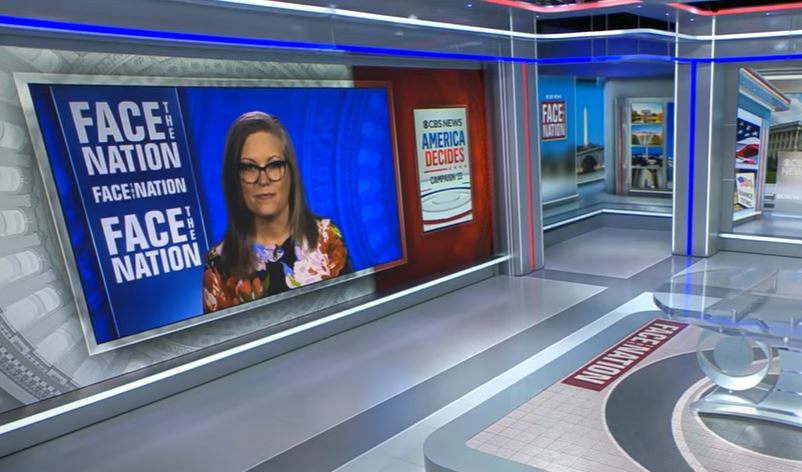
In a Sunday interview, Democratic gubernatorial candidate Katie Hobbs said she wouldn’t put any limits on abortion. Hobbs also evaded questions about her strength to handle a debate with Lake, as well as who caused the present border crisis.
Hobbs’ remarks occurred during her 8-minute one-on-one interview with CBS host Major Garrett, as part of a “Face the Nation” segment that also featured a separate one-on-one with Lake. Concerning abortion limits, Hobbs stated repeatedly that no laws should exist limiting abortion.
“I support leaving the decision between a woman and her doctor, and leaving politicians entirely out of it,” said Hobbs.
Hobbs said she didn’t agree with the state’s 15-week limit on abortions. She didn’t denounce late-term abortions but claimed that they’re never elective.
When pressed about her refusal to debate Lake, Hobbs claimed that her opponent would create a “circus” of no benefit to voters. Hobbs refused to answer Garrett when he asked if she were strong enough to handle the “circus” Lake might concoct. Rather, Hobbs said voters had plenty of other opportunities to see her performance under crisis, referencing controversy over the 2020 election.
Hobbs said there were no circumstances under which she would debate Lake.
Hobbs again refused to answer Garrett when he asked who she considers responsible for the present border crisis, and whether the Biden or Trump administration policies were safer for immigrants. Rather, Hobbs said that decades of bad policies from both parties were to blame.
Garrett pressed Hobbs, reminding her that she’d criticized “current immigration policy” — which would be that of President Joe Biden’s administration. Hobbs admitted that Biden should do more to mitigate the border crisis, but didn’t say he was to blame. She noted that former President Donald Trump failed to fulfill his promise of a complete border wall.
“Biden does need to step up immigration and border security,” said Hobbs.
Hobbs also claimed that her economic plan, which includes upending Arizona’s universal school choice, would reduce inflation.
During her one-on-one interview, Lake took the opposite stance on all issues. Lake answered nearly all of Garrett’s questions directly, except for his question about whether she believed that President Joe Biden was the legitimate president. Rather, Lake said that distrust in elections has been a pervasive issue since the early 2000s. She said that the ability for people to question elections ceased with the 2020 election, though doubts over the 2016 election continue to be permitted.
“All of a sudden in 2020, we don’t have free speech anymore,” said Lake. “All I’m asking for is the ability to speak out: when our government does something wrong, we should be able to speak against it.”
Concerning her plan to form an interstate compact to secure the border, Lake explained that the Constitution granted her plan the legal authority to act. She disclosed that other governors agreed to join the compact.
“We meet all three criteria [of Article I Section X of the Constitution]: we have an invasion, our people are in danger, and time is of the essence,” said Lake. “I hope that Joe Biden doesn’t fight us, because then it will really look like he’s on the side of the cartels.”
Lake said that the “lust” for cheap illegal immigrant labor exists not only in Arizona, but nationwide. She pointed to House Speaker Nancy Pelosi’s (D-CA-12) press conference remarks that Republican-led states should welcome illegal immigrants because they can “pick the crops” there. Lake expressed concern not only for the quality of life for illegal immigrants,
On abortion, Lake said that she would uphold the law as governor. She said that she was for “true choices” which would entail more than just abortion. Lake asserted that abortion was the only choice offered at abortion clinics, not other choices like adoption.
Lake agreed with last week’s arrest of an Iowa man who threatened a Maricopa County supervisor over the 2020 election. She opined that the root cause of these threats were frustrations from restrictions on free speech and expression that occurred during the pandemic.
The latest polling shows Hobbs and Lake tied among likely voters.
Read the full transcript of the Hobbs and Lake interviews here.
Corinne Murdock is a reporter for AZ Free News. Follow her latest on Twitter, or email tips to corinne@azfreenews.com.
The cities of Nogales, Arizona and Nogales, Sonora signed a Memorandum of Understanding last week that will allow construction of a new international railway crossing and relocation of train tracks to a less urban area east of the current tracks.
The agreement signed by Mayor Juan Francisco Gim Nogales of Nogales (SON) and Mayor Arturo Garino of Nogales (AZ) was witnessed by Heriberto Aguilar Castillo, the Sonoran Secretary of Infrastructure and Urban Development on behalf of the State of Sonora.
Business leaders on both sides of the border have been pushing for decades for improvements to rail infrastructure leading to and at the international crossing. Rerouting the tracks and upgrading the crossing has been a priority for Gov. Alfonso Durazo Montano of Sonora when he took office last summer.
Any financial commitments on the part of the two cities was not revealed during the signing ceremony, but Durazo previously suggested that $36 million (US) would be available from Mexican government entities.
Union Pacific Railroad operates the track from Nogales north to its East-West Sunset Route in Tucson. Heading southward from Nogales, Ferromex Rail serves customers along routes to Hermosillo, Guaymas, and Guadalajara.
In May, Durazo facilitated a meeting with Union Pacific, Ferromex, and other stakeholders to emphasize his support for the project. He pointed to public safety issues that have long plagued emergency responders on both sides of the border, and he noted there will be a significant increase in demand for expedient freight train service once the Port of Guaymas is upgraded.
An average of 70 northbound trains come into the U.S. through the Nogales Port of Entry each month, with traffic on pace to exceed 800 trains for the first time in more than six years. However, construction of the new crossing is a long way off, as both cities must undertake feasibility studies to identify the best location for the new international crossing and for the layout of the train tracks.
The Nogales rail project will complement Mexico’s $245 million (US) modernization of the Guaymas area championed by Mexico President Andrés Manuel López Obrador to expand the port, reinforce docks, and upgrade technology.
According to the UA Eller College of Management, Nogales has the oldest rail crossing of any border port of entry along the U.S. / Mexico border. Automobiles manufactured at the Ford Motors plant in Hermosillo, Sonora are shipped via rail to U.S. and Canadian markets through Nogales, as are bulk commodities such as cement and agricultural product.
“The dynamics of train crossings, and number of rail containers through the Nogales border port of entry reflect the composite effects of both trade between Mexico, Canada and the U.S., as well as between Arizona and Mexico,” according to the Eller College of Management’s Arizona-Mexico Economic Indicators.
Data provided by the UA Economic and Business Research Center shows more than $11.8 billion in U.S. exports went to Mexico in 2021 through U.S. ports of entry in Arizona. Nearly $10 million of that crossed through Nogales by either vehicle or rail.
Meanwhile, $17.6 million was imported across the U.S. ports of entry in Arizona from Mexico in the same period, with all but $3 billion coming through Nogales.
During her last year in the State Senate in 2018, Democratic gubernatorial candidate Katie Hobbs backed a bill to add 131 new tax auditors, managers, and staff to the Arizona Department of Revenue (ADOR) using $8.3 million in state funds. At the time, Hobbs was the State Senate’s minority leader.
Throughout her gubernatorial campaign, Hobbs said she would lighten the tax process burden for the working class if elected. Hobbs also pledged to cut income taxes for 800,000 families if elected governor.
We need a governor with a plan to tackle rising costs. I’ll cut taxes for Arizona’s working families and lower costs on things like school supplies and diapers. Because these solutions can’t wait. pic.twitter.com/FMzHcbv0UH
Additionally, Hobbs promised that working-class Arizonans wouldn’t pay “a center higher” for her economic plan, nor would they face unnecessary tax burdens.
My plan for a more Affordable Arizona keeps hard-earned dollars in your pockets, helps Arizonans get back to work, and ensures families statewide can access necessities without unnecessary tax burdens.
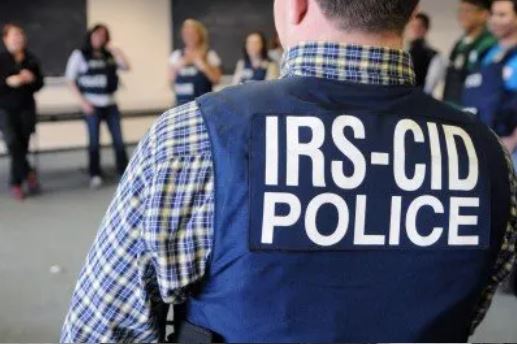
Hobbs’ proposed plan to increase ADOR was similar to the Biden administration’s recent accomplishment: expanding the IRS. In August, Congress voted to increase the size of the IRS by about 87,000 agents through the Inflation Reduction Act (IRA), a repackaged version of President Joe Biden’s Build Back Better (BBB) Act. Republicans decried the provision as a weaponization of the IRS that would cause disproportionate harm to the working class. Democrats dismissed those concerns, insisting that the IRS would only target the wealthy not paying their fair share of taxes, and that the IRA would mitigate inflation.
Last year, over 50 percent of all IRS audits targeted taxpayers making under $75,000 a year, which applies to about 171.6 million Americans (52 percent). About 25 percent of IRS audits applied to taxpayers making between $75,000 to $200,000, which applies to about 118.8 million Americans (36 percent).
In all, 75 percent of audits may apply to the 290.4 million Americans that comprise 88 percent of the population (about 330 million).
Over 75% of IRS audits targeted Americans making under $200,000 per year.
Democrats want to hire 87,000 new IRS enforcers to target the middle class even more. pic.twitter.com/cxmCqE4eBN
The bill that Hobbs cosponsored in 2018, SB1324, proposed the addition of two corporate income tax audit managers, 28 corporate income tax auditors, two transaction privilege tax managers, 28 transaction privilege tax auditors, two transaction privilege tax license compliance staff managers, 18 transaction privilege tax license compliance staff members, 40 tax collectors, and 11 support staff members.
The bill died quietly, having never received a vote in any committee. Its House companion, HB2137, experienced the same fate.
At the time, Governor Doug Ducey expressed a desire to expand ADOR — but by 25 tax collector positions that had been eliminated several years prior, about 80 percent less than what HB2137/SB1324 proposed. Ducey was looking for ways to make up about $83 million in lost audit revenue.
Corinne Murdock is a reporter for AZ Free News. Follow her latest on Twitter, or email tips to corinne@azfreenews.com.
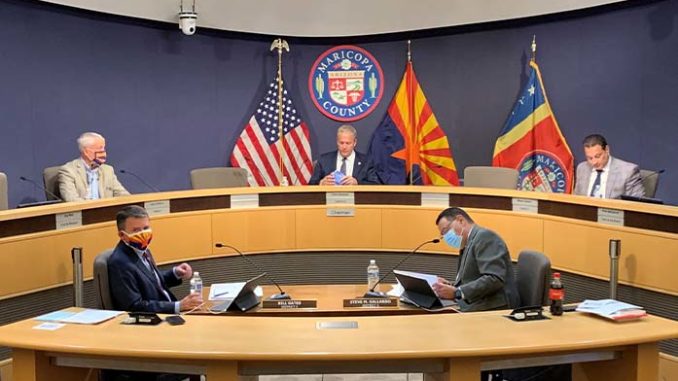
On Thursday, the Department of Justice (DOJ) arrested an Iowa man for allegedly threatening Maricopa County Supervisor Clint Hickman.
64-year old Mark Rissi reportedly told Hickman in a voicemail last September that he was going to lynch and hang him for being a “lying commie” for supporting the results of the 2020 election. Rissi also issued a similar threat to Hickman via a voicemail left with Attorney General Mark Brnovich’s office in December.
“When we come to lynch your stupid lying Commie [expletive], you’ll remember that you lied on the [expletive] Bible, you piece of [expletive],” said the voicemail. “You’re gonna die, you piece of [expletive]. We’re going to hang you. We’re going to hang you.”
Although the DOJ press release announcing Rissi’s arrest didn’t identify Hickman as the subject of Rissi’s alleged threats, Hickman spoke out in a press release of his own to thank the DOJ and FBI. However, Hickman said that the DOJ’s actions weren’t enough because there were many other threats made to him, fellow supervisors, Recorder Stephen Richer, and numerous county elections staff.
Hickman also chided Arizonans “in positions of power [and] leadership [and] influence” for being silent.
“I’m speaking out today in hopes that others will follow. Whether it’s a person who shares your politics or your worldview or not, no one should be subjected to this kind of hatred,” stated Hickman. “And if we truly want to keep our country great, we will do everything we can to denounce threats against election workers and combat the disinformation that imperils our democracy.”
Today @thejusticedept announced the arrest of a man who threatened to hang Maricopa County Supervisor Clint Hickman. Here is his response. pic.twitter.com/SvKFyn6PVJ
Maricopa County took another step to counter election disinformation recently. They launched a disinformation center and limited press access last week to control the narrative and manage the flow of information.
So far, the FBI has taken action against those who issued threats to elected officials critical of the 2020 election audit and claims of fraud. They haven’t made arrests for those threats made to Republican officials supportive of the audit, such as death threats given to Senate President Karen Fann (R-Prescott) and State Senator Michelle Ugenti-Rita (R-Scottsdale).
In August, the FBI charged a Missouri man for threatening Richer. In July, they arrested a Massachusetts man for threatening Secretary of State Katie Hobbs.
This latest arrest comes two days after the DOJ briefed 300 election officials and workers on available grant funding for physical election security enhancements, some of which may come from the American Rescue Plan; among those in attendance were election officials and their representatives from Arizona. The DOJ also updated the election officials on their Election Threats Task Force.
That task force, which launched last June, has reviewed over 1,000 contacts reported as hostile or harassing by the election community. The task force reported that only 11 percent of those contacts warranted an investigation. It’s unclear whether the threats faced by those such as Fann and Ugenti-Rita met the DOJ’s threshold.
CORRECTION: A previous version of this story listed the arrested man as being from Illinois. The man is from Iowa, and the story has been corrected.
Corinne Murdock is a reporter for AZ Free News. Follow her latest on Twitter, or email tips to corinne@azfreenews.com.
Katie Hobbs has her reasons for refusing to debate Kari Lake face-to-face in the race for Arizona Governor. But by doing so Hobbs is limiting the opportunities for Arizonans to hear her explain her history of supporting higher taxes while a member of the state legislature.
Hobbs, a Democrat currently serving as Arizona Secretary of State, has spent the last few weeks touting her promise to not raise taxes if elected. In fact, she is even promising to reduce taxes for many Arizonans even though it is doubtful that Democrats will control the legislature.
So with Hobbs making herself scarce for public questioning, voters are left to scrutinize her legislative history. And what can be found there casts doubt on her tax cut mantra.
Hobbs served in the Arizona State Senate from 2013 to 2019 and was Senate Minority Leader during much of that time. She also served one term as a member of the Arizona House of Representatives prior to the Senate.
In January 2018, Hobbs co-sponsored Senate Bill 1316 along with progressive Democratic Senators Juan Mendez, Jamescita Peshlakai, and Martin Quezada to eliminate the light class motor vehicle classification from Arizona’s fuel tax statutes.
But more importantly, SB1316 proposed to double the state’s per gallon motor fuel tax from 18 cents to 36 cents. The bill, which would have been one of Arizona’s largest tax hikes in state history, was so unpopular it was never heard by a Senate committee.
SB1316 is not the only time in Hobbs’ legislative history that she supported tax increases. In 2017, she was a fervent proponent of a sales tax increase that would have cost taxpayers between $500 and $600 million a year.
And back in 2015, Hobbs opposed critical legislation which was introduced to protect Arizonans from the effect of inflation on personal income tax brackets. The bill was eventually signed into law by Gov. Doug Ducey.
Hobbs’ legislative history on the subject of taxes is one reason organizations such as the Arizona Free Enterprise Club are encouraging voters to look at facts, not campaign speeches when it comes to Hobbs’ promise of tax cuts.
“Anyone who has followed Hobbs’ political career knows that this is just another outrageous lie,” AFEC posted Wednesday. “During her time in the state legislature, Katie Hobbs regularly opposed tax cuts for families while making it a habit to support multiple tax hikes….Hobbs has spent her political career trying to squeeze every possible dollar from your bank account.”