Will Of The People is urging voters to vote “no” on Propositions 128, 129, and 132 which are on the 2022 General Election ballot. But who is behind those efforts came under scrutiny this week upon the filing of the group’s latest campaign finance report.
The website for Will Of The People notes 20 percent of contributions are “coming from out of state,” although a recent political mailer reflects an out-of-state contribution rate of 43 percent. However, that rate could be as high as 99.9 percent based on the $324,959.44 the group received July 17 through Sept. 30.
It is the corporate contributions listed on group’s 2022 post-primary election (Q3) Schedule C4b which has garnered review, including 11 payments from Washington, D.C.-based The Fairness Project totaling more than $254,633. The other cash contributions came from Berkeley-based Every Single Vote ($70,000) and another D.C.-based donor, Ballot Initiative Strategy Center ($326.11).
Another $33 total in cash came from four individual contributors in Arizona, according to the PAC’s treasurer, Dacey Montoya.
The Fairness Project is funded in turn by the Service Employees International Union (SEIU), which is “dedicated to improving the lives of workers and their families and creating a more just and humane society” and has won praise from U.S. Secretary of Transportation Pete Buttigieg.
While Will Of The People is focused on Props 128, 129, and 132, SEIU is behind Healthcare Rising AZ, which supports efforts to amend Arizona statutes by adding restrictions to how medical debt can be collected. Healthcare Rising AZ recently received $15,000 in contributions from the Maricopa County Democratic Party and Arizona Democratic Party.
THE PROPOSITIONS:
Prop 128 would amend the Arizona Constitution to allow the state legislature to amend, divert funds from, or supersede an initiative or referendum measure enacted by the people of Arizona if the measure is found to contain illegal or unconstitutional language by the Arizona or United States Supreme Court.
Currently, state law prohibits legislators from correcting the illegal or unconstitutional language. A “yes” vote would amend the Constitution to allow such corrections, while the “no” vote advocated by Will Of The People would leave the restrictive prohibition in place.
Prop 129 would amend the Arizona Constitution to limit an initiative measure to a single subject and require that subject to be expressed in the title of the initiative measure. A “yes” vote supports the proposed amendment while a “no” vote shall have the effect of retaining existing law on initiative measures.
Prop 132 would amend the Arizona Constitution relating to initiative and referendum measures by requiring any initiative or referendum that seeks to approve a tax to receive at least 60 percent of the votes cast to become law. A “yes” vote is for amending the Constitution while a “no” voter leaves the existing law of 50 percent plus 1 in effect.
Democratic congressional candidate Kirsten Engel pledged support for reallocating police funding to social programs and replacing police with social workers.
The University of Arizona (UArizona) law professor made those remarks in a resurfaced 2020 Clean Elections interview, which her Republican opponent Juan Ciscomani shared.
“What we need to do is shift where the money is going. Not every 911 call requires a police officer to show up at your door,” said Engel.
IN HER OWN WORDS:
“Defund the police. Would you support a reduction in police budgets…”@EngelForArizona: “Yeah… the way you’ve asked that question, I agree with it.”
In Kirsten Engel’s America, our police are defunded and our neighborhoods are left unprotected. #AZ06 1/ pic.twitter.com/vB1QtqVMOc
In June 2020, Engel sided with Tucson Councilwoman Lane Santa Cruz after she accused Tucson police officers of murder and violence concerning the death of a man in custody.
The man in question, Carlos Ingram-Lopez, died from cardiac arrest due to excessive cocaine in his system. Contributors to Ingram-Lopez’s death bore striking similarities to that of George Floyd’s less than a month earlier: a drug overdose, enlarged heart, and physical restraint. The Tucson Police Officers Association (TPOA) disclosed that the officers Santa Cruz accused falsely of killing Ingram-Lopez resigned out of fear for their families’ safety.
Engel criticized TPOA for speaking out against Santa Cruz’s fabrication. She accused TPOA of bullying and intimidation.
Then-Police Chief Chris Magnus offered to resign over Ingram-Lopez’s death. The city rejected his resignation. Magnus would later be appointed as the head of the U.S. Customs and Border Protection (CBP).
At the height of the BLM riots, Engel donated to the Arizona Justice Bailout Fund, which pledged to use donations to bail out BLM protestors. That bailout fund was launched by the scandal-ridden Our Voice Our Vote Arizona in conjunction with Arizona Coalition for Change.
Engel’s 2020 advocacy marked a departure from her previous years in the state legislature, when she was endorsed by the Fraternal Order of Police (FOP).
I am thankful that the Fraternal Order of Police have put their trust in me to help make where I can. pic.twitter.com/NP2alF0UYv
Engel’s social media postings about police slowed after the summer of 2020, when she signaled support for the sweeping police reforms and the Black Lives Matter (BLM) protests across the nation. Additionally, Engel’s campaign platform doesn’t address policing at all. However, Engel’s recent campaign actions indicate that her perspective on policing hasn’t veered too far from her 2020 stance.
In June, Engel signed a pledge by the Reparations Pledge PAC. That PAC and its founder, Redeem Robinson, advocate for defunding the police.
Corinne Murdock is a reporter for AZ Free News. Follow her latest on Twitter, or email tips to corinne@azfreenews.com.
An order last month by Gilbert Mayor Brigette Peterson for town police officers to remove three people from a council meeting has resulted in a notice of claim being served against town officials for First Amendment violations.
A notice of claim is required under Arizona law before a party can initiate a lawsuit against a public entity. On Thursday, such a notice was served on the Gilbert mayor and council members on behalf of Ryan Handelsman, Dr. Brandon Ryff, and Joanne Terry, who contend they were forced out of Sept. 20 town council meeting for engaging in constitutionally protected speech.
According to attorney Tim La Sota, his three clients attended the meeting during which dozens of protest signs were taken into the council chambers. Some of the signs were printed with the phrase “Stop Lying” while others read “Don’t Mesa My Gilbert.”
Peterson interrupted the meeting at one point and ordered a Gilbert police officer to remove a 6-inch by 24-inch “Stop Lying” sign Terry was holding in the back of the room. Terry set the sign down and the officer did not confiscate it.
A short time later, Handelsman addressed the mayor and council during the call to the public to challenge town officials to cite a statute or code being violated by those holding signs. Then Handelsman, Ryff, and Terry each decided to silently hold their signs.
“The Mayor halted the meeting and ordered the police to remove Dr. Ryff, Mr. Handelsman and Ms. Terry from the room. The police escorted them out of the meeting without incident,” according to the notice of claim, which notes the town code does not prohibit signs in the council chambers.
A First Amendment obstruction or retaliation violation could cost the town tens of thousands of dollars in legal fees plus potential damages to each of the three claimants. However, La Sota says his clients will settle for $1, but it will also cost something other than money.
In exchange for a complete release of their claims, the claimants will accept $1 as damages if Peterson and the town of Gilbert issue an official apology, La Sota wrote. In addition, Peterson would have to attend a First Amendment training class.
According to the notice of claim, Handelsman, Ryff, and Terry acknowledge that the government “need not tolerate actual disruptions of government business” and that courts have held that municipalities may enforce “certain free-speech restrictions.”
But those restrictions apply to time, place, and manner of public comment, La Sota noted, and even then courts have ruled such restrictions “must be reasonable, consistently enforced, and fall within constitutional parameters.”
Free speech restrictions by the government are also reviewed to ensure they “are both viewpoint neutral, equally and consistently enforced, as well as narrowly-tailored to meet the needs of the governing body to conduct its business, free of actual disruptions,” La Sota noted.
It is also not allowable to engage in retaliation against someone for asserting their First Amendment rights, which is what the notice of claim alleges Peterson did when she ordered Ryff removed. La Sota points to Ryff’s critical comments about the mayor during his call to the public comments at the prior council meeting.
“Then, at the very next meeting, 50 ‘Stop Lying’ signs show up with essentially the same message,” the notice of claim states, adding that Ryff contends Peterson believed Ryff was responsible for the signs.
“Dr. Ryff’s rights were violated by a vindictive Mayor who seized the opportunity to retaliate against him for years of political opposition and for having filed ethics complaints against her in the past,” the notice of claim states.
The notice of claim further alleges Handelsman, Ryff, and Terry were not being disruptive in how they displayed their signs at the Sept. 20 meeting. It also contends Peterson did not treat all sign-holders the same during that meeting, including an attendee with a visible “Don’t Mesa My Gilbert” sign who was not forced to leave the meeting.
“Certain persons silently holding signs in the back of the room may have been a distraction to the Mayor, but not every distraction is necessarily a disruption and not every disruption is an actual disruption which impedes the ability of the Council to do its business,” La Sota notes, citing a major First Amendment ruling from the Ninth Circuit of the U.S. Court of Appeals (Norse v. City of Santa Cruz, 2010).
Peterson later commented on her actions, arguing she could not read what was written on the signs. Yet that does not explain why his clients were ordered out of the council chambers while others with signs were allowed to remain, La Sota wrote in the notice of claim.
Town officials have 60 days to reject or accept the settlement demand included in the notice of claim.
Six U.S.-based global banking firms which participate in Environmental, Social, and Governance (ESG) practices that seek to restrict investment in companies engaged in fossil fuel-related activities are under investigation by 19 states, it was announced this week.
Arizona Attorney General Mark Brnovich and 18 other state attorneys general served civil investigative demands against Bank of America, Citigroup, Goldman Sachs, JP Morgan Chase, Morgan Stanley, and Wells Fargo related to each company’s involvement with the United Nations’ Net-Zero Banking Alliance (NZBA). The demands act as legally enforceable subpoenas.
NZBA-member banks have promised to set emissions reduction targets in their lending and investment portfolios to reach net zero by 2050. It is one example of ESG practices which have come under scrutiny for prioritizing policy initiatives ahead of sound investment strategies.
In the case of the NZBA initiative, it could lead to some farmers, oil leasing companies, suppliers, and other businesses connected with fossil-fuel production being unable to get loans or find investors from the six banking firms and their affiliates, according to Brnovich’s office.
“American banks should never put political agendas ahead of the secure retirement of their clients,” Brnovich said in announcing Arizona’s involvement in the investigation. “These financial institutions are entrusted with protecting a different type of green.”
Arizona, Kentucky, Missouri, and Texas are the leadership states on the NZBA investigation. Some of the 10 interrogatories included in the civil investigative demands served on the six banking firms seek information on:
All divisions, groups, offices, or business segments whose responsibilities relate or used to relate to membership in the Net-Zero Banking Alliance or to ESG Integration Practices, and identify all executives, directors, officers, managers, supervisors, or other leaders of each division, group, office, or business segment;
Each Global Climate Initiative with which the firm is affiliated and an explanation of the reasons for choosing to join such Global Climate Initiatives;
Who made the decision to join each Initiative, including any involvement or input from the Board of Directors, investors, or Covered Companies;
All involvement in each Global Climate Initiative, including dates as well as “any promises, pledges, or other commitments” made by each company;
A detailed description of the company’s involvement with the Net-Zero Banking Alliance, including identities of all individuals who have represented the company within the NZBA.
In August, Brnovich joined Arizona in a 21-state coalition in commenting on a U.S. Securities and Exchange Commission (SEC) proposed rule that would add requirements for investment funds which consider ESG factors in their investment decisions. The proposed SEC rule was seen by the states as an attempt to transform the agency from a “federal regulator of securities into a regulator of social ills.”
The same month, Arizona was one of 19 states which sent a letter that put investment firm BlackRock on notice that its actions on a variety of governance objectives may violate multiple state laws by using “the hard-earned money of our states’ citizens to circumvent the best possible return on investment.”
BlackRock, which oversees some pension funds in those states, has been engaging in a “quixotic climate agenda” that appeared to be sacrificing pensioners’ retirements instead of focusing solely on financial return.
“Fiduciary duty is not lip service. BlackRock has an obligation to act in the sole financial interest of its clients,” the Aug. 4 letter stated. “Given our responsibilities to the citizens of our states, we must seek clarification on BlackRock’s actions that appear to have been motivated by interests other than maximizing financial return.”
And in November 2021, Brnovich announced a review of Climate Action 100+ and its investment company members which manage trillions of dollars in assets. This was prompted by concerns that the firms will put their ESG goals ahead of well-established fiduciary duties.
This could include inappropriate pressure and anticompetitive conduct against the members’ own clients and customers who do not comply with the ESG practices of Climate Action 100+, according to the attorney general’s office.
The Arizona Citizens Clean Elections Commission (AZCCEC) gubernatorial debate will take place on Sunday, following its postponement last week. Republican gubernatorial candidate Kari Lake promised to attend, but not Democratic candidate Katie Hobbs. It’s unlikely Hobbs will attend, given her consistent refusal to debate Lake.
Whereas before Hobbs had no Arizona PBS (AZPBS) or AZCCEC opportunities to showcase her platform due to her refusal to debate, Hobbs now has two opportunities: a special interview on Tuesday that caused the AZCCEC to split from AZPBS and the Arizona legislature to threaten to defund AZPBS, and the newly rescheduled Sunday debate.
🚨Breaking 🚨
Thank you to @AZCEC for rescheduling the gubernatorial debate with a new broadcast partner.
Arizona voters deserve this. I’m looking forward to being there. @katiehobbs, given how badly last week went for you, I hope you find the courage to join me. https://t.co/P0FCvP4M8s
Battinto Batts, dean of Arizona State University’s (ASU) Walter Cronkite School of Journalism and Mass Communication, defended the AZPBS decision to work around AZCCEC and the Arizona law on candidate debates. ASU owns AZPBS.
“It is our responsibility as a news agency to provide the public with access to the candidates who are running for office so they can learn more and make informed decisions,” said Batts.
ASU President Michael Crow concurred with Batts’ sentiment, saying that while he didn’t direct AZPBS to make a special exception for Hobbs, he did stress the importance of doing so.
“[I] did indicate that we need to continue to fulfill our mission of unbiased and nonpartisan coverage of public figures and talk to important people in the public realm like Lake and Hobbs to have the public learn of their views, even if there is no debate,” stated Crow.
AZPBS also offered Lake a one-on-one interview for Tuesday. However, Lake rejected the offer. She said she would only accept Tuesday’s invitation if it were reformatted to be a debate between her and Hobbs.
Hobbs accused Lake of avoiding difficult questions by refusing the invitation — similar to the accusations Lake leveled against her for months.
And there you have it. If Kari Lake can’t create a spectacle and has to take tough questions about her dangerous record, she won’t participate. https://t.co/A6EasmsZCF
Lake dismissed rumors that she or her supporters were planning to protest Hobbs’ interview at ASU.
Kari Lake supporters are not planning to waste their time today and “protest” at ASU. We are planning a lovely chicken dinner and candidate forum in Chandler tonight to talk about the actual issues facing Arizonans.
Even so, Hobbs accused Lake of stirring up violence against her and ASU.
Tonight, I will be appearing on Arizona PBS filmed at ASU. Kari Lake’s temper tantrum last week led to death threats and racial slurs toward their staff. Now, faculty and students are advised not to go on their own campus. I am outraged by her dangerous rhetoric. pic.twitter.com/MDhFfPcH4s
“This is what Arizonans have been asking for: a voting system that enhances our democracy and increases participation. It’s that simple… We know that when more people get involved and have a say, we have a state that reflects what Arizonans actually want.”
— Arizona Democratic Party Chairman, Senator Raquel Terán (D-Phoenix), speaking at a July 7 press conference about the now-invalidated, dark-money fueled Arizonans for Free and Fair Elections 2022 ballot initiative to roll back voter ID, allow same-day registration, allow outside money into elections offices, and thwart challenges to future ballot initiatives and election results.
– – –
There’s a powerful, secretive infrastructure gunning to flip Arizona blue. Its elements appear disparate, coincidental at best. In truth, each element has a specific role to play: some transient with the fervor and impact of an October surprise, others established with the consistency and familiarity that eludes scrutiny. It is the seeming disconnection of these elements that makes the left’s secretive infrastructure that much more powerful.
The principal source of power is money, and though the left often complains about dark money, they are its principal cultivator by far. Despite this fact, they’re very much in favor of a purported solution to dark money on the November ballot: the Voters Right to Know Act, or Proposition 211. Upon closer examination, the rationale for their support is clear: this proposition comes with neat carve outs ensuring that leftist dark money critical to their Arizona infrastructure remains untouched — namely from corporate media, Big Tech, most labor unions, and “nonpartisan” political action committees. If the proposition is successful, it will enable leftist actors to continue building onto their secretive infrastructure to gain a greater hold of Arizona politics.
If money is the lifeblood, then the body of the left’s secret infrastructure exists in the coordination of 501(c)(3) and 501(c)(4) nonprofits (C3 and C4, respectively), pop-up groups run by nonexistent people and entities that only exist for a few weeks around elections, mystery shell campaigns acting behind a veil on behalf of the Democratic Party and leftist organizations, and political action committees (PACs) dressing up their activity as grassroots work.
Dark money describes a shuffling of funds that intentionally obscures its origins and, ultimately, shapes its targeted political landscape to its liking. This shuffling is accomplished through networks of nonprofits, national organizations backed by a powerful few whose resources eventually shuffle down to more localized organizations.
As you read this article, more discernible traces of this leftist infrastructure are busy at work all around you. In the coming weeks, you will likely notice their fingerprints in campaign ads from groups with unfamiliar, novel names online, on the radio, on TV, and in your mail.
Some of those ads will originate from the Future Forward (FF) PAC, a D.C.-based organization funded initially by Facebook co-founder Dustin Moskovitz and a favorite of Silicon Valley Democrats. According to a trigger report, they paid nearly $246,500 collectively in recent weeks for ad campaigns opposing three of former President Donald Trump’s endorsed candidates: Mark Finchem for secretary of state, Kari Lake for governor, and Abraham Hamadeh for attorney general. Their ad buys were estimated to be a little over $82,100 per candidate.
Since nonprofits aren’t legally obligated to disclose their donors, even for election expenditures, they may trade funds back and forth in the dark at will. Effectively, the leftist infrastructure “washes” the money before it reaches its final destination — they’re arguably the best at it.
The leftist infrastructure far outspends the right. For example, in the 2020 Arizona Corporation Commission race, the left backing Democrats had around $10.2 million in outside spending versus Republicans’ $156,000.
Dark money critic Mark Kelly receives huge boost from dark money group in AZ Senate race https://t.co/lEPT40xutZ
A vast majority of this “washed” money traces back to a few with deep pockets: the Arabella Advisors (Washington, D.C.), the Tides Foundation (San Francisco, California), and George Soros (Katonah, New York). Each boasts revenues and expenditures in the billions annually.
Arabella Advisors issues funds through five distinct nonprofits: the Hopewell Fund, the Sixteen Thirty Fund, the New Venture Fund, the North Fund, and the Windward Fund. In the 2020 election, Arabella Advisors’ nonprofits funneled vast amounts of money into Arizona. The company has nearly $10 billion at its disposal. Their current president and CEO is Rick Cruz.
Arabella Advisors launched in 2005 under Eric Kessler: a self-described “serial entrepreneur” whose career began elsewhere within the left’s network, working as a national field director for the League of Conservation Voters (LCV). When the LCV executive director at the time, Bruce Babbitt (also former Arizona attorney general and then governor), moved up in the political world with the election of President Bill Clinton, Kessler got a boost, too. He became an Interior Department appointee under Babbitt. Once the Clinton administration ended, Babbitt joined former secretary of state Madeleine Albright’s National Democratic Institute (NDI), and shortly after, he launched Arabella Advisors. He remains a senior managing partner for the organization.
The Tides Foundation is one of many nonprofits within a larger network underneath the Tides Network, which is part of the Tides Nexus. It’s similar to another nonprofit within the network, Tides Advocacy (formerly the Tides Advocacy Fund, the Advocacy Fund, and the Tsunami Fund). The Tides Foundation is chaired currently by Roslyn Dawson Thompson, the former president and CEO of Texas Women’s Foundation (formerly Dallas Women’s Foundation), another left-wing nonprofit.
The Tides Foundation began in 1976 with Drummond Pike, a liberal political activist allied with Wade Rathke, who founded the defunct advocacy group esteemed by Secretary of State and gubernatorial candidate Katie Hobbs, Association of Community Organizations for Reform Now (ACORN). The organization received initial financial backing from Reynolds tobacco heiress Jane Lehman, who chaired the organization until her death in 1988.
Finally, George Soros is considered a principal financial backer for a wide array of Democratic Party efforts. Soros channels funds to various Arizona PACs and organizations through his Open Society Foundations (OSF). He also channeled funds through his Democracy PAC, which funneled over $1 million at least into Arizona for the 2020 election to Not Our Faith, Arizona Wins, and ProgressNow Arizona, respectively. The Democracy PAC gave $100,000 last year to Way to Lead PAC, chaired by Dacey Montoya. Montoya, also former chair of the now-inactive Not Our Faith, also owns the Money Wheel: a consulting firm that Democratic candidates and groups have paid hundreds of thousands into since 2018.
Leftist C3 and C4 nonprofits have a unique codependency in Arizona. While both receive tax-exempt income, C4s may engage in political activities like lobbying and campaigning while C3s generally may not.
Since C4s may engage in election activities, politically driven C3s fund C4s. However, those C3s don’t stop there. They ensure that their funds are spent properly by coordinating through grassroots lobbying. In contrast to direct lobbying, grassroots lobbying mobilizes the public on political issues.
In Arizona, major politically driven C3s include AZ Wins, One Arizona, ProgressNow AZ, and Save Our Schools Arizona (SOSAZ) Network.
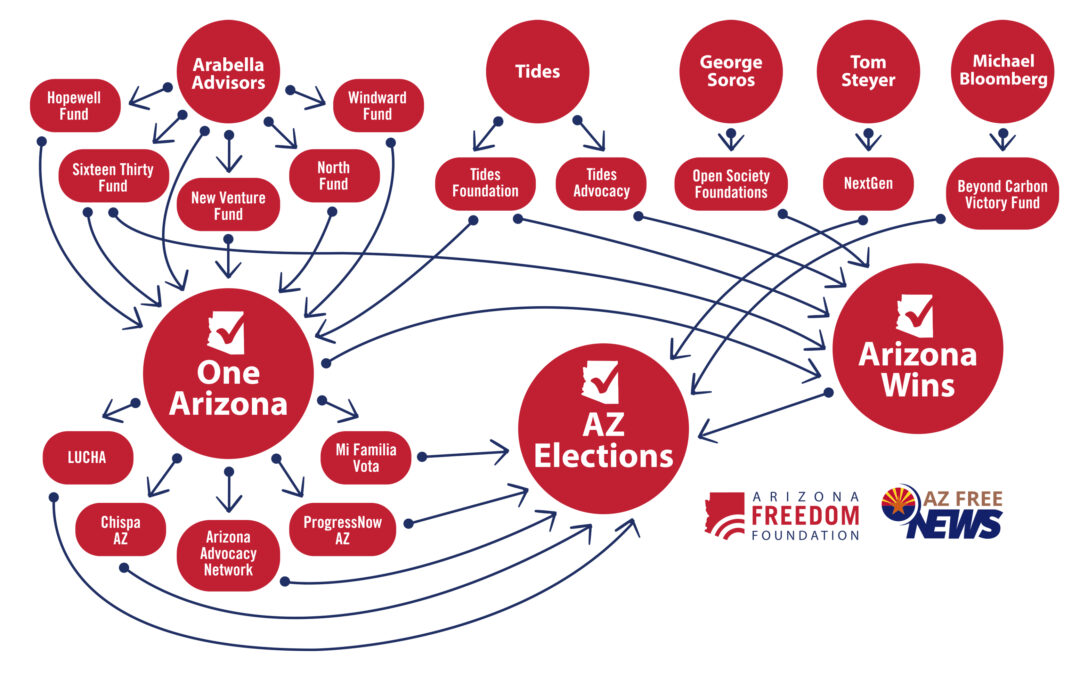
One Arizona exemplifies the C3 to C4 relationship. This C3 nonprofit is a coalition of leftist groups, among which is Mi Familia Vota, a C4. One Arizona routes funds to Mi Familia Vota and coordinates grassroots lobbying efforts. Their biggest funders include the Tides Foundation, George Soros’ Open Societies Foundation, and several different organizations under Arabella Advisors.
Hundreds of organizers are out talking to Arizona voters now. They've been out since 6 am and will be out til the polls close.
C3 resources and support put the wind in C4 sails. In 2020, it was Mi Familia Vota that successfully sued to extend the voter registration deadline another 18 days — just 11 days before the Election Day.
BREAKING:Voter registration deadline has been extended to October 23rd 5pm! Thank you @MiFamiliaVota & @OVOV_AZ! #MFV and so many grassroots organizations have been hard at work for more than a decade to ensure our voices are heard at the ballot box! This year was no exception! https://t.co/iQf6fZ0Exb
— Raquel Terán #BlackLivesMatter (@RaquelTeran) October 6, 2020
The Pop-Up Groups
Another integral component of the left’s secretive infrastructure exists within various “pop-up groups.” These are political groups that appear shortly before an election and become inactive after the election ends, made up to appear like an authentic group of concerned citizens and not political activists working on behalf of a party.
Oftentimes, the identifying information given by these pop-up groups upon registration is untraceable: faulty or fake phone numbers, addresses, and personnel. Yet somehow, even with their tight deadline and obscurity, these pop-up groups manage to have enough voter contacts and resources for mass outreach efforts.
This year, a pop-up PAC by the name of “Defend Arizona Rights” registered in late June. As of this report, nearly all of their income — which came from Damon Ely, a Democratic state representative and attorney from New Mexico — went toward a website to oppose Proposition 309 (SCR1012), the ballot measure to require voter ID.
A prominent example of a pop-up group from 2020 was “Arizonans for Energy Independence,” which focused on the Arizona Corporation Commission race. They registered with the secretary of state about two weeks before the election. Their listed phone number led to an alarm business, their address was a shipping service location, and the only listed officer appears to be a ghost. Those who signed petitions from NextGen America received text from Arizonans for Energy Independence in late October.
NextGen America (formerly NextGen Climate) is one of multiple major leftist C4s that bankrolls the leftist infrastructure.
The Shell Campaigns
Much like pop-up groups, leftist shell campaigns are driven and largely funded by a political party. Unlike pop-up groups, however, these shell campaigns last for the entire election year and usually hire several identifiable staffers. Markers of a shell campaign include political attack-dog websites, ad campaigns, and artificial demonstrations staffed by professional activists staged to look spontaneous.
One example of a shell campaign from 2020 was Arizona Families First — not to be confused with Arizona Families F.I.R.S.T., an Arizona Department of Child Safety (DCS) program for parental substance abuse.
The Arizona Families First PAC was live for all of 2020, then went inactive after the election. The Arizona Democratic Party was the primary bankroller, pouring $1.7 million total into the PAC; the party launched the PAC with $45,000 contributions from February to March of 2020.
The PAC spent close to $2 million altogether on outreach: over $1 million on mailers, $916,900 on digital ads, $25,000 on radio ads, and $10,800 on its website. It also spent nearly $21,000 on legal services from Coppersmith Brockelman — a go-to law firm for Democrats, from which the newly appointed Biden nominee for the Ninth Circuit Court of Appeals, Roopali Desai, hailed. The director of Arizona Families First, Ramon Alvarez, earned over $70,400.
With the 2020 election concluded and their work done, the PAC refunded their remaining $15,400 back into the Arizona Democratic Party last February.
Other major funders of the Arizona Families First PAC included tens of thousands respectively from the National Institute for Reproductive Health Action Fund, Healthcare Rising AZ, Working for Working Americans Non-Federal Arizona PAC, 314 Action Victory Fund, and Trilogy Interactive.
Several corporations gave thousands to the PAC: Zillow, Pepsi, Intuit, and Sanofi. Additionally, the PAC received a smaller donation from one of the prominent families contributing to the state’s leftist infrastructure: Abby Rockefeller.
An example of a shell campaign from this year was Arizonans for Free and Fair Elections PAC. They launched last December with the purpose of getting their eponymous initiative on the ballot, which aimed to roll back voter ID, allow same-day registration, allow outside money into elections offices, and thwart challenges to future ballot initiatives and election results. AZ Free News issued a detailed report in July on the leftist infrastructure funding behind this shell campaign.
According to the secretary of state’s campaign finance reporting site, the last expenditure for that shell campaign was $50,000 to the Barton Mendez Soto law firm last November — a month before the PAC registered with the secretary of state.
The Left’s Use of Arizona-Based PACs to Shuffle Money
There are over 900 PACs listed as active through the Arizona Secretary of State. Of these, a handful serve as consistent conduits for the leftist infrastructure’s funds under the title of grassroots work. These include One Arizona/Arizona Wins, Mi Familia Vota, Arizona Advocacy Network, ProgressNow AZ, Living United for Change in Arizona (LUCHA), Opportunity Arizona, Mijente, PODER in Action, Forward Majority Action Arizona, Way to Lead Arizona (Way to Lead PAC), and Future Now Arizona.
None of them broke the secretary of state’s campaign finance top ten for major income and expenditures this year. There are others who made that list: those who have raised and spent mass amounts of funds in a short window of time this year. They may be classified as shell PACs integral to the leftist infrastructure since they assume a local identity while receiving and distributing funds from out-of-state Democratic billionaires and the three primary financiers of Democratic money (Arabella Advisors, Tides Foundation, and George Soros).
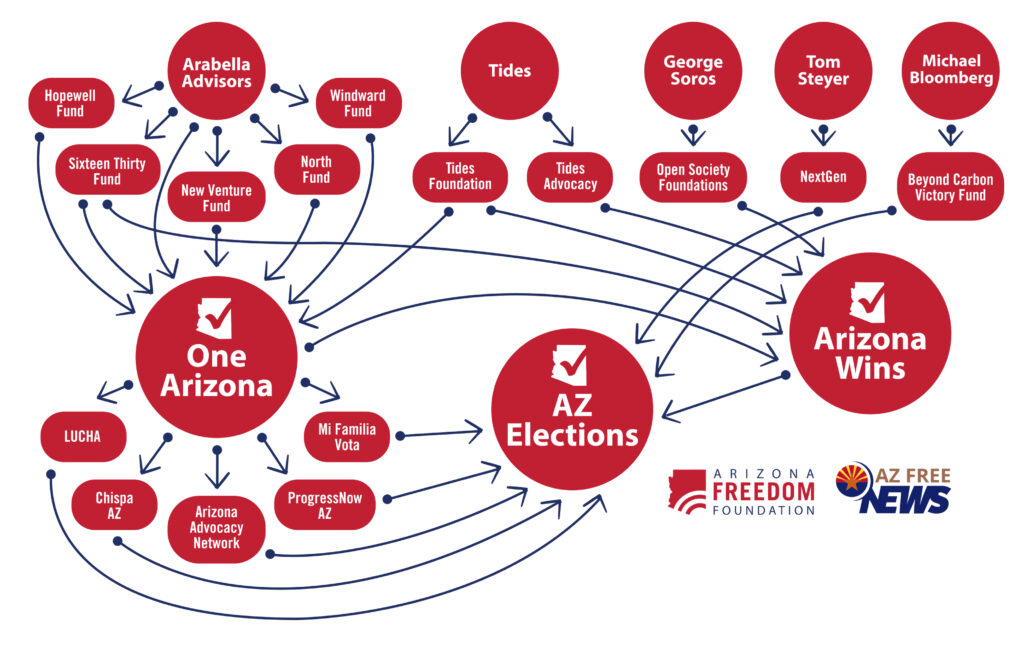
While not a complete pitcure, the above graphic illustrates some of the connections in the left’s secretive infrastructure and how they relate to Arizona elections.
According to the secretary of state’s campaign finance portal, these are the PACs with the top 10 incomes this year:
$8.2 million, The PAC for America’s Future – AZ
$7.6 million, Arizonans for Free and Fair Elections (review previous section for details)
$3.5 million, Arizonans Fed up with Failing Healthcare, or Healthcare Rising AZ
$2.2 million, Put Arizona First
$2 million, Worker Power PAC
$1.4 million, Our Voice Our Vote Arizona PAC
$1.3 million, DLCC Victory Fund
$775k, ActBlue Arizona
$737k, Arizona Pipe Trades 469
$665k, United Food & Commercial Workers Union of AZ Local 99
And these are the PACs with the top 10 expenses this year:
$5.2 million, Republican Governors Association (RGA) Arizona PAC
$3.4 million, Arizonans Fed Up with Failing Healthcare (Healthcare Rising AZ)
$3.3 million, The PAC for America’s Future – AZ
$2.2 million, Put Arizona First
$1.5 million, Republican Attorney Generals Association (RAGA) Arizona for Freedom PAC
$1.3 million, Arizonans for a Just Democracy
$885k, Planned Parenthood Votes
$817k, Southwest Regional Council of Carpenters Legislative Improvement Committee
$800k, National Rifle Association (NRA) Political Victory Fund
$786k, Arizona Pipe Trades #469
Of all these PACs, a prime example of the left’s money “washing” that’s also most cryptic in its origins and nature would be Arizonans for a Just Democracy. The PAC launched last July, with a mailing address located at the same UPS store in Phoenix as ProgressNow Arizona and Arizona Wins. Their website hasn’t been updated since their launch.
Arizonans for a Just Democracy only has four donors listed, of which three are: Merle Chambers, millionaire Democratic funder; the Arabella Advisors’ Sixteen Thirty Fund, and a ghost of a PAC called “The Future We Want.” That last PAC also has a mailing address at the same UPS store; its chair is Juliana Horwin, a former educator with the Arizona Education Association (AEA).
According to the Federal Election Commission (FEC), a similarly named Super PAC was active from 2018 to 2019 and its sole financier totaling $547,000 was a Phoenix-based PAC called “Citizens for Accountable Government” (yet somehow it spent over $716,000). Citizens for Accountable Government’s mailing address is also located at the same UPS store and shares the same treasurer as The Future We Want, Isis Gil of the Puente Human Rights Movement. Citizens for Accountable Government’s chair is Chris Love: the former Planned Parenthood Advocates of Arizona (PPAZ) chair. Their primary funds come from either The Future We Want or Arizona Wins.
Arizonans for a Just Democracy’s chair, Grecia Lima, is the national political director for Community Change (also known as Center for Community Change) and its advocacy arm, Community Change Action. Community Change receives mass funding from the Democratic network: Democracy Alliance, AFL-CIO, Planned Parenthood. The PAC’s treasurer is Sarah Michelsen: the senior campaign strategist for the ACLU, and as of June 2021 the owner of “Michelsen Strategies,” a Phoenix-based campaigning firm. From the moment Michelsen launched her firm until present, she’s raked in at least $18,300 from the Arizonans for a Just Democracy PAC.
Michelsen has worked with the Center for Progressive Leadership, Arizona Wins, NARAL Pro-Choice Arizona, Planned Parenthood Advocates of Arizona, and Bernie Sanders’ presidential campaign.
Then there’s PAC for America’s Future – AZ. Of their $8.2 million in income this year, not even half of a percent came from Arizonans ($16,800, composed of many individual donations ranging from $25 to $1,000). The vast majority of the PAC’s major funding came from Democrat billionaires. This PAC plays an integral role in ensuring Arizona’s leftist infrastructure is relied upon both locally and nationally — it passes along funds to PACs, organizations, and committees across other states. Only $106,000 went to Arizona candidates, all Democrats; $260,000 went to the Arizona Democratic Party. That’s four percent of their income this year.
As AZ Free News reported in August, about half of Healthcare Rising AZ’s funds came from the California union, SEIU United Healthcare Workers. Its main expenses were for signature-gathering efforts for its Predatory Debt Collection Act, a ballot initiative to thwart debt collection efforts.
The RGA Arizona PAC receives its funds from its national affiliate, the Republican Governors Association, and all of its expenditures went toward ad campaigns against Democratic gubernatorial candidate Katie Hobbs.
RAGA Arizona for Freedom has spent nearly equal amounts of over $700,000 each on ad campaigns to support Republican attorney general candidate Abraham Hamadeh and oppose Democratic attorney general candidate Kris Mayes.
Likewise, the NRA Political Victory Fund spent nearly equal amounts of over $400,000 each on ad campaigns to support Republican gubernatorial candidate Kari Lake and oppose Democratic gubernatorial candidate Katie Hobbs.
This is Part One in a series on the Democratic dark money network in Arizona. Be sure to sign up for our newsletter to be notified of Part Two in the series.
Corinne Murdock is a reporter for AZ Free News. Follow her latest on Twitter, or email tips to corinne@azfreenews.com.