by Corinne Murdock | Aug 6, 2023 | News
By Corinne Murdock |
Arizona Democratic lawmakers representing the border issued a public announcement on Tuesday declaring the border to be improved.
Neither of the senators behind the announcement, Brian Fernandez (D-LD23) and Rosanna Gabaldon (D-LD21), acknowledged the state of the border as a crisis.
Gabaldon indicated that ongoing concerns over the border were overblown, likening the border to a “political pawn” used to score points for voting bases. Gabaldon said that the 25 percent decline in border arrests last month and the decline in border encounters indicate an improvement in border security.
Customs and Border Protection (CBP) documented about 144,600 encounters last month, a decline from the 206,700 encounters in May. Last month’s encounters were 63,200 less than last June’s total, and 44,400 less than the total for June 2021. However, the total remains four times as many as the total for June 2020 (33,000) and 40,200 more than June 2019.
Under President Joe Biden, there has been an historic total of nearly 5.7 million illegal immigrant encounters at the southwest border.
With one more month in this fiscal year, terrorist illegal immigrant apprehensions by CBP at the southern border have reached 140, already surpassing last year’s total of 98.
Gabaldon did allude that illegal immigrants do continue to suffer in their attempts to evade legal ports of entry on their journey to the U.S., though she didn’t expand on her remark.
“We must begin to recognize the human cost of failing to address the border properly,” said Gabaldon.
Fernandez said that the public’s current understanding of the border as a crisis was due to “misinformation” and “pointing fingers” to assign blame. Fernandez added that reporting over the border crisis is “sensationalized” due to the decline in encounters and arrests.
Fernandez further said that leadership, including Gov. Katie Hobbs, were taking the right actions to mitigate the border crisis. He cited one meeting with Homeland Security Secretary Alejandro Mayorkas as proof of action.
“Governor Hobbs has already made a concerted effort to address our border needs,” said Fernandez.
Hobbs also held listening sessions in March to better gain a grasp on the state of the border. That same month, Hobbs began the process of ending former Gov. Doug Ducey’s Border Strike Force. Hobbs already removed the shipping containers closing up the border wall installed in the waning weeks of the Ducey administration.
The senators called for increased funding for legal ports of entry, declaring that’s where a majority of illicit trafficking occurs. The pair also called for citizenship opportunities for illegal immigrants.
“It is our responsibility to better protect our communities and those seeking asylum,” said Gabaldon.
“Our policies must offer a pathway to citizenship for those paying into our economy and communities,” said Fernandez. “It’s time we look at our immigration policy and present Arizona with a pathway forward that offers security and opportunity for all.”
The southern border hasn’t been alone in handling the illegal immigrant influx: the northern border has seen a marked increase in attempted illegal entries, especially by those wanted on criminal or terrorist charges. In June, Rep. Andy Biggs (R-AZ-05) began investigating reports of the northern border left unmanned while remaining open for 24 hours.
Corinne Murdock is a reporter for AZ Free News. Follow her latest on Twitter, or email tips to corinne@azfreenews.com.
by Corinne Murdock | Aug 6, 2023 | News
By Corinne Murdock |
Attorney General Kris Mayes is fighting the state of Idaho’s ban on minors traveling to other states to obtain an abortion.
Mayes joined a coalition of 20 Democratic attorneys general to challenge the ban in federal court.
Those in the challenge, led by the state of Washington, are California, Colorado, Connecticut, Delaware, Hawaii, Illinois, Maine, Maryland, Massachusetts, Minnesota, Nevada, New Mexico, New Jersey, New York, North Carolina, Oregon, Rhode Island and Washington, D.C.
In a Tuesday press release, Mayes cast those opposed to abortions for minors as “anti-choice extremists.”
“States are free to regulate abortion within their border, but Idaho’s restrictive law goes too far,” stated Mayes. “When a state like Idaho prevents it[s] residents from getting reproductive healthcare in their home state, those patients are entitled to seek out care in a state that lets patients make medical decisions without imposition of the government.”
Idaho law prohibits the recruitment, harboring, and transportation of mothers seeking abortions. In the amicus brief, the attorneys general argued that the law violated the rights of interstate travel and free speech, as well as infringed on the legality of abortion in surrounding states.
The attorneys general further argued that Idaho law posed an inappropriate, and even dangerous, deterrent to abortionists and pro-abortion organizations. They claimed that abortion was safe at virtually any stage of the pregnancy, but that delays could pose an increased risk to the mother.
Parental competence was also addressed by the attorneys general. The Democratic leaders argued that up to one-third of pregnant minors had unreliable, confrontational, or dangerous parents, citing research from the American Academy of Pediatrics.
Expanding abortion access has been a defining aspect of the Mayes administration so far. In March, Mayes formed a six-member Reproductive Rights Unit within her office: the first of its kind. Heading the unit is deputy solicitor general Hayleigh Crawford.
Mayes’ abortion rights unit bears resemblance to the Justice Department’s Reproductive Rights Task Force. Both have sought to fight against various states’ attempts to restrict or ban abortion and have fought legal challenges against the prohibition of the abortion-inducing drug mifepristone.
Last month, Mayes petitioned for the Biden administration to prevent the health information of women who received an abortion from being accessed for the purpose of any criminal, civil, or administrative investigations related to abortion restrictions or bans.
Mayes is also fighting to prevent the enactment of the state’s original law on abortion — a near-total ban — over the more recent law, a 15-week restriction.
Corinne Murdock is a reporter for AZ Free News. Follow her latest on Twitter, or email tips to corinne@azfreenews.com.
by Daniel Stefanski | Aug 5, 2023 | Education, News
By Daniel Stefanski |
Arizona’s schools’ chief is laser focused on protecting children in their places of education.
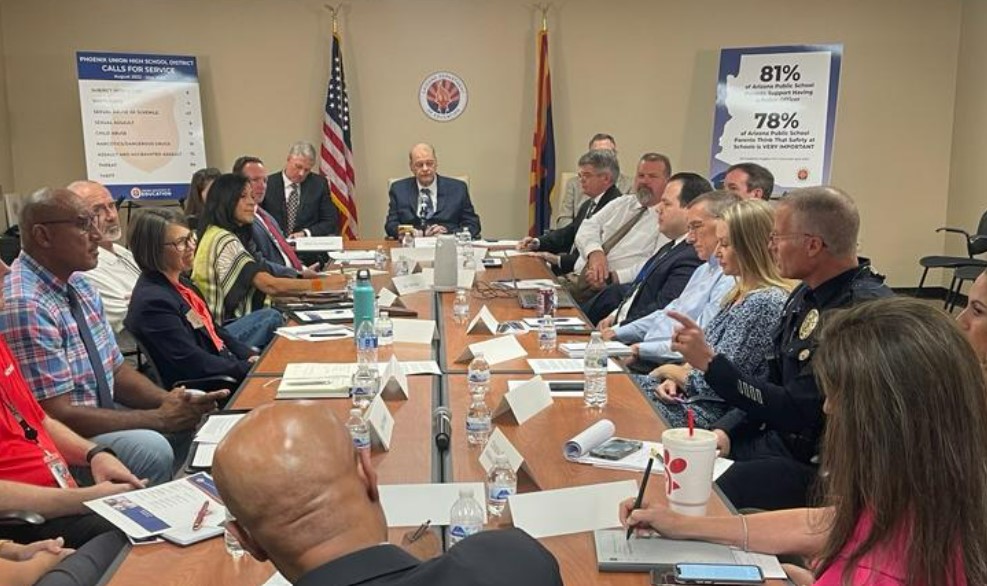
On Wednesday, Arizona Superintendent of Public Instruction Tom Horne announced that he had “convened the first School Safety Task Force with a focus on getting more armed officers in schools in concert with social workers to protect (the state’s) schoolchildren, educators, and staff.”
After the meeting, Horne released a statement, saying, “Protecting the lives of our children is one of the most important issues we face. We hope that the School Safety Task Force will work to increase the number of law enforcement officers and social workers in schools as well as using our role in Career and Technical Education to encourage more people to consider law enforcement as a profession. I am grateful for all of the educators, law enforcement professionals, community leaders and both Democrat and Republican elected officials who have come together in this vital, bipartisan effort.”
Freshman Republican Representative Matthew Gress, one of the participants in the meeting, added his thoughts on Twitter, writing, “As parents send their children to school, they have every right to expect they will come home safely. With experience as a former schoolteacher and school board member, I look forward to this opportunity to productively contribute to this very important conversation.”
Gress announced earlier this week that he had “accepted an invitation from Horne to serve on the Task Force recently established by the Arizona Department of Education. He noted that he had “particular interest in identifying how public schools can use available one-time funding to improve the capital facilities on campuses to improve school safety” and in “focusing attention on law enforcement response times to schools and bolstering the School Resource Officer program.”
The Arizona Department of Education highlighted that “in the meeting, department staff reported that funding for School Resource Officers (SROs) has been utilized to expand the number of SROs from 190 in the previous administration to 301 currently.” Additionally, the Department forecasted that “the group will explore ways to integrate counselors and social workers into an effective School Safety Program, expand the definition of an SRO in accordance with state certification requirements so the applicant pool can be enlarged; and consider allowing schools to hire School Safety Officers (SSOs), review training models, and review Law Related Education.”
In May, Superintendent Horne’s school safety recommendations were approved by the Arizona State Board of Education, giving the Department of Education approximately $100 million from a combination of federal and state grants. Horne said at the time, “I have been asking the schools to prioritize school resource officers. The nightmare is that a maniac gets into a school, kills 20 children, and the parents find out that the school could have had a school resource officer to defend the students, but the school did not do so. Imagine how the parents would feel about those decision makers?”
Horne isn’t the only elected official in Arizona concentrating on bolstering safety in schools across the state. Last month, Peoria Mayor Jason Beck announced that, in keeping his promises to his constituents, there would be a police presence at all Peoria Unified School District schools during the 2023-2024 year. Beck highlighted that there would be four new SLO’s (School Liaison Officers) and rotating SLO’s at every school; that this presence would be expanded to all elementary schools; that there would be 22 Peoria schools with police coverage and an increase in SLO salary.
The mayor said, “It’s the fact that we are trying to take care of our kids. Our first priority as a city is to take care of the residents. Safety and wellbeing is our first priority.”
Earlier this year, Republican Superintendent of Public Instruction Tom Horne and the Arizona Department of Education released the findings of a poll, which found that “81% of Arizona Public School parents support having a police officer” and “78% of Arizona Public School parents think that safety at schools is VERY IMPORTANT.”
Daniel Stefanski is a reporter for AZ Free News. You can send him news tips using this link.
by Corinne Murdock | Aug 5, 2023 | News
By Corinne Murdock |
Attorney General Kris Mayes is fighting to continue government’s collusion with social media to control online speech.
Mayes joined a 21-state coalition of Democratic attorneys general to oppose a federal decision prohibiting federal officials from coordinating with social media companies to control speech. In a press release, the attorney general stated that control over free speech is paramount to public safety, implying that the government’s interest in maintaining this safety outweighed the constitutional right of speech.
“Social media companies and government officials must have open communication in order to ensure the safety of Americans online,” said Mayes. “A pillar of the U.S. government is to ensure the safety and wellbeing of its citizens. The lower court’s decision impedes on this protection and means federal, state and local officials cannot contact social media companies about dangerous online content.”
In an appeal led by New York, the 19 other attorneys general hail from California, Colorado, Connecticut, Delaware, Hawaii, Illinois, Maine, Massachusetts, Michigan, Minnesota, Nevada, New Jersey, New Mexico, New York, Oregon, Pennsylvania, Rhode Island, Vermont, Wisconsin, and the District of Columbia.
The coalition’s brief characterized speech control as “content moderation,” and argued that the federal government should maintain the ability to do so since it’s been doing it “[s]ince the advent of social media.”
“[I]n the experience of amici States, information-sharing and dialogue have not been coercive, but rather, helpful in ensuring that social media companies make fully informed decision about their own content moderation policies,” stated the brief.
The Louisiana Western District Court issued a preliminary injunction last month that barred the federal government from colluding with social media companies to regulate speech on their platforms.
Arizona leadership from both parties have either called for or participated in censorship.
Last March, Maricopa County Recorder Stephen Richer worked with the federal government on tactics to control online speech. Richer met with the Cybersecurity and Infrastructure Security Agency (CISA) Cybersecurity Advisory Committee (CSAC) Misinformation & Disinformation (MDM) Subcommittee, all under the Department of Homeland Security (DHS).
Last September, Maricopa County rolled out a press pass program to control which outlets and reporters could gain access to government proceedings and property. Last November, the county launched a disinformation center and further limited press access. In April, Maricopa County paid a $175,000 settlement for denying press credentials to a reporter under their press pass program because his work didn’t constitute truth in their eyes.
This past March, Sen. Mark Kelly (D-AZ) asked the Federal Reserve, Treasury Department, and the Federal Deposit and Information Corporation (FDIC) whether they could work with social media companies to censor information in order to prevent a run on the banks.
Gov. Katie Hobbs, while in her former capacity as secretary of state, used the Center for Internet Security (CIS) as a middle man of sorts to censor online speech. Although requests were made for an investigation into the relationship, the transition of power in the attorney general’s office effectively made those requests dead on arrival.
Arizona government workers have also been trained by the Aspen Institute: the liberal think tank behind the coordinated cover-up of the Hunter Biden laptop story. The institute launched its first Arizona-based leadership program last year with startup funding from Walmart.
Corinne Murdock is a reporter for AZ Free News. Follow her latest on Twitter, or email tips to corinne@azfreenews.com.
by Corinne Murdock | Aug 5, 2023 | News
By Corinne Murdock |
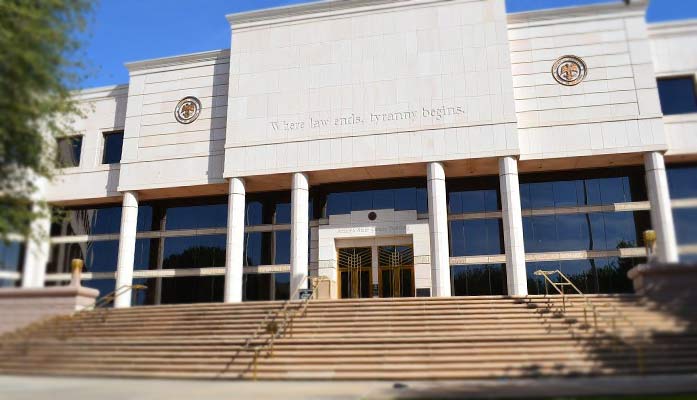
Republican Attorney General candidate Abe Hamadeh has taken his appeal for a new trial to the Arizona Supreme Court.
In the petition filed on Thursday, Hamadeh’s team argued that the state’s judicial branch had thus far failed to provide timely decisions in such a time-sensitive case. The trial court took 161 days to issue its order denying Hamadeh’s motion since the initial January filing, which included over 60 days for the judge to set oral argument, and another 60 days for the judge to issue his denial.
“Pointedly, the parties’ rights to speedy decisions have been grossly and repeatedly violated,” stated the petition. “Given the urgency to resolve all of these matters and the lack of a plain, speedy, and adequate remedy, a special action to this Court is warranted.”
Hamadeh declared that the public had the right to a full, unfettered review of the evidence. According to his petition, that amounts to “hundreds, if not thousands” of uncounted votes that would heavily weigh in his favor and, ultimately, determine him the rightful winner of this past election.
“Our justice system cannot tolerate the government withholding evidence,” tweeted Hamadeh. “Count the votes.”
This evidence, according to Thursday’s petition, indicates critical vote count discrepancies that undermine the integrity of the recount result’s 280-vote lead that declared Democratic opponent Kris Mayes the victor. This included the allegation that machine tabulators misread valid votes as undervotes.
Last month, the trial court rejected Hamadeh’s bid to further undertake the process and exploration of alleged vote count discrepancies uncovered through the recount.
Hamadeh filed a motion for a new trial in January based on alleged evidence of uncounted votes discovered through the recount process. In Thursday’s petition, Hamadeh counsel explained it wasn’t possible to obtain this evidence warranting a new trial until after the late-December evidentiary hearing.
“[T]he newly discovered evidence was information and data that government bodies not only failed to disclose but that they also wrongfully withheld,” stated the petition. “[S]tate and county officials used the power and purse of the government to take a substantive position in an election contest and to actively tip the scales of justice by withholding public records and concealing information that validated the vote count issues Petitioners raised at trial.”
The petition further argued that the trial court’s denial was due to a lack of procedural clarity in election contests, not lack of evidence.
“If elections in Arizona are to truly be free and equal, Arizonans must be assured that government bodies cannot use resource and information asymmetry to favor one candidate over another with impunity,” concluded the petition.
Corinne Murdock is a reporter for AZ Free News. Follow her latest on Twitter, or email tips to corinne@azfreenews.com.
by Daniel Stefanski | Aug 4, 2023 | News
By Daniel Stefanski |
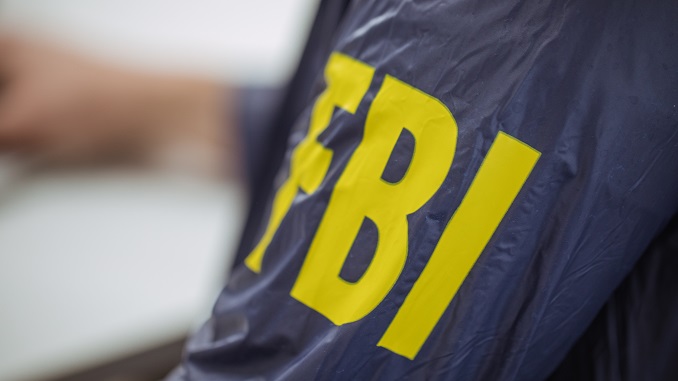
The Federal Bureau of Investigation (FBI) is warning Americans of a scam that is sadly targeting a growing number of individuals.
Late last month, the FBI issued a Public Service Announcement (PSA), “warning the public of a recent nationwide uptick in technical support scams targeting older adults, where scammers instruct victims to send cash, wrapped in a magazine(s), via shipping companies.”
The PSA informed readers that “tech support scammers usually initiate contact with older adult victims through a phone call, text, email, or pop-up window purporting to be support from a legitimate company,” informing those victims “of fraudulent activity or potential refunds for a subscription service.” Victims will then call the numbers provided to them by the scammers, who tell the victims “they have a refund for the victims” – but “the only way the money can be sent is by connecting to the victims’ computers and depositing it into the victims’ bank account.”
The victims will download software programs that unwittingly allow the scammers to gain access to their computer. Victims then follow instructions to sign into their bank accounts. The FBI notes that the scammers “supposedly transfer an amount to the victims’ bank account but ‘accidently’ deposits a much larger amount than intended,” which the victims are convinced to return to “save” the scammers’ jobs.
Lastly, “the scammers instruct the victims to send the money in cash, wrapped in a magazine(s), or similar method of concealment, via a shipping company to a name and address provided by the scammers.”
The FBI gives four tips for Americans to protect themselves against these scams. The first is for people to refrain from downloading software coming from strangers. The second cautions individuals to be vigilant with the people who have access to their computers. The third warns against clicking “on unsolicited pop-ups, links sent via text messages, or email links or attachments.” The final tip states that people should “never send cash via mail or shipping companies.”
Those who are being targeted by these scammers are encouraged to report these fraudulent or suspicious activities to the FBI Internet Crime Complaint Center at www.ic3.gov.
Daniel Stefanski is a reporter for AZ Free News. You can send him news tips using this link.