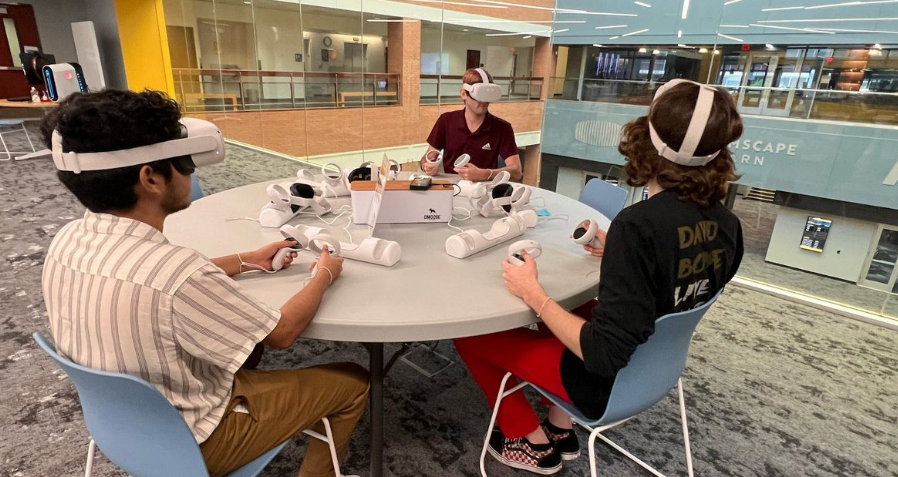
Arizona State University (ASU) has replaced its in-person labs with virtual reality (VR) for its introductory biology courses.
ASU officials explained that they made the switch to increase inclusivity after marking a decline in science, technology, engineering, and math (STEM) graduates. The university soft-launched the switch last spring to conduct a comparison study, with one class using VR labs and the other using traditional labs. ASU reported that “historically underrepresented” students in the class with VR labs performed better versus that category of students in the class with traditional labs.
Inside Higher Ed reported that students in the class with the VR lab enjoyed watching the cartoon animals and storylines presented, and that some cried when the fictional matriarch of a digitized dinosaur family died in one of the storylines.
Since the historically underrepresented students did well, ASU decided to transition all introductory biology classes to VR.
However, Barrett Honors students had media lab grades one point higher than the collective of students attending VR lab classes. (97 percent versus 96 percent).
Once the VR helmet is on and the wrist sensors are snapped in, students in Biology 181 are transported into another world. 🦕
Introductory biology classes aren’t the only use of VR at ASU campuses. The university is looking to use the technology for a wide range of other classes and programs, such as filmmaking and their Learning Futures program.
#ASU students at Learning Futures are developing a VR learning space called Huddle that will be tested by an ASU class this semester.
ASU began expanding its use of VR through its partnership with VR company Dreamscape in 2020.
In addition to logistical fixes with implementing VR for classes, ASU noted that it was seeking to improve diversity, equity, and inclusion arrangements: more diverse narrator voices, and more diverse avatar options to represent a wider array of the student population (such as body types, gender expression, disability).
Corinne Murdock is a reporter for AZ Free News. Follow her latest on Twitter, or email tips to corinne@azfreenews.com.
Arizonans who were under the impression that a Democrat governor in office would tip the scale in favor of more progressive policies are readjusting their expectations after the new state budget was signed into law.
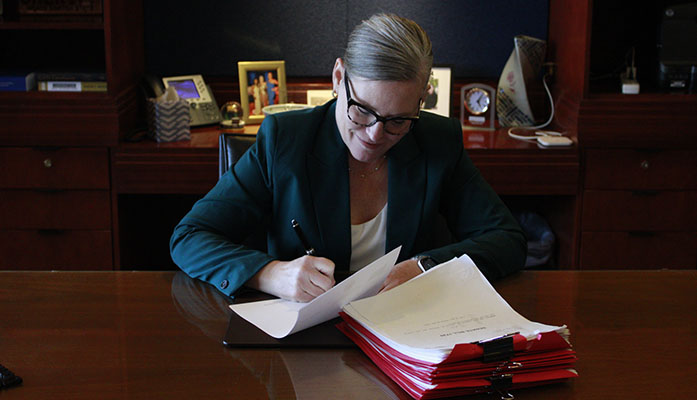
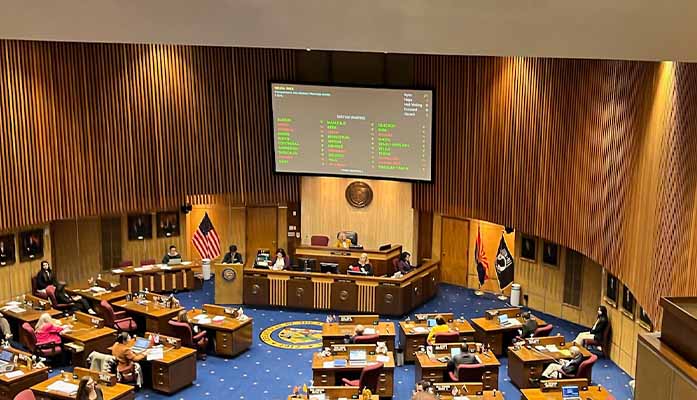
On Friday, Governor Katie Hobbs signed the budget sent to her earlier in the week by the Republican-led Arizona Legislature. The $17.8 billion budget was approved in both the House and Senate with broad bipartisan support, though several Democrats refused to back the compromise.
Many observers thought that with Arizona’s divided government and with the political animosity between state Republicans and Democrats, this budget wouldn’t become a reality until June or later. Veteran communicator Barrett Marson tweeted, “A lot of people said it couldn’t be done. A lot of pundits (me included) said there’d be no budget deal until June/July. We were wrong. Governor Hobbs, President Petersen and Speaker Toma came together to craft a budget with broad bipartisan support. There’s a lot to like. Let’s celebrate.”
A lot of people said it couldn't be done. A lot of pundits (me included) said there'd be no budget deal until June/July. We were wrong. @GovernorHobbs@votewarren@RepBenToma came together to craft a budget with broad bipartisan support. There's a lot to like. Let's celebrate!
Though both sides received concessions in the budget, it appears that Republicans were the significant winners in the deal thanks to the shrewd negotiations employed by Petersen, Toma, and members of their staff. Both chiefs of staff, Josh Kredit (Senate) and Michael Hunter (House), have dealt with the state budget for a number of years and gave their bosses an extreme advantage when coming to terms with Arizona’s chief executive.
Petersen took a victory lap after the governor’s signature ended the budget saga for this fiscal year, stating, “We’re able to do this for our citizens, while also reducing government spending by $300 million. In fact, this is the first budget since 2017 where we have not added any new ongoing spending above formula increases. Additionally, Senate Republicans prevented the Governor and Democrat Legislators from advancing their extremist agenda. State-funded abortions and tuition-free college education for undocumented immigrants will not happen in Arizona. We are not getting rid of state-funded border security resources to keep our communities safe, especially as the Biden Administration foolishly lifts Title 42. We’re also not capping, cutting or eliminating the historic universal school choice program that now has more than 50,000 participants. Needless to say, your Republican Majority at the Legislature will continue to fight to protect Arizona from turning into California at the hands of the radical left.”
FOR IMMEDIATE RELEASE: Senate Republicans Reduce Spending, Provide Historic Tax Rebates to Families, Protect School Choice and Stop Democrats' Extremist Agenda with 2023-2024 Budget pic.twitter.com/1nJvW6hehc
After the House cleared the budget on Wednesday, Speaker Toma also championed this major achievement for his chamber and caucus: “From day one, our Majority has been focused on getting the job done for our constituents: putting Arizona families first, protecting the vulnerable, and growing opportunity and freedom. We’re conservatives. We believe you should keep more of your money and the government should spend less. That’s why we believe this is Arizona’s Budget — a budget that reflects our needs, gives back, spends smart, and addresses real issues. We needed a budget that the Governor would sign that accomplishes our goal of putting Arizona families first. This budget accomplishes both.”
🚨BREAKING NEWS FOR IMMEDIATE RELEASE🚨
‘Arizona’s Budget’ Approved by House of Representatives Puts Families First, Gives Back, Spends Smart, and Addresses Real Issues
House Republican Leaders hailed the budget’s passage as a huge win for Arizona families and the state:
— Arizona House Republicans (@AZHouseGOP) May 10, 2023
Cathi Herrod, President of the Center for Arizona Policy, also praised Republican leaders for protecting the future of family values in the budget. She wrote, “I credit Senate President Warren Petersen and House Speaker Ben Toma for standing strong against any pro-abortion funding or other measures. The popular universal Empowerment Scholarship Account (ESA) program did not get a cap or any restrictions, which is great news for all Arizona families who want to choose the best educational environment for their children.”
The Senate Republicans shared additional highlights from the Fiscal Year 2023 budget:
Education: $680 million in new education investments, including a $300 million infusion into K-12, an $88 million ongoing increase to per pupil funding, and $183 million for school capital funding
Public Safety: $256 million, including operational investments for the Departments of Corrections, Public Safety, and Emergency and Military Affairs, as well as $36 million in local sheriff and police department support
Transportation: $610 million in state and local transportation projects, including $89 million to expand lanes on the I-10, $76 million to expand lanes on the I-17, as well as $54 million in pavement rehabilitation for roads affected by winter weather
Tax Cuts: $260 million for the Arizona Families Tax Rebate, which will provide up to $750 to taxpayers with children and adult dependents
Health and Welfare: $342 million, including $150 million for the Housing Trust Fund to develop more affordable housing, $60 million for emergency homeless services and temporary shelters, as well as $14 million specifically allocated for veteran housing and employment services
Natural Resources: $174 million in natural resource investments, including $143 million in reallocated funding for targeted water-related projects
Daniel Stefanski is a reporter for AZ Free News. You can send him news tips using this link.
An Arizona legislator’s persistent efforts to push one of his bills across the finish line appears to be finally paying off.
On Wednesday, Republican Representative Alex Kolodin announced that his chamber had passed HB 2561, which is “an emergency measure that directs a municipality to provide water service through a standpipe until 2026 to up to 750 households that lack access to sufficient water if those households had previously received water service from the municipality, the municipality is reimbursed for providing water service and providing this water does not reduce water available to the municipality or the households.”
The issue stemmed from an action taken by the City of Scottsdale on water hauling operations to Rio Verde Foothills, an unincorporated community of approximately 2,000 homes. According to the Arizona House fact sheet, “Scottsdale ceased providing water for hauling to Rio Verde Foothills in 2023” because the Bureau of Reclamation’s declaration of a Tier 1 shortage on the Colorado River triggered the city’s “Drought Management Plan, which required that when a Tier 1 shortage occurred, any water hauling operations would cease unless the customer could prove the hauled water was being directly supplied to a resident or business within the city’s limits.” Approximately “500-700 households depend on the delivery of hauled water” in this case.
HB 2561 passed the House with a robust bipartisan vote of 46-13 (with one vacant seat).
One of Kolodin’s colleagues shed valuable light on the bill’s slog through the chamber before its passage. Republican Representative Justin Heap reminded Arizonans that the eventual success of HB 2561 occurred on the fourth attempt to pass the bill, tweeting: “Politics is a profession defined by indolence & self-aggrandizement. Because of this, truly remarkable efforts by leaders to help the people they represent often go unnoticed & unrewarded. For this reason, I would like to acclaim my colleague @realAlexKolodin of District 3. No bill has been more fiercely contested or required more effort this year then the task of getting water to the 900 residents of Rio Verde Foothills (“RFV”) who’ve been without reliable access to water since 2022. As their House Rep Alex made it his mission to get them water. It was a herculean task for a freshman legislator, against opposition from cities, the county BofS, the Governor’s Office, even his own party. Alex was undaunted. I share the thin office wall with Kolodin & every day overheard him making calls to residents, experts, & lawmakers. His bill HB2561 failed 3 times on the House floor. Each time it failed Alex went to no votes & worked with them, addressing their concerns & amending the language, to get an agreement. The number of yes votes improved each time it failed & Alex went back to the negotiating table. In order to get an Emergency Clause in the bill & get RVF water before the summer heat, Alex would need 40 votes. So he crossed the isle & worked with House Democrats to craft a bipartisan solution. Alex was still meeting with opponents on the day of the vote to find an agreement. When the final count on HB2561 came in at 46-13 watching Alex collapse back into his chair with relief & exhaustion was one of the most memorable moments of the session for me. Little of what we do as legislators has much real impact on the lives of everyday citizens of Arizona. But 900 people in a district of a quarter million has clean drinking water bc their Rep. cared enough to fight tirelessly for them against all odds & it was inspiring to watch. @realAlexKolodin is an example to what representative government should be & LD3 is lucky to have him. Alex recently reminded me of a verse from the Torah, which is God’s counsel to those chosen to be leaders, ‘Tzedek, tzedek, tirdof’ ‘Follow justice and justice alone’ – Deut. 16:20 You exemplified that calling in this fight, my friend. I’m honored to serve with you!”
Politics is a profession defined by indolence & self-aggrandizement. Because of this, truly remarkable efforts by leaders to help the people they represent often go unnoticed & unrewarded. For this reason, I would like to acclaim my colleague @realAlexKolodin of District 3. pic.twitter.com/itTZ6MNK13
— Az State Rep. Justin Heap (@azjustinheap) May 11, 2023
In Kolodin’s release, he shared information about the current state of events in the Rio Verde Foothills area and the objectives of his bill, writing, “The EPCOR private water company has agreed to provide a long-term solution to install their own water standpipe but this cannot be accomplished for about two years. In the interim the City of Scottsdale has agreed to provide water to the residents through EPCOR but states that they will only sign a contract with a government entity as the go between party between them and EPCOR. This bill creates a temporary standpipe district that can be that go between entity.”
Per Representative Kolodin, the Senate will have the opportunity to vote on the bill on Monday.
Daniel Stefanski is a reporter for AZ Free News. You can send him news tips using this link.
Microsoft founder Bill Gates will deliver the keynote speech for this year’s Northern Arizona University (NAU) graduation.
Gates will deliver the keynote address on Saturday during NAU’s 3 pm ceremony for the College of Engineering, Informatics, and Applied Sciences as well as the College of the Environment, Forestry, and Natural Science. NAU will also award Gates with an honorary doctorate.
NAU President José Luis Cruz Rivera said in a press release that Gates was a thought leader that exemplified NAU values.
“It is our privilege to recognize Bill Gates for his pioneering work in science and technology and his long standing thought leadership and philanthropic commitment to creating a world where every person has the opportunity to live a healthy life and live up to their full potential,” said Cruz Rivera.
Gates has advanced and pioneered on several progressive initiatives in science and technology. Most recently, Gates shared with ABC News that he would like the country to rely mainly on nuclear energy in the future to achieve energy independence. Gates also believed that artificial intelligence (AI) should be advanced most for use in health and education.
In recent decades, Gates has also bankrolled efforts to normalize the consumption of bugs or lab-grown meats as an alternative to meat.
Last year, Politico revealed that Gates had helped orchestrate the global responses to the COVID-19 pandemic. Gates’ philanthropy — the Bill & Melinda Gates Foundation, one of the largest in the world — identified vaccine developers and invested in each step of the vaccine development process. His organization also played a role in a global distribution plan for the shots.
In his statement, Cruz Rivera also expressed gratitude that the Bill & Melinda Gates Foundation provided significant financial support to the university.
“As NAU advances its mission to deliver equitable postsecondary value, we are honored to have the support of the Bill & Melinda Gates Foundation as we seek to ensure that the talent and aspirations of people in Arizona and beyond are met with the opportunity to realize economic mobility and social impact—shaping a brighter future for themselves and the communities they represent,” said Cruz Rivera.
Gates’ organization donated just over $500,000 to NAU last October for expanding equity.
On Tuesday, Gates wrote in his blog that he agreed to give a commencement speech at NAU because he believed NAU was “redefining the value of a college degree.” Gates dismissed the traditional notion that the more prestigious and exclusive schools were, the more valuable the degree. Gates said that accessibility, affordability, and economic mobility were better metrics to determine the value of a college’s degree, and declared that NAU was an “emerging leader” by that standard.
NAU had a 57 percent six-year graduation rate as of the latest Arizona Board of Regents data from 2021. Last summer, NAU didn’t rank within the top 100 of the nation’s best universities. They ranked 288.
Gates commended NAU’s achievements in diversity, equity, and inclusion: he praised the fact that nearly half of all NAU’s 30,000 students were “people of color,” mainly Hispanic or Native American, as well as the fact that many were first-generation college students or from low-income families.
Gates commended NAU’s equity-based financial aid structure favoring Native Americans from Arizona tribes over other races.
Corinne Murdock is a reporter for AZ Free News. Follow her latest on Twitter, or email tips to corinne@azfreenews.com.
The city of Phoenix began cleaning up the mass homeless encampment known as The Zone this week, after attempts to resist a court injunction to do so. Local residents and business owners have endured the burgeoning public health and safety hazards of the area for about three years.
The cleanups began on Wednesday. City officials reportedly won’t allow the homeless to return to the area if they don’t find shelter. About 900 homeless camped out in The Zone.
The cleanup has begun at “The Zone” on 9th Ave between Washington and Jefferson. pic.twitter.com/aKYZGaNqi3
The city also re-released a plan to address homelessness on Wednesday morning, largely centered on doubling down on efforts to place homeless individuals with relevant treatment programs. The plan was published originally late last month.
— City of Phoenix, AZ (@CityofPhoenixAZ) May 10, 2023
The city’s plan includes creating 800 more shelter beds by the end of 2024, and parsing out the $140 million committed beginning in July 2021. The city also proposed potentially leasing hotel rooms, using vacant plots, and creating a campsite of sorts.
The city noted in its plan that the five cleanups initiated since December resulted in placement of 67 percent of the several hundred offered services.
The CEO of the shelter at the heart of the Zone, Amy Shwabenlender with Human Services Campus, toldAZ Family that the cleanup was necessary, but not a “long-term solution.”
The city of Phoenix unsuccessfully fought the Maricopa County Superior Court order to clean up the Zone earlier this month. Within the same day of the city’s petition to extend the July deadline for cleanup, Maricopa County Superior Court denied the petition. Judge Scott Blaney rejected the city’s claim in its petition that it had already undertaken significant action.
“The Court interprets this argument as meaning the injunction is unnecessary because the City is already taking steps to abate the horrible conditions in the Zone,” wrote Blaney. “But the Court issued the Preliminary Injunction based, in part, upon the City’s past failure to address the issues in The Zone, as well as the City’s apparent lack of intent to do so until faced with possible judicial intervention.”
Blaney ordered the city to commence its cleanup of The Zone in late March. Blaney declared that the city had done nothing to improve the public nuisance caused by the mass homeless encampment burdening the downtown area. Rather, Blaney said that the city’s actions purporting to address the homeless crisis had served only to grow its bureaucracy and ineffective programs initiated by themselves and nonprofits over the years.
“With few exceptions, the action items about which city representatives testified centered around the creation of more bureaucracy, additional staff positions, and obtaining additional funding for programs to vaguely address homelessness in general,” stated Blaney. “The Court received very little evidence — if any — that the City intends to take immediate, meaningful action to protect its constituent business owners, their employees, and residents from the lawlessness and chaos in the Zone.”
Corinne Murdock is a reporter for AZ Free News. Follow her latest on Twitter, or email tips to corinne@azfreenews.com.
Some Arizona special interest groups and legislative Democrats were furious with the state’s budget compromise this week, and Governor Katie Hobbs may be feeling their wrath for months to come.
As details of the finalized budget negotiations were unveiled, outrage ensued over the protection of Arizona’s historic ESA program, which Hobbs and most other Democrats have vowed to dismantle or cap while in office. Senate President Warren Petersen, House Speaker Ben Toma, and other legislative Republicans had accomplished their primary mission to defend and sustain the ESA program for existing and new families, despite the Grand Canyon State’s divided government.
Before the votes in both chambers, the two Democrat leaders for the House and Senate issued a statement, calling on negotiations to continue, in large part, due to the uncapped and very-much-so protected ESA program.
— Arizona House Democrats (@AZHouseDems) May 9, 2023
A coalition (consisting of the Arizona High School Democrats, Arizona State University Young Democrats, Keep Arizona Blue Student Coalition, Maricopa County Young Demcorats, Northern Arizona University Young Democrats, University of Arizona Young Democrats, and the Young Democrats of Arizona) wrote a letter to the state’s chief executive, urging her “to go back to the drawing board and reject any budget that does not include a cap on ESA vouchers.” The student-led letter asserted that “continuing this reckless expansion would have a detrimental effect on public education in our state.”
Save Our Schools Arizona Director Beth Lewis wrote an op-ed for a local publication, stating, “For Hobbs and legislative Democrats, this budget is a must-win game that will decide the future of public education in our state. Will they rise to the challenge and play full court press, or will they fail to deliver on their campaign promises to public education? We’ll know soon.”
The organization also reminded Hobbs of her recent call (on March 22) to roll back the ESA program in the latest budget, tweeting, “We couldn’t agree more, Governor Hobbs! AZ’s budget **must** roll back ESA vouchers, or the state cannot fulfill its constitutional responsibility to fund our public schools.”
The lobbying from Save Our Schools and others turned to desperation and politicized grief as both the House and the Senate passed the budget bills over Tuesday-Wednesday, ensuring that Arizona’s ESA program will continue to benefit tens of thousands of families attempting to control their children’s educational pursuits and objectives. After the state senate approved of the K-12 Education budget bill, Save Our Schools AZ tweeted, “Under cover of night, the Senate votes 25-5 to pass the K12 portion of the budget with zero progress towards a cap on unfettered ESA vouchers.”
And after the Arizona House gave a green light to the same K-12 budget bill, Save Our Schools AZ responded, “BREAKING: AZ House passes the K-12 budget 43-16, betraying AZ public schools by failing to cap the universal ESA vouchers that threaten to bankrupt AZ. Thank you to the 16 #PublicSchoolProud lawmakers who took a principled stand by voting NO. Fighting for what’s right matters.”
BREAKING: AZ House passes the K-12 budget 43-16, betraying AZ public schools by failing to cap the universal ESA vouchers that threaten to bankrupt AZ. Thank you to the 16 #PublicSchoolProud lawmakers who took a principled stand by voting NO. Fighting for what's right matters. pic.twitter.com/mn3fozl7rb
After the dust settled on the votes, Arizona Republic columnist Laurie Roberts opined, “Hobbs, in her State of the State speech, called for a repeal of the universal voucher program but the more likely prospect was a spending cap, to ensure it doesn’t suck the lifeblood out of the public schools that the vast majority of Arizona children attend. Instead, she negotiated a budget that protects the Republicans’ signature universal voucher program. Instead of standing tough and insisting on a budget that could draw legitimate bipartisan support, she teamed up with Republicans and steamrolled her own stunned allies.”
On Wednesday, the Arizona House Majority Communications sent out a press release, announcing the creation of an Ad Hoc Committee to Examine ESA Administration – due to “discussions between the House Speaker and the Minority Leader.” The purpose of the new committee is “to provide clarity and ensure that the governance and administration of ESAs is appropriately designed to manage a growing and complex program.”
Speaker Toma & Leader Cano Agree to Create Ad Hoc Committee to Examine ESA Administration. pic.twitter.com/MsrOetKPZ4
— Arizona House Democrats (@AZHouseDems) May 10, 2023
Democrat Senator Catherine Miranda seemed to see it as an opportunity to quell her fellow Democrats’ complaints and applauded the news of the new committee, saying, “It was our last piece of hope to get SOMETHING to at least have ESA CAP talks. This will allow that path.”