by Daniel Stefanski | Jan 28, 2024 | News
By Daniel Stefanski |
One of Arizona’s State Representatives is working to increase transparency from certain foreign agents.
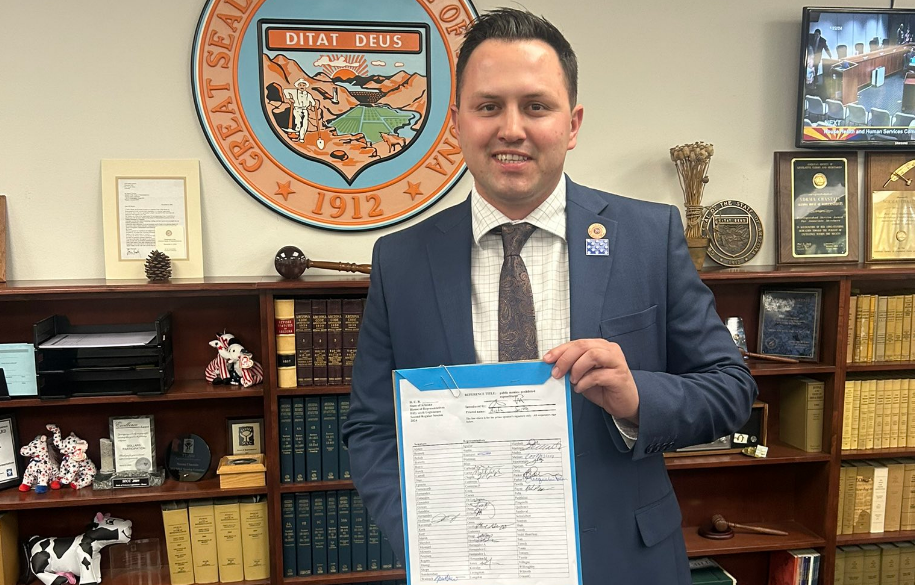
Republican State Representative Matt Gress, entering his second year in office, sponsored HB 2506, the State Foreign Agents Registration Act (FARA). House Majority Leader Leo Biasiucci is a co-sponsor of the legislation.
According to Gress’ press release, the bill would “require transparency from foreign agents acting on behalf of adversarial countries within Arizona,” forcing these individuals to “register with the Arizona Attorney General’s Office.” Under the federal FARA, there are exceptions for “commerce, religious activities, research, or education;” those would be removed under this new proposal. There would be penalties for any foreign agents who failed to comply with the requirements.
In a statement released in conjunction with his announcement, Gress said, “I am proud to sponsor the State Foreign Agents Registration Act as a crucial step towards safeguarding our democracy. While the federal FARA has its merits, our state legislation aims to close existing loopholes that have allowed foreign agents to operate unnoticed. As foreign nations increasingly attempt to exert influence on American soil, it is important that we take proactive measures to ensure we protect Arizonans from efforts to compromise our freedom and security.”
The press release added that HB 2506 “would help protect U.S. citizens and foreign nationals residing in Arizona from foreign agents acting on behalf of countries such as China, Russia, and Iran who seek to impose their authoritarian rule domestically.”
There are no individuals or organizations that have yet indicated support or opposition for the bill on the Arizona Legislature’s Request to Speak system.
Daniel Stefanski is a reporter for AZ Free News. You can send him news tips using this link.
by Daniel Stefanski | Jan 28, 2024 | News
By Daniel Stefanski |
An Arizona Republican legislator is looking to present voters with an upcoming opportunity to help protect their state’s sovereignty.
Earlier this week, freshman State Representative Austin Smith announced that he had introduced HCR 2040, which is a concurrent resolution to enact and order “the submission to the people of a measure relating to public monies.”
In a comment to AZ Free News, Smith said, “The public policy of this state, political subdivisions, and universities should be – public monies are not spent to join organizations that promote anti-freedom agendas listed in HCR2040. This HCR aims at the heart of what the World Economic Forum and the UN Climate Council are working to implement globally. HCR2040 is about protecting freedom. Period.”
The definition of the prohibited expenditures of public monies was laid out in the bill, as follows:
1. REDUCING THE CONSUMPTION OR PRODUCTION OF MEAT OR DAIRY PRODUCTS OR REPLACING ANIMAL-BASED PROTEIN WITH INSECT OR SYNTHETIC PROTEIN.
2. REDUCING OR REPLACING MOTOR VEHICLE TRAVEL WITH WALKING, BIKING, OR PUBLIC TRANSIT.
3. REDUCING OR LIMITING TRAVEL BY AIRPLANE.
4. LIMITING THE NUMBER OF ARTICLES OF CLOTHING AN INDIVIDUAL MAY PURCHASE OR OWN.
5. REUSING WATER THAT HAS TOUCHED HUMAN FECES AS A SOURCE OF MUNICIPAL DRINKING WATER.
6. REDUCING GREENHOUSE GAS EMISSIONS OR TRACKING AND COLLECTING OF ANY INFORMATION OR DATA FOR DETERMINING CONSUMPTION-BASED EMISSIONS.
7. LIMITING THE INCREASE OF THE AVERAGE GLOBAL TEMPERATURE OR PRODUCING OR ADOPTING A CLIMATE ACTION PLAN.
8. REPLACING PRIVATE OWNERSHIP WITH SHARED OR RENTED GOODS AND SERVICES TO PROMOTE A CIRCULAR ECONOMY.
9. FURTHERING MARXIST IDEOLOGIES, INCLUDING STAKEHOLDER CAPITALISM.
10. IMPLEMENTING MASS SURVEILLANCE SYSTEMS TO MONITOR MOTOR VEHICLE TRAVEL.
The resolution was cosponsored by Representatives Biasiucci, Carbone, Carter, Chaplik, Diaz, Dunn, Gillette, Griffin, Heap, Hendrix, Jones, Marshall, Martinez, McGarr, Montenegro, Parker, Parker, and Payne; as well as by Senators Hoffman and Wadsack.
If the resolution were to pass the Arizona House and Senate, it would be transmitted to the Secretary of State to be offered to the voters in the November General Election.
Daniel Stefanski is a reporter for AZ Free News. You can send him news tips using this link.
by Corinne Murdock | Jan 27, 2024 | News
By Corinne Murdock |
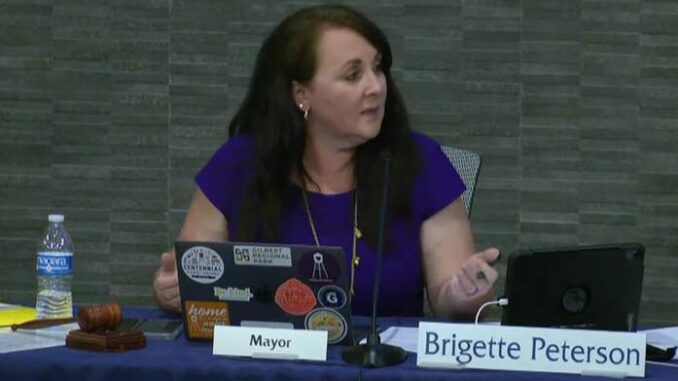
Gilbert Mayor Brigette Peterson ended her reelection campaign on Thursday.
Peterson’s sudden decision comes amid several months of community grief and outrage over the “Gilbert Goons”: the violent teen group that had reportedly plagued the community for several years leading up to the October murder of 16-year-old Preston Lord. The youth’s death, and the Gilbert Goons’ alleged involvement, went viral across multiple social media platforms and attracted national media coverage.
The mayor said in a statement that her desire to spend time with family outweighed her intent on seeking another term in office, among other, “many reasons” to which she alluded but didn’t elaborate.
“Now a new chapter has begun, almost 15 months ago my grandson was born; life is short and I am choosing to focus my energy on my family and so as of now I’m ending my reelection campaign,” said Peterson.
According to an email obtained by The Arizona Republic, Peterson informed the town’s executive leadership about her intent to drop her campaign within an hour of when the media was anticipated to announce it. Peterson promised to not resign, despite community advocates’ demands.
“I promise you, I will not be resigning before the end of my term,” said Peterson. “I will not put this team and the current council through that process and I will fulfill my obligation.”
Peterson also elaborated to town leadership that she hadn’t seen her grandson often, though he lived close by.
“My grandson is about to turn 15 months old and I realized I haven’t seen him 15 times and he only lives in the west valley,” said Peterson.
Peterson’s announcement came shortly after Vice Mayor Scott Anderson launched his candidacy against her, and less than two days after another contentious town council meeting, in which Peterson again faced much public comment critical of her handling of the Gilbert Goons, as well as new criticisms over her permissiveness of the town’s Office of Digital Government.
“We desperately need some change in Gilbert,” said Anderson. “I view myself more as a statesman, a leader.”
In addition to Anderson, Peterson had another opponent seeking to unseat her: former deputy county attorney Shane Krauser.
In response to Peterson’s sudden exit, Krauser made a promise of more public transparency through recurring town halls.
“Our government officials have hidden for too long and, thus, we’ve had a lack of real accountability,” said Krauser. “New leadership is coming. A new level of accountability is on the horizon. Our best days are ahead.”
Since taking office in 2021, Peterson’s tenure has been fraught with public controversy: including free speech lawsuits and no less than a dozen ethics violation complaints.
Corinne Murdock is a reporter for AZ Free News. Follow her latest on Twitter, or email tips to corinne@azfreenews.com.
by Daniel Stefanski | Jan 27, 2024 | Education, News
By Daniel Stefanksi |
Arizona Senate Republicans are throwing a challenge flag over the state’s Democrat Governor’s shocking recognition of School Choice Week.
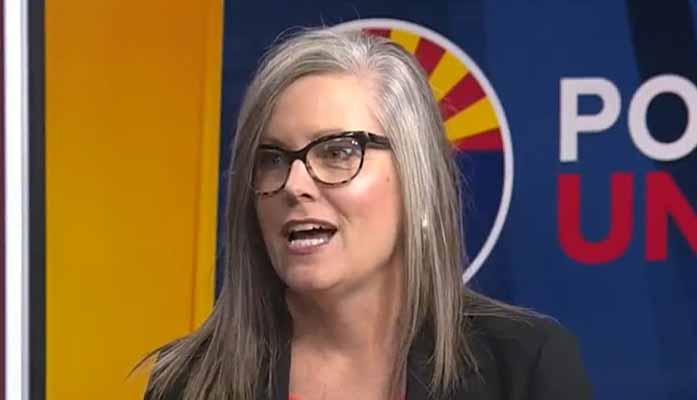
On Tuesday, the National School Choice Awareness Foundation announced that Governor Katie Hobbs had “officially proclaimed January 21-27 as Arizona School Choice Week.”
The Foundation expressed thankfulness to Hobbs for her ceremonial action, writing, “Governors play a key role in raising school choice awareness, so we’re grateful to Gov. Hobbs for helping Arizona families explore high quality education options.”
This praise for Hobbs earned a sharp retort from the Arizona Senate Republicans Caucus “X” account. They stated, “This has got to be a JOKE, right? Governor Hobbs has been dead set on dismantling Arizona’s universal school choice program since she entered office. She currently wants to pull nearly 50,000 students out of the program as reflected in her budget proposal.”
Cathi Herrod, one of Arizona’s top advocates for family and school choice issues, echoed the sentiments from the State Republicans, posting, “When you think you can’t be surprised by anything that happens, you see this…from a governor trying to do all she can to dismantle school choice. Unreal.”
Hobbs, perhaps in a show of regret for her published commendation, returned to form on her education position on the same day of the Foundation’s social media post. She shared a clip from her recent State of the State address before the Arizona Legislature, renewing her vow to “address the lack of accountability and transparency in Arizona’s ESA program.”
Arizona Republicans and Democrats enter the second year of a divided state government at odds over the future of the historic Empowerment Scholarship Accounts (ESA) program. Democrats wanted to reform or end the program in 2023, before Hobbs acquiesced to legislative Republicans in the Fiscal Year 2024 budget compromise, which left these school choice opportunities completely intact. In the aftermath of last year’s budget passage and in her latest State of the State address, Hobbs has redoubled her rhetoric against ESAs as she attempts to rally her base in a pivotal election year for Arizona.
While Democrats have sharpened the political and legislative knives against the ESA program, Arizona Republicans have remained stalwart defenders of all school choice opportunities for families in the Grand Canyon State. Senate President Warren Petersen and House Speaker Ben Toma have led the charge in the state legislature to counter the governor’s actions and to hold the line for the tens of thousands of boys and girls enrolled in the program.
Daniel Stefanski is a reporter for AZ Free News. You can send him news tips using this link.
by Elizabeth Troutman | Jan 27, 2024 | News
By Elizabeth Troutman |
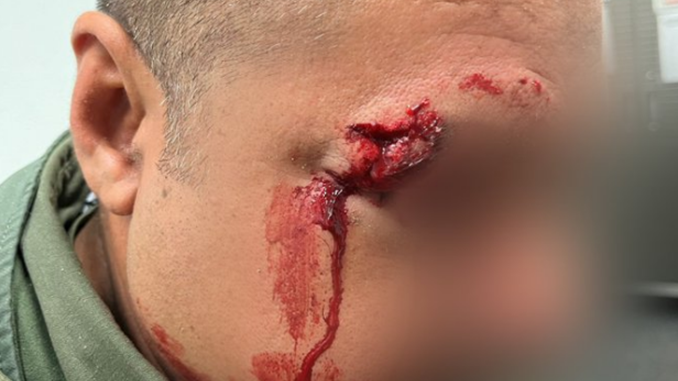
Human smugglers assaulted a Border Patrol agent with rocks while he was arresting several illegal immigrants near San Luis, Arizona, earlier this week, Border Patrol reported. Rep. Andy Biggs, R-Ariz., called out the “lawlessness” of the incident.
“This lawlessness must come to an immediate halt,” Biggs said on Twitter.
Chief Patrol Agent Sean McGoffin said human smugglers threw rocks at the Border Patrol Agent hitting him in the head early Tuesday morning, leading to lacerations across the eye. An investigation is underway to bring those responsible to justice, according to Border Patrol.
“Wishing this agent a speedy recovery,” Biggs continued. “Many folks streaming across our border right now are armed and dangerous.”
McGoffin of the Yuma Sector Border Patrol said individuals were making an illegal entry into the area of the assault and the smugglers who were on the Mexican side of the border began throwing rocks.
The agent was taken to the hospital and is now on the road to recovery, according to McGoffin.
“The agent is doing okay,” McGoffin said. “We’re thankful for him being okay, but he did have to go and receive medical treatment. He’s currently not back to work yet, but we anticipate he will be in the near future, we’re just so thankful that he’s safe.”
McGoffin said that though overall assaults have been down over the previous year, every assault is serious and could be fatal.
Elizabeth Troutman is a reporter for AZ Free News. You can send her news tips using this link.
by Elizabeth Troutman | Jan 26, 2024 | News
By Elizabeth Troutman |
A bill proposed by state Sen. Warren Petersen, R-Gilbert, to require cities and counties to have a 2/3 vote to increase taxes passed out of the Senate Government committee.
Every Republican voted yes, while every state Senate Democrat voted no.
Senate Bill 1056 “Prohibits the common council of a municipality from increasing an assessment, tax or fee without a two-thirds vote of the common council of the municipality and “Prohibits the board of supervisors of a county from increasing an assessment, tax or fee without a two-thirds vote of the board of supervisors of the county.”
“Basically, if you want to increase taxes or fees, you need to have a supermajority, or a two-thirds vote, I should say,” Petersen said in summation of the bill during the state Senate Committee On Government meeting.
Taxes are often the biggest expense people face in their lifetime, Petersen said.
“Right now, our citizens are reeling from inflation, which has been caused by a large part by Washington, D.C. and our printing of money and overspending,” Petersen said. “The last thing we need to do right now is increase taxes and fees on our citizens.”
Governments need to find more efficient solutions, according to Petersen.
“I saw one study,” Petersen said, “It shows over your lifetime. You spend over one out of every three dollars of your money on taxes, whether you’ve got income tax when you receive money. When you spend money, sales tax, you’ve got property tax. You have utility taxes. I could go on and on and on.”
Government is very well represented while the taxpayer is limited, Petersen continued.
“I think this levels the playing field a little more between the taxpayer and the government,” Petersen said.
Elizabeth Troutman is a reporter for AZ Free News. You can send her news tips using this link.