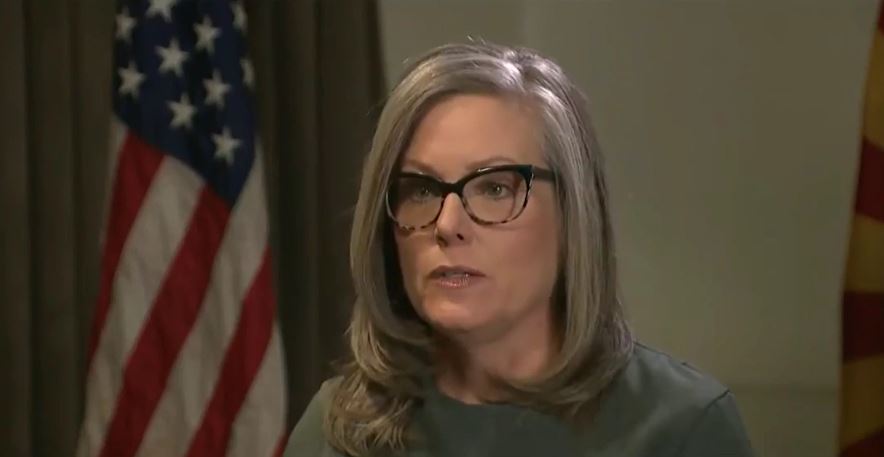
Governor Katie Hobbs, who bedecked the Ninth Floor of the Arizona Executive Tower with the Progress Pride Flag to mark Pride Month, has chosen to also mark the month by vetoing SB 1511. The bill would have required fair treatment for one of the most marginalized groups of all: those who suffer from gender transitions and now seek to reverse the damage, known as ‘de-transitioners.’
Arizona Senator and Vice Chair of the Senate Health and Human Services Committee Janae Shamp (R-Surprise) proposed the “Detransitioner Bill of Rights” in February, which would guarantee an equality of care and medical coverage for those seeking to reverse so-called ‘gender affirming’ care. On February 22, it was passed by the Senate, and on June 12 was sent to Hobbs after passage in the House. The governor issued her veto six days later with the comment: “This bill is unnecessary and would create a privacy risk for patients,” and no further explanation.
According to Greg Scott, the Vice President of Policy at the Center for Arizona Policy, the bill was a “simple ‘good faith’ bill that levels the health care playing field for a vulnerable population of Arizonans and takes the politics out of medicine and insurance coverage.” In an Op-Ed for the AZ Capitol Times, Scott added, “The purpose of SB 1511 is not to pronounce judgment about the merits or the dangers of gender transition. And it doesn’t. Rather, it does what a law is supposed to do – solve a real problem affecting real people.”
Responding to the veto from Hobbs, Sen. Shamp wrote in a press release, “If doctors are going to block the natural puberty process of children and surgically alter the genitalia of people struggling with gender dysphoria, they must be prepared to undo the damage – as much as possible.”
“And if insurers are going to pay for gender-altering drugs and surgeries, they must also pay for any effort to regain the victim’s God-given identity. My heart goes out to the growing number of people, especially children, who are struggling with their identity and are being pushed into physically altering their bodies as a solution, instead of receiving the mental healthcare they deserve. Shame on Governor Hobbs for sending a message that the institutions tasked with protecting their health and wellbeing have turned their backs on them.”
🚨 FOR IMMEDIATE RELEASE: Hobbs Marks "Pride Month" by Denying Necessary Medical Treatment for Growing Number of Detransitioners
Shamp added, “I’m fighting for equal treatment for people like Chloe Cole, who traveled to the Capitol from out of state to share her heartbreaking experience of the irreversible damage and regret from attempting to transition into the opposite sex,” said Senator Shamp. “As a child who was confused with her gender identity, she was given puberty blockers and underwent a double mastectomy. She has since detransitioned and struggles with the severe damage left behind. It’s unfathomable that we consider mutilating an undeveloped child’s body as “healthcare,” but what’s even more horrifying is the fact that we deny them access to care when they go on to suffer the mental and physical consequences.”
WATCH:
Speaking to a press conference on February 1, Cole told reporters, “Everything that I went through did nothing to address the underlying mental health issues I had. My doctors, with their gender theories, thought all my troubles would go away as soon as I was transformed into something that vaguely resembled a boy. Their theories were wrong. I now have two giant scars across my chest that remind me every day that I was butchered by the institutions that we all thought we could trust. The drugs and surgeries changed my body, but they did not and could not change the undeniable reality that I am, and forever will be, a female.”
According to the release, SB 1511 would have “required insurers and providers of gender-altering drugs and surgeries to also provide and cover detransition procedures. This bill would have held health care providers and insurance companies accountable for the damage they cause by prescribing off-label drugs and experimenting on children and adults with irreversible surgeries.”
When asked by AZ Free News if she intends to reintroduce SB 1511 or another bill like it, Shamp said, “Absolutely. This legislation will continue until there is coverage for detransitioners.”
“Will it be run again?” she continued. “Absolutely. It might actually get more robust to include more informed consent with patients who are transitioning. Patients need to know that insurance companies will not cover detransition.”
A measure to potentially reform Arizona’s judicial retention system is heading to the November General Election ballot.
Last Wednesday, the Arizona Legislature passed SCR 1044, which is another ballot referral for state voters to consider in the all-important election this fall. If passed, the measure would “constitutionally replace term limits for Arizona Supreme Court justices, intermediate appellate court and superior court judges with terms of good behavior and outline conditions that require a vote of retention for a justice or judge; [and would] require an intermediate appellate court judge who is subject to a vote of retention to be elected on a statewide basis” – according to the purpose statement from the Arizona State Senate.
The Arizona House of Representatives approved the measure with a 31-29 vote, sending the proposal back to the Senate since it was amended. The Arizona Senate then concurred with the changes with a 16-10 vote (with four members not voting).
The Arizona Senate Republicans Caucus “X” account championed the passage of this measure, posting, “Democrats HATE when judges respect the justice system by accurately interpreting our laws, and as a result, they want to punish these judges for doing so when their rulings go against radical Left ideologies. Today, all Senate Democrats voted ‘NO’ on protecting ethical judges and want to allow bad actors to continue to fly under the radar within our justice system.”
🚨JUST IN- Democrats HATE when judges respect the justice system by accurately interpreting our laws, and as a result, they want to punish these judges for doing so when their rulings go against radical Left ideologies.
Legislative Democrats and progressive interest groups were very vocal in their opposition of the measure. Senator Priya Sundareshan said, “This ballot referral would be a fundamental reworking of our judicial retention system in fact it would move us away from a retention process towards lifetime appointments.”
Senator @priya4az explains the dangers of SCR1044 and the power it will strip away from voters. #azleg
➡️ “This ballot referral would be a fundamental reworking of our judicial retention system in fact it would move us away from a retention process towards lifetime… pic.twitter.com/SmFghgp1TS
— Arizona Senate Democrats (@AZSenateDems) June 14, 2024
Representative Analise Ortiz added, “SCR 1044 would take away my right and the right of my constituents who want to vote not to retain those judges who approved the 1864 total abortion ban. It says your voice doesn’t matter, we are throwing out your vote. That’s what authoritarianism looks like, and it’s terrifying.”
“SCR1044 would take away my right and the right of my constituents who want to vote not to retain those judges who approved the 1864 total abortion ban. It says your voice doesn’t matter, we are throwing out your vote. That’s what authoritarianism looks like, and it’s… pic.twitter.com/q8DtiFJb2l
— Arizona House Democrats (@AZHouseDems) June 12, 2024
Many Democrats and their allied organizations pointed to Republicans’ motivations being the protection of two Arizona Supreme Court justices, who voted in favor of the legal standing of the state’s longtime abortion ban earlier this year. These justices, Kathryn King and Clint Bolick, are up for retention on the November General Election ballot this year.
Last month, Bolick wrote an opinion piece for The Arizona Republic on the dangers of weaponizing the judicial retention system over controversial decisions from courts. He wrote, “Justice O’Connor warned of the danger that ‘a retention election will be infected with issue-based politics.’ That is exactly what is happening, placing her precious legacy in grave jeopardy. In our state, the people have the ultimate lawmaking power, including the ability to overturn our decisions. But we cannot afford to have conscientious judges voted out for unpopular decisions.”
Daniel Stefanski is a reporter for AZ Free News. You can send him news tips using this link.
The driver behind the killing of Senate candidate and Pinal County Sheriff Mark Lamb’s son and family, Brian Alexander Torres-Perez, 22, was indicted by the Maricopa County Attorney last week.
According to Maricopa County Attorney Rachel Mitchell, Torres-Perez faces three counts of manslaughter, a class two felony.
Torres-Perez was driving intoxicated in December 2022 when he crashed into Cooper Lamb, his fiancée Caroline Brooke Patten, and their 11-month-old daughter, Lainey. The baby and Cooper perished at the crash, and Caroline later died at the hospital.
Patten was driving their vehicle when the crash occurred.
Torres-Perez drove 70 MPH, about 25 miles over the speed limit, with a blood alcohol content level of .03 and the presence of THC in his blood.
Last night, Sheriff Lamb lost his son, Cooper Lamb, along with his one-year-old granddaughter in a crash in Gilbert. Cooper and his daughter were passengers in the vehicle. Cooper’s fiancé and mother of the child was also seriously injured. She remains in critical condition. pic.twitter.com/OrhRbSvQTu
The case was referred to Mitchell’s office in February 2023.
“This defendant’s reckless disregard for life wiped out an entire family,” said Mitchell. “After an extensive review of the evidence, it’s time for Torres-Perez to be held responsible for his actions.”
Torres-Perez is in custody with the Maricopa County Sheriff’s Office on a $150,000 bond.
Sheriff Mark Lamb posted the following after the passing of his son and granddaughter:
“We are truly humbled and touched by the outpouring of love from our Family and Friends/Community. We cannot thank you enough. Our hearts are broken but we are comforted in your love and the love of God and Jesus Christ.
We are praying for our precious Caroline who is still in critical condition.
We would also like to express our gratitude for those citizens and first responders who rendered aid to our son Cooper and our granddaughter. God Bless you all!”
A GoFundMe for their funeral expenses far exceeded the asking amount of a $35,000 goal: over $70,500.
The following was posted by a family friend to honor the memories of Cooper, his fiancée Caroline, and infant daughter Lainey:
“If you know about Sheriff Mark Lamb, then you may know about his son Cooper.
Everyone has their struggles in life… and Cooper was not exempt from this.
He was on a downward path with no hope in sight.
Then something wonderful happened:
He was arrested and went to jail.
He paid his price…
And from this point forward, his life had only gone upwards…
He now had a fiance who loved him.
A new daughter who admired him with her big doe eyes.
So he stepped up to become what they needed…
A husband to be. A father. A man.
He was committed to becoming better…
And building a life for his family was his new mission.
Mark and Janel are so proud of their son…
He figured it out and he was on his way.
But on Friday, December 16th — just yesterday — there was a knock at the door.
It was past 8 PM and his son and family weren’t home… This was not normal…
Then came another knock at the door.
Mark swung it open, with a smile on his face. Ready to hold his granddaughter again.
But instead of seeing them…
He saw the Maricopa County Sheriff and Mark’s Chief Deputies at the door.
His son Cooper, Caroline, and their daughter Lainey were in a car accident…
Cooper and little doe-eyed Lainey… didn’t make it.
Cooper’s wife Caroline is in critical condition.
The world stopped spinning.
The police say the other driver was impaired…
But does it really matter at this point?
They are gone.
How do you comfort someone who lost their child?
How do you comfort someone who lost their grandchild?
The truth is… you can’t… Only God can deliver his peace to his children.
So please, tell your family you love them.
It may be the last time.
God Bless.”
AZ Free News is your #1 source for Arizona news and politics. You can send us news tips using this link.
Voters in Maricopa County have the opportunity to submit comments for public review on a proposition that will be on the ballot in the November General Election.
Last week week, the Maricopa County Elections Department notified “interested individuals, political committees and organizations” that the portal to submit arguments for or against Proposition 479 was now open. These comments will be collected for publication in the 2024 General Election Maricopa County Publicity Pamphlet, which will be distributed to county voters before they have the opportunity to start voting in October for the fall campaign.
Proposition 479 is a result of SB 1102, which was passed in 2023, requiring “that the Maricopa County Board of Supervisors call a countywide election for the continuation of the county transportation tax at least two years before the expiration of the tax, and shall conduct that election on a consolidated election date no less than one year before the expiration of the tax.”
The official title of the measure is the “Regional Strategic Transportation Infrastructure Investment Plan.”
If passed by Maricopa County voters, the revenues would be allocated in the following manner: “(a) 40.5 percent to freeways and other routes in the state highway system; (b) 37 percent to public transportation; and (c) 22.5 percent to arterial streets, intersection improvements and regional transportation infrastructure.”
Last month, Noble Predictive Insights published a poll, which showed that “nearly 7 in 10 Maricopa County voters (68%) support the renewal of Prop 479, with only 18% opposed; [and that] this is a notable increase in support compared to last July when 56% were in favor and 17% opposed.”
Nearly 7 in 10 Maricopa County voters (68%) support the renewal of Prop 479, with only 18% opposed. This is a notable increase in support compared to last July when 56% were in favor and 17% opposed.
— Noble Predictive Insights (@NoblePredictive) May 30, 2024
After the Arizona Legislature passed a compromise for this proposal in July 2023, Republican Senate President Warren Petersen claimed victory, calling SB 1102 “the most conservative transportation plan in our state’s history.” He added, “The guardrails, taxpayer protections and funding allocations in the text of this bill reflect the priorities of voters, to reinvest their tax dollars in the transportation modes they use most.”
Democrat Governor Katie Hobbs, who signed the compromise, was diplomatic in her statement, saying, “Today, bipartisan leaders invested in the future of Arizona families, businesses, and communities. The passage of the Prop 400 ballot measure will secure the economic future of our state and create hundreds of thousands of good-paying jobs for Arizonans. I am glad we were able to put politics aside and do what is right for Arizona.”
Members of the Arizona Freedom Caucus were adamantly opposed to the bill as it was released and approved. After the Prop 400 plan passed, the Freedom Caucus tweeted, “Legislative conservatives near unanimously opposed this horrible bill. Conservative watchdog groups unanimously opposed it. The bill may have been better than the communists at @MAGregion’s horrific plan, but that’s a ludicrously low bar for success. This bill was antithetical to conservatism.”
The breakthrough on the Prop 400 compromise took place after Governor Hobbs vetoed a Republican proposal earlier that summer. At that time, Hobbs stated, “I just vetoed the partisan Prop 400 bill that fails to adequately support Arizona’s economic growth and does nothing to attract new business or create good-paying jobs.”
In May 2023, the governor had created unrest over ongoing negotiations, allegedly sending out a tweet that highlighted her fight with Republicans at the Legislature at the same time she was meeting with Senate President Warren Petersen.
Petersen stressed the importance of the agreed-upon bill, asserting that officials had “secured a good, responsible product for the citizens of Arizona to consider in 2024, giving voters the option to enhance critical infrastructure that our entire state relies upon.”
Voters will soon have that opportunity to consider this product as the November General Election quickly approaches.
Daniel Stefanski is a reporter for AZ Free News. You can send him news tips using this link.
The State of Arizona has passed a balanced budget through the Republican controlled House and Senate not only hammering down a $1.4 billion shortfall in projected tax revenues but actually expanding and reforming the state’s Empowerment Scholarship Accounts (ESA), and School Tuition Organization (STO) eligibility, much to Democrat Governor Katie Hobbs’ chagrin. Hobbs, despite her opposition toward the ESA program, implied her acceptance of the budget in a Saturday post to X, and on Monday evening signed the budget into law.
As reported by 12News, the budget was approved in a marathon of votes that stretched throughout the Saturday workday and landed on Hobbs’ desk where it was approved at the end of the business day. Many agencies in Arizona are now working with a budget cut of approximately 3% that arose primarily from depressed sales tax collections in 2023-24. Hobbs and her fellow Democrats have tried to assign the blame to former Republican Gov. Doug Ducey for tax cuts and expansion of the ESA program to allow all students access to the education of their choice.
In spite of this rhetoric, the GOP led legislature successfully prevented a reduction in the funds directed to putting students in underperforming schools into private schools and under the tutelage of homeschooling parents. The budget even included a 2% inflation-driven increase in the K-12 public schools budget.
Senate Majority Whip Sine Kerr explained in a statement from the AZ Senate Republicans:
“What’s not included in the $16.1 billion budget is an elimination of the historic Universal Empowerment Scholarship Accounts program or our School Tuition Organizations program providing tens of thousands of Arizona families the freedom to pick the best schools to meet their children’s unique learning needs.
We are continuing our commitment to providing every family in the state of Arizona with a quality education, no matter their zip code or economic status. Additionally, we said ‘no’ when Governor Hobbs and Democrats proposed eliminating our Arizona Freedom Schools at our public universities, which are dedicated to civics education and ensuring students are equipped down the road to lead our state to a brighter tomorrow.”
In the new budget, the ESA program sees an expansion to “allow the use of account monies to reimburse the parent of a qualified student or a qualified student for the purchase of a good or educational service that is an allowable expense.” Reforms to the ESA will be extensive with the Arizona Department of Education to work in consultation with the Auditor General to generate risk-based audits of the program and ensuring that educators being paid through the program are not subject to disciplinary action by the State Board of Education and requiring all teaching staff and personnel with unsupervised contact with the students be fingerprinted as public school teachers already are. Expansion to the STO program grew the student eligibility to include any students who “are placed in foster care … at any time before the student graduates from high school or obtains a general equivalency diploma.”
In her comments posted to X, Hobbs commented, “While this bipartisan budget delivers reforms to ESAs, they are not enough.” She added a commitment to bring “accountability and transparency” to the program referring to it as “unsustainable.”
Despite that deficit, we made important investments in delivering childcare to working families, combatting the fentanyl epidemic and securing our border, and protecting critical health and human services for vulnerable Arizonans.
— Governor Katie Hobbs (@GovernorHobbs) June 16, 2024
But I know we still have more work to do. While this bipartisan budget delivers reforms to ESAs, they are not enough. I stand committed to bringing much needed accountability and transparency to the unsustainable ESA program.
— Governor Katie Hobbs (@GovernorHobbs) June 16, 2024
In addition to the preservation and expansion of Arizona’s ESA and STO programs, the AZ Senate GOP offered the following highlights from the budget:
Reduces state spending by $1.7 billion below the 2023-2024 enacted budget (a 10% reduction).
Reduces ongoing spending by $330 million.
Protects school choice programs—both Empowerment Scholarship Accounts and School Tuition Organizations are funded for continued growth.
Protects Arizona Freedom Schools.
Does not pull dollars from the rainy-day fund.
No new taxes or tax increases.
No new debt.
Reduces ongoing funding of state agencies by 3.5%, including cuts to universities by $23 million.
Maintains law enforcement funding, while adding $5 million for local border security support and $4 million for fentanyl interdiction and law enforcement response.
Prohibits board fee increases for 2 years.
Lowers vehicle emissions testing fees by 5%.
Ends ongoing funding for COVID federal programs.
Maintains road infrastructure funding.
Adds additional full-time employees to reduce concealed carry permit application and renewal time frames.
Makes conservative policy and spending reforms to the Arizona Commerce Authority, the Arizona Department of Transportation, the Industrial Commission of Arizona, and the Board of Technical Registration.
Senate President Warren Petersen summarized the contentious budget in statement, “Following last year’s state budget, where Republican lawmakers provided inflationary relief to everyday Arizonans through $274 million in tax rebates distributed to struggling families, as well as a ban on the tenant-paid rental tax taking effect this January, Republicans are again successfully supporting our hardworking citizens while simultaneously reining in spending.” He added, “In this year’s budget, we defended more than $520 million allocated last year for much-needed transportation projects statewide. We also cut fees for Maricopa County drivers on emissions testing by 5%, and we banned fee increases on Arizonans from state boards for the next two years.”
“Arizonans can rest assured that their state has a balanced budget. I’m thankful for members of the legislature who came together, compromised, and passed this bipartisan agreement,” Gov. Katie Hobbs said in a statement reported by AZ Mirror. “But I know we still have more work to do.”
Despite the modest gains of the budget, not all Republicans supported the compromise. The Arizona Freedom Caucus seemed very displeased and took their case to the public in a post to X, writing, “It’s a perfect example of the Swamp that establishment Republicans at the Arizona Capital are saying ‘the Freedom Caucus is the problem’ on this budget The reality is that this is what happens when weak Republicans negotiate a budget in secret with Democrats.”
It’s a perfect example of the Swamp that establishment Republicans at the Arizona Capital are saying “the Freedom Caucus is the problem” on this budget 🤡
The reality is that this is what happens when weak Republicans negotiate a budget in secret with Democrats.
The result is…
— Arizona Freedom Caucus (@AZFreedomCaucus) June 15, 2024
The Caucus cited a dozen shortcomings in the budget, namely that the Democrat and Republicans who formulated it, “Fail to appropriate any new meaningful border security money for local Sheriffs, kneecap a school choice tax credit, regulate private faith-based schools, weaponize public schools’ ability to stop conservative teachers from providing instruction to ESA students, impede parents’ right to educate their children as they see fit, gift hundreds of millions of your tax dollars to the healthcare industrial complex, refuse to do anything meaningful to fix our elections, use budget gimmicks to pretend to solve the state’s deficit, rather than actually solving it, sweep $430M of water funding intended to help solve our state’s water crisis, fail to hold Hobbs accountable for her illegal pay-to-play scheme, fail to hold Mayes accountable for weaponizing the justice system against her political opponents,” and “fail to hold Fontes accountable for his totally illegal Election Procedures Manual.”
They added, “In the case of the current budget, when @AZFreedomCaucus members approached leadership, raised concerns with some of the nonstarters in the budget, offered solutions, and indicated that with changes we could achieve Republican unity… Warren Petersen and Ben Toma rejected the changes instantly without even considering them, and then spent the rest of the day attacking, defaming, and insulting the members of the Freedom Caucus for not just blindly following orders. Unfortunately, establishment Republicans’ failure to see the present battlefield for what it really is will cost us the legislature. When Democrats take control, whether it’s in November or in two years… you can look back at who voted YES on this year’s budget to figure out who to blame.”
The budget is also likely to draw a legal challenge from Arizona Attorney General Kris Mayes regarding the ‘sweep’ of funding from the $1.14 billion, 18-year opioid One Arizona Agreement. The agreement, long a bone of contention between the AG, Governor, and Legislature, stems from a lawsuit that capped the Big Pharma opioid scandal and resulted in then-Attorney General Mark Brnovich signing onto to a $26 billion national settlement with Cardinal, McKesson, and AmerisourceBergen and Johnson & Johnson, which distributed, manufactured and marketed opioids respectively.
The funds are held by the AG’s Office as steward for the money designated for opioid treatment, prevention, and education. Mayes told 12 News’ Brahm Resnick, “I am not giving that money to them. It’s in my bank account at the Attorney General’s Office. It’s not going anywhere.”
In a lengthy statement posted to X, Mayes said, “I have stated publicly + very clearly that I refuse to release these funds in this way as it would violate the agreement, & I stand by those words today. This is an egregious grab, and I will do everything in my power to protect these opioid settlement funds for all Arizonans.”
Last Thursday, the U.S. Department of Justice (DOJ) announced that “the Phoenix Police Department and the City of Phoenix engage in a pattern or practice of conduct that violates the U.S. Constitution and federal law.”
“The Justice Department has concluded there is reasonable cause to believe that the City of Phoenix and the Phoenix Police Department engage in a pattern or practice of conduct that deprives its residents and visitors, including Black, Hispanic, and Native American people, of their rights under the Constitution and federal law,” said Attorney General Merrick B. Garland. “The release of today’s findings report is an important step toward accountability and transparency, and we are committed to working with the City of Phoenix and Phoenix Police Department on meaningful reform that protects the civil rights and safety of Phoenix residents and strengthens police-community trust.”
The DOJ found that:
“PhxPD uses excessive force, including unjustified deadly force and other types of force.
“PhxPD and the City unlawfully detain, cite, and arrest people experiencing homelessness and unlawfully dispose of their belongings. This is the first time the Department has found a pattern or practice of conduct that focuses on the rights of people experiencing homelessness.
“PhxPD discriminates against Black, Hispanic, and Native American people when enforcing the law.
“PhxPD violates the rights of people engaged in protected speech and expression.
“PhxPD and the City discriminate against people with behavioral health disabilities when dispatching calls for assistance and responding to people in crisis.”
In a message to City of Phoenix employees, City Manager Jeff Barton said, “We are taking all allegations seriously and are planning to review this lengthy report with an open mind… Self-reflection is an important step in continuous improvement, and our Police Department has demonstrated a commitment to reform by making improvements to policy, discipline, internal investigations and training.”
The City of Phoenix and Phoenix Police Department are reviewing the findings from a nearly three-year investigation by the U.S. Department of Justice. Read more: https://t.co/tQ8qKeZdHj
— City of Phoenix, AZ (@CityofPhoenixAZ) June 13, 2024
Phoenix Interim Policy Chief Michael Sullivan added, “We want to see not only what these individual incidents are that the Department of Justice refers to, but we also want to see whether it included policy change or whether it possibly included discipline, or other changes within the department as far as practices go.”
According to its press release, the DOJ shared that it had “provided a detailed briefing on the findings to the City and PhxPD on Tuesday and proposed that the parties agree in principle to negotiate expeditiously and in good faith to reach a comprehensive court-enforceable settlement with independent monitoring.”
The Arizona Senate Republicans Caucus was less diplomatic than the City of Phoenix in the aftermath of the release of the report, writing, “The weaponized and radical Department of Justice is at it again, this time targeting our selfless public servants within the Phoenix Police Department who risk their lives everyday. Biden’s corrupt DOJ is out of control and is working against our citizens and our republic. We will always back the blue, our policies will continue to reflect that notion, and we will continue to speak out against the injustices our men and women in law enforcement are subjected to at the hands of the radical left.”
The weaponized and radical Department of Justice is at it again, this time targeting our selfless public servants within the Phoenix Police Department who risk their lives everyday.
Biden’s corrupt DOJ is out of control and is working against our citizens and our republic.