by Staff Reporter | Jul 7, 2024 | News
By Staff Reporter |
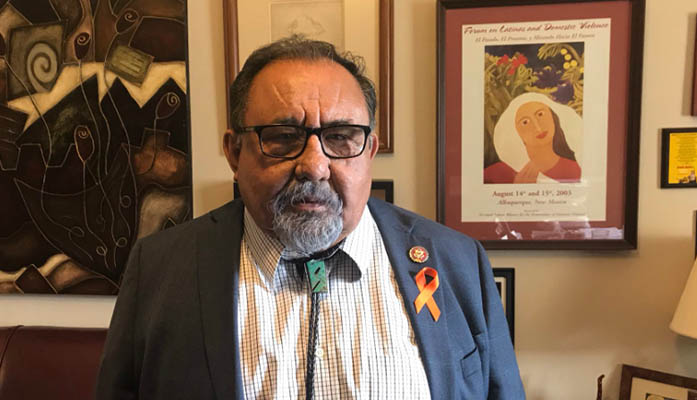
Longtime Democratic Rep. Raúl Grijalva wants President Joe Biden to drop out of the race.
Grijalva told reporters on Wednesday that he would support Biden as the presidential candidate, but would much rather see the president drop out while he’s ahead in order to preserve Democratic footing at the national level.
“If he’s the candidate, I’m going to support him, but I think that this is an opportunity to look elsewhere,” said Grijalva in an interview with the New York Times. “What he needs to do is shoulder the responsibility for keeping that seat — and part of that responsibility is to get out of the race.”
The sentiment marked a sharp departure from his last public endorsement of Biden, which was issued the day after the debate last week.
“This election is a clear choice: protect our freedoms and democracy with Joe Biden, or succumb to a convicted felon’s unhinged vengeance and reckless desire to destroy everything to save himself,” said Grijalva. “To stop Trump, we must win AZ. I’m ALL IN and will do all I can to make sure we win.”
Grijalva also issued a lengthy defense of the Biden administration, specifically their massive spending on projects through the Inflation Reduction Act, the Bipartisan Infrastructure Law, and CHIPS and Science Act. Grijalva expressed confidence that it was Biden who could usher in more aggressive progressive changes to laws and regulations on abortion, minimum wage, paid leave, climate change, corporations, and race relations.
“The Biden presidency stands in clear contrast to the extremism presented by Trump and Congressional Republicans,” said Grijalva. “It’s clear the American people have benefitted from the leadership of President Biden and his commitment to defending the freedoms and values essential to American democracy.”
Grijalva is an automatic delegate for the Democratic National Committee next month.
Conversely, Governor Katie Hobbs has doubled down her support for the president. Hobbs effectively agreed with a remark from Biden that, while he may not be a great candidate, he was better than Trump.
“As the president himself has said, don’t compare him to the almighty, compare him to the alternative. And by that metric, the choice is abundantly clear in this race,” said Hobbs.
Grijalva joins a growing coalition of top Democratic leaders urging the president to allow another to take his place as the party’s candidate such as Texas Congressman Lloyd Doggett.
Former House Speaker Nancy Pelosi also came out to question Biden’s fitness to secure a Democratic win this November, let alone carry out a second term.
“I think it is a legitimate question to say is this an episode or is this a condition?” said Pelosi.
A number of other Democratic congressmen have not completely sided with the notion that Biden should step down, but expressed concerns to the New York Times about his ability to improve his performance: Reps. Jake Auchincloss, Don Davis, Debbie Dingell, Marie Gluesenkamp Perez, Jared Golden, Greg Landsman, Ann McLane Kuster, Seth Moulton, Katie Porter, Mike Quigley, Jamie Raksin Hillary Scholten, Peter Welch, and Sheldon Whitehouse.
AZ Free News is your #1 source for Arizona news and politics. You can send us news tips using this link.
by Staff Reporter | Jul 6, 2024 | Education, News
By Staff Reporter |
A north central Phoenix legislative district may have a chance to replace its Democrat state senator in the upcoming November election.
State Senator Christine Marsh is running for reelection in Arizona Legislative District 4 this November. Based on her history of election finishes, Marsh may be in for another close contest in the swing district.
Marsh has served in the Arizona Legislature since January 2021. In the November 2020 General Election, she defeated Republican State Senator Kate Brophy McGee by fewer than 500 votes in Legislative District 28 (under the last redistricting lines). The previous election, McGee had bested Marsh by 267 votes in the 2018 General Election.
In the first election under the new redistricting lines for the decade, Marsh won another narrow victory over Nancy Barto by less than 1,200 votes for the right to represent the citizens of Legislative District 4.
The Democrat legislator has been a fierce opponent of her state’s efforts to increase school choice opportunities for Arizona families. In January 2017, Marsh co-authored an op-ed in the Arizona Republic, entitled “Expanding vouchers is dangerous for Arizona.” She wrote, “Those of us who care deeply about public education and the future of our state must work together to focus on what impacts 80 percent of students in our state – stopping the expansion of vouchers and School Tuition Organizations.”
On June 24, 2022, Marsh voted against the historic legislation to expand Arizona’s Empowerment Scholarship Accounts program, joining nine of her colleagues.
The following year, Marsh penned another op-ed for the Arizona Republic, stating that “Anti-public-school Republicans have chosen a path apt to cut safety and services, and sacrifice Arizona’s next generation’s chance to succeed. It’s time our state scrapped the universal private school voucher expansion before our public school system and, more importantly, your neighborhood public school is shuttered.”
Marsh has proven to be a reliable Democrat vote during her time in office, joining her caucus on a number of controversial issues that haven’t always reflected the sentiments of her district. Many of her votes throughout her tenure in the Arizona Legislature defy one of her posted priorities on her campaign website, which reads that “we need more balance at the Capitol in order to force negotiation and compromise.”
In 2022, Marsh cosponsored SB 1281, which would have repealed the preemption on cities from banning plastic bags. That same year, she voted against bills that would have prohibited minors from having irreversible sex change surgeries, banned taxpayer money from going to lobbyists, stopped government from forcing children to mask up without parental consent, and prohibited one single politician from unilaterally shutting down businesses in a self-declared state of emergency.
That same year, when Marsh voted against a proposal requiring accommodations for students who do not want to use a bathroom with a student of the opposite sex, she said that the schools can just get shower curtains.
Earlier this year, Marsh voted against a bill “requiring students in grades 7 to 12 to be taught about the Holocaust and other genocides” – even though fellow Democrat, Governor Katie Hobbs, signed the legislation into state law.
She joined Democrats in voting “NO on a bill requiring public schools to teach Arizona students about the victims of communism.”
Marsh also “voted NO on tougher punishments for public school and public library employees who expose our children to wildly disgusting pornographic books and images.”
She voted against a bill “prohibiting the court from ending probation early for criminals who are in our country illegally and are being deported.”
At the end of the 2024 legislative session, Marsh opposed legislation “classifying Mexican drug cartels as terrorist organizations.”
In June, she also voted against a bill “allowing Arizona kids to have lemonade stands without a license and without having to pay taxes.”
In another major action for the just completed legislative session, Marsh voted no on HCR 2060, which referred several border-related policies to the ballot in November for Arizona voters to empower local law enforcement with more tools to protect communities from the historic effects of the border crisis.
Additionally, Marsh voted against “a child safety bill cracking down on companies that don’t perform reasonable age verification before allowing access to the websites they manage with content considered harmful for children.”
Senator Marsh has also been an advocate for legislation seeking to mitigate the liberty provided by the Second Amendment, boasting about Democrats’ efforts to pass universal background checks.”
On her website, Marsh lists several endorsements from interest groups, including left-leaning Arizona List, Moms Demand Action, and the Sierra Club.
Marsh is running unopposed for the Democrat nomination for state senator in the July primary election. Republicans Kenneth R. Bowers, Jr. and Carine Werner are vying for the Republican nomination to face the Democrat incumbent in the November General Election.
According to the Arizona Legislative District 4 Democrat Party, Republicans control 38% of the district’s voter registration, compared to 27% Democrats and 35% Other. In 2022, LD 4 had a higher voter turnout than both Maricopa County and the State of Arizona at 76%.
AZ Free News is your #1 source for Arizona news and politics. You can send us news tips using this link.
by Staff Reporter | Jul 6, 2024 | News
By Staff Reporter |
The balance of Arizona’s Legislature may hinge on Republicans being able to pick up seats in districts under Democrats’ control in the upcoming election. Robert Scantlebury, who is running for state senate in Legislative District 9 in Mesa, may be one of those candidates for the Republicans in November 2024.
Robert has lived in Mesa since 1992, when he joined the City of Mesa Police Department as an officer after graduating from California State University with his Bachelor of Arts in Criminal Justice. He started his career with Mesa in its holding facility before serving as a police officer, special investigations detective, patrol sergeant, school intelligence detective, and a detective sergeant. After this distinguished body of work for the Department, Scantlebury retired in 2018, completing 25 years with the city.
Retirement couldn’t keep Robert from the persistent itch of public service. He served as a volunteer Reserve Police Officer until 2020, when the Mesa Police Department ended the program. In this role, he worked as a School Resource Officer and School Intelligence Detective. As Scantlebury reflected on this period of his life, he said that “I loved my job and have always felt I had a calling to protect and stand up for others.”
When his tenure at the Department came to an end after the sunset of the reserve program, Scantlebury followed in the footsteps of his parents, creating his own small business, Little American Tractor Service. He also serves as a school board member for Step-up School, which is a nonprofit school in his community.
The Mesa law enforcement officer veteran entered the political realm in 2018, when he unsuccessfully ran for Mesa City Council in District 4, finishing third. However, Scantlebury just barely missed the bar to move on to the November 6 election, falling 39 votes short of second place. He then challenged incumbent State Senator Tyler Pace in the August 2022 Primary Election, garnering more than double the votes for a shocking victory. Robert couldn’t defeat his Democrat opponent, though, losing to incumbent Eva Burch by five percent (just over three thousand votes).
Scantlebury decided to run again for Legislative District 9 in the 2024 cycle. In August 2023, he wrote that “people have asked why I’m going to run for office again when it is so hard to do,” answering that he has “always done hard things to do my part to make things better and stop bad people from hurting others.”
On March 29 of this year, Scantlebury turned in 920 signatures of qualified voters to make the ballot for the primary election. That number was almost three times the minimum he was required to submit to the Arizona Secretary of State. In a Facebook post, he thanked “all the people who talked with me at their front door and all the supporters who visited their neighbors and advocated for me.”
His three top priorities for public office at the state legislature are public safety, lower cost of living, and supporting parents and students. On his campaign website, Robert writes that his “thirty years in law enforcement have made it clear to me that we need our state government to do more. I will be a voice to empower local law enforcement, address serious mental illness appropriately, and work to stop human trafficking and the flow of drugs coming across our border.”
Scantlebury goes on to address his economic priority, stating that “we should be able to afford groceries, gas, electricity, and rent or buy a home in a safe neighborhood. But today, we’re paying more to buy less and our kids can’t envision ever affording a house. That’s the opposite of the American dream.” He promises to “defend our flat tax, oppose new taxes, stand up to radical environmental policies that raise the cost of our gas and electricity, and balance community needs with individual property rights.”
In addressing his priority of supporting parents and students in Arizona schools, Robert asserts that “one size doesn’t fit all and families should be able to access what works for their child, regardless of where they live or how much money they make.” He assures voters that “I am going to protect this for any family that needs it.” He adds that he “want[s] schools to focus first on the basics of education like reading, writing and math” and “schools that are responsive to students’ and parents’ needs.”
The Republican lists endorsements from the Mesa Police Association, the Arizona Republican Assemply, LUCA-Latino United, East Valley Young Republicans, and Arizona State Representative Barbara Parker on his website.
Robert has been married to his wife, Heather, for 23 years, and they have two daughters, Ryley and Robyn.
In July’s Primary Election, Scantlebury faces off against fellow Republican Christopher Stapley. The winner of the contest will be pitted against the entrenched Democrat incumbent, Eva Burch, for the November General Election.
AZ Free News is your #1 source for Arizona news and politics. You can send us news tips using this link.
by Staff Reporter | Jul 5, 2024 | News
By Staff Reporter |
Governor Katie Hobbs’ high rate of vetoes in election-related legislation was featured in a new Ballotpedia report released this week.
That report also detailed the thousands of election-related bills considered nationwide, highlighting those passed and vetoed in Arizona specifically.
Arizona with its divided government saw the passage of three key election bills, and the veto of seven.
The digital nonprofit featured several key bills passed by the Arizona legislature this year: HB 2785, which modified the statewide primary date by one week; SB 1342, which provided compensation to political party designees for post-election audit hand counts, with a limit of 75 percent of those conducting the hand count from being members of the same political party; and HB 2482, which required county election officials to notify voters of registration record changes within 24 hours.
Ballotpedia also highlighted the seven bills vetoed by Governor Katie Hobbs: SB 1060, allowing federal candidates to choose observers at polling centers; SB 1330, replacing the term “drop box” with “ballot box” or “container”; SB 1097, making school board races partisan; HB 2393, allowing for an alternative presidential preference election for overseas military voters; HB 2404, prohibiting county recorders from issuing voter registration cards to out-of-state addresses; HB 2612, prohibiting individuals convicted of ballot abuse offenses from holding elected public office; and HB 2031, reducing the threshold for asking voters to expand the board of supervisors from 150,000 to 125,000.
Hobbs’ vetoes pushed Arizona to the top in terms of highest vetoes nationwide.
Although Arizona was featured as one of the key states reviewed, the state didn’t make the top 10 for most active overall in passing bills. With the exception of Maryland and Virginia, all of these states had Republican trifectas. In order from most activity to least: Tennessee, Georgia, Virginia, Louisiana, Idaho, South Carolina, Utah, West Virginia, South Dakota, and Maryland.
Arizona was, however, most active among the 10 states with divided governments.
In its report, Ballotpedia tallied the total of election-related legislation considered across Arizona and the rest of the nation: over 3,700 bills.
The nonprofit also noted that legislation topic or type was often determined by the political party leading the state. In Republican-led states, the election-related bills focused on ballot harvesting or collection, voter registration drives, noncitizen voting, or ranked-choice voting. In Democrat-led states, the bills focused on ballot curing for absentee or mail-in voting, voter suppression, and election disinformation or misinformation.
Bipartisan support existed for about eight percent of bills on topics such as voter list maintenance, protections for elections officials and workers, presidential electors, and voting by eligible but incarcerated individuals or felons.
States with a Republican trifecta and Republican or other sponsorship of the bills enacted the greatest majority of election-related legislation: 64 percent (196 bills). Democratic trifecta and Democratic or other sponsorship of the bills enacted 19 percent of the legislation (57 bills). “All other” totaled 17 percent (52 bills).
However, states with Democratic trifectas considered more changes to election laws than those states with Republican trifectas or divided governments. Ballotpedia noted that this was true for the third year in a row of their tracking history.
AZ Free News is your #1 source for Arizona news and politics. You can send us news tips using this link.
by Matthew Holloway | Jul 5, 2024 | News
By Matthew Holloway |
Arizona Senator Jake Hoffman (R-LD15) has raised a potent legal challenge to the politically driven prosecution that he and 17 other prominent Republican alternate electors have faced at the hands of Arizona Attorney General Kris Mayes whom he referred to as “zealously partisan.” Hoffman released a scorching statement to accompany a legal motion to dismiss the case on July 2, along with his official mugshot taken after his indictment “in response to Kris Mayes political persecution campaign against the 2020 Republican electors.”
Hoffman wrote,
“In war, only leaders are targeted for assassination.
This is a political war.
You can persecute us.
You can attack us.
But you will never silence us.
Truth will always prevail.
NEVER SURRENDER.
Before an investigation had even been conducted and with no evidence, Kris Mayes declared that she believed electors such as myself were guilty of a crime, that it was her job to get Biden re-elected, and that she would control the timing of the indictment.
Let me be unequivocal, I am innocent of any crime, I will vigorously defend myself, and I look forward to the day when I am vindicated of this naked political persecution by the judicial process.”
Hoffman’s attorney Tim La Sota filed the motion citing Arizona state law that allows for rapid dismissal of cases under special circumstances to protect citizens from legal action for exercising a constitutional right known as “SLAPP” or “strategic lawsuit against public participation,” according to the Arizona Republic.
La Sota called the charges against Hoffman “politics by other means,” describing it as, “an effort by an overtly partisan elected attorney general to shame and punish her political opponents and critics for exercising their constitutional rights.”
In the motion, La Sota added, “The attorney general’s novel, overzealous, and retaliatory prosecution is also tied to Sen. Hoffman’s Republican colleagues’ efforts to conduct oversight of her office.”
Hoffman’s attorney pointed to multiple examples of extra-judicial speech from Mayes and her Chief Deputy Dan Barr for prejudicial statements posted to social media, such as a July 2022 post in which Mayes wrote she “would have immediately investigated the fake electors” stating they “videotaped their crime for all to see.” He also pointed to an August 2022 post from Barr who wrote, the alternate GOP electors were “criminals” claiming they “should be prosecuted as such,” according to AZCentral.
La Sota wrote in the motion, “Attorney General Mayes’ and Chief Deputy Attorney General Barr’s extrajudicial statements demonstrate a strong animus against those who questioned the 2020 election and particularly the alternate electors, including Senator Hoffman, and a desire to prosecute them before any investigation had taken place.”
In an email to the outlet Tuesday, he explained that Mayes’ and her surrogates had effectively branded his client and his co-defendants as criminals before any investigation into their actions began. “It was more than a mere pledge to investigate whether or not they committed a crime, which would have been ethical.”
Executive Director of Save Arizona and Chairwoman of Strong Communities Action Merissa Hamilton reposted Hoffman’s post to X supportively writing, “Future generations will look back on this dark time in our nation’s history and remember those that stood in the gap to save our freedom! Please keep @JakeHoffmanAZ and his family in your prayers! They have backbones of steel! Every day wake up and ask yourself what you can do to save Arizona today! Then go forth like your freedom and life depends on it!”
Matthew Holloway is a senior reporter for AZ Free News. Follow him on X for his latest stories, or email tips to Matthew@azfreenews.com.
by Staff Reporter | Jul 4, 2024 | News
By Staff Reporter |
Democratic Senate candidate and Congressman Ruben Gallego has flipped his stance on voting rights for illegal migrants.
The congressman recently introduced legislation to clarify the illegality of non-citizen voting in federal elections. Yet last year, Gallego voted against a bill that similarly condemned non-citizen voting.
The legislation Gallego rejected, House Joint Resolution 24, was an opposition to the D.C. City Council’s approval of the Local Resident Voting Rights Amendment Act of 2022. Even without Gallego’s vote, the resolution ultimately passed the House 260-162.
That D.C. act allowed noncitizens, mainly illegal immigrants, to vote in elections. It became law last February for a time, but the House quickly voted to cancel it.
Gallego’s newest bill, the Voting Clarity Act, serves as an advisory to illegal immigrants. The brief legislation is a mandate for Customs and Border Protection to inform illegal immigrants of federal law: that only citizens may vote in federal elections.
“The Secretary of Homeland Security shall provide information to each alien applying for asylum under this section on the restrictions on voting and the penalties for voting unlawfully under Federal law, including under section 611 of title 18, United States Code, at the time of such application. Information under this paragraph shall be provided in a form and language that the alien can understand.”
Violation of voting law would incur a fine and/or up to one year in prison.
In a press release, Gallego said that the privilege of U.S. citizenship, voting, shouldn’t be extended to noncitizens.
“That is why it is critical that those seeking to enter the U.S. are told clearly and upfront that they cannot vote in our elections if they are not citizens,” said Gallego. “I’m proud to introduce this commonsense bill to combat misinformation about who can, and cannot vote in our federal elections.”
Gallego’s legislation portrays the Senate candidate as tough but fair on the hot topic of the border. Last week, Gallego issued an ad featuring the sheriff who denied the border crisis and rejected Arizona National Guard assistance for his county in doing so, Santa Cruz County Sheriff David Hathaway.
Hathaway has downplayed the severity of the state of the border.
“We don’t have a migrant crisis on the border. We do not need to militarize our counties and have troops come to the border,” said Hathaway. “We have certain, very vocal sheriffs in this state who are trying to fan the flames on a supposed crisis.”
Conversely, Gallego has admitted that the state of the border constitutes a crisis.
The National Republican Senatorial Committee issued a statement claiming the Voting Clarity Act was just a way to “pander” to Arizonans.
“Ruben Gallego has been rubber-stamping the far left’s most radical, open border policies for his entire career in Washington,” said the NRSC. “His election year pandering is a slap in the face to Arizonans who are facing the brunt of the border crisis Gallego helped create.”
AZ Free News is your #1 source for Arizona news and politics. You can send us news tips using this link.