by Terri Jo Neff | Aug 18, 2021 | Education, News
By Terri Jo Neff |
Starting this Friday, low-income families with K-12 students will be able to apply online for up to $7,000 in immediate relief to support educational opportunities which will close the achievement gap and better equip underserved students.
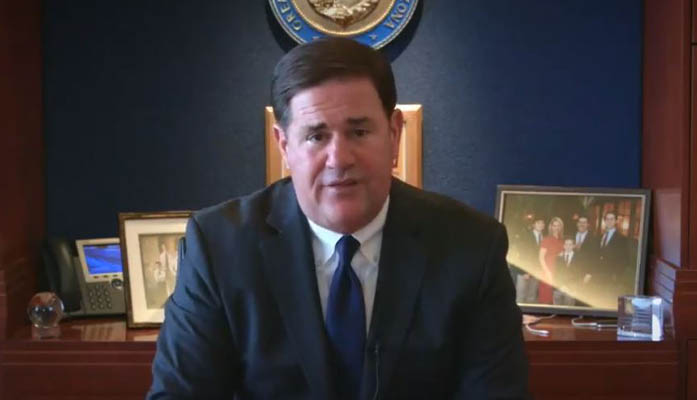
Gov. Doug Ducey announced Tuesday an initial $10 million investment for Arizona’s COVID-19 Educational Recovery Benefit program. The funding – on a first come, first serve basis – will provide choice for families facing financial and educational barriers due to unnecessary closures and school mandates which do not comply with state law.
“Our COVID-19 Educational Recovery Benefit will empower parents to exercise their choice when it comes to their child’s education and COVID-19 mitigation strategies,” Ducey said. “It will also give families in need the opportunity to access educational resources like tutoring, child care, transportation and other needs.”
According to the governor’s office, Ducey has been working for weeks to create an additional program to provide more education options for families.
Eligible families can have a total household income up to 350 percent of the Federal Poverty Level. In addition, applicants must demonstrate the student’s current school is isolating, quarantining, or subjecting children to physical in-school COVID-19 constraints such as mask mandates or preferential treatment of vaccinated students.
“We know that historically disadvantaged communities bear the brunt of excessive and overbearing measures, and we want to ensure these students are protected,” Ducey said.
The COVID-19 Educational Recovery Benefit program has the full support of Senate President Karen Fann and House Speaker Rusty Bowers.
“Educators, families and state leaders are working hard to get students back on track, and the Educational Recovery Benefit program will make sure kids have every opportunity to grow and thrive,” said Fann.
Bowers noted the desire to keep children “safe, healthy, and achieving” during the pandemic, adding that with the new program, “we can do it all at the same time.”
Grant applications can be submitted starting Friday. Additional information is available at https://arizonatogether.org/educationalrecoverybenefit/
by Corinne Murdock | Aug 18, 2021 | Education, News
By Corinne Murdock |
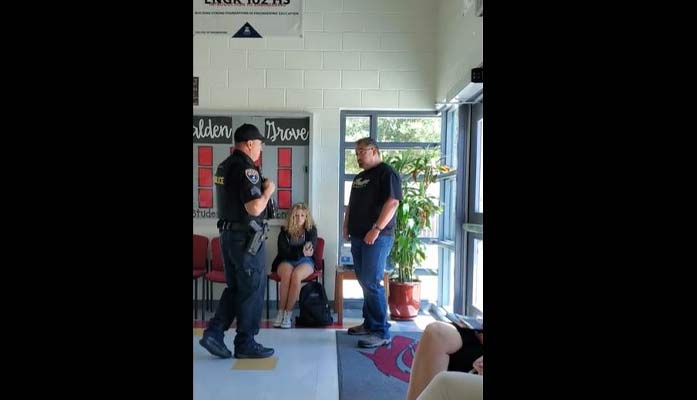
Last Friday, a teenage student and her parents were arrested for trespassing as they advocated for her education. The family was attempting to negotiate their daughter’s forced quarantine with the school principal. According to the parents, Damien and Jennifer Majuta, their daughter was healthy and not proven to be infected. The semester had just begun the previous week.
Sahuarita Unified School District (SUSD) policy requires that individuals potentially exposed to COVID-19 must quarantine for 10 days or until they receive a negative test. Even with a negative test, students must quarantine at least 7 days. Walden Grove High School (WGHS) thereby prohibited the Majutas’ daughter from attending school. Contact tracing indicated that she’d potentially been exposed to an infected individual.
AZ Free News inquired with SUSD about their policies for mitigating learning loss, as well as providing for students who rely on in-person resources such as school meals. SUSD didn’t respond by press time.
Five other adults accompanied the Majutas to contest the apparently-healthy student’s quarantine. When the group of seven wouldn’t leave, Sahuarita Police Department (SPD) responded to the scene. SPD attempted to mediate the situation. Ultimately, they arrested the Majutas for trespassing at WGHS’s insistence. SPD published an account of the incident on Facebook.
Videos captured of the Majutas show them insisting to the officers that they’d broken no laws by bringing their daughter to school.
Jennifer Majuta insisted that trespassing doesn’t apply because her daughter is legally enrolled in the school, and that no laws exist concerning quarantining measures imposed by public schools. Jennifer Majuta pleaded with the officers to understand that their daughter would never get to go to school because of constant quarantines.
“There is no law. They have no justification to remove her from the school. She is legally enrolled in the school. If you want to remove my husband and I – we are her legal guardians, she is an underage minor – you can either arrest her with us, [or] you can leave her here, and we respect you, you can do whatever you need to do, but we will be filming it and we will go peacefully,” said Jennifer Majuta. “You guys are backing somebody – an entity – that is not even based in law.”
An SPD officer responded that the law empowers schools to send home students for any reason. He pleaded with the Majutas to not make them arrest their family. The officer asked if there was anything he could say or do to convince them to leave the campus. Daniel Majuta said that they could allow his daughter the right to receive her education. The officer said he had no control over that.
“The law is – they are asking you to leave, they are asking your daughter to leave,” said the officer.
Damien Majuta emphasized that the arrests needed to be done. He insisted that no other recourse existed. According to the Majutas, they’d attempted to speak with the district and school board on multiple occasions about COVID policy, to no avail.
“People throughout history have [had] to stand up to get things to change,” said Damien Majuta. “The optics are in our favor. The school district is going to get in a lot of trouble for this.”
SPD released the Majutas by citation after photographing and fingerprinting them.
Corinne Murdock is a reporter for AZ Free News. Follow her latest on Twitter, or email tips to corinne@azfreenews.com.
by Corinne Murdock | Aug 17, 2021 | Education, News
By Corinne Murdock |
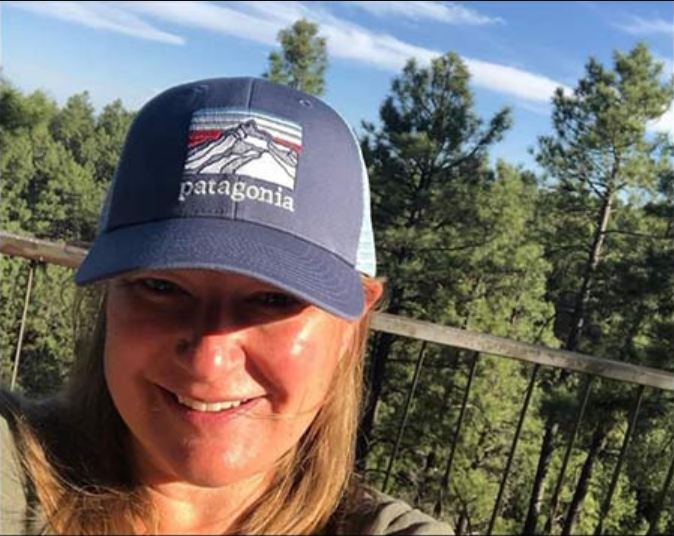
The board president of Northland Preparatory Academy (NPA), a Flagstaff charter school, called parents and students who disagree with mask mandates “the worst of humanity who can’t STFU [shut the f*** up]” about their freedom. Governing Board President Cristy Schaefer Zeller leveled these criticisms in a Facebook post late Friday night. Zeller’s complaints followed the first day of NPA’s reinstated mask mandate, during which three students reportedly refused to wear masks.
“We are so angry that we now have to spend our time dealing with the worst of humanity who can’t STFU about their freedom to choose about a piece of fabric on their face,” wrote Zeller.
Zeller called Arizona, Florida, and Texas “banana republics.” She claimed all of Flagstaff’s systems were “falling apart.” Zeller also suggested they treat those expressing opposing beliefs as “a**hole[s]” and “bullies.”
“Don’t be crazy and cause a police situation but show support. We know what to do with bullies. Do it,” wrote Zeller.
Zeller’s social media posts generally depict Republicans in a negative light, calling them “a**holes” and intellectually inferior.
In response to a tweet from Stop the Steal founder Ali Alexander saying that he would give his life to fight for the truth about the election, retweeted by the Arizona Republican Party, Zeller called Trump supporters “idiot a**holes.”
“Apparently these idiot a**holes are ready to die for @realDonaldTrump,” wrote Zeller.
In reference to the October 7 debate between then-Vice President Mike Pence and current Vice President Kamala Harris, Zeller insinuated that Pence had the mental acuity of a toddler.
“Maybe @vp touched his butt hole and then touched his eyes and got pink eye. Like a toddler,” wrote Zeller.
As of press time, Zeller’s post criticizing those opposed to masks was public. The entirety of Zeller’s post is reproduced below:
“What’s on my mind Facebook? A whole crap ton of anxiety. That’s what is on my mind.
I am deeply worried about our educators and health care workers. I have seen and heard things this week that are frankly shocking. Things that are unacceptable in the wealthiest country in the world.
Maybe it’s better in states that aren’t devolved banana republics like Arizona (I see you TX and FL). Here, in Flagstaff, AZ, our systems are falling apart in very frightening ways. I am not being dramatic. I have spoken with dozens of people in education and healthcare that are about to break, if they are not already broken. They are angry, sad, and defeated. They love their professions, but despise their jobs right now.
The anger and frustration is electric. It did not have to be this way. We are so angry dealing with the worst of humanity who can’t STFU about their freedom to choose about a piece of fabric on their face.
So what do we do? We know we can’t change minds of a portion of the population. I can’t waste my time on them anymore. My like-minded people, here is what we can do:
*If you see someone being an a**hole (picketing your child’s school, accosting a school administrator, demanding unreasonable things from a health care provider)… step in. Be brave. Be a helper. Don’t be crazy and cause a police situation but show support. We know what to do with bullies. Do it.
*Write a thank you note, send an email to the educators and healthcare workers in your life. The small things make all the difference.
*Become an activist. Write your lawmakers, submit public comment and demand better.
*Be kind and patient. If things are imperfect or inconvenient at the school or the hospital, know that the front line person you are talking to is not to blame. They showed up for work. It’s a systemic problem resulting from lack of staffing, general a**holery from the highest levels, messed up politics, lack of funding, and things beyond their control.
Finally.. Us liberals tend to want to be fixers and empathetic and all the rainbows and unicorns. No more. As MTV taught us… it’s time to stop being polite and start being real. Get busy.”
Corinne Murdock is a reporter for AZ Free News. Follow her latest on Twitter, or email tips to corinne@azfreenews.com.
by Terri Jo Neff | Aug 15, 2021 | Education, News
By Terri Jo Neff |
Whether a new state law concerning mask mandates is effective now, or doesn’t go into force until Sept. 29 is the question a Maricopa County judge must answer, but even he admits the final decision will be made by someone else.
Judge Randall Warner held oral arguments Friday morning in a petition for a temporary restraining order (TRO) requested by Douglas Hester against his employer, Phoenix Union High School District, which recently announced a mandatory mask policy for its students, parents, and staff when on school property, including buses.
The Centers for Disease Control and Prevention (CDC) currently recommend K-12 students, parents, and staff wear masks when indoors even if vaccinated for COVID-19. Phoenix Union and at least nine other districts across the state have announced or implemented mask mandate.
Hester contends the new state law barring cities, towns, charter and public schools, community colleges, and public universities from ordering or enforcing any such mandated mask usage became effective June 30.
One or both the sides in the case could appeal Warner’s decision on the effective date of the no-mask mandate statute, depending on how he rules and the reasoning behind his decision. Warner acknowledged as such Friday when he said his ultimate duty in the case is to “tee it up for the Supreme Court” and let the justices make the final ruling
Hester, a science teacher for the district, contends HB2898, the K-12 Education Budget Reconciliation Bill which created the new law, is already in effect due to a retroactive clause. Therefore, he wants Warner to issue a TRO to block enforcement of Phoenix Union’s new policy.
Phoenix Union, through its attorney Mary O’Grady, opposes any TRO. O’Grady also filed a motion on the district’s behalf asking Warner to dismiss the case. It is the district’s position that the effective date of the new statute is not until Sept. 29, the ninety-first day after the legislative session ended.
The district also questioned why legislators would include a retroactive effective date if the new law took effect on the schedule Hester’s attorney Alex Kolodin contends is in place.
According to Kolodin, the 90-day provision does not apply to HB2898m the K-12 Budget reconciliation bill. He argued Friday that is one reason appropriations bills are not subject to voter referendums.
“The retroactivity clause, the governor, and members of the Legislature have all expressed their intent was for schools to not be able to do this after June 30 by putting in that retroactivity clause,” he argued.
Hester named the Phoenix Union District and its eight board members as defendants. Warner’s decision is expected next week.
by Corinne Murdock | Aug 12, 2021 | Education, News
By Corinne Murdock |
25 Arizona House and Senate Republicans led by freshman State Representative Jake Hoffman (R-Phoenix) called for Governor Doug Ducey to do something about the school districts defying state law with their mask mandates. The news release on Wednesday revealed that Republican legislators have urged Ducey privately to take action, to no avail. This public statement appears to be their next step in convincing Ducey to enforce the law.
It’s been over a week since the first school district called a mask mandate: Phoenix Union High School (PXU). Other schools followed suit soon after: most recently, Flagstaff Unified School District (FUSD). Ducey hasn’t taken action – though his spokespersons have relayed Ducey’s finger-wagging statements of disapproval in response to those school districts.
The legislators proposed that Ducey respond to the districts’ actions by withholding federal funding, authorizing temporary Empowerment Scholarship Accounts (ESAs) for families, inform families of the law, and take legal action.
Hoffman’s statement explained that the ban on mask mandates included a retroactivity clause that puts it in effect – contradicting school districts’ insistence that the law can’t take place until 90 days after the end of the legislative session, per Arizona statute. He noted that the school districts’ behavior undermined lawful government and bordered on anarchy.
“Under Arizona’s constitutional form of government, local governments do not have the authority or power to usurp state law simply because they disagree, yet that is precisely the kind of illegal activity in which many local governments are presently engaged. The Arizona legislature, with the Governor concurring, very intentionally enacted the laws at hand to protect Arizonans and Arizona children from the threat of government mandating them to wear a mask or be injected with a vaccine,” wrote Hoffman. “A resounding message must be delivered to any local government or subdivision of the state considering defying state law – lawlessness will not be tolerated.”
https://twitter.com/AZHouseGOP/status/1425545781558218754
House Speaker Pro Tempore Travis Grantham (R-Gilbert) signed onto the statement admonishing Ducey. He told AZ Free News that he also supports law enforcement stepping in to enforce the law. Grantham hinted that this debacle sparked a legislative priority for next year – adding more teeth to legislation.
“It’s unfortunate that some of our government-funded schools have chosen to blatantly ignore state law and the will of the majority of Arizonans by instituting mandates regarding students wearing face coverings,” relayed Grantham. “I support executive action by the governor to include withholding of taxpayer dollars and expansion of school choice funding options giving more educational choices to parents. I also support any efforts by law enforcement to enforce state law and I encourage parents and teachers to follow state law when sending their children to school and when on school grounds. Next year I will make it a focus to hold those who violate state law accountable and ensure appropriate funding reductions are in place for districts that purposely violate the law.”
State Representative Joseph Chaplik (R-Scottsdale) also signed onto the statement. He reiterated to AZ Free News that disagreement with the law isn’t justification for violation of it. Chaplik wrote the legislation that effectively banned mask mandates in schools. He, too, asserted that the power to act is in Ducey’s hands.
“Just because some don’t agree with policy and law, we should not disrespect and violate it while also teaching children these illegal tactics,” said Chaplik. “We passed this policy due to the inconsistencies of results with mask use and the unknown long term health issues that can impair our children. We need to stop this madness. The legislature did its job and now the executive branch needs to enforce the law.”
As of press time, Grantham and Chaplik said that they haven’t seen or heard any responses from Ducey.
Corinne Murdock is a reporter for AZ Free News. Follow her latest on Twitter, or email tips to corinne@azfreenews.com.
by Corinne Murdock | Aug 12, 2021 | Education, News
By Corinne Murdock |
One week into Peoria Unified School District’s (PUSD) school year, parents are already reporting that their students have been required to quarantine until they receive a negative test result – even if they’re not symptomatic or feeling sick in the slightest. Students are required to quarantine 10 days at most, 3 if they test negative for the virus. However, these rules don’t apply to everybody.
Only fully vaccinated individuals, “essential worker” educators that are asymptomatic, and those who’ve recovered from COVID-19 in the last three months aren’t required to quarantine. According to PUSD policy, the district will continue to quarantine all others exposed to COVID-19 at the discretion of Maricopa County Department of Public Health (MCDPH). If the county determines that there’s been an “outbreak,” they will require all students exposed to the infected student to be quarantined.
Educators may remain in school so long as they wear masks if they’ve been exposed and are asymptomatic – but unvaccinated, asymptomatic students who haven’t contracted COVID in the last three months must go home.
“Students, staff, and educators who are close contacts of someone who has COVID-19 and are not fully vaccinated (or have not tested positive for and recovered from COVID-19 in the prior 3 months) must quarantine away from others for up to 10 days following their last exposure per MCDPH. Importantly, per CDC, ADHS, and MCDPH, all close contacts who have been fully vaccinated (starting 2 weeks after the final COVID-19 vaccine dose) do not need to quarantine if they do not have any symptoms. In other words, if identified as a close contact, the need to quarantine depends on a person’s COVID-19 vaccination status and/or COVID-19 infection history. MCDPH recommends that close contacts be tested for COVID-19 3-5 days following their last exposure, regardless of vaccination status.
Close contacts who must quarantine need to be excluded from school and extracurricular activities during their quarantine period. The duration of quarantine is either 10 full days or 7 full days following their last exposure, as long as a COVID-19 test performed on day 6 or 7 is negative and the contact has no symptoms. If a staff member or an educator is determined to be a close contact who must quarantine and they are considered to be an essential worker (as designated by the school), they can continue to work during their quarantine period if they do not have any symptoms and wear a mask while working. Please see the Quarantine Guidance on the MCDPH website for more detailed information.” (original emphasis included and emphasis added)
Previous Arizona Superintendent of Public Instruction Diane Douglas told AZ Free News that quarantining healthy students is negatively impacting their education. Douglas referenced the stunted reading skills of younger children who’d done distance learning due to COVID-19.
“The parents I hear from, they’re not happy. They don’t want their kids quarantined, potentially without an illness,” said Douglas. “We’re taking very extreme responses to something I don’t think deserves such an extreme response and we’re not looking at the damage it’s doing to our children’s learning.”
Douglas relayed the story of one mother who’d confided that her son was forced to quarantine 6 times for COVID-19 exposure – altogether, he missed 2 months of school – but he never became sick.
The former superintendent asserted that this continued exercise of power has gone too far.
“Unfortunately, and this in my opinion, they’ve just pretty much been given free reign to do whatever they want to do – I think it’s the old saying, absolute power corrupts absolutely,” said Douglas.
Corinne Murdock is a reporter for AZ Free News. Follow her latest on Twitter, or email tips to corinne@azfreenews.com.