by Matthew Holloway | Jul 23, 2025 | News
By Matthew Holloway |
Arizona Representative Nick Kupper (R-LD25) has stepped up to the ongoing controversy surrounding the hacking of the Arizona Secretary of State’s website. The lawmaker has requested a formal briefing from Secretary of State Adrian Fontes to account for the attempted breach of security to all members in the legislature, not merely the “select members” already discussing the matter.
The incident was reportedly carried out by Iranian hackers, according to the Secretary of State’s Office, who replaced images of the candidates on the website with images of the late Ayatollah Ruhollah Khomeini.
In a letter to Fontes, Kupper wrote in part: “While I understand your office has communicated with select members of the Legislature regarding this issue, I believe that all lawmakers should be afforded the opportunity to receive a comprehensive briefing on the nature of the attempted breach, any data or system vulnerabilities identified, and the steps you have taken to ensure the integrity and security of our electoral infrastructure.”
Kupper referenced reported failures in the AZSOS candidate portal noted by Turning Point Action’s Tyler Bowyer last week, writing, “Since the incident, the candidate portal has experienced noticeable slowdowns, which have affected accessibility and overall functionality.”
In a statement released alongside the letter to Fontes, Kupper noted, “Arizona’s election systems should never be this easy a target for foreign adversaries. This wasn’t a prank — it was a politically motivated act of cyberwarfare, and we deserve answers. Every legislator has a responsibility to understand what happened and what’s being done to keep it from happening again.”
Kupper has called for “a comprehensive briefing on the breach, including how it occurred, what systems or data may have been accessed, and what steps are being taken to prevent future incidents.”
The Arizona Representative even offered to arrange the logistics of “a full in-person briefing that will be open to all Arizona House Members and State Senators,” with the reservation of a conference room in the Arizona House of Representatives. He added that the briefing should occur in the next two weeks.
Reporting from KJZZ revealed that the images uploaded by the hackers were also linked to social media accounts, including a Telegram account which wrote, “We were not looking for war or adventure. However, President Trump’s flagrant violation of the agreement, through his aggressive attack on the nuclear and civilian infrastructure of the great nation of Iran, has forced us to face a difficult and regrettable confrontation. Now the American people share in the consequences of his risky decision. Our erosion revenge has begun.”
The attacks persisted for approximately a week, according to Arizona Department of Homeland Security Spokesman Aaron Thacker: “What this incident has done is it’s created — it’s not just an attack on the Secretary of State’s Office. It’s also an attack on government as a whole. We are not the only agencies that are being attacked.”
Thacker added, “When it comes to our overall collective security, this isn’t really something we should be playing politics with, and there have been a few folks that are being unnecessarily critical.”
Matthew Holloway is a senior reporter for AZ Free News. Follow him on X for his latest stories, or email tips to Matthew@azfreenews.com.
by Matthew Holloway | Jul 23, 2025 | News
By Matthew Holloway |
Congressman Paul Gosar (R-AZ09) joined a growing bipartisan chorus calling for an investigation into the Dragon Bravo Wildfire.
Gosar’s statement differed slightly, however, from Democrat leaders in one key concern: the culpability of the Biden administration.
Raging across the North Rim of the Grand Canyon National Park, the wildfire escalated quickly, destroying the historic Grand Canyon Lodge as well as park administrative offices and residences. As of this report, the massive blaze is currently 8% contained and has burned over 12,000 acres. Approximately 70 buildings have been destroyed.
According to the Grand Canyon National Park Service, the fire was started by a lightning strike on July 4th and was allowed to burn for a few days for “resource objectives.” It was behaving as planned until “really strong aggressive winds” arose from the canyon and “changed the fire behavior dramatically very quickly,“ National Park Service Public Affairs Officer Joëlle Baird told AZ Family.
Robert Rickey, a National Weather Service science operations officer in Flagstaff, told the outlet that a mixture of high-pressure, disappearing humidity, and high winds triggered the explosive expansion of the fire.
“We had this big area of high pressure. All that moisture basically evaporated,” he said. “In terms of humidity, we consider 15% to be a critical threshold, so when we’re seeing humidities in the single digits, I mean that’s about as low as it can possibly get.”
Wind gusts at Grand Canyon National Park reportedly hit as high as 40 mph.
“The winds shifted more toward the northwest, and I think that really caused them some issues,” Rickey said per AZ Family. “When you get more of a northerly flow at night time, all that air just drops right down into the Grand Canyon and so basically it accelerates right along the rim.”
In a single day, the fire exploded from 120 acres to 1,500 acres.
Ken Phillips, a 27-year veteran employee at the Grand Canyon and former chief of emergency services told The Guardian that he believes the decision to “control and contain” the fire initially was a mistake.
“The North Rim did not need to burn the way it did and put firefighters in harm’s way,” he said. “There is a history of escaped managed wildfires at Grand Canyon. It is very tragic that the lessons learned from those fires weren’t heeded in this situation.”
Rachel Pawlitz, a National Park Service (NPS) spokeswoman, offered a different view in an interview with the Arizona Republic. She defended the park’s response saying, “The National Park Service and our interagency partners actively fought the Dragon Bravo fire employing tactics that met the suppression objectives and mitigated risk. Firefighters had constructed containment lines and were prepared to conduct a defensive firing operation before conditions rapidly changed.”
NPS told the outlet that the fire was “expertly handled.”
In a statement to the Republic, Gosar’s spokesman, Anthony Foti, said, “The Congressman is both sickened and troubled by the fire. As the dean of the Arizona congressional delegation and as member of both the House Oversight and Government Reform Committee and the House Natural Resources Committee he will be calling for a full and complete investigation. More details very soon.”
Congressman Gosar said in a statement, “I am concerned that the Dragon Bravo Wildfire is the direct result of recently inherited policies from the Biden Administration.”
“We must not waver in our efforts to seek answers for the people of Arizona. Today, I call on Secretary of the Interior, Secretary Burgum, to seek answers for the people of Arizona, who want answers as to the causes of this disaster and what can be done to prevent tragedies like this in the future.
“The people of Arizona will not be calling for answers alone. I will continue to seek answers and solutions, because these wildfires deeply impact Arizonans and our state.”
In a letter to Secretary of the Interior Doug Burgum, Gosar wrote, “I am concerned that the spread of the Dragon Bravo Wildfire is the direct result of the recently inherited policies from the previous administration. Specifically, the Biden-Harris administration promoted policies that allowed for the mass overgrowth of brush, prohibited effective fuel reduction operations, and locked up the lands from resource development.”
He added, “President Trump’s Executive Order 14308, published on June 12, 2025, sought to correct this mismanagement and empower the Department of the Interior (DOI) to identify the steps necessary for innovative wildfire response—with some actions already identified by Congress, like forest thinning and improved suppression response times.”
Matthew Holloway is a senior reporter for AZ Free News. Follow him on X for his latest stories, or email tips to Matthew@azfreenews.com.
by Matthew Holloway | Jul 20, 2025 | News
By Matthew Holloway |
Former Pima County Supervisor and daughter of late Arizona Democratic Congressman Raúl Grijalva, Adelita Grijalva, defeated her fellow Democrats to win the 7th Congressional District nomination. Grijalva was armed with the endorsements of Democrat Socialists of America (DSA) darling Rep. Alexandria Ocasio-Cortez (D-NY), self-avowed socialist Senator Bernie Sanders (I-VT), and a major ad-spend and endorsement from the Working Families Party (WFP). Both Democrat leaders and the WFP also endorsed socialist New York City Mayoral Candidate Zohran Mamdani.
As previously reported by AZ Free News, Grijalva opted to run for her late father’s congressional seat with Tucson Mayor Regina Romero declining to run in order to chair the Grijalva campaign.
“At a time when Trump, Musk, and their billionaire gang are attacking our democracy and ripping off the working class, we need leaders who have the backbone to take them on,” Sanders said in a statement in April. “That’s why I’m proud to endorse Adelita Grijalva for Congress. Adelita understands that real change never comes from the top down, it comes from the bottom up.”
Described as Sanders’ “Progressive Protégé,” by the Maricopa County Republican Committee, Grijalva also proudly boasted of her endorsement by Democratic Socialists of America member Rep. Alexandria Ocasio-Cortez.
Grijalva also enjoys the endorsement of the openly socialist WFP with Maurice Mitchell, National Director of the Working Families Party, saying Tuesday, “Adelita’s victory tonight isn’t just a win for families in Southern Arizona. It’s a win for all those who believe in a government that works for everyday people. Voters are tired of politicians who hide in the pockets of their billionaire donors. We know that Adelita is going to be a fearless fighter for working families in her district.”
According to the WFP website, the party spent significantly on ads in the CD7 race, writing “The Party was a significant force in the race, spending $221,000 on several ads for TV, digital, and sending thousands of texts to voters. Along with our union and grassroots partners, we knocked on more than 90,000 doors and sent two direct mail pieces to likely voters in the district.”
The party also credited itself with the victories of Zohran Mamdani as well as Mayoral races in Buffalo, Syracuse, and Albany. WFP has historically supported members of ‘The Squad,’ the most radical leftists in Congress, including Reps. Ayanna Pressley, Rashida Tlaib, and Jamaal Bowman. Grijalva will face Republican candidate Daniel Butierez in a Special Election on September 23rd.
Matthew Holloway is a senior reporter for AZ Free News. Follow him on X for his latest stories, or email tips to Matthew@azfreenews.com.
by Matthew Holloway | Jul 19, 2025 | News
By Matthew Holloway |
A quiet battle has been raging over the groundwater of the Hualapai Basin between Arizona State Representative John Gillette (R-LD30) and Mohave County Board of Supervisors Chairman Travis Lingenfelter.
Gillette has alleged that Lingenfelter enjoys the support of Governor Katie Hobbs, and High Ground, LLC., a firm “closely tied to the Walton Family Foundation and Environmental Defense Fund.”
In an email to AZ Free News, Rep. Gillette stated that Lingenfelter “has ‘cozied up’ with Governor Hobbs and High Ground, LLC., not by joining their party, but by aligning on a policy platform that places rural water in the hands of the Governor. He has advocated for several of the leftists’ water bills that trample the rights of property owners.”
The controversy appears to have arisen around the Final Assessment of the Hualapai Basin Water Data Integrity issued by Gillette to fellow legislators and third-party reviewers, which was allegedly made public by Lingenfelter in a May 8, 2025, formal rebuttal.
In his final assessment, Gillette wrote, “After continued research, legislative engagement, and review of both historical and current data, my original 2021 assessment of the Hualapai Basin water situation remains valid. The data presented by the City of Kingman and Mohave County remains suspect, with indications of overstatement used to drive political narratives and policy agendas.”
In the assessment, which Rep. Gillette asserted was reviewed by “three independent scientific and policy bodies prior to publication,” he found:
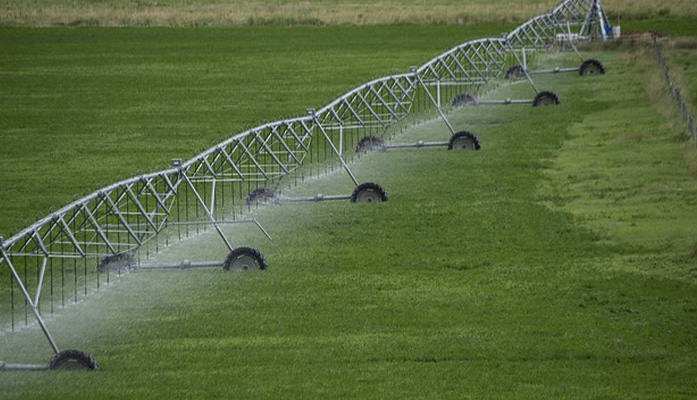
- The Hualapai Basin has enough groundwater storage to supply the region for 100–300+ years, even under heavy usage.
- Forecast models were based on worst-case pumping assumptions and should not be used to justify alarmist policy actions.
- Recharge estimates, storage volumes, and historical withdrawal rates all point to significant long-term water availability.
- The City of Kingman and Mohave County appear to have overstated risks—possibly to justify control over water rights or block agricultural competitors.
In the formal rebuttal dated May 8th, Lingenfelter addressed Gillette and claimed, “Your letter unfortunately contains a series of flawed assumptions, technical inaccuracies, and mischaracterizations that misinform rather than advance the public dialogue around long-term rural groundwater sustainability in Mohave County.”
He added, “Your letter asserts that data presented by Mohave County and the City of Kingman remains ‘suspect’ and ‘politically compromised.’ Such a characterization is categorically false and impugns the reputations of Mohave County, City of Kingman, and credentialed hydrologists at the ADWR and USGS and the public they serve.”
Responding to Lingenfelter’s rebuke in a formal response on May 16th, Gillette wrote, “While I welcome constructive dialogue, your letter reflects a degree of emotional overreach rather than a calm, scientific response to the concerns raised. Unfortunately, it reveals more about political defensiveness than about data transparency or hydrological best practice.”
Responding to critiques of the assessment’s findings Gillette wrote, “The assessment I authored was reviewed by three independent scientific and policy bodies prior to publication. All concluded that the findings were as accurate as possible given available data. I welcome peer review. What I reject is politically motivated resistance to scrutiny. As further evidence of bias, it should be noted that the ‘comparison document’ you reference—submitted by your team only days after my final assessment—contains several confirmations of my position.”
Rep. Gillette pushed back on Lingenfelter’s assertions based on the MODFLOW-NWT model from the U.S. Geological Survey and its 75,586 adjustable parameters writing, “As any trained analyst knows, such complexity magnifies sensitivity. Even small changes in assumptions—especially politically influenced assumptions—can result in dramatic shifts in outcome. Your confidence in the model would carry more weight if you supported my proposal to recalibrate baseline figures using 15 new field test sites with controlled, non manipulated measurement inputs. This is the kind of ground-truth methodology science demands. Strangely, your rebuttal ignores this recommendation entirely.”
He further strongly criticized the veto of a bill to cap irrigation on an irrigation non-expansion area (INA) by Governor Katie Hobbs, saying the veto “executed without explanation—is further evidence that political goals are outweighing scientific governance.”
AZ Free News reached out to Supervisor Lingenfelter for a comment and received the following reply:
Thank you for reaching out. I am not aware of any dispute or controversy between the Mohave County District 1 Office and Representative Gillette’s Office as you phrase it. As Mohave County Supervisor for District 1, I have served as Mohave County’s lead on water issues for the past five years, and was actively involved in our local water policy advocacy during my prior four years on the Kingman City Council.
My responsibility is to represent the shared, official position of both Mohave County and the City of Kingman, guided by the most accurate and credible data and hydrological modeling available, based on a multi-year, science-based partnership between Mohave County, the City of Kingman, and the United States Geological Survey (USGS)—an independent agency with a long-standing reputation for being the gold standard of scientific water modeling.
The ‘Final Assessment of the Hualapai Basin Water Data Integrity’ issued by Rep. Gillette is his office’s interpretation. The County and City remain firmly grounded and unified in the professional peer-reviewed science and long-term hydrological data and modeling that have guided our efforts to protect rural groundwater and ensure sustainable water use for future generations.
As always, Mohave County, City of Kingman, and USGS look forward to jointly collaborating with all legislators on our water issues on behalf of our rural communities.”
Based upon his team’s findings, Rep. Gillette has announced his intention to pursue “a stand-alone Hualapai Basin bill—developed outside of executive influence—that reflects the data as it exists, not as it is manipulated.”
Editor’s Note: Following the filing of this report, AZ Free News was contacted by Nick Ponder, Senior Vice President of Government Affairs of HighGround Public Affairs. Mr. Ponder provided the ’Analysis of Water Constraints and Economic Growth,’ a report prepared for Mohave County by Rounds Consulting Group, and the formal rebuttal issued on May 8th by Chairman Lingenfelter to Rep. Gillette with the note: “The County, City, and USGS have been very transparent in the processes and data used in determining the water situation in the Hualapai Valley Basin. The letter and the attached analysis should reflect that robust and transparent process.”
Matthew Holloway is a senior reporter for AZ Free News. Follow him on X for his latest stories, or email tips to Matthew@azfreenews.com.
by Matthew Holloway | Jul 18, 2025 | News
By Mathew Holloway |
Municipal Affairs Liaison at the Goldwater Institute William Beard sat for an interview with AZ Free News to expand on an op-ed published Saturday, “Regional Transit In Tucson: Bigger Tax Bill, Worse Results?”
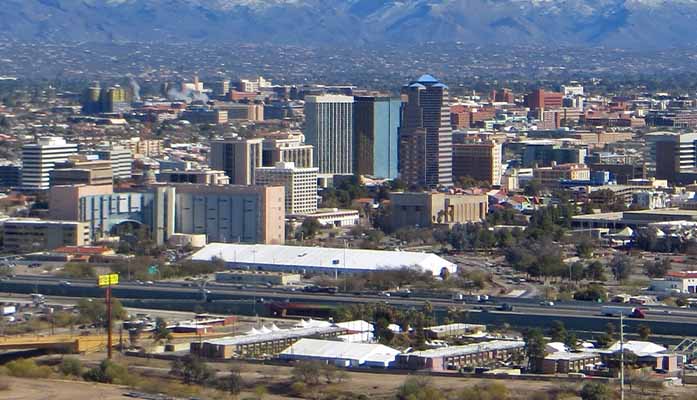
Beard warned in his column that as we approach 20 years of the 2006 vintage Regional Transportation Authority (RTA), only 18 of the 35 projects promised to the taxpayers of Pima County have been completed.
He wrote, “The mismanagement is staggering. Tucson’s unfinished Regional Transportation Authority (RTA) projects are estimated to be $400–$600 million short. At the current pace—roughly $50 million in spending per year—completing the work would take at least eight more years. There’s one big problem, however: the sales tax that funds the RTA is set to expire in 2026, and time is running out. Tucson officials have responded by throwing up their hands and admitting defeat, postponing four projects for inclusion in a future ‘RTA Next’ plan.”
Beard directly attributes the RTA’s financial woes and lack of productivity to a series of economic factors, exacerbated by the City of Tucson’s project mismanagement, delays, and unwillingness to shoulder the added cost burden. He explained, “Every infrastructure plan faces risks, and Pima County’s strategy was no exception. The 2008 recession slowed tax collections, and inflation has since driven construction costs well beyond the 10% buffer allowed by law. Tucson, however, made matters worse by repeatedly altering project scopes to appease neighborhood groups, further delaying timelines and driving up costs. Each time, Tucson failed to take responsibility by allocating more supplemental resources. Instead, city leaders appeared to hope the problem would simply go away.”
He added, “Tucson’s leaders clearly misunderstand the purpose of the RTA, viewing it more as a construction manager responsible for overruns than a basic funding mechanism distributing tax dollars. Each city was responsible for designing and building its own projects. Any change in scope—additional lanes, neighborhood preferences, unforeseen costs—was theirs to fund, not the RTA’s.“
Speaking with AZ Free News, Beard elaborated:
“I’m from Tucson. I grew up there, so this is a little personal for me. But there’s a history of kicking the can down the road by the community writ large, leadership, etc. A ‘Why deal with it today when we can postpone to tomorrow’ attitude. And it’s only when things truly reach a critical point that something happens politically.
“The powers that be down there would prefer to kind of maintain the status quo. They don’t want their boat rocked. They don’t want anybody coming in and potentially undermining their political power, so let’s maintain things as they are.
“To the point of the article, the problem fundamentally is two things. One, was it a failure to plan or a plan to fail? And number two, remember when voters vote on these long-term things, you always end up with a situation where the compromises politically that were made in order to get the thing past the voters that were approved in the beginning, political leadership that are elected further on into the cycle, they don’t believe that they are obligated to follow the wishes of whatever compromises were made in the first place.”
As for the political fallout, Beard predicted that an attempt from Tucson Mayor Regina Romero to extricate the city from the RTA, as she threatened in 2022, might not “end well for her politically speaking.”
He noted, “The problem is she is basically telling all of the voters across Pima County, not just the other communities, but the voters throughout Pima County, including her own voters, ‘eff you’. And I don’t think, given what happened with (Proposition) 414 a few months ago in the city of Tucson, I don’t think that will end well for her politically speaking.”
City voters soundly rejected Prop 414 or the “Safe & Vibrant City” proposition, which would have enacted a half-cent sales tax increase for the next 10 years to fund various city projects. City Manager Tim Thomure told AZCentral that the Proposition’s rejections sent city planners “back to the drawing board [to] sharpen our pencils and work it out so that we live within the budget that will be available to us.”
Beard continued saying that Romero, “is, of the opinion, and there are other people, including Supervisor Hines on the Board of Supervisors, of the opinion that the City can basically go its own way and make its own sales tax. They’re forgetting, of course, that if that happens, roughly… a third of the total revenue that would come to the region would disappear because it would revert back to the state legislature to determine whether or not those funds get distributed based on the regional planning that southern Arizona currently enjoys.”
He added that Tucson’s deviation from the RTA planning adopted in 2006 could leave the city open to legal consequences. He observed, “I’m not an attorney, so I don’t give legal advice, but I spent 30 years in the contracting world and I’ve read enough of the documents, the intergovernmental agreements, the procedures, policy procedures of the RTA that was adopted in 2006, all of them keep referring to voter language, you know, the amount of money that was set aside by the voters that could go to these projects.
“Under state law, you can vary that up to 10 % overrun, because it’s the vagaries of construction, that happens. But anything above and beyond that, you’ve got to go back to the voters in order to get their approval to make that kind of scope change. Again, I’m not an attorney, but I can read what’s in the language and it’s pretty clear.”
According to Beard, the RTA board did send its new legal counsel a question with the hope of getting an answer by the end of July at their next formal board meeting, asking: “What is the legal obligation of the RTA board to complete all of the projects if the revenue has not come in to satisfy all of the needs that the voters … determined 20 years ago?”
He concluded: “To be blunt, the city of Tucson’s got nobody to blame but themselves. You can point fingers at the RTA all you want to. You can point fingers to the leadership. The reality is in the numbers; the math is the math. And for all of these projects the City of Tucson kept postponing, it only dramatically increased the amount of money they would have to bring to the table, even assuming the RTA never had a revenue shortfall.
“Because the City of Tucson kept postponing these projects, the costs were going through the roof and there was no way legally for the RTA to step forward and say, oh yeah, we’ll cover those extra costs. That’s not possible.”
Matthew Holloway is a senior reporter for AZ Free News. Follow him on X for his latest stories, or email tips to Matthew@azfreenews.com.