by Matthew Holloway | Feb 9, 2025 | News
By Matthew Holloway |
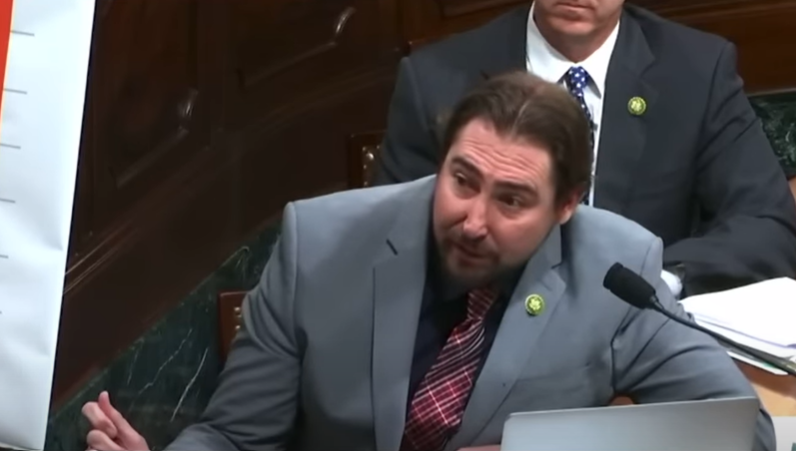
A Democrat SuperPAC bankrolled by leftist billionaires Michael Bloomberg, Illinois Gov. J.B. Pritzker, hedge fund manager Tom Steyer, and LinkedIn co-founder Reid Hoffman has reportedly targeted Arizona’s 2nd District Congressman Eli Crane for removal in the 2026 Congressional midterm. In a post to X, Crane shared the report from Fox News reporter Liz Elkind listing him with 13 other Congressmen to be opposed with a $50M investment summed up in a simple response: “Bring It.”
In a post to X on Monday, Crane wrote in full, “The great thing about #AZ02 is they see through phony attacks by coastal elites. Bring it.”
Elkind had reported that “Democrats’ House Majority PAC is rolling out a new initiative to win back working-class voters[.] 2026 Win Them Back Fund is launching with a $50M investment & initial plan targeting 14 Republicans who narrowly won their seats in November.”
According to Fox News, Mike Smith, president of the House Majority PAC told the New York Times that the “Win Them Back Fund” was created with an aim to generate appeal to draw working class voters to the Democratic Party after so many flipped to support President Donald Trump and the Republican Party this year. “We’re laying a marker down now,” he told the Times. “This is a priority.”
In addition to Crane, the House Majority PAC is targeting GOP Reps. Nick Begich (R-AK); David Valadao (R-CA-22); Ken Calvert, (R-CA-41); Gabe Evans, (R-CO-08); Mariannette Miller-Meeks, (R-IA-01); John James, (R-MI-10).
In a press release obtained by Fox News, the PAC said, “One of the major roadblocks we have faced as a party has been declining support among a multi-racial group of working class voters. That’s why HMP is today launching a 2026 Win Them Back Fund focused on ensuring that we win back working class voters across the congressional battlefield.”
“While Democrats at the Presidential level have consistently lost ground with working class voters for over the last decade, House Democrats like Reps. Adam Gray, Marie Gluesenkamp Perez, Don Davis, and Gabe Vasquez continue to overperform with this crucial bloc of voters. Their victories demonstrate that House Democrats can win back this coalition of voters with the support of strategic investments in recruitment, research, and programming.”
As noted by the outlet, while Democrats continue to deride billionaires such as Elon Musk and President Trump’s participation in the electoral process, high-profile donations to the PAC included $13 million from Bloomberg, $3 million from Pritzker, and $2 million from Steyer.
Matthew Holloway is a senior reporter for AZ Free News. Follow him on X for his latest stories, or email tips to Matthew@azfreenews.com.
by Matthew Holloway | Feb 8, 2025 | News
By Matthew Holloway |
In an Executive Order signed by President Donald Trump on Thursday, newly confirmed Attorney General Pam Bondi has been handed a mandate to chair a new Justice Department Task Force to eradicate anti-Christian bias.
According to the White House, the task force is to include Bondi’s fellow cabinet members in addition to ”the heads of such other executive departments, agencies, and offices that the Chair may, from time to time, invite to participate.”
In the text of the order, the President cited the U.S. Constitution’s prohibition against government interference with the free exercise of religion and the Civil Rights Act of 1964’s protections against religious discrimination. He declared, “The previous Administration engaged in an egregious pattern of targeting peaceful Christians, while ignoring violent, anti-Christian offenses.”
Trump added that, “The Biden Department of Justice sought to squelch faith in the public square by bringing Federal criminal charges and obtaining in numerous cases multi-year prison sentences against nearly two dozen peaceful pro-life Christians for praying and demonstrating outside abortion facilities.” He also referred to the arrest and prosecution of “a Catholic priest and 75-year-old grandmother, as well as an 87-year-old woman and a father,” for praying and singing hymns outside an abortion facility in protest, as well as an FBI memorandum that claimed “radical-traditionalist” Catholics were domestic-terrorism threats.
Trump also pointed to attacks against Christian churches and organizations noting, “At the same time, Catholic churches, charities, and pro-life centers sought justice for violence, theft, and arson perpetrated against them, which the Biden Department of Justice largely ignored. After more than 100 attacks, the U.S. House of Representatives passed a resolution condemning this violence and calling on the Biden Administration to enforce the law.”
Trump also laid “hostility and vandalism against Christian churches and places of worship,” at the feet of the Biden Administration noting “the number of such identified acts in 2023 exceeding by more than eight times the number from 2018.”
He also highlighted Biden’s Department of Education seeking to repeal religious liberty protections for faith-based organizations on university campuses and attempting to compel “Christians to affirm radical transgender ideology,” contrary to their beliefs via the Equal Employment Opportunity Commission, and drive them out of the foster-care system. Finally he pointed to the highly controversial declaration of a “Transgender Day of Visibility,” on Easter Sunday 2024, by the Biden Administration which drew widespread scorn.
In the text of the order, the President concluded, “My Administration will not tolerate anti-Christian weaponization of government or unlawful conduct targeting Christians. The law protects the freedom of Americans and groups of Americans to practice their faith in peace, and my Administration will enforce the law and protect these freedoms. My Administration will ensure that any unlawful and improper conduct, policies, or practices that target Christians are identified, terminated, and rectified.”
In a speech at the National Prayer Breakfast on Thursday, Trump told the gathered press that the task force’s mission is to “immediately halt all forms of anti-Christian targeting and discrimination in the federal government.”
“In addition, the task force will work to fully prosecute anti-Christian violence and vandalism in our society, and to move heaven and earth to defend the rights of Christians and religious believers nationwide,” he continued.
Matthew Holloway is a senior reporter for AZ Free News. Follow him on X for his latest stories, or email tips to Matthew@azfreenews.com.
by Matthew Holloway | Feb 8, 2025 | News
By Matthew Holloway |
A bill to construct a new Veterans Center on 232 acres of land in Young, Arizona, the first of its kind to support rural veterans and their families, was introduced by Congressman Eli Crane (R-AZ-02) and has passed the U.S. House of Representatives. The facility would be operated by Gila County and provide family housing, meeting and activity spaces, resource rooms, Veteran Ceremonial Grounds, and outdoor recreation.
“This veterans center is so crucial for rural veterans in northern Arizona who selflessly served our nation. I’m grateful to see my colleagues in the House recognize the significance of this land transfer,” said Crane. “This was the first piece of legislation I introduced and is a testament to the significance of northern Arizona’s veterans. Anytime Congress can vote on legislation that returns power to the states is a good thing. I’m grateful to House Committee on Natural Resources Chairman Bruce Westerman for his leadership and look forward to the advancement of this bill in the Senate.”
According to Crane’s office, the effort to get the new Veterans Center on its feet found unusual allies joined in a common cause with Rep. Paul Gosar (R-AZ) and former Rep. Tom O’Halleran (D-AZ) getting the bipartisan ball rolling during the 117th Congress with Democrat Senator Mark Kelly (D-AZ) leading corresponding efforts in the Senate.
“America’s veterans and their families have sacrificed so much to defend our freedom, and Congress must do everything in its power to provide our servicemembers with proper care and opportunities. The commonsense, bipartisan land transfer provided by H.R.837 will do just that by opening up new experiences to veterans in the area for recreation and recovery.” House Committee on Natural Resources Chairman Bruce Westerman explained, “A veteran himself, Representative Crane has led on these issues this Congress, and I look forward to continuing to work with him to get this bill through the Senate and signed into law.”
Gila County Supervisor Woody Cline, who testified before the House Natural Resources Committee, told Congress of the significant impacts and extensive resources the center would provide for veterans and their families in the region.
During his testimony, Rep. Crane said, “One of the things I love so much about this project, is that you’re not coming here, Mr. Cline, and asking the federal government for any money. You’re actually trying to take something that’s a beautiful piece of land that’s not being used anymore and revitalize it into something amazing for some of our nation’s finest individuals.”
“This site will only be one of two sites in Arizona. There’s one in the southern part of Arizona and one in the northern part […] It’s huge for our local community as well. We have a local veteran community of about 100 people right there in that small town. And then right there between us and Payson, there’s roughly another 5,000-7,000 more right there. Having this accessible, not only to the local members, the state members, the national members, but also, we’re adjacent to the White Mountain Apache Tribe that is not very far away that has a number of veterans in that reservation as well that have been big supporters of this project. It means everything to these folks,” said Cline.
Data from the Veterans Administration shows that by population density, as of 2019, veterans are most represented in Yavapai and Cochise Counties, the northern and southernmost counties respectively with between 11.78-14.45% of the population and between 14.46-16.74% of the population.
Matthew Holloway is a senior reporter for AZ Free News. Follow him on X for his latest stories, or email tips to Matthew@azfreenews.com.
by Matthew Holloway | Feb 7, 2025 | Education, News
By Matthew Holloway |
Arizona Superintendent of Public Instruction Tom Horne announced his endorsement of new legislation proposed by Rep. Leo Biasiucci that would forbid Arizona schools from providing foods on campus which are deemed harmful. Horne was joined by Education Committee Chairman Rep. Matt Gress and Registered Nurse, Sen. Janae Shamp, announcing the bill to “cut the chemicals,” on Tuesday.
In a press release, the Arizona Department of Education (ADE) revealed that HB 2164 would establish a ban on schools serving or selling foods found to contain ingredients that scientific studies have found to be harmful to students health, including potassium bromate, propylparaben, titanium dioxide, brominated vegetable oil, yellow dyes 5 and 6, blue dyes 1 and 2, red dyes 3 and 40, and green dye 3.
“Our kids deserve better than artificial dyes and cheap fillers in their lunches. If we’re providing meals at school, they should be real, nutritious food—not the kind of processed junk that’s banned in other countries. This bill puts the health of Arizona’s children first, plain and simple,” Biasiucci said in the release.
In a statement, Horne said, “The time has come to eliminate harmful foods from public schools and vending machines. Synthetic food dyes are associated with behavioral issues which then affect a child’s ability to perform academically and engage socially.”
Horne explained the extent of the discrepancy between food ingredients permitted in other developed nations versus those allowed by federal authorities in the U.S.
“There are approximately 10,000 ingredients approved for use in the U.S. versus about 400 in Europe, and these issues need to be addressed. Replacing foods that contain these ingredients and synthetic dye with those that are minimally processed is achievable. Manufacturers have already worked over the past few years to remove trans-fat and reduce sodium to meet USDA requirements. ADE also administers the ‘Try it Local’ program which provides additional reimbursement to school nutrition program operators who purchase locally grown, minimally processed foods.”
Horne concluded his comments adding, “This is a familiar crusade for me. In 2006, I was successful in getting sugared sodas out of schools, and I am just as enthusiastic about seeing this effort succeed. I urge passage of this bill, and the governor should sign it.”
The move was hailed by actor, health food advocate, and an increasingly prominent figure in Arizona conservative politics, Rob Schneider, who said, “The needs of the most precious members of our community, our children, must come first. We can no longer allow school lunches to be junk foods filled with toxic chemicals, unhealthy additives, dyes and preservatives. Our kids deserve better! I look forward to working with Representative Leo Biasiucci and the wonderful Chef’s in Arizona to bring healthy organic real food to our state school’s lunch programs!”
In a post to X, Schneider followed up, “The KEEP AMERICA’S CHILDREN SICK Food Lobbyists are TRULY DESPICABLE (SEE VIDEO BELOW) & I am GLAD THE ARIZONA LEGISLATURE is NOT FALLING FOR THEIR ‘SICK’ LIES. They are JUST AS AWFUL PEOPLE AS THE CIGARETTE companies that CLAIMED THEIR PRODUCTS WERE NOT ADDICTIVE or CANCEROUS!”
Senator Shamp, who as President Donald Trump pointed out, “is not a politician—she’s a registered nurse,” and holds her degrees from ASU in Molecular Biosciences & Biotechnology with a Nursing degree from Grand Canyon University, enthusiastically endorsed the bill.
“What we feed our kids matters. Schools shouldn’t be serving ultra-processed, chemically engineered, junk food. I’m proud to back HB2164 because Arizona’s children deserve better. And this is just the beginning—I’m excited to launch the Make America Healthy Caucus with Rep. Biasiucci to start making real change. Let’s Make Arizona Healthy Again!”
Matthew Holloway is a senior reporter for AZ Free News. Follow him on X for his latest stories, or email tips to Matthew@azfreenews.com.
by Matthew Holloway | Feb 6, 2025 | News
By Matthew Holloway |
On Monday night, hundreds of protesters organized by the Party for Socialism and Liberation took to the streets of Phoenix. They marched against the mass deportation policy of the Trump administration in front of the Immigration and Customs Enforcement (ICE) office on Central Avenue and the Capitol Museum.
The demonstrators blocked traffic and paraded with obscene signs and Mexican flags. The protests, which included several distinct marches throughout the city, were part of a “Day Without Immigrants,” opposed to the enforcement of U.S. immigration law. AZ Central reported that several incidents of reckless driving near a protest at 43rd Avenue and McDowell Road were observed with at least one person detained by Arizona State Troopers after fireworks were set off in the street. The radical leftist group posted to Instagram on Sunday, “Join us tomorrow to stand against the attacks on our communities. We refuse to let ICE tear apart our families and terrorize our people. Arizona says NO to raids, NO to deportations, NO to family separation!”
AZCentral noted that, among the signs visible, some read: “Families belong together” and “Donald Trump is a racist to all nations,” as well as “No more ICE,” “Don’t bite the hands that feed you,” “We speak for those that can’t” and “Mexicans Aren’t Going Anywhere.”
Metro Light Rail service was impacted by the protestors taking over the intersection as they approached Monterey Park, as reported by Arizona Family. ABC15 reported that the intersection was later closed by Phoenix Police responding to “reckless and unsafe” activity there.
Arizona Senator Wendy Rogers posted video of the march in front of the Capitol Museum, referring the gathering to ICE writing, “Hey @ICEgov! Right now. One-stop shop our in front of the @azcapitolmuseum”
Independent journalist ‘The Stu Studio’ posted a video of protestors to X chanting “Chinga La Migra!” which roughly translates to “F**k the Border Patrol,” in front of the ICE field office in Phoenix.
A Phoenix Police Spokesman Sgt. Robert Scherer told AZCentral that Phoenix PD was notified of the protest in advance and had officers monitoring the situation. “The Phoenix Police Department respects the rights of all community members to peacefully express their first amendment rights,” he said in a statement.
“To ensure the safety of our community, resources were organized, and we began to monitor activity related to this event,” said Scherer. “This included working with our partners with the Arizona Department of Public Safety.”
Matthew Holloway is a senior reporter for AZ Free News. Follow him on X for his latest stories, or email tips to Matthew@azfreenews.com.