Former Ambassador and Senator Jeff Flake (R-AZ) wrote a post to X on Sunday in which he reiterated his support for Democrat Presidential nominee Kamala Harris, extolling the virtue of the “rule of law.” In a scathing response to the post, former Maricopa County Sheriff Joe Arpaio refuted Flake’s stance based in the “rule of law” by hearkening back to a 2014 scandal that nearly ended Flake’s career.
In his post, Flake wrote, “I’m voting for Kamala Harris not in spite of being a conservative, but because I’m a conservative. Conservatives believe in the rule of law.”
In reply, an evidently unamused Arpaio wrote, “Your son Austin and his wife killed 23 dogs, and then sued me and the Sheriff’s Office for prosecuting them. You tried to destroy me and my detectives, you don’t believe in the rule of law!”
Your son Austin and his wife killed 23 dogs, and then sued me and the Sheriff's Office for prosecuting them. You tried to destroy me and my detectives, you don't believe in the rule of law!
Arpaio was referring to an incident which found Flake’s son Austin Flake and wife Logan Flake (née Hughes) indicted on multiple felony charges in connection with the deaths of 23 dogs at the Green Acre dog-boarding facility, owned by his in-laws Jesse Todd and MaLeisa Hughes. Arpaio, then-Sheriff, was the public face of the Maricopa County Sheriff’s Department which led the investigation and told the public during a press conference, “The caretakers were the Senator’s son and his wife.”
As reported by ABC15, the case against the Flakes was dismissed and the Hughes pleaded guilty to animal cruelty charges in 2014. As the saga unfolded, the Flake family launched a lawsuit, alleging malicious prosecution against Arpaio and his now-late wife Ava personally, along with Maricopa County, the Maricopa County Board of Supervisors, and Deputy Sheriff Marie Trombi and her husband.
The legal battle raged for three years until its resolution, largely in Arpaio’s, Trombi’s, and the county’s favor in 2018. That’s when a final effort to revive the lawsuit and a civil trial was dismissed by U.S. District Judge Neil Wake, according to AZCentral.
During the ongoing litigation, then-Senator Flake announced that he would not seek re-election. Flake was facing collapsing populariaty, had vocally set himself against the sitting President Trump, and faced primary defeat from pro-Trump Republicans. At the time, Politico reported that a top GOP strategist “said Flake’s team had been polling the race since the beginning of the year and had repeatedly found no path to victory in either the GOP primary or the general election.”
“He basically lost to all comers,” the GOP strategist told the outlet. “There wasn’t a Republican or a Democrat you could put next to him on the ballot who he wouldn’t lose to.”
Since his public fall from grace with the Arizona GOP, Flake has become a minor surrogate for the Biden administration, attracting a small cohort of anti-Trump Arizona Republicans. He was rewarded for siding against Trump with a posting as U.S. Ambassador to Türkiye. The 61-year-old ex-Senator stood down from his post in Ankara in September and has since aligned himself with the Biden campaign at first, and now the Harris campaign as previously reported by AZ Free News.
Flake’s enthusiastic advocacy for Harris has left many in Arizona wondering what a future under Harris could hold for the Snowflake-born politician. When asked by AZ Free News if he received any policy concessions for his endorsement, such as protecting the filibuster, religious liberty, or SCOTUS; or if he was promised another ambassadorship or a cabinet post, Flake did not reply.
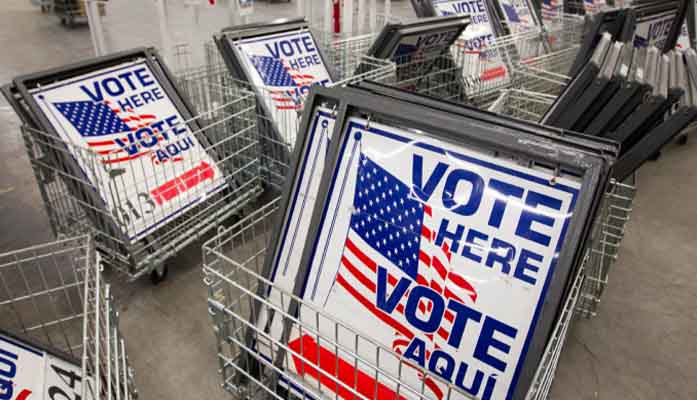
Security measures for Arizona voting centers are a prominent concern in 2024 and already hardened locations are being selected as polling places. Some facilities used for years have even declined to do so due to concerns over threats and violence. Maricopa County authorities have stepped up coordination with local, state, and federal agencies to address the concerns.
According to a report from NPR/KPBS, one Phoenix-area site slated for a voting center is equipped with barbed-wire fencing, six-foot tall security gates, and badge-controlled access doors. The building is a school district office, and according to the Superintendent, the security features are the only reason he is comfortable with the facility being used on election day.
The District Superintendent spoke to the outlet on condition of anonymity citing a concern over increased threats. He told NPR that his district has provided as many as 17 polling centers in past elections, but that number has been reduced now to just this one, with the high-security district office being the only option.
The school official told reporters that since the tense days of the 2020 and 2022 elections, “What happened is the rhetoric got stronger, higher, louder, and that’s what brought me to the decision — from a safety perspective — I can’t have those kinds of incidents that are making the front page on my campuses.”
Describing the security measures at the district office he said, “This is one step below Fort Knox.”
During the 2022 election, similar security measures were on display at the Maricopa County Tabulation and Election Center in Phoenix.
ARIZONA: Heavy police presence outside of Maricopa County Election Center as individuals protest the state government’s extremely slow release of ballots.
The District Superintendent recounted that during past elections, it fell to him to inform voters waiting in line that they could not open-carry firearms or demonstrate within the 75-foot weapons and electioneering limit. But rather than stop providing election locations altogether, he’s opted to provide just one that is highly secured. “As a large district, I want to be a community contributor that makes a difference in my community,” he told NPR. “Schools are the community.”
According to VoteBeat, as of May 2024, a survey of election administrators by the Brennan Center revealed that 40% of them have taken steps to bolster the physical security of election offices and polling places since the 2020 election. Approximately 38% reported workers experiencing either harassment or abuse and many are investing in “panic buttons” or training workers in de-escalation techniques.
Tammy Patrick, the chief programs officer for the Election Center, a non-profit representing these officials, told the outlet, “Election officials aspire to prepare for every possible election scenario — sadly, the possibility of violence is one of those scenarios that has been part of election contingency plans and protocols for years, if not decades.”
She added, “What is different this year is the preparation for potential, albeit remote, issues to arise at tabulation centers and election offices over the course of the election, with particular consideration for the post-election period and certification.”
Maricopa County Elections spokeswoman Jennifer Liewer told VoteBeat that county officials are working with the Sheriff’s Department as well as state and federal authorities via the County Command Center. “Agencies have been meeting for more than a year to prepare for the 2024 General Election,” she told reporters. She also noted that the county is among those including de-escalation tactics in poll worker training with “protocols on when and who to contact should poll workers feel the security of the facility or those in it might have a safety issue.” .
“It is our hope that voters will peacefully cast their ballots,” Liewer concluded. “Poll workers are prepared to intervene and de-escalate situations, but should the potential for violence occur, law enforcement is prepared to respond.”
Arizona Superintendent of Public Instruction Tom Horne announced the extension of free services through the Achievement Tutoring Program until the end of the 2024-25 school year. Horne hopes the move will allow a greater number of Arizona students to take advantage of the highly successful program.
In a statement released Wednesday, Horne said, “Studies show tutoring to be the best method for academic growth. A year ago, I announced that we would repurpose about $40 million in COVID relief funds that had been allocated by the previous administration, and were not being used for academic purposes, to create the Achievement Tutoring Program. The results have been excellent as students who get this tutoring have shown significant academic growth. Because we have received an extension that allows remaining funds to continue to be used, this program will continue through at least the end of the current school year.”
The program’s website lays out that it consists of “Six-week tutoring blocks with 60 minute sessions up to four days per week.” The students will also complete pre-and post-tutoring testing to determine their needs and gauge advancement during each tutoring block.
Due to Federal rules in the extension of COVID relief (ESSER) funds, the program is no longer available at public schools but can still be accessed by students in need through private providers and the Arizona Department of Education.
According to the Department, the Achievement Tutoring Program provides tutoring for K-12 students in reading, writing, and mathematics and since its inception, has instructed 30,400 students over a seven session period. Enrollment grew from November 2023 with 4,200 students to over 6,800 students, and the current session is accepting new enrollments through October.
The highly successful Achievement Tutoring Program initiated last year by Superintendent Tom Horne is being extended through the end of the 2024-25 school year, allowing more students to take advantage of this free program. https://t.co/S8n6Zv5oORpic.twitter.com/WtlMSqRxpr
— Arizona Department of Education (@azedschools) October 16, 2024
The release noted that in terms of academic achievement, the students enrolled “experienced at least a half-year’s worth of academic growth in six weeks, which is excellent progress in a short period of time.”
Several parents participating in the program with their children sent testimonials to the Arizona Deparment of Education, and Horne highlighted five:
Colleen, wrote to say, “I am incredibly grateful for the services and support provided by the program. I am confident that all three of my children will have increased confidence and improved report cards in the fall.”
Heather wrote, “As a single mom raising six young men, I could never afford to get tutoring like this to help them get caught up and build the confidence they need to have in life.”
From Jennifer, “The Achievement Tutoring program has helped tremendously to fill in the gaps in (my child’s) learning loss… He has improved immensely!”
Alexandra said, “My son has grown so much in reading… He finally has the confidence in reading that he has lacked for so long! I was so proud I actually cried.”
Catherine wrote, “My daughter had been struggling, but is now much more confident in her math skills… I truly hope the ATP program will continue, as it’s changing lives and helping so many. Especially some of us with limited financial resources.”
A new investigative film by the Public Interest Legal Foundation (PILF), a public interest law firm dedicated to election integrity, has revealed the group’s findings following its inspection of hundreds of commercial addresses listed on Arizona voter registrations as residences. The group found gas stations, liquor stores, abortion clinics, vacant lots, a strip club, an Arizona Cardinals training facility, and more all listed as voters’ residences.
Under Arizona law (A.R.S. 16-152), voters are required to register to vote where they reside, and the form even specifically forbids the use of business addresses or P.O. Boxes. Under the text of the law, voters must provide, “The complete address of the registrant’s actual place of residence, including street name and number, apartment or space number, city or town and zip code, or such description of the location of the residence that it can be readily ascertained or identified.”
PILF began the full film with a simple statement indicating that this issue was brought to the awareness of Arizona officials years ago. In on screen text, they wrote, “After years of failing to identify and remove commercial addresses from the voter roll, PILF is documenting this widespread problem to force Arizona election officials to investigate these addresses.”
PILF President J. Christian Adams said in a press release,
“We have been warning Arizona election officials about people registered to vote from commercial addresses since before the 2020 election. I hope this film will embarrass election officials into investigating the hundreds of commercial addresses on the voter roll. Arizona always comes down to a handful of votes which is why it’s so important this problem is fixed and why Arizonians need to go out and vote early this year.”
The foundation observed that that the illegal use of commercial addresses for voter registration is hardly the only issue with the Arizona voter rolls in 2024, noting several issues that AZ Free News has reported on in the past. These issues include the “glitch” that incorrectly marked 98,000 registrants as having provided proof of citizenship, the 2022 controversy over ballot printing errors at 70 Maricopa County voting centers that caused extensive delays and eroded voter confidence, and the Attorney General investigation of the 2020 election that showed as many as 200,000 ballots were transported illegally without the proper chain of custody.
The investigation by PILF closely resembles a similar undertaking by the investigative team of Louder with Crowder in 2021 following the controversial 2020 Presidential Election in which reporters for the show exposed voters registered under “addresses that do not exist,” including empty lots, highway overpasses and yes, commercial locations numbering in the thousands.
This week, the Arizona Republican Party reported that the AZGOP’s fundraising efforts “crushed” the party’s goals for the third quarter of 2024, raising a total of $9.22 million.
According to a press release from the party, the Republicans credited the success with Arizonans being “FED UP with the radical Harris/Walz agenda and the dangerous, California-style policies like Prop 140,” adding that they are “threatening” the state.
Chairwoman Gina Swoboda said in a statement, “This $9.22 million haul shows just how serious Arizonans are about WINNING this fight. Our supporters are fueling a movement that will stop the disastrous radical Left policies and ensure Arizona NEVER becomes California. We’re ready to turn out voters in November and WIN.”
The AZGOP noted that the fundraising effort will “supercharge” the party’s war chest going into the endgame of the 2024 election adding the funding is for “crucial efforts to protect Arizona from the Left’s overreach, defend our elections, and mobilize voters across the state.”
In its monthly newsletter, the AZGOP reported that the fundraising efforts are working to fund the Arizona Republican Coordinated Campaign (AZRCC) which it described as “the driving force behind securing Republican victories in November. Unlike traditional independent expenditures, the AZRCC works directly with candidates in critical swing districts, deploying targeted voter contact campaigns to ensure success at the ballot box.”
The party is currently engaged in 18 legislative races and is campaigning heavily to defeat the controversial, California-esque Propositions 140 and 139. As reported by The Hill earlier this month, the Republican party on a national level has lagged on spending in Arizona with only $17 million in aired ad spending in the state.
In a January interview with Steve Bannon’s Warroom, Swoboda told the host that the AZGOP came into the year with “no money,” as State Affairs noted the party ended 2023 with approximately $160,000 cash on hand. Republican consultant Chuck Coughlin told the outlet that the decision to move the party’s headquarters and sell the existing location near Park Central was “prudent.” He told State Affairs, “It seems Ms. Swoboda is making the best of a bad situation.”