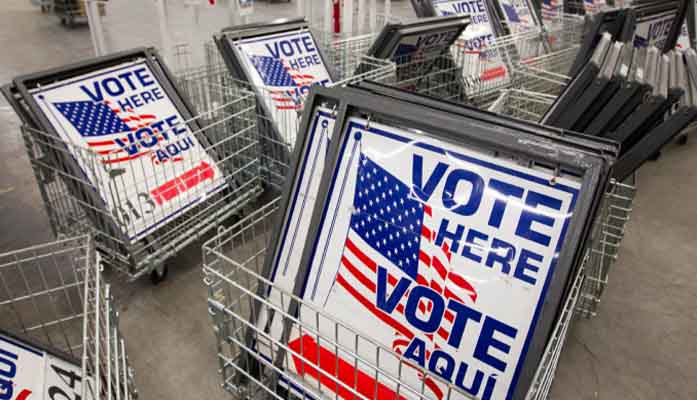
On Thursday, the Senate Judiciary Committee passed a bill to require proof of citizenship for those registering to vote, 5-3 along party lines. HB2492, which would require county recorders to search databases for a registrant’s citizenship proof, passed the House at the end of February.
Activists present were outspoken, interrupting the meeting multiple times to the point that Chairman Warren Petersen (R-Gilbert) had to remove an individual from the room and call a five minute recess.
SHAME ON THE COMMITTEE PASSING #HB2492!! We packed the room and told them that passing this would be unconstitutional yet they DO NOT LISTEN TO THE COMMUNITY. pic.twitter.com/7kvSHRo48I
During public comment on HB2492 in committee, there was contention as to whether HB2492 violated the Supreme Court (SCOTUS) 2013 ruling in Arizona v. Inter Tribal Council of Arizona. That ruling struck down Arizona’s law requiring voter registration applicants to be turned down if the registrant didn’t provide proof of citizenship, declaring that the federal voting laws established through the National Voter Registration Act (NVRA) of 1993.
Arizona Association of Counties (AACo) Executive Director Jen Marson, quoted from SCOTUS Justice Antonin Scalia’s opinion in the 2013 ruling to argue that the ruling nullified HB2492. Marson insisted that passage of the law would effectively require counties to violate federal law.
“‘We hold that [NVRA] precludes Arizona from requiring a Federal Form applicant to submit information beyond that required by the form itself. Arizona may, however, request anew that the [Election Assistance Commission] EAC include such a requirement among the Federal Form’s state-specific instructions, and may seek judicial review of the EAC’s decision under the Administrative Procedure Act,’” read Marson.
Those in favor of the bill argued that it complied with the SCOTUS ruling because voter registration would only be denied for those found to not be citizens, not those who merely lack citizenship proof.
Arizona Free Enterprise Club Deputy Director Greg Blackie rebutted that the bill wouldn’t violate the 2013 ruling because Scalia also said that the “NVRA doesn’t preclude states from denying registration based on information in their possession establishing the applicant’s ineligibility” — meaning, that those found to not be citizens could be rejected and those without any information confirming or denying their citizenship could be registered as federal-only voters.
“This bill carefully stays within the framework established by Arizona v. Inter Tribal Council,” insisted Blackie.
In addition to the nuance of compliance with SCOTUS, legislators emphasized that determining citizenship was a must-have for elections. Majority Whip Sonny Borrelli (R-Lake Havasu City) said that the bill had nothing to do with voter suppression.
“I don’t want somebody coming in here from a foreign country — particularly, you know, Italy for that matter — and just coming in and registering on a president-only vote, ballot, and they’re not even a US citizen. Because what that does, it nullifies the legal resident,” said Borrelli. “I don’t see the big burden here; I mean we want to make sure that a legal citizen has a right to vote and an illegal vote does not negate a legal vote. And that’s what it is, that’s about voter protection. It’s not about undermining the vote.”
Outspoken Democrats on the bill were rebuked by Petersen for going off the subject and impugning Republicans’ motives. Minority Whip Martin Quezada (D-Glendale) implied that Republicans were purposefully targeting individuals like the activists in attendance at the committee meeting because they feared them.
“What do those people look like? And why are those people being targeted if this bill passes? They’re afraid of you all right now. And this bill is targeting you all right now —” said Quezada.
“That’s absolutely ridiculous,” interjected Petersen. “Mr. Quezada, you’re impugning the motives of the sponsor of this bill and the members of the committee.”
Petersen stated that there are 36,000 people in Arizona registered to vote that haven’t proven citizenship status, noting that just recently an individual complained that the bill jeopardized their ability to vote in Arizona because they’re an illegal immigrant.
“I even saw a tweet from someone who said, ‘This bill is a risk to me! I’m a DACA person,’” stated Petersen. “We want everyone to vote, but we want citizens to vote. And it’s our job to make sure that happens.”
Call your AZ State Rep and deliver a message to save democracy in the state #HB2492 is threatening my ability as #DACA and the ability of #immigrants in AZ to help those eligible citizens to register to #VOTE Make a call now https://t.co/e2tMCn32Nj
The Arizona Senate kicked off their Monday with a show of bipartisanship. Four Senate Republicans joined their Democratic colleagues in voting against a bill to prohibit local governments from using lobbyists: State Senators Paul Boyer (R-Glendale), Tyler Pace (R-Mesa), T.J. Shope (R-Phoenix), and Senate President Karen Fann (R-Prescott). The bill from State Senator Warren Petersen (R-Gilbert), SB1198, failed 12-17.
The four senators didn’t explain their “no” vote; neither did the Democrats. The bill would’ve prevented counties, cities, towns, school districts, and any other political subdivisions from contracting with or spending money on lobbying services, with exemptions for employees of that local government entity, cities or towns with less than 75,000 citizens, or counties with less than 250,000 citizens.
Peterson explained during the Senate Government Committee that the end of lobbying at the state level several years ago allowed for a “greater balance” between citizens and the state government.
A spokesman for Apache County, Greenlee County, Scottsdale, and Prescott said that the bill was a good idea philosophically but would result in higher costs for the cities and counties. He said that the local governments would have to hire full-time employees to fulfill duties normally filled by lobbyists contracted at lower costs.
The League of Arizona Cities and Towns also opposed the bill. Their spokesman explained that their lobbyists alleviated the burdens of keeping up with the legislature for elected officials.
The Goldwater Institute National Litigation Director Jon Riches said the bill prevented taxpayer dollars from being spent on services that further government interests while ignoring the taxpayer.
“Tax dollars should not go to support status quo special interests at the expense of taxpayers, small businesses, and citizens who might not be able to afford a team of well-funded lobbyists, including lobbyists who often advocate against those taxpayers’ interests,” said Riches.
Arizona Free Enterprise Club Vice President Aimee Yentes concurred with Riches’ statement, insisting that it’s elected officials’ duty to take on the responsibilities that they pass on to lobbyists. Yentes is also a member of the Gilbert Town Council.
Disappointing result on SB1198. The Senators in red voted to allow government entities to continue wasting our tax dollars to pay lobbyists to lobby against the taxpayers’ interests.
The Arizona Senate passed a bill banning gender reassignment surgeries for minors late last week after State Senator Tyler Pace (R-Mesa) switched his vote. Pace voted against the original version of the bill during the Senate Health and Human Services Committee. At the time, Pace argued that parents should have the right to make those medical decisions for their children.
Pace agreed to support the bill after he authored a strike-all amendment modifying it, which the committee approved. The amendment removed language prohibiting physicians or health care professionals from referring minors to health care professionals for gender transition procedures. It also removed language prohibiting government funds from going to entities, organizations, or individuals that provide gender transition procedures to minors.
When the committee reconsidered the bill as rewritten under Pace’s amendment, Pace cited the international standards of care of World Professional Association for Transgender Health (WPATH) to justify his changed mind, noting that they don’t support transgender surgeries for minors. Pace clarified that physicians who implement gender reassignment surgeries on minors would be in violation of international best standards of care and subject to sanctions otherwise.
“There’s a certain threshold of irreversibility that can happen during a gender transition. We acknolwedge as a state, and so does other very friendly transgender countries like Finland, like I brought up earlier, as well as the international organizations that say: when you get to this degree of irreversibility, it should not be made as a minor,” said Pace.
There was disagreement in the committee between State Senators Nancy Barto (R-Phoenix) and Raquel Terán (D-Phoenix); Terán wanted to hear more public testimony, but Barto said that they heard almost 3 hours on the same subject the previous week.
The final Senate version of the bill removed the amendment stipulation that a minor must not have lived continuously in the gender role congruent with their gender identity for 12 months in order for the surgical prohibition to apply.
During the Senate floor vote, Democrats said the legislation opposed equality and attacked minors. State Senator Christine Marsh (D-Phoenix) said the bill was an “unnecessary,” masked effort to choose “buzz-words out of thin air” for the true objective of attacking children.
State Senator Rosanna Gabaldon (D-Sahuarita) claimed that transgender procedures merely prevented puberty. Gabaldon didn’t broach the subject of reported adverse effects of hormone blockers and therapies or gender reassignment surgeries.
With the amended language, the bill passed along party lines — no Republicans objected to it.
No gender reassignment surgery under the age of 18 passed the Arizona Senate. On to the house. pic.twitter.com/g7TGnDYjYR
CORRECTION: The bill still needs to be considered in the Senate. The “win” is confined only to the House vote as of 9:30 a.m., on June 29.
Back in January, on the second day of the legislative session, Sen. Warren Petersen and 27 other legislators introduced Senate Concurrent Resolution 1003 in hopes of garnering voter support to rein in a governor’s emergency powers.
It took more than five months, but the effort by Petersen (R-LD23) and the co-sponsors of SCR1003 paid off last week. The result – voters will decide in November 2022 whether to approve a constitutional amendment that ensures the legislature has a say after a governor issues a state of emergency.
A governor currently has power to declare a state of emergency for conditions of “disaster or extreme peril to the safety of persons or property within the state caused by air pollution, fire, flood, epidemic, riot, earthquake or other causes that are likely to be beyond the control of any single county or municipality.” Such a declaration is only terminated by proclamation of the governor or a concurrent resolution of the legislature.
The legislature, however, might not be in session when a state of emergency is issued.
SCR1003 would constitutionally require a governor to call the legislature into special session within 10 days of proclaiming a state of emergency. And once assembled, the legislature could determine whether to enact laws or issue legislative orders to terminate or modify the governor’s emergency powers as well as the state of emergency.
Those legislative orders would have the same authority as a governor’s executive orders, according to a provision of SCR1003. Another provision addresses a concern raised during the COVID-19 lockdowns – how to conduct legislative business if lawmakers cannot make it to the floor of their chambers.
Remote voting is currently allowed but the head count conducted for determining a quorum is based on those legislators present in the building. But if SCR1003 is approved by voters, quorums could be counted based on remote-attendance by a lawmaker under certain situations.
That would ensure the legislature can do its constitutionally-mandated duties even if several members are not in the building.
One of the most impassioned SCR1003 floor speeches came from Rep. Jake Hoffman (R-LD12) who advocated during voting on June 25 not only in support of the concurrent resolution but also to end of the COVID-19 public health emergency Gov. Doug Ducey declared more than 15 months ago.
According to Hoffman, Arizona’s state of emergency statutes permit “the most draconian measures out of all the states except for one. That is abhorrent. That is terrible.” He added that current laws allows emergency powers which are “unchecked and out of control.”
SCR1003, Hoffman said, “is measured, it is reasonable, it does not overreach, and it does not eliminate the ability for emergency orders and emergency declaration.”
He also called on Ducey to put on end to Arizona’s COVID-19 public health emergency. “It is time for this emergency order to end, period, stop all. End of story, turn it off,” Hoffman said.
But legislators did more last week that just ensure SCR1003 gets before voters next year.
The House and Senate also passed SB1819 which includes a provision that ends a governor’s public health state of emergency after 120 days unless extended in whole or in part by concurrent resolution of the legislature. That provision of the bill will not apply to a state of emergency issued before Jan. 1, 2023.
Petersen, the bill’s prime sponsor, told AZ Free News both SCR1003 and SB1819 are important given Arizona’s rating as second worst in the nation for the balance of powers between the executive and the legislative branches when it comes to emergency orders.
“SCR1003 and SB1819 are needed to bring Arizona into balance like the rest of the nation,” Petersen explained. “The measure that goes to the voters is important because it brings the legislature into session to consider any emergency orders issued. Meanwhile, SB1819 that we passed is important because it terminates those orders after four months.”
The two measures work hand in hand, Petersen noted.
“One makes sure the legislature has a voice in emergency orders from the start. The second makes sure that they don’t last forever,” he said.
Just hours after a judge slammed the door on their legal challenge to two State Senate subpoenas, the Maricopa County Board of Supervisors announced they will not appeal a court order requiring them to comply with the election-related subpoenas.
“Judge [Timothy] Thomason’s ruling brings clarity to whether Senate subpoenas apply to ballots that, per state law, must be kept private following an election; as well as the many other documents and equipment demanded,” Board Chairman Jack Sellers said in a statement. “We respect his legal opinion and will immediately start working to provide the Arizona Senate with the ballots and other materials.
The ruling by Thomason that the subpoenas issued in January “are legal and enforceable” made it clear that the Senate and its soon-to-be-announced auditor must not only be given access to Maricopa County’s electronic voting system -computers, software, tabulators- but also the more than 2 million ballots cast in the 2020 General Election.
“The Subpoenas comply with the statutory requirements for legislative subpoenas,” Thomason wrote in his detailed, 16-page finding. “The Senate also has broad constitutional power to oversee elections. The Arizona legislature clearly has the power to investigate and examine election reform matters. Accordingly, the Senators have the power to subpoena material as part of an inquiry into election reform measures.”
In his statement, Sellers also noted that Maricopa County elections officials have already turned over more than 11GB of election-related data demanded in the two subpoenas issued by Senate President Karen Fann and Senate Judiciary Chair Warren Petersen. And it didn’t take long for legislators to react to the county’s no-appeal decision.
“County said they needed a court order to comply with the subpoena. They got it,” Petersen tweeted after Thomason’s clerk released the detailed ruling to the parties. “Election integrity wins today.”
News of Thomason’s ruling that the Senate’s subpoenas served a legitimate legislative purpose and did not violate separation of powers principles was also well received by former Sen. Eddie Farnsworth. It was Farnsworth who along with Fann issued two subpoenas back in December that Maricopa County’s five-member board also ignored.
Instead of complying with the Fann / Farnsworth subpoenas, the county board sued the Senate and later decided to do its own post-election audit of the electronic voting system without participation by any of the legally-authorized political party observers.
“It is unfortunate that the Maricopa County Board of Supervisors’ incessant delaying tactics and smoke and mirrors audit in contempt of the legislature’s legal authority has cost Arizona citizens so much time, money, and trust,” Farnsworth said Friday. “Hopefully, the Senate, through a true forensic audit, can restore some confidence in the election system.”