by Daniel Stefanski | Jan 17, 2024 | News
By Daniel Stefanski |
Partisan lines have been drawn over the Arizona Governor’s Executive Budget Proposal for Fiscal Year 2025.
Late last week, Democrat Governor Katie Hobbs released her second budget for the Grand Canyon State. In a statement accompanying the announcement, Hobbs said, “Arizonans are counting on us to make the state we call home the best place to live, work, and raise a family. We made incredible progress during my first year in office, and my Executive Budget proposal builds on this foundation and expands opportunities for every Arizonan to reach their full potential. We are cutting out the wasteful taxpayer spending while making critical investments that will help middle class families buy a home, expand access to childcare, make prescription drugs more affordable, and protect disabled Arizonans and seniors. This is what it looks like to invest in our communities and build a state that works for every Arizonan.”
Legislative Republicans were quick to come out in opposition to the governor’s proposal. Senate Appropriations Chairman John Kavanagh wrote, “These elements in her proposal are dead on arrival with the Republican Majority. Her grandstanding of bipartisanship during her State of the State Address is a far cry from the reality of this budget proposal, as her funding cuts strictly target Republican priorities.”
House Appropriations Chairman David Livingston added, “Like last year’s proposal, the governor’s budget is an unserious mess. Her revenue and enrollment predictions don’t reflect reality, and her solution to the deficit proposes cuts to K-12 and water investments. We understand most of this is meant to appeal to her base. When she is willing to engage more seriously, Republicans are ready.”
Hobbs’ allies in the Arizona Legislature supported her proposal. House Democratic Leader Lupe Contreras released a statement, saying, “We applaud the Governor for producing a budget that protects the priorities that will drive our state forward and that our caucus has consistently championed for our communities – public education, affordable housing, childcare for working families and vital services for the most vulnerable Arizonans. She is listening and leading.”
The Senate Democrat Caucus posted, “This budget is a good first step in providing Arizona families with assistance in affording the high costs of childcare, housing, and prescription medications.”
In the inaugural week of the 2024 legislative session, Republicans and Democrats took political shots at one another over the budget in anticipation of the governor’s proposal. Arizona Senate President Warren Petersen accused his Democrat counterparts of “refusing to come to the table for budget negotiations,” threatening that his caucus might have to move on without them. The Senate Democrats Caucus clapped back at the Republican chamber leader, asserting that he had “moved forward on every other budget without Democrats, so this newest attempt at grandstanding falls flat.”
The early back-and-forth between the two political parties follows Democrat Governor Katie Hobbs’ second State of the State address, where she called on legislators to “find common ground” and to “work together to solve this gap.”
Both parties have vastly differing approaches to solving the state’s budget shortfall, though their rhetoric is somewhat similar at the start of the legislative session. In the Senate Republicans’ Majority Plan for 2024, they vowed to complete this mission “without irresponsibly tapping into the Rainy-Day Fund or using budget gimmicks,” promising instead to “use sound fiscal management strategies, like trimming unnecessary spending and prioritizing government’s top functions.” Hobbs stated that her soon-to-be-released budget would “rein in wasteful spending without sacrificing public safety and public education, establish guardrails on unaccountable programs without hurting hard-working families, and tighten our collective belts through increased efficiencies and innovation without gutting programs that support small businesses, seniors, and those in need.”
Last year, House and Senate Republicans approved a budget that was vetoed by Hobbs. Despite many partisan fights in the public eye between Republicans and the governor, Petersen and House Speaker Ben Toma deftly managed a surprise budget compromise, in which their policy priorities remained largely intact. Hobbs will be under increased pressure this time around to extract more concessions from Republicans – especially over the Empowerment Scholarship Account (ESA) program.
Daniel Stefanski is a reporter for AZ Free News. You can send him news tips using this link.
by Daniel Stefanski | Jan 14, 2024 | News
By Daniel Stefanski |
Arizona’s leading Republican lawmakers are again joining state attorneys general on another matter of national importance.
Last week, the Arizona State Senate Caucus revealed that President Warren Petersen and House Speaker Ben Toma had joined an amicus brief to urge “the U.S. Supreme Court to take up a dangerous ruling out of Colorado” that had barred “former President Donald Trump from the GOP primary ballot in the 2024 presidential election.” The filing was led by the States of Indiana and West Virginia and joined by 25 additional states, as well as the Arizona Legislature.
In a statement that accompanied the announcement, Petersen said, “If the high court does not immediately act, we anticipate election chaos will ensue over former President Trump’s eligibility as a candidate. This is clearly a case of judicial activism and a violation of the separation of powers. Leftist bias and prejudice are on full display from the Colorado Supreme Court. These justices are only playing partisan games by recklessly feeding a false media narrative that seeks to disenfranchise voters. I’m confident the U.S. Supreme Court will strike down this dangerous attack on our democracy.”
Petersen’s news release called the Colorado State Supreme Court’s decision to bar Trump from the ballot under the 14th Amendment of the U.S. Constitution “an egregious abuse of power,” asserting that America’s governing document “reserves the power to determine the political question of what constitutes an ‘insurrection’ to Congress – not rogue courts.”
Shortly after the brief was transmitted to the U.S. Supreme Court, the challenge was scheduled for arguments before the nation’s high court in early February.
The legislators’ sign-on to this brief marks the second time they have joined Republican attorneys general on their legal filings in 2024. At the start of the year, Senate Republicans shared that the Arizona Legislature had joined an amicus brief in federal court to help challenge California’s Assault Weapon Control Act. That brief was led by the attorneys general of Idaho, Iowa, and Montana, and co-signed by almost two dozen additional states.
In December, Petersen and Toma joined a public comment letter to the Bureau of Alcohol, Tobacco, Firearms and Explosives (ATF) to address its newly proposed rule, Definition of “Engaged in the Business as a Dealer in Firearms.” That letter was led by the States of Kansas, Iowa, and Montana, and co-signed by 22 other attorneys general.
Over the past month, the two Republican legislative leaders have signaled a more aggressive shift in taking the reins from Arizona Attorney General Kris Mayes to defend the law and Constitution. Attorneys general are not usually joined by outside parties on their amicus briefs, yet multiple coalitions of Republican state prosecutors have included Petersen and Toma on these major filings.
Both Majority Plans released by Senate and House Republicans preview their commitment to aggressively weigh in on state and federal litigation to defend the interests of Arizonans and uphold the rule of law. Senate Republicans wrote that they “firmly believe in the rule of law and will continue to defend state laws, especially when our Attorney General refuses to do so. We will also continue to seek appropriate relief through the courts to serve as a necessary check on abuses of executive authority at both the state and federal levels.” House Republicans added that “under the Biden administration, our constitutional rights and individual liberties are under daily threat…this complete disregard for the Constitution will not be tolerated. House Republicans will always protect rights guaranteed by the Constitution.”
Daniel Stefanski is a reporter for AZ Free News. You can send him news tips using this link.
by Daniel Stefanski | Jan 13, 2024 | News
By Daniel Stefanski |
Arizona legislative Republicans are warning against unilateral action from the state’s governor on water policy.
On Monday, Governor Katie Hobbs spent time in her second State of the State address to discuss the importance of water for Arizona and her past and future work on this front. Hobbs said, “Let us remember that water and drought do not care about party registration or job titles or whether you live in an urban or rural community. We can only protect our water supply by working together. I stand ready to work with you to pass legislation that makes the changes we need today – all to safeguard Arizona’s water for tomorrow. And those who have spent years refusing to act: if you don’t, I will.”
That last line earned the Democrat governor an ovation from her allies in the Arizona House chamber, yet a warning of legal repercussions from two powerful lawmakers who were listening to her words.
Senate President Pro Tempore T.J. Shope responded, “Yeah, I don’t think she has that type of authority to act alone but she seems willing to bend the State Constitution to her will pretty often so I’m sure she’ll try and I’m sure we’ll see her in court.”
Shope’s colleague, Senate President Warren Petersen, added onto the comment, writing, “Kind of like when she broke the law by appointing 13 fake directors?”
The future of Arizona’s water policy has always been a complex issue, but perhaps more so during the past year with a divided government and two parties with very distinct ideas about how to manage the vital resource. As the governor also mentioned in her State of the State address, she created a Water Policy Council during her first year in office “to analyze and recommend updates, revisions and additions to the 1980 Arizona Groundwater Management Act (GMA) and related water legislation, which shall include without limitation, analysis and recommendations for groundwater management outside current Active Management Areas.” Hobbs referred to this council as “bipartisan,” though one prominent Republican, Senator Sine Kerr, resigned from her post in October, alleging that the Council was “nothing more than a forum to rubberstamp the progressive environmental goals of special interest groups,” and that “this community (of Arizona citizens and stakeholders) is not being provided with fair representation at the table.”
Along with Kerr, the Arizona Farm Bureau also announced its withdrawal from the Council that month, opining, “…the outcome of the greater Council appears to be pre-determined as essentially a cross between the seriously flawed attempts of the past and an AMA (Active Management Areas).”
Hobbs created unfavorable headlines for the future of Arizona’s water during summer 2023, when she held a press conference to announce the publication of the Phoenix Active Management Area Groundwater Model. At the press conference, she stated that the study’s results “show we need to take action once again,” and that if the state does nothing at this juncture, “we could face a four percent shortfall in groundwater supplies over the next 100 years.” The governor announced a pause on “approvals of new assured water supply determinations that rely on pumping groundwater, ensuring that we don’t add to any future deficit.”
Republicans were quick to push back against Hobbs’ interpretation of the model. Kerr asserted that the results from the model “show the GMA of 1980 is working as it should,” and that “the remaining 4% of unmet demand over 100 years can be achieved through non-groundwater sources.” Representative Austin Smith told AZ Free News that “we can’t be beating the drum about a housing crisis, and then in the same beat, kneecap the housing industry.” Petersen also weighed in, writing, “There is no need to stop homebuilding. Homes use the least amount of water.”
Both the Arizona Senate and House Republican Majority Plans for 2024 addressed the issue of water. Senate Republicans promised that, “unlike the work product of the Governor’s Water Policy Council,” their solutions would “be grounded in the consent of the governed, the collaborative buy-in of all water users, and the common goal of preserving the health of groundwater basins for future generations.” House Republicans vowed to “protect, prioritize, and secure water resources for our state’s future.”
Daniel Stefanski is a reporter for AZ Free News. You can send him news tips using this link.
by Daniel Stefanski | Jan 13, 2024 | News
By Daniel Stefanski |
On Tuesday, Senate President Warren Petersen issued a press release, blasting his Democrat counterparts for “refusing to come to the table for budget negotiations.”
Petersen’s release revealed that the Senate Appropriations Chairman, John Kavanaugh, had transmitted two messages to Democrats – one on December 21, 2023, and the other on January 4, 2024. Those emails requested “input on which areas of government the Minority Caucus would prefer to reduce expenditures on, and which areas to prioritize continued funding for. According to Senate Republicans, not only have Kavanaugh’s emails gone without “response or acknowledgement,” but Petersen “was informed the Minority Leader is directing her Caucus not to engage with the Senate Appropriations Chairman on the budget.”
In a statement accompanying the news release, Petersen said, “It’s unfortunate we’re kicking off this legislative session with Senate Democrats playing games at the expense of our taxpayers. It’s time to be adults. We want all lawmakers to be at the table during budget negotiations, as the citizens of Arizona expect of their elected leaders, but we’ve heard nothing but crickets from the Minority Leader on her statutory obligation. We may have no other choice but to move forward without their input.”
The Senate Republican leader’s words hit a nerve with the chamber’s Democrats, who fired back through their “X” account, writing, “FOR IMMEDIATE RESPONSE: it’s day 2 of session. You’ve moved forward on every other budget without Democrats, so this newest attempt at grandstanding falls flat. The state’s revenue picture has gotten worse month over month, so you know it’s not fiscally responsible to make budget decisions prior to the next Finance Advisory Committee meeting.”
Senate Republicans corrected the record by reminding Democrats that they had “actually invited Democrats to the table last year as well.” The Republican Caucus shared an email from Kavanaugh from March 2, 2023, in which he extended an invitation to the Senate Minority Leader to “begin the process of discussing with you the budget priorities of the Senate Democratic Caucus.”
The early back-and-forth between the two political parties follows Democrat Governor Katie Hobbs’ second State of the State address, where she called on legislators to “find common ground” and to “work together to solve this gap.”
Both parties have vastly differing approaches to solving the state’s budget shortfall, though their rhetoric is somewhat similar at the start of the legislative session. In the Senate Republicans’ Majority Plan for 2024, they vowed to complete this mission “without irresponsibly tapping into the Rainy-Day Fund or using budget gimmicks,” promising instead to “use sound fiscal management strategies, like trimming unnecessary spending and prioritizing government’s top functions.” Hobbs stated that her soon-to-be-released budget would “rein in wasteful spending without sacrificing public safety and public education, establish guardrails on unaccountable programs without hurting hard-working families, and tighten our collective belts through increased efficiencies and innovation without gutting programs that support small businesses, seniors, and those in need.”
Last year, House and Senate Republicans approved a budget that was vetoed by Hobbs. Despite many partisan fights in the public eye between Republicans and the governor, Petersen and House Speaker Ben Toma deftly managed a surprise budget compromise, in which their policy priorities remained largely intact. Hobbs will be under increased pressure this time around to extract more concessions from Republicans – especially over the Empowerment Scholarship Account (ESA) program.
Daniel Stefanski is a reporter for AZ Free News. You can send him news tips using this link.
by Daniel Stefanski | Jan 9, 2024 | News
By Daniel Stefanski |
Arizona’s leading Republican lawmakers wasted no time in holding the state’s Democrat governor accountable on the first day of the Second Regular Session of the 56th Legislature.
On Monday, Arizona Governor Katie Hobbs delivered her second State of the State address, and the border crisis was the first theme she tackled in her speech to legislators and guests in the House chamber and gallery.
Hobbs blamed both “Democratic and Republican administrations” for “the failure to secure our southern border,” railing against “the same old political games that created this crisis and that have continually hurt communities, families, and our state.” The second-year governor asserted that she “delivered” on multiple fronts to help mitigate the crisis, including the launch of Operation SECURE and the creation of a Border Coordination Office within the Arizona Department of Homeland Security.
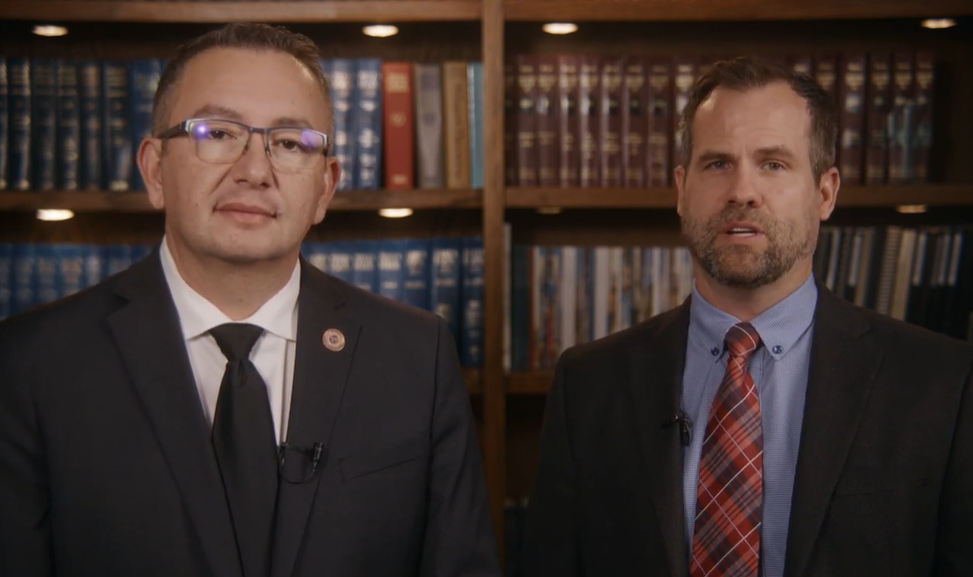
Both Senate President Warren Petersen and House Speaker Ben Toma reacted to the governor’s State of the State, releasing a joint video immediately after the conclusion of Hobbs’ remarks. The two men prioritized their response to this specific issue, dedicating almost two minutes of their five-minute video to discuss the governor’s record on border security. Toma argued that despite Hobbs’ attempt to make Arizonans “believe she’s all about securing our border and ending the lawlessness caused by Joe Biden’s immigration system…her record is one of open borders…and she’s continued that approach as governor.” The House Speaker alleged that “the governor’s reputation on immigration policy has only fueled this crisis.”
Petersen talked about “major mistakes” from Hobbs by vetoing three bills in particular “that would have kept families safe from drugs and crime.” Those 2023 bills, according to the Senate Republican leader, were HB 2675 (drug cartels, terrorist organizations; sponsored by Montenegro), HB 2469 (sovereign authority, border, health crisis; sponsored by Montenegro), and SB 1408 (electronic applications, human smuggling; sponsored by Wadsack). The East Valley lawmaker also noted that Hobbs “was a staunch critic of the shipping container barrier and advocated for its removal” at the border.
Toma also highlighted an instance when his colleagues “stopped (Hobbs’) irresponsible proposal of providing $40 million in state funding to pay for the college education of illegals in our state.”
During 2023, the first year of a rare, divided government in the Grand Canyon State, legislative Republicans effectively pointed out that the reality with the border crisis could have been more daunting for Arizonans if not for their check on Democrats. When Hobbs signed the state budget compromise in May, Petersen noted his members “prevented the Governor and Democrat Legislators from advancing their extremist agenda,” and promised “we’re not getting rid of state-funded border security resources to keep our communities safe.” Despite Hobbs’ efforts to be perceived as taking the border crisis seriously in the new year, she is unlikely to work with legislative Republicans on much – if any – fixes to help mitigate the lawlessness and consequences for affected communities.
Daniel Stefanski is a reporter for AZ Free News. You can send him news tips using this link.