by Kerri Toloczko | Sep 10, 2024 | Opinion
By Kerri Toloczko |
Tonight, the presidential candidates will have their first debate. But there is one critical election issue the American people are not debating at all. They agree that non-U.S. citizens should not vote in U.S. elections.
This is a convenient opinion for Americans to hold as it is also the law.
The National Voter Registration Act of 1993 (NVRA) and other federal codes and state constitutions require that only citizens vote in our elections. This is unequivocal. It is in writing. It is common sense.
The problem with laws is that people break them — including noncitizens who commit one federal crime by registering to vote and then another by actually voting. But because federal statutes are silent on requiring documentary proof of citizenship for either step, states have not demanded citizenship proof for voter registration on federal forms.
These registration forms are provided to people applying for a driver’s license or state ID with no consideration to whether that person is a citizen or not. And the entire citizen “confirmation” process is an innocuous checkbox on the federal form that many registrants fill in just because it’s there.
For noncitizen newcomers not proficient in English, all they know is that a government official handed them a form to fill out with a box to check — or that a liberal activist group told them to check it.
Election at Risk
Earlier this year, Tea Party Patriots commissioned a poll of citizens who vote regularly and found that 86 percent believe “proof of U.S. citizenship should be required to register to vote in American elections” and “only U.S. citizens should vote in elections in America.”
Who is the clueless other 13 percent? Leftwing political elites, their friends in the deceitful media, and the current occupants of the White House and vice president’s mansion, that’s who.
How do we know this? By following the SAVE Act and seeing who opposes it.
The Safeguard American Voter Eligibility Act passed the U.S. House of Representatives in July, hung out for a while in the do-nothing Senate, and may now bounce back to the House as an add-on to a must-pass bill.
House Speaker Mike Johnson and congressional Republicans acknowledge that noncitizens are registering to vote in numbers not seen before — and those illegal votes, cast in specific cities or counties, could sway the entire federal election.
The SAVE Act closes federal loopholes that allow noncitizens to register to vote by requiring election officials to ask about citizenship during registration, and potential registrants to provide documentary proof of citizenship. It gives states unfettered access to existing federal databases to check citizenship status against voter rolls.
It is a “must pass” all by itself — to protect our constitutional republic where the people’s will should matter most.
SAVE the Vote
Noncitizens aren’t the only ones paying consequences for unlawful registration and voting. Punishments include jail, fines, and immediate removal procedures. Naturalization is also permanently denied for applicants who show up on voter rolls, and they are subject to deportation.
Then there’s the American voter. Every time a noncitizen illegally votes — intentionally or unknowingly — a citizen’s ballot is removed from the count. Americans have clearly signaled they know this is happening, they don’t like it, and they do not want to pay that price.
But there is nothing in law allowing action against election officials who fail to uphold laws on citizenship requirements, or DMV bureaucrats who knowingly hand voter registration forms to noncitizens. The SAVE Act will empower citizens to bring civil suits in these cases and includes penalties for those enabling or encouraging noncitizens to register and to vote.
Progressive politocrats and their media friends offer two deceptive talking points about noncitizen voting.
One is “It’s against the law anyway.” It is also against the law to steal a car, commit murder, and jaywalk. But perhaps worse is their casual quip, dripping with moral relativism, that illegal immigrants voting “is not widespread.”
Both these ridiculous notions can be easily repudiated.
Proof
The federal government recently indicted a group of noncitizens from 15 countries on federal voting charges. Virginia recently purged 6,500 noncitizens from its voter rolls. Texas removed 6,300 people — 30% of whom had voting records. A 2014 academic journal reported that 6.4% of noncitizens voted in 2008.
There are about 24 million noncitizens currently in the U.S. If they voted only at the same rate of 6.4% this year as they did in 2008, they would account for 1.5 million votes.
Within 39 months of the Biden/Harris administration (including our “border czar”) coming into office, the foreign-born population of our nation increased by 6.6 million; at least 4.6 million of those are illegal immigrants.
Flyers have been found being widely distributed on the Mexican side of the U.S.\Mexican border encouraging illegal immigrants to vote for Biden in 2024. Biden issued Executive Order 14019 in March 2021, demanding anyone approaching the federal government for services (with no citizenship caveats) be provided a voter registration form. The Biden/Harris administration officially opposes the SAVE Act. Is all of that coincidence? And what could possibly go wrong?
If we learned nothing else from the presidential election of 2020, we know Americans of both political parties are profoundly disturbed by foreign interference of any kind in our elections.
Noncitizen voting is foreign influence.
We live in a representative republic. It’s beyond time our representatives listen to what we are telling them about the sanctity of our elections. Let’s get on with ensuring that only Americans vote in American elections.
Originally published by The Stream.
Kerri Toloczko is the executive director of Election Integrity Network and senior advisor to the Only Citizens Vote Coalition. Both of these nonprofit organizations are dedicated to protecting all ballots and ensuring that elections follow the law. They are also leading organizers of the 2024 Only Citizens Vote Week, which runs from September 15 to September 21.
by AZ Free Enterprise Club | Apr 12, 2024 | Opinion
By the Arizona Free Enterprise Club |
Everyone knows that political pundits, social media influencers, and the corporate media love a good narrative. And one of their favorites for years has been the claim that Arizona is trending blue—that a demographic shift toward Democrats is inevitable.
This ‘conventional wisdom’ is repeated so often that much of the Republican political class in the state has accepted it as fact. Some are even advising candidates that the only path forward for Republicans is to abandon their conservative principles, embrace center-left policy solutions, and settle for a future of divided government.
But a funny thing about narratives and conventional wisdom: numbers don’t lie, especially those showing party preference when people are registering to vote.
Last month, the Secretary of State updated the statewide voter registration data prior to the Presidential Preference Election. The latest figures show that Republicans are once again the largest voting bloc in Arizona, surpassing Independents by nearly 40,000. This is certainly an important development—especially given all the attention it received on social media when Independent registrations surpassed Republicans last year.
But that’s not the most significant voter registration trend…
>>> CONTINUE READING >>>
by Jeff Caldwell | Oct 4, 2023 | Opinion
By Jeff Caldwell |
Have you ever shown up to vote and were told at the voting location that your voting information does not match the information on your driver’s license? If this has happened to you, have you wondered if your vote was counted?
We finally know why this happens! And there’s someone fighting for you!
EZAZ.org put out a Call to Action for its Grassroots to speak at the Maricopa County Board of Supervisors Meeting on September 27. One of the talking points included that voters are unknowingly being re-registered as a different political party or even in a different county than the county they live in. One of the commenters utilized this talking point.
Maricopa County’s legal team followed up by stating that during the MVD and Service Arizona process, when someone re-registers their vehicle in another county, sometimes the opt-out box is mischecked and changes voter registration without the voter knowing. Maricopa County Elections Director, Scott Jarrett, agreed.
Yes, this is the same elections department run by Maricopa County Recorder Stephen Richer. Both offices stated that the MVD and Service Arizona process is allowed under state statute. They are saying their hands are tied, and they can’t do anything about it.
This means that a voter could get mismatched information or be registered under the wrong party affiliation for something like re-registering a vehicle, registering a new vehicle, or getting a new license… And the voter wouldn’t even know until it’s too late!
So, then what would happen? If someone shows up to vote and their voting registration information is different from the information on their driver’s license, the voting location provides what is called a provisional ballot.
The Arizona Secretary of State’s Office says, “Provisional ballots are a fail-safe measure designed to ensure that all eligible voters have their ballots counted.” The county is supposed to go back and determine if voters who cast provisional ballots were legal and then count the ballots of those who are legal. But if provisional ballots are such a fail-safe measure, then consider this.
There are currently over 9,000 provisional ballots not counted in the Arizona Attorney General race. Abe Hamadeh is still fighting in the courts because his team has discovered many of these voters tend to vote in every election and some were mysteriously re-registered in another county. There are only 280 votes separating Mayes from Hamadeh.
Abe’s team has been trying for months to get access to the envelopes of provisional ballots to verify information of those who did cast a vote in such a way, but the counties have not allowed this to happen. This is ridiculous!
It’s time for the MVD and Service Arizona to change its misguided process. And it’s time for the courts to force the counties to allow Abe’s team to inspect the provisional ballot envelopes. After all, real election integrity ensures that every legal vote is counted.
Jeff Caldwell currently helps with operations at EZAZ.org. He is also a Precinct Captain, State Committeeman, and Precinct Committeeman in Legislative District 2. Jeff is a huge baseball fan who enjoys camping and exploring new, tasty restaurants! You can follow him on X here.
by AZ Free Enterprise Club | Aug 13, 2023 | Opinion
By the Arizona Free Enterprise Club |
Clean and accurate voter rolls are a cornerstone to safe and secure elections. And they are required by both state and federal law. Section 8 of the National Voter Registration Act (NVRA) specifically obligates states to conduct a general program that makes a reasonable effort to remove the names of ineligible voters from the official lists of eligible voters due to death or change of residence. The U.S. Supreme Court even backed this up in its 2018 decision in the case Husted v. A. Philip Randolph Institute.
But Arizona’s current Secretary of State Adrian Fontes and its former Secretary of State (now Governor) Katie Hobbs have failed to perform the necessary voter list maintenance. And right now, 14 Arizona counties are in violation of Section 8 of the NVRA…
>>> CONTINUE READING >>>
by Corinne Murdock | May 24, 2023 | News
By Corinne Murdock |
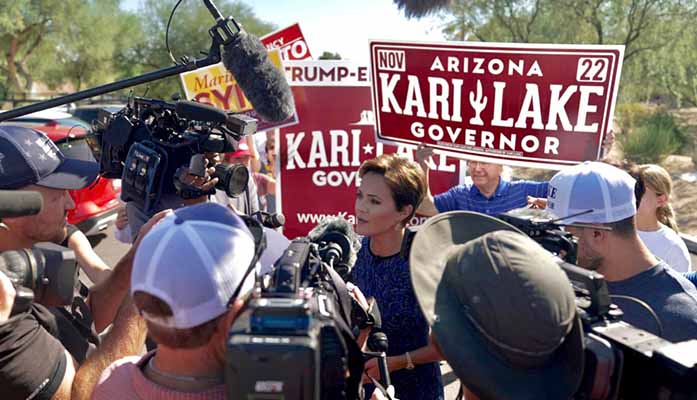
On Monday, the Maricopa County Superior Court dismissed Republican gubernatorial candidate Kari Lake’s case. Tuesday, Lake announced the launch of the “largest ballot chasing operation” in state history, which she clarified was a voter registration initiative for the upcoming election year.
Leading the initiative, backed financially with the Save Arizona Fund, will be longtime grassroots activist Merissa Hamilton.
Lake asserted that her team had proven “beyond a shadow of a doubt” to the Maricopa County Superior Court the brokenness of the state’s election system. However, despite her court loss, Lake pledged to continue to fight for election wins. Lake said that left-wing political actors shouldn’t be the only ones that conduct voter registration.
“We’ve got to work in this rigged, corrupt system, and we can do it,” said Lake.
Lake said that while she opposes mail-in ballots, she believes that the current election system requires participation to win. She claimed that about 500,000 Republican and independent voters combined were sent a mail-in ballot that they didn’t return.
“If this is the game we have to play, if this is their rigged system, we’ll work in their rigged system,” said Lake.
The Arizona Supreme Court granted a review of Lake’s challenge in March.
In Monday’s ruling, Maricopa County Superior Court Judge Peter Thompson explained that Lake failed to prove that election officials engaged in misconduct that affected the results of the gubernatorial election. Thompson ruled that Lake’s presentation of evidence that the signature review process was unlawful didn’t provide certainty that a specific number of ballots were impacted by the allegedly quick review.
Thompson cited several testimonies presented by Lake’s witnesses, who reported a preference for a more hasty and thorough signature review process but admitted that the multiple signature reviews required by law were completed. He said it was Lake’s own witnesses that confirmed the counties had abided by election law concerning signature processes, and rejected Lake’s argument based on Reyes v. Cuming that proper elections administration wasn’t adhered to and therefore hindered their ability to argue on a specific number of affected ballots.
“[T]his review was done hastily and possibly not as thoroughly as [complainants] would have liked — but it was done,” wrote Thompson. “This evidence is, in its own right, clear indicia that the comparative process was undertaken in compliance with the statute, putting us outside the scope of Reyes. There is clear and convincing evidence that the elections process for the November 8, 2022, General Election did comply with A.R.S. § 16-550 and that there was no misconduct in the process to support a claim under A.R.S. § 16-672.”
Lake’s team argued that the ballot signatures were processed much too quickly — under one second — to be in compliance with the spirit of the law. Thompson dismissed this argument, saying that time constraints weren’t outlined in the Election Procedures Manual (EPM) and therefore weren’t a standard that could be held against the counties.
“Plaintiff argues that this is so deficient for signature comparison that it amounts to no process at all. Accepting that argument would require the Court to rewrite not only the EPM but Arizona law to insert a minimum time for signature verification and specify the variables to be considered in the process,” stated Thompson. “Plaintiff asks the Court to interpret the word ‘compare’ in A.R.S. § 16-550(A) to require the Court to engage in a substantive weighing of whether Maricopa County’s signature verification process, as implemented, met some analytical baseline. But there are several problems with this. First, no such baseline appears in Section 16-550. Not one second, not three seconds, and not six seconds: no standard appears in the plain text of the statute. No reviewer is required by statute or the EPM to spend any specific length of time on any particular signature.”
Thompson stated the Lake’s witnesses were truthful in their testimonies.
“The Court makes no finding of dishonesty by any witness — and commends those signature reviewers who stepped forward to critique the process as they understood it,” said Thompson.
Thompson declared that no further matters remained on the case, save costs sought by the state and county election officials. Thompson issued a 5:00 pm Tuesday deadline for proposed form of judgment from the defendants, with a 5:00 pm Wednesday deadline for objection to those proposals by Lake’s team.
Corinne Murdock is a reporter for AZ Free News. Follow her latest on Twitter, or email tips to corinne@azfreenews.com.