by Daniel Stefanski | Nov 9, 2023 | News
By Daniel Stefanski |
Arizona’s Republican legislative leaders are wading into another fight with the President of the United States over a recent federal land grab.
On Monday, Arizona Senate President Warren Petersen and House Speaker Ben Toma announced that they “filed an amicus curiae in the case of Garfield County v. Biden.” The case, led by Utah Attorney General Sean Reyes, involves President Joe Biden’s “unilateral move in 2021 of declaring more than 3 million acres of land in the southern part of the state now representing two ‘national monuments.’” Arizona’s leaders are supporting the State of Utah’s position that the president’s action here violates the Antiquities Act. After a District Court Judge sided with the White House, Utah appealed the decision, leading to additional briefing.
“It is time for the courts to weigh in and stop this federal corruption. Joe Biden’s unlawful maneuvers in both Utah and Arizona promise to wreak havoc on our local economies, the livelihoods of our citizens, and our national security. His end goal is to pander to radical environmentalists by ending mining, ranching and other local uses of federal lands. This has nothing to do with protecting actual artifacts,” said Senate President Petersen. “This federal overreach is unconstitutional, unacceptable, and sets a dangerous precedent. In the absence of Arizona’s Attorney General fighting back against Biden’s dictator-style land grabs, the Arizona Legislature is stepping up to protect our communities. We ultimately anticipate this issue will make its way to the U.S. Supreme Court where the president’s abuse of power will be reined in.”
In their brief, Petersen and Toma argue that “the President does not have discretion to declare anything an ‘object’ under the Antiquities Act” because the law “is a type of conditional legislation that limits the President to ascertaining whether something is objectively an object of historic or scientific interest” and “Constitutional concerns underscore the need to limit the President’s discretion under the Act.” The legislators also assert that “Courts are not powerless to stop the President’s clear abuses of power.”
The lawmakers make the case that “the power that the President claims here is an expansive and aggressive assertion of executive authority. If his reading of the Antiquities Act is right, the only thing preventing the President from declaring all federal land a national monument is his self-restraint; after all, all federal lands have landscapes that, according to President Biden, are an ‘object of historic or scientific interest…’ Such a power, with its attendant consequences for the use of the land, is plainly one ‘of vast economic and political significance.’”
The case is currently before the United States Court of Appeals for the Tenth Circuit.
Daniel Stefanski is a reporter for AZ Free News. You can send him news tips using this link.
by Peggy McClain | Mar 27, 2023 | Opinion
By Peggy McClain |
“Even if just one life is saved.”
Who does not agree with a statement like this? It certainly tugs at the heartstrings, but what we often don’t hear is how many lives are lost or compromised due to what was deemed as a solution.
Last year the Teen Mental Health House Ad Hoc Committee was formed at the Arizona Legislature with this stated purpose:
The Ad Hoc Committee on Teen Mental Health, which will consist of members of the House of Representatives and of the community, is intended to research and review information regarding how substance abuse, depression and mental illness, bullying and social media, and other factors may affect mental health in youth and potential teen suicide. The committee shall work to identify potential solutions and make recommendations to public and private agencies with the goal of addressing teen mental health issues and improving access to mental health care.
Most of the time when governments choose committee members, it is so a pre-determined goal will be achieved. What the public sector continually lacks is the diligence to take a deep dive into issues and critically think about ramifications. Officeholders prefer politically expedient solutions, while education contractors benefit financially via lobbyists who peddle their wares.
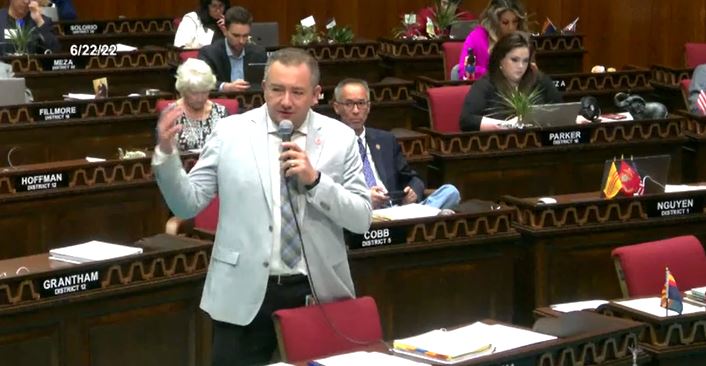
The issues surrounding Arizona HB2635 are real and scary, whether one supports the bill or not. Representative Travis Grantham (R-LD14) was the Vice Chair of the Teen Mental Health Committee, and the personal stories he heard clearly moved him. He sponsored HB2635 which would allow local governing boards to provide a mental health app for teens to have on their phones simply for access to a suicide prevention line.
But high schools and colleges are already required by Arizona law to print a suicide hotline number on student IDs. While an app for quick access to a suicide hotline sounds lifesaving, there are long-term risks involved for a product like this that lacks proven results. According to a study conducted by Internet Safety Labs and published December 13, 2022, even apps customized for school districts are less safe compared to generic apps—as 96% of the apps recommended by school districts share personal information with third parties.
We know our phones are tracking and listening to us. Apps can be developed to pick up on keywords which may relate to a stressful situation or even just an argument a teen has with his or her parents. Apps are also programmed to pick up certain emojis. Schools could then be notified and intervene based on a narrative which has nothing to do with suicide. Meanwhile, the information the app gathered never goes away. Mental health information gleaned from an app may be a problem later in life when the child is applying for jobs or certain academic programs.
In addition, according to study by Internet Safety Labs, 61% of custom apps send information to Google, while 81% access location information. These apps synchronize with the student’s Chromebooks and other devices. This is especially unnerving in Arizona, which is a leading state for sex trafficking. On top of that, several Arizona school districts recognize that social media is contributing to youth mental health problems, and one is even suing Facebook, YouTube, and TikTok. Why would our legislature support an app which leads students to these platforms?
Representative Grantham has been looking at a similar mental health app used in Utah. The idea started as a pilot program, collected data, and through the data it was deemed necessary to expand the program. Now that the data is documented, the proponents call it “evidence-based.”
Due to pushback, Representative Grantham proposed adding an amendment to provide “guardrails” for the mental health app. Will guardrails tell us who is on the other end of a suicide hotline? Like former Superintendent Kathy Hoffman’s QChat, parents are circumvented while minors are talking with strangers their parents know nothing about.
One of the mental health apps used in Utah is Bark, which has an LGBTQIA+ page. Bark also links students to the Trevor Project, which steers children to gender ideology. At the same time, the child’s data is recorded forever. That is concerning, especially since Bark advertises the CDC as one of its partners. Exactly what is the government doing with the information collected while the minor is tracked?
Children are suffering from a lack of personal interactions with parents, teachers, and friends. Sending them to an app—especially sinister ones like this—only exacerbates the problem. The Arizona Legislature should vote no on HB2635. Gathering data on children is an outright assault on them.
Peggy McClain is a concerned citizen who advocates for accountability in Arizona’s schools. You can follower her on Twitter here.
by Terri Jo Neff | Aug 26, 2022 | News
By Terri Jo Neff |
The Arizona Attorney General’s Office (AGO) has been reached an agreement to provide $400,000 to fund a new radio dispatch system for the Colorado City Police Department in an effort to improve emergency response times along the Arizona / Utah border.
Earlier this year, the Arizona State Legislature appropriated the funds to the AGO via House Bill 2862 for the express purpose of identifying ways to replace the outdated communication system relied on by police, fire, and EMS personnel in Colorado City, its sister city of Hildale, Utah, and surrounding areas of Mohave County.
“Every second counts during an emergency, so law enforcement requires efficient communication technology,” said Arizona Attorney General Mark Brnovich. “Our office is pleased to work with Colorado City’s police department to help ensure that its officers have the equipment needed to provide the fastest response times for residents of Northern Arizona.” Rep. Regina Cobb (R-Kingman) chaired the House Appropriations Committee which earmarked the funds. It was then up to Brnovich’s staff to work with Colorado City Police Chief Robb Radley to ensure the money is spent as intended no later than June 30, 2023.
“Reliable radio communications are critical to ensure an effective and timely response in emergency situations, especially in rural communities,” said Representative Regina Cobb, Chairwoman of the House Appropriations Committee. “I’ve been proud to work with Arizona Attorney General Mark Brnovich and his office to help secure this important public safety funding for the Colorado City Police Department.”
Among the provisions of the agreement is that the new radio system must meet at least minimum industry standards. Copies of all quotes, bid proposals, purchase orders, invoices, and receipts must be submitted to the AGO within 30 days of purchase and any excess funds not expended by the deadline must be returned to the AGO.
Radley took over the beleaguered department in August 2019 despite the fact a 2017 federal court order was in effect related to years of corruption, illegal conduct by some officers, and discriminatory services toward non-members of the Fundamentalist LDS Church. The agreement signed earlier this month by Radley signals a major step in his continuing efforts to improve emergency response services to the community.
“The Colorado City Police Department’s police, fire, and EMS communications center are extremely grateful to the State of Arizona, Representative Regina Cobb, the Attorney General’s Office, and Attorney General Mark Brnovich for the opportunity to further upgrade the center with modern radio communications,” said Radley. “The radio system will ensure first responders have the best opportunity to provide the highest quality of services possible for the residents and visitors of Northern Arizona.”
by Terri Jo Neff | Nov 25, 2021 | Economy, News
By Terri Jo Neff |
A partisan effort to make it harder for fossil fuel-based energy companies to obtain bank financing and banking services prompted a warning letter to the U.S. banking industry on Nov. 22 from the top financial officers of several states, including Arizona.
“Denying banking services to traditional, reliable energy production industries simply to advance radical, socialist policies from the White House, is both immoral and goes against the very free market principles that our country was founded upon,” said Arizona Treasurer Kimberly Yee in announcing the letter. “In this case, they are picking the energy industry as the losers and that goes against the free marketplace in America.”
Yee joined the financial officers of Alabama, Arkansas, Idaho, Kentucky, Louisiana, Missouri, Nebraska, North Dakota, South Carolina, South Dakota, Texas, Utah, West Virginia, and Wyoming in signing the letter, cautioning the banking industry of potential consequences for allowing itself to be used as a political pawn against law-abiding companies in the coal, oil, and natural gas industries.
According to the letter, the Biden Administration is “pressuring U.S. banks and financial institutions to limit, encumber, or outright refuse financing for traditional energy production companies.” The White House is also supporting an end to American financial support for traditional energy production projects in developing countries around the world, “likely ceding future development and exploration to Chinese interests,” the letter states.
“We believe, as almost all Americans do, that the free market should remain free and not be manipulated to advance social agendas,” the letter states. “We are not asking for special treatment of the fossil fuel industries. To the contrary, we simply want financial institutions to assess fossil fuel businesses as other legal businesses – without prejudice or preference.”
The letter also says the states have a compelling government interest “to select financial institutions that are not engaged in tactics to harm the very people whose money they are handling.”
Each state will undertake its own actions to counter the “undue pressure” being placed on the banking industry, according to the letter. Yee has not outlined what steps her office might take if financial institutions which do business with the state engage in efforts to deny services to the energy industry.