by Matthew Holloway | Oct 19, 2025 | News
By Matthew Holloway |
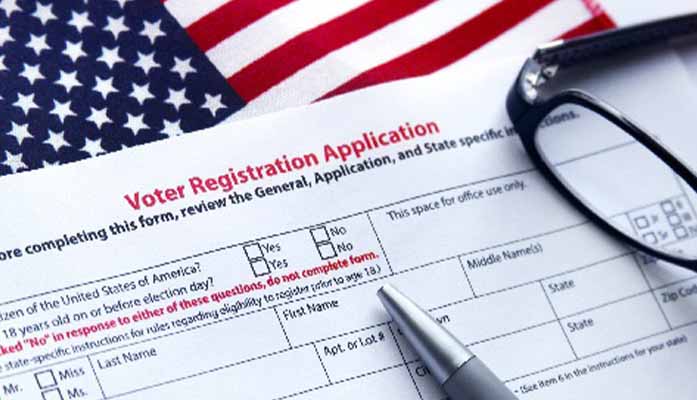
The U.S. Department of Justice (DOJ) has filed a brief in support of Arizona’s law requiring proof of citizenship to vote. The intervention comes in Mi Familia Vota v. Warren Petersen, a lawsuit filed by leftist groups against two laws passed by the Republican-controlled Arizona Legislature in 2022.
The laws require voters registering via the state form to provide documentary proof of U.S. citizenship to participate in state and local elections. The DOJ’s brief backs Senate President Warren Petersen’s defense of the laws following a Ninth Circuit Court of Appeals ruling that invalidated key provisions. The brief argues that Arizona’s birthplace attestation requirement “does not violate the Materiality Provision because it is generally important that an election official would consider important to the process of determining an applicant’s eligibility to vote.”
“We are thankful to again have a White House and Department of Justice committed to the rule of law and fair elections,” Petersen said in a statement. “The DOJ’s brief is appreciated in our fight to uphold a commonsense law and the will of the people. Given the clear precedent handed down from the U.S. Supreme Court, we are confident we will ultimately prevail. With the continued absence of our governor and attorney general, thankfully, the Arizona Legislature is again picking up the slack and is returning to our nation’s high court to defend election integrity.”
The case traces back to challenges by Mi Familia Vota and other groups, including some based outside Arizona, against House Bill 2492. The law bars enhances the legal guardrails of the Arizona voter registration process, ensuring that proof of citizenship is required to ensure only U.S. citizens are voting in our elections.
In August 2024, a three-judge Ninth Circuit panel vacated an emergency stay previously issued by another panel of the court. That decision permitted Arizona residents to register using the state form without proof of citizenship for federal races, such as U.S. president and Congress.
Petersen then sought emergency relief from the U.S. Supreme Court, which affirmed Arizona’s authority to reject incomplete registrations, marking the last binding order in the dispute until the Ninth Circuit’s latest deviation.
Eleven judges dissented from the Ninth Circuit’s most-recent majority opinion, saying, “Republican government serves as the keystone of the Constitution. In such a government, a majority of citizens who lawfully vote determines who represents us in the White House, Congress, and state legislatures. Courts must therefore defend the franchise—both by protecting the right of all citizens to vote, and by ensuring non-citizens do not vote. Arizona passed laws to protect the franchise… Sadly, the panel majority opinion undermines republican government, shreds federalism and the separation of powers, and imperils free and fair elections.”
The case now heads back to the U.S. Supreme Court for potential review, where Arizona will seek to enforce its citizenship verification requirements.
Matthew Holloway is a senior reporter for AZ Free News. Follow him on X for his latest stories, or email tips to Matthew@azfreenews.com.
by Jonathan Eberle | Sep 23, 2025 | News
By Jonathan Eberle |
Arizona Senate President Warren Petersen and House Speaker Steve Montenegro announced that Arizona’s legislative leaders have filed amicus briefs in two companion cases before the U.S. Supreme Court: Little v. Hecox (Idaho) and West Virginia v. B.P.J. The cases, expected to be argued this fall, address whether states may preserve the integrity and safety of girls’ and women’s sports by limiting participation to biological females.
Petersen emphasized that the cases offer the Court an opportunity to uphold fairness and safety in female athletics. “These cases give the Court an opportunity to affirm what science and common sense already make clear: biological males hold inherent physical advantages that make women’s athletic competitions unfair and unsafe when they are allowed to participate,” he said.
Speaker Montenegro echoed these sentiments, highlighting Arizona’s legislative action. “Arizona passed the Save Women’s Sports Act to keep competition fair for girls,” he said. “It’s unacceptable that our state’s top lawyer refuses to defend that law. While Attorney General Mayes stands aside, House Republicans are doing the job she won’t—standing up for Arizona’s daughters and every female athlete who trains and competes. The Ninth Circuit sidelined our law; I’m confident the Supreme Court will correct course and affirm what parents and coaches know: girls’ sports are for girls.”
The Save Women’s Sports Act, signed into law in 2022, restricts participation in girls’ athletic events at public schools to biological females. After Attorney General Mayes declined to defend the statute, Republican leaders in the House and Senate intervened in federal court. While the Ninth Circuit recognized the state’s interests in competitive fairness, student safety, and equal athletic opportunities, it left the act enjoined as applied to two transgender, biologically male athletes.
Arizona’s briefs in the Idaho and West Virginia cases urge the Supreme Court to uphold state laws that maintain female-only sports to protect safety, fairness, and equal athletic opportunities. The filings assert that the federal injunction against Arizona’s law has already harmed girls, impacting placements, roster spots, and playing time. They also argue that courts should defer to elected legislatures—rather than unelected athletic bodies—when setting uniform participation standards, particularly in areas involving scientific and medical disputes.
“Girls deserve a level playing field,” Speaker Montenegro said. “House Republicans will continue to vigorously defend Arizona’s law and support states working to keep girls’ sports fair and safe.” The Supreme Court’s rulings in the Idaho and West Virginia cases will likely shape the future of Arizona’s law and similar legislation across the country.
Jonathan Eberle is a reporter for AZ Free News. You can send him news tips using this link.
by Jonathan Eberle | Aug 8, 2025 | Education, News
By Jonathan Eberle |
As schools across Arizona reopen for the fall semester, State Superintendent of Public Instruction Tom Horne is encouraging parents to be alert to classroom content they believe may conflict with their family’s values. His call follows a recent U.S. Supreme Court ruling affirming parents’ rights to withdraw their children from classes that conflict with their religious beliefs.
“The U.S. Supreme Court recently ruled that parents have the Constitutionally protected right to opt their children out of classes when their religious beliefs conflict with course material,” Horne said in a public statement. “As the new school year begins, I am urging parents to be aware they have the power to ensure their child’s school is concentrating on academics, not social indoctrination.”
Horne cited a case from earlier this year involving a Tucson-area teacher whose lessons, he claimed, undermined students’ religious beliefs and promoted gender ideology. According to Horne, the teacher has since retired, and the matter was resolved. “This is exactly the type of situation that was addressed in this recent Supreme Court decision,” he said.
To address concerns like these, the Arizona Department of Education operates an “Empower Hotline,” which allows parents, educators, and citizens to report what they view as inappropriate content in the classroom. Horne said the hotline has received complaints about lessons that focus on race, gender identity, or content perceived as deviating from traditional academic instruction.
“Students need education in reading, writing, math, science, history, and the arts,” Horne added. “The inappropriate lessons about which parents are complaining are a distraction from these crucial academic subjects. My principal goal has been to bring back academic focus into the classrooms.”
The Supreme Court decision referenced by Horne affirms long-standing interpretations of parental rights in education but has gained renewed attention amid ongoing debates over curriculum content in public schools across the country.
Jonathan Eberle is a reporter for AZ Free News. You can send him news tips using this link.
by Ethan Faverino | Jun 30, 2025 | Education, News
By Ethan Faverino |
Arizona’s State Superintendent of Public Instruction Tom Horne is applauding the U.S. Supreme Court for its decision to allow parents to opt their kids out of inappropriate sexual classes. This ruling requires all schools to offer parents the option to withdraw their children when their religious beliefs conflict with course material.
In its decision on Friday, the U.S. Supreme Court ruled 6-3 that parents can opt their children out of public-school lessons containing inappropriate sexual content or LGBTQ+ themes that conflict with the family’s religious beliefs.
Horne praised this ruling, calling it a critical step in protecting young students from “inappropriate sexual lessons” and refocusing the classroom on core academics.
The case, Mahmoud v. Taylor, originated in Maryland, where parents challenged the local school board’s policy of not allowing opt-outs from lessons involving books with LGBTQ+ characters or sexual content. The Supreme Court’s decision sent the case back down to the lower courts for additional review but signaled strong support from parents all over the country.
The case involved “inclusivity” books that were announced in 2022 for students in pre-K through fifth grade in Maryland. Parents opposed the way the books defended controversial ideology around gender and sexuality.
For example, The Becket Fund noted one book tasks three and four-year-olds to search for images from a word list that includes “intersex flag,” “drag queen,” “underwear,” “leather,” and the name of a celebrated LGBTQ activist and sex worker.
Becket said another book advocates a child-knows-best approach to gender transitioning, telling students that a decision to transition doesn’t have to “make sense,” and teachers are instructed to say doctors only “guess” when identifying a newborn’s sex anyway.
“While scientific education regarding reproduction at an appropriate age is perfectly proper, there has been a trend to subject young children to sexual lessons that are inappropriate to their age,” said Horne. “Defenders of these programs say they want to be welcoming and inclusive. The proper way to do that is to include all students in education about reading, writing, math, science, history, and the arts. The inappropriate lessons about which parents are complaining are a distraction from these crucial academic subjects.”
Ethan Faverino is a reporter for AZ Free News. You can send him news tips using this link.
by AZ Free Enterprise Club | Apr 2, 2025 | Opinion
By the Arizona Free Enterprise Club |
In 2022, the Arizona Free Enterprise Club crafted the blueprint to stop illegals from voting in our elections, authoring landmark legislation that was signed into law, becoming the first state in the nation requiring proof of citizenship to register to vote with HB2492. Now, states around the country are taking notice and adopting our model, and just last week President Trump signed an Executive Order to do it nationally. Arizona was just the tip of the spear, and the dominoes are finally beginning to fall.
As of this week, two states require proof of citizenship to register to vote. Arizona was the first with HB2492. Earlier this year, Wyoming became the second. And now, the Texas Senate is considering a bill that is nearly identical to the Arizona Model, which would make them the third.
Arizona has long been at the forefront of this issue. In 2004, Arizona voters overwhelmingly approved Prop 200 to require proof of citizenship to vote. After nearly a decade of litigation, the U.S. Supreme Court allowed us to only implement the requirement on our own voter registration form but prevented us from requiring it on the federal form. The result over the decade following the decision was the complete proliferation of the “Federal Only Voting” list, amounting to tens of thousands of potential noncitizens registering and voting in our elections…
>>> CONTINUE READING >>>