by Staff Reporter | Feb 13, 2026 | Education, News
By Staff Reporter |
Arizona Superintendent of Public Instruction Tom Horne believes the new federal guidance on prayer in schools serves as a pathway to further purge K-12 of diversity, equity, and inclusion (DEI).
Horne said the administration’s characterization of speech compulsion made it clear that DEI presented an impermissible threat to religious freedoms.
“The new guidance issued by the U.S. Department of Education states that ‘No public school, teacher, or school official should ever coerce or press a student to engage in speech or affirm a viewpoint that would violate the student’s sincere religious beliefs,’” said Horne. “Numerous DEI precepts violate widespread religious beliefs, such as urging students to change genders, age-inappropriate sexual lessons, and other elements that may demean a student’s religious beliefs.”
Horne clarified that the new guidance doesn’t permit schools to coerce religious expression, either. Both the superintendent and the guidance cited the 2025 Supreme Court decision, Mahmoud v. Taylor, which found that public schools mandating curriculums endorsing homosexuality and transgenderism were violating religious freedom.
“No public school, teacher, or school official should ever coerce or pressure a student to engage in speech or affirm a viewpoint that would violate the student’s sincere religious beliefs,” stated the guidance. “[A] public school cannot require a student group to adopt a particular viewpoint in order to be recognized by the school if the viewpoint violates the student members’ religious beliefs. School officials also cannot express hostility toward religious student groups by demeaning their beliefs.”
The guidance, issued last week, addresses the issue of DEI elements in the context of requirements under federal law to advise on constitutionally protected prayer in public elementary and secondary schools. This updated version replaces the last guidance issued under the Biden administration in 2023.
Horne offered a marked copy of the guidance highlighting key new provisions across the four parts of the nine-page guidance.
In order to receive federal funding, local education agencies (LEAs) must certify in writing to the Arizona Department of Education (AZED) by Oct. 1 every year that none of their policies prevent or otherwise deny participation in constitutionally protected prayer in public K-12 schools.
AZED will establish processes by which the LEAs provide that certification and by which complaints may be filed against noncompliant LEAs. AZED must also send a list of noncompliant LEAs to the Department of Education by Nov. 1.
Presently, AZED requires LEAs to answer on Critical Race Theory and DEI as part of public reporting of school grades to assist with parental choice in schools.
“We will add this question to our list and report answers not only on our website, but also, as required, to the federal government,” said Horne. “Those with unsatisfactory answers to this question will then be deprived of federal funds.”
The guidance further clarified that the Trump administration’s perspective on religious freedom within schools was unlike the “wall of separation” view undertaken by previous administrations. It cited the most recent Supreme Court decision on prayer by school officials, Kennedy v. Bremerton School District, which found that a high school football coach had a right to engage in prayer on the field after games.
“This is not the familiar but legally unsound metaphor of a ‘wall of separation’ between religious faith and public schools,” stated the guidance. “It is rather a stance of neutrality among and accommodation toward all faiths, and hostility toward none, deeply rooted in our nation’s history, traditions, and constitutional law — a stance that upholds our Constitution’s ‘recognition of the important role that religion plays in the lives of many Americans.’”
AZ Free News is your #1 source for Arizona news and politics. You can send us news tips using this link.
by Matthew Holloway | Dec 16, 2025 | Education, News
By Matthew Holloway |
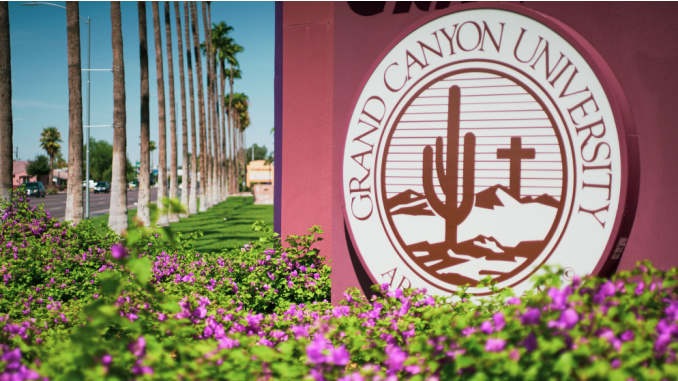
The U.S. Department of Education under Secretary Linda McMahon has formally restored Grand Canyon University’s nonprofit status, a reversal of a years-long dispute that had kept recognition of the Phoenix-based university’s tax-exempt classification in limbo.
The Department of Education’s (USDOE) action means it will now consider Grand Canyon University (GCU) a nonprofit institution for federal purposes, aligning its treatment under federal student-aid rules with the university’s longstanding recognition as a nonprofit by the Internal Revenue Service.
“We are appreciative that officials within the current Department of Education adhered to the recent Ninth Circuit decision in our favor and conducted an objective and thorough review of GCU’s operations in determining GCU’s nonprofit status under the correct legal standard,” GCU President Brian Mueller said in a statement. “We look forward to working with the Department in a cooperative manner moving forward and being part of the conversation to address the many challenges facing higher education.”
The move follows a May decision by the USDOE to reverse a $37 million fine against GCU, imposed under the Biden administration with prejudice. The fine was the largest ever levied by the agency against a university.
In November 2024, the U.S. Court of Appeals for the Ninth Circuit ruled that the Department of Education had unlawfully denied GCU nonprofit status and remanded the matter to the department for reconsideration under the correct legal standard. In 2018, the IRS reaffirmed GCU’s 501(c)(3) tax-exempt status after a multi-year audit, concluding that the university met all requirements of a nonprofit educational institution.
The restoration of nonprofit recognition comes as several Arizona members of Congress and other lawmakers have publicly advocated for the university’s status.
U.S. Rep. Eli Crane (R-AZ02) took to X on Monday to highlight the Education Department’s decision, calling the reinstatement of nonprofit status a significant development for the institution.
U.S. Rep. Andy Biggs (R-AZ05) also posted on X following the department’s announcement, noting the change in federal recognition and urging continuation of support for aligned legislative efforts.
In previous years, Arizona Republican lawmakers, including Reps. Gosar and Biggs had criticized the Department of Education’s handling of the university’s nonprofit status and its regulatory actions. They characterized earlier denials and fines as misplaced or excessive and called for greater alignment between federal treatment and GCU’s IRS-recognized status, per the Arizona Sun Times.
Gosar told the outlet at the time, “GCU is being targeted for its religious views and for being the largest Christian university in the country. The Department of Education should recognize GCU’s lawful nonprofit status and stop the harassment.”
With the Education Department’s updated decision, the agency will now consider GCU’s application as a nonprofit institution in future federal evaluations, including eligibility for Title IV federal student financial aid programs.
“This decision removes the cloud of confusion over our nonprofit status and allows us to put our complete focus and resources on our mission to provide affordable, Christian higher education to students from all socioeconomic backgrounds,” Mueller added. “We are excited to move forward with clarity and purpose.”
According to the university, nonprofit recognition is also expected to expand access to private scholarships restricted to nonprofit institutions, increase eligibility for nonprofit-specific grants and partnerships, restore eligibility for future government relief programs, reduce legal expenses associated with defending its status, and solidify GCU’s standing as a voting member of NCAA athletics.
Matthew Holloway is a senior reporter for AZ Free News. Follow him on X for his latest stories, or email tips to Matthew@azfreenews.com.
by Ethan Faverino | Oct 31, 2025 | Education, News
By Ethan Faverino |
Arizona Superintendent of Public Instruction Tom Horne issued a statement opposing the State Board of Education’s decision to postpone the rulemaking to strip Diversity, Equity, and Inclusion (DEI) language from Arizona’s teaching standards.
The issue will now be taken up at the Board’s December meeting—a delay Horne warns risks $866 million in federal education funding and violates clear federal civil rights directives.
“I respectfully but strongly disagree with the vote to postpone opening the rule-making process,” declared Horne. “The President issued an Executive Order requiring DEI language to be removed from programs funded by federal dollars. It made it abundantly clear that federal education funding is at risk if DEI language remains in education programs. Failure to comply with federal guidance may result in the loss of an estimated $866 million to Arizona schools. That is a major funding cut to our schools, and we need to begin dealing with this as soon as possible.”
Horne pointed to a letter from the U.S. Department of Education’s Office for Civil Rights (OCR), signed by Acting Assistant Secretary Craig Trainor, which reaffirms that discrimination based on race, color, or national origin is illegal under Title VI of the Civil Rights Act of 1964, the Equal Protection Clause, and controlling Supreme Court precedent.
The guidance explicitly condemns race-based preferences in admissions, financial aid, hiring, training, discipline, housing, and graduation ceremonies, and warns that DEI programs often “preference certain racial groups and teach students that certain racial groups bear unique moral burdens that others do not.”
The OCR letter also cites the Supreme Court’s 2023 ruling in Students for Fair Admissions v. Harvard (SFFA), which states that the use of racial preferences in school testing and admissions is unlawful. Their message is simple: “If an educational institution treats a person of one race differently than it treats another person because of that person’s race, the educational institution violates the law.”
“Not only is the $866 million at risk, but there is a philosophical issue at stake, too,” continued Horne. “All people should be judged based on their character and ability, not their race or ethnicity. DEI language and programs promote the exact opposite, and they have no place in the classroom. The teaching standards, unfortunately, include DEI references, and they need to be removed.”
The teaching standards at issue direct educators to teach “equitably,” with “responsiveness to the cultural backgrounds and differing perspectives learners bring to the learning environment,” and to address the “social, emotional, and cultural needs of students.”
“These terms do not belong in teaching standards,” Horne concluded. “The standards are meant to direct educators on the most effective ways to teach students’ core academics. Every instructional minute is precious, and DEI efforts distract from that essential mission.”
Ethan Faverino is a reporter for AZ Free News. You can send him news tips using this link.
by Ethan Faverino | Oct 21, 2025 | Education, News
By Ethan Faverino |
A new study has revealed that Arizona has one of the lowest college graduation rates in the nation at 49.58%.
Ranking eighth worst in the U.S., Arizona’s graduation rate falls 11.34% below the national average of 60.92%, according to the latest data from the U.S. Department of Education’s National Center for Education Statistics.
The study, conducted by Hennessey Digital, analyzed graduation rates across all colleges in each state, highlighting a troubling trend for Arizona, where only 49.58% of the students in the cohort completed their degrees within 150% of the normal program completion time (4 years).
This places Arizona alongside other struggling states, making it one of the eight states below 50% graduation.
“Regardless of what you’re studying, college can be a challenging time, said CEO of Hennessey Digital, Jason Hennessey. “For many, it’s the first experience of independence, a change from the environment you’ve grown up in and ultimately, incredibly intense. It’s not surprising to see that many drop out of their courses before graduation, but ultimately, every student needs to consider what’s going to make them happy and successful and an academic path is not always going to achieve that.”
The research identifies Alaska as the state with the lowest college graduation rate at 32.93%, a staggering 27.99% below the national average. Only 735 of 2,232 students in Alaska’s cohort completed their degrees.
Following closely are Nevada, with 45.20% completion, with 4,932 out of 10,912 students graduating, and New Mexico, with 47.80% completion and 3,523 out of 7,370 students graduating. Both are struggling with significant gaps in degree completion compared to the national average.
In contrast, Massachusetts leads the nation with a 75.41% graduation rate, 14.49% above the national average, with 40,011 out of 53,060 students completing their degrees.
Rhode Island follows at 73% with 8,835 of 12,103 students graduating and then Connecticut at 70.77% with 14,898 of 21,052 students graduating.
Ethan Faverino is a reporter for AZ Free News. You can send him news tips using this link.
by Staff Reporter | Sep 18, 2025 | Education, News
By Staff Reporter |
The Department of Education (ED) announced a significant new investment in school choice.
On Monday, ED pledged “historic” investments into charter schools, American history and civics programs, Historically Black Colleges and Universities (HBCUs), and Tribally Controlled Colleges and Universities (TCCUs).
The department repurposed funding from Diversity, Equity, and Inclusion programs to fund these investments.
ED Secretary Linda McMahon said the funds were reserved for programs “which support student success.”
“The Department has carefully scrutinized our federal grants, ensuring that taxpayers are not funding racially discriminatory programs but those programs which promote merit and excellence in education,” said McMahon. “The Trump Administration will use every available tool to meaningfully advance educational outcomes and ensure every American has the opportunity to succeed in life.”
ED also pledged over $160 million to the American History and Civics Education National Activities — Seminars for America’s Semiquincentennial program. 2026 will mark the 250th anniversary of the founding of the United States of America.
ED will award American history and civics grants for seminars that “directly commemorate the 250th anniversary of the Founding of the United States.” Eligible seminar programming must make a feature study of American political tradition: the ideas, institutions, and texts instrumental to this nation’s constitutional government and history. The seminars must also be based on “the first principles of American founding.” Eligible seminars must include the Declaration of Independence, Constitution, and Bill of Rights.
$500 million in grants will be distributed to charter schools for the 2025 fiscal year. Another total of nearly $500 million collectively will be sent as one-time investments to HBCUs and TCCUs.
As justification for the reallocation of millions in government grants, ED cited the poor student outcomes exhibited by the 2024 National Assessment of Educational Progress (NAEP) scores released earlier this month. Student NAEP scores reached “historic lows” throughout K-12.
Nationally, average NAEP scores were lower across all three assessments: science at grade 8, mathematics at grade 12, and reading at grade 12.
Arizona students scored lower across the various subjects than the average national scores for both fourth and eighth graders. Fourth grade math scores averaged 232, compared to the national average of 237; fourth grade reading scores averaged 208, compared to the national average of 214; and fourth grade science scores averaged 149, compared to the national average of 153.
Eighth grade math scores averaged 270, compared to the national average of 272; eighth grade reading scores averaged 254, compared to the national average of 257; and eighth grade science scores averaged 148, compared to the national average of 153.
McMahon called the NAEP results “devastating,” and indicative of a trend of generations unprepared for adult life. McMahon questioned the spending of billions annually with such dismal results, and pledged to claw back some of those funds to invest in individual states and educational choice.
“At a critical juncture when students are about to graduate and enter the workforce, military, or higher education, nearly half of America’s high school seniors are testing at below basic levels in math and reading. Despite spending billions annually on numerous K-12 programs, the achievement gap is widening, and more high school seniors are performing below the basic benchmark in math and reading than ever before,” said McMahon. “If America is going to remain globally competitive, students must be able to read proficiently, think critically, and graduate equipped to solve complex problems. We owe it to them to do better.”
In May, ED pledged to increase charter school funding by $60 million for a program budget total of $500 million.
AZ Free News is your #1 source for Arizona news and politics. You can send us news tips using this link.