Arizona is introducing a new apprenticeship program aimed at tackling the state’s ongoing teacher shortage, according to Superintendent of Public Instruction Tom Horne. The Arizona Teacher Registered Apprenticeship Program (AZ TRAP), developed in collaboration with the Arizona Office of Apprenticeship, provides aspiring educators with a pathway to certification at little to no cost. Participants gain classroom experience while earning a wage and receiving mentoring and professional development.
“There is a crisis in Arizona, and we must take strong action. We are losing more teachers than are coming into the profession,” Horne said. “If we don’t do something major, we could end up with zero teachers. Apprenticeship programs are another tool to be used alongside efforts to improve teacher pay and administrative support.”
Horne emphasized that the program is designed to increase accessibility to teacher certification and build a stronger pipeline of educators. “The Arizona Department of Education is a service-oriented agency, and this effort is part of my commitment to training quality educators for Arizona classrooms,” he said.
The program has received $1.5 million in funding from the Maricopa County Workforce Development Board to support apprentices in Maricopa County for the 2025–2026 school year.
Key features of AZ TRAP include:
Pilot partnerships with Mesa Public Schools, Phoenix Union High School District, The Arizona Teacher Residency Program, and PLC Charter Schools, which will employ teacher apprentices and collaborate with the Department of Education.
Hands-on experience, giving aspiring teachers thousands of hours of on-the-job learning under the guidance of mentor teachers.
Grow Your Own Model, allowing schools to select prospective employees and integrate them into their culture early, with the goal of improving teacher retention.
The apprenticeship program represents a targeted effort to prepare educators for Arizona classrooms while addressing one of the state’s most pressing education challenges.
Jonathan Eberle is a reporter for AZ Free News. You can send him news tips using this link.
School bureaucrats who have mismanaged their finances are hoping that voters will blame a convenient scapegoat: families using Empowerment Scholarship Accounts (ESAs) to educate their children. As usual, their allies in the legacy media are trying hard to help them shift the blame—but the numbers don’t lie.
Channel 12 recently ran a story titled “Deer Valley teachers self-fund or rely on classroom wish lists for basics, while ESA parents buy luxury items with state tax dollars.” Most of the article reads like a press release from Deer Valley Unified School District Superintendent Curtis Finch, who claims that the ESA program has “zero accountability,” “no oversight,” and is “out of control.” Meanwhile, the article quotes teachers in Deer Valley who are spending hundreds of dollars from their own pockets to cover school supplies for their students.
The implication is clear: district schools are financially starved while ESA families waste money on frivolous luxuries. But the reality is exactly the opposite.
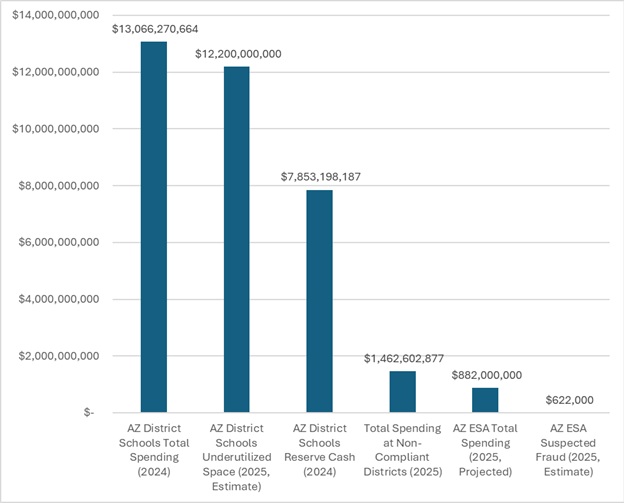
Misuse of the ESA program is vanishingly small. The Arizona Department of Education’s internal audit had turned up $622,000 in ESA funds that are “possible fraud or misuse.” That’s approximately 0.05% of total ESA spending over the past two years.
Misuse of funds in the ESA or any other public program must be detected, deterred, and punished. This is in fact happening in the ESA program, as the Arizona Department of Education had already found the misuse, suspended accounts of those responsible, and reports that it is “in the process of collecting more than $600,000” in improper spending. All of this makes the ESA program far more transparent and accountable than Arizona school districts, which do not post their purchases.
And while Deer Valley teachers may indeed purchase their own school supplies, it has nothing to do with the ESA program and everything to do with misplaced district priorities.
One of the oldest tricks in the school district advocate playbook involves pretending that teachers must buy their own classroom supplies because of a lack of funding. The Channel 12 story cites a Deer Valley biology teacher who said she “spends at least $500 of her own money every summer for her classroom.”
Days after the report aired, former Deer Valley school board candidate Tiffany Hawkins revealed that Deer Valley Unified had spent $560,407 to send students and staff on trips to Disneyland, Knott’s Berry Farm, Sea World, Universal Studios, and other destinations in Arizona, California, Hawaii, Indiana, and Texas. Apparently, the district leadership decided that these trips took precedence over classroom supplies for Deer Valley teachers.
Don’t hold your breath waiting for Channel 12 to cover that. Deer Valley Superintendent Finch—who recently faced charges of stonewalling public records requests and illegal electioneering on school grounds—attacked the ESA program for “out of control” spending with “zero accountability.” But his critiques of the ESA program much more accurately describe spending in his own district.
The Arizona Auditor General reports that Deer Valley spends $13,717 per pupil, meaning that a classroom of 25 students thus generates over $340,000 in total revenue. Where did this money go? Mainly not to teachers.
The Auditor General reports that Deer Valley average teacher pay is $2,163 below the state average. If Deer Valley is not prioritizing teachers, what is it prioritizing instead? The Auditor General report helpfully provides an answer: “high” and “very high” spending on administration and transportation, respectively, compared to a group of peer school districts.
The Goldwater Institute recently published a study of Arizona school superintendent compensation. Goldwater needed to use the open-records law to obtain this information, as districts compensate their superintendents in a variety of creative ways outside of their base salary, including providing either vehicles or “car allowances,” extra retirement benefits, and other perks.
The Goldwater Institute found that Deer Valley provides a total compensation package for their Superintendent of $290,505, including a car allowance of $10,000. This car allowance alone could have provided 20 teachers with $500 each for classroom supplies.
Even if one were to take the highly perverse view that students were the indentured servants of the school districts in which they reside, it would still be absurd for Deer Valley Unified officials to blame their problems on the ESA program. Arizona Department of Education reports show that 10,966 students lived within the boundaries of Deer Valley Unified but attended other public schools in 2024.
Deer Valley Unified meanwhile “drained” almost 3,000 students and their funding from other public schools. At the end of 2024, only 709 students had left a Deer Valley school to participate in the ESA program. Four different public schools outside Deer Valley Unified each have enrolled more students who reside in the district than the ESA program. Moreover 217 total public schools outside the district enroll Deer Valley Unified resident students.
Luckily, Arizona policymakers have decided that Arizona children are not merely funding units for their local school districts. Arizona families can use ESAs to choose the schools that are the best fit for the interests and aspirations of their children.
Arizona school districts have never had as much money as they have now, enough apparently to prioritize trips to California and perks for superintendents. If Deer Valley Unified officials hope to gain the enrollment of the thousands of resident students who have chosen to pursue their education elsewhere, a clear path forward would be to prioritize their funding.
Purchasing classroom supplies for teachers would be a great first step.
Matthew Ladner is a Senior Advisor for education policy implementation and Jason Bedrick is a Research Fellow at the Heritage Foundation’s Center for Education Policy.
A transgender high school teacher received a three-year suspension of his teaching certificate for multiple alleged offenses, which included discussing his sex life and conducting private storage closet excursions with students.
Erin Quigley — a man who identifies as a woman — up until recently taught sports medicine for Amphitheater High School at Amphitheater Public Schools (APS) in Tucson.
In response to an investigation launched last year by the Arizona State Board of Education (ASBE), Quigley agreed to a negotiated settlement in which Quigley’s teaching certificate would be suspended for three years. Quigley also agreed to take the National Association of State Directors of Teacher Education and Certification Prevention and Correction course.
ASBE’s case file on Quigley noted that he gave a student a gold necklace under the pretext of being a “secret admirer” and texted that student to discuss his personal life. According to ASBE, Quigley regularly gave out his personal phone number to students. On at least one occasion, Quigley was reported to have given his home address as well when he invited the entire class to his house for a Thanksgiving dinner.
The student gifted the necklace also reported that Quigley publicly discussed his sex life with students, offering details about how he had sex with many women in the past. Quigley also reportedly encouraged his students to share their sex lives — such as whether they were sexually active or if they needed Quigley to buy condoms for them — and other private information with him.
Another student in Quigley’s class reported that Quigley would periodically leave his classroom to take several other students into a storage closet for up to 20 minutes at a time, leaving the other students unattended.
Quigley also reportedly asked students to hook him up with their “hot aunts.”
In one reported instance, Quigley participated in a prank requested by another student in which Quigley told a female student that he heard two heartbeats through his stethoscope on her midsection, and offered to buy her a pregnancy test.
Quigley also reportedly divulged details of the abuse he experienced from his father, as well as the gender transition processes he had yet to undertake.
ASBE further reported that Quigley managed multiple school clubs granting him off-campus time and access to his students.
ASBE began investigating Quigley after receiving a report of unprofessional conduct from the high school’s general counsel and associate to the superintendent last January.
According to a feature by Northern Arizona University (NAU), Quigley received his Career and Technical Education (CTE) Bachelor of Science in Education (BSED) in 2015, followed by a CTE graduate certificate in 2016.
However, neither of NAU’s commencement programs from 2015 (May, December) listed any CTE BSED candidates named “Erin Quigley,” nor do they list any individuals with the last name “Quigley.” NAU ceased digitizing its full commencement programs after 2015.
AZ Free News is your #1 source for Arizona news and politics. You can send us news tips using this link.