by Matthew Holloway | Sep 10, 2025 | News
By Matthew Holloway |
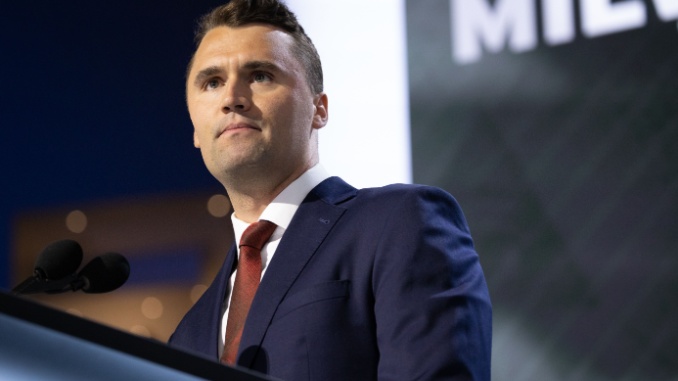
Charlie Kirk, a conservative activist leader and co-founder of Turning Point USA and Turning Point Action, was silenced by an assassin’s bullet at Utah Valley University (UVU) on Wednesday.
As Kirk took questions in his well-known debate format, seated beneath a tent as part of The American Comeback Tour, a single loud shot rang out across the open air.
Kirk was addressing a question on the recent string of mass shootings involving transgender Americans in what would be his last public exchange.
“Do you know how many transgender Americans have been mass shooters over the last 10 years?” Kirk was asked.
“Too many,” Kirk replied.
The individual answered that there were five.
“Do you know how many mass shooters there have been in America over the last 10 years?” Kirk was then asked.
He responded, “Counting or not counting gang violence?”
Within a fraction of a second, Kirk was shot and seen reacting immediately as it struck the left side of his neck. He bled profusely and slumped to the ground.
Kirk was rapidly airlifted from the scene to an area hospital where he was pronounced dead a little over two hours later.
A person of interest was arrested shortly after the shooting at the university but was later released. However, at 3:31 p.m. MDT, FBI Director Kash Patel announced the arrest of a second subject, who was also subsequently released after questioning. The assassin is still at large as of this report.
Turning Point USA is based in Arizona and has been a major force in state and local politics as well as on the national scale since Kirk moved the organization’s headquarters from Chicago to Phoenix in 2018.
Arizona officials from both sides of the aisle issued statements following the assassination of Kirk. Arizona House Speaker Steve Montenegro stated, “God bless American hero Charlie Kirk and his family. His horrific assassination today is a devastating tragedy that strikes at the heart of our nation. Charlie was a fearless voice who inspired millions with his faith, his devotion to freedom, and his conviction to defend America’s founding principles.”
Montenegro added, “This was political terrorism. Violence aimed at silencing any voices must be confronted and dealt with justly and without hesitation. Charlie is now with his Heavenly Father, but his legacy will endure in the movement he built, the young people he awakened, and the truth he spoke without apology.”
Congressman Andy Biggs issued a statement on X, saying, “Erika and Charlie’s young children are in my family’s prayers as I know the Lord will cover them in love. Cindy and I ask everyone to continue praying and sending strength to the Kirk family. We have tragically lost a tremendous leader and a friend. But his most important role was as a loving husband, father, and devout Christian who shared his faith unapologetically. Charlie Kirk was an inspiration to an entire generation and will be remembered as someone who changed the course of our country.”
In a post to X, Arizona Senate President Warren Petersen responded to Kirk’s assassination, saying, “I am absolutely shocked, sickened, and outraged to hear about the passing of Charlie Kirk. Today was a dark day where evil was on full display. He was singular, indispensable, and irreplaceable. America will not be the same without him.”
The top-ranking Democrats in Arizona, Governor Katie Hobbs and Attorney General Kris Mayes, condemned “the violent attack” and “the horrific act of violence against Charlie Kirk,” respectively.
Congressman Abe Hamadeh (R-AZ08) wrote in a statement:
“Charlie Kirk was a force to be reckoned with. He was a Happy Warrior for the conservative cause.
He was martyred doing what he did best – talking to young people and sharing ideas. That is what is supposed to happen on our college campuses, and throughout our country: sharing diverse opinions and entertaining others’ points of view in the pursuit of a brighter future.
We will not let a lone gunman snuff out the bright fire Charlie lit in the hearts of young patriots who share the America First agenda and make up the Make America Great Again Movement, nor will we stop our efforts to bridge the political divide through conversation.
We will carry on what he started and build on his lasting legacy of inspiring the next generation of American leaders.
I urge everyone to join me in praying for the soul of this faithful patriot, his beautiful family, and our country.”
Matthew Holloway is a senior reporter for AZ Free News. Follow him on X for his latest stories, or email tips to Matthew@azfreenews.com.
by Matthew Holloway | Aug 31, 2025 | News
By Matthew Holloway |
The legal fight between Maricopa County Recorder Justin Heap and the County Board of Supervisors escalated Monday. America First Legal filed two motions on Heap’s behalf, and Arizona’s legislative leaders submitted an amicus brief supporting him.
In a press release, the County Recorder’s Office stated that the motions filed by America First Legal “reveal how the County Board of Supervisors and County Attorney Rachel Mitchell have weaponized county government against duly-elected Recorder Justin Heap simply because he dared to fulfill his statutory duties and protect the sanctity of Arizona elections.”
Heap said in a statement, “It’s unfortunate that the Board’s unprofessional and bad faith actions have forced us to litigate this issue; however, it’s significantly more unfortunate that the Board continues to deny the voters of Maricopa County the positive, common sense election integrity reforms that they voted for last November when they elected me. As I’ve promised from day one, I am working to ensure honest, secure, and transparent elections for every voter in Maricopa County. I am not, and will not, waiver in my commitment to executing on this promise. I’m grateful to America First Legal for standing by my side in this battle.”
America First Legal detailed Heap’s allegations in the first filing: “The Defendants — the members of the Maricopa County Board of Supervisors (‘BOS’) — have crossed from fiscal oversight into outright sabotage. Ignoring [state law] and decades of precedent, the BOS has refused to fund the Recorder’s ‘necessary expenses’ — from modern ballot-processing equipment to indispensable IT staff — while simultaneously seizing control of the very election functions its stonewalling endangers. The BOS’s obstruction is not mere bureaucratic foot-dragging; it is a calculated power grab that throttles the Recorder’s constitutional duty to administer secure, timely elections.”
In an amici filing in support of Heap, Arizona House Speaker Steven Montenegro and Senate President Warren Petersen’s legal representation call for a strict interpretation of state statutes which govern the responsibilities of the county recorder and board of supervisors. They argue that the “court should narrowly conclude that, based on the statutes’ plain language, when the statute authorizes ‘the county recorder or other officer in charge of elections’ to act, it is the recorder’s duty to ensure the statute is complied with unless the recorder expressly agrees to delegate that duty to another ‘officer in charge of elections.’”
As previously reported by AZ Free News, the months-long negotiations between Heap and the Board, led by Chairman Thomas Galvin, devolved steadily since Heap’s election and the replacement of Stephen Richer in January until finally collapsing into litigation in June.
The crux of the disagreement between the Board of Supervisors and County Recorder Heap rests upon a Shared Services Agreement (SSA) agreed to by Heap’s predecessor, Richer, who ardently opposed the election integrity efforts that Heap ran for office to enact. For nearly six months, the two county offices negotiated; however, Heap and the Supervisors were unable to reach an agreement, culminating in a lawsuit filed by Heap.
Since then, Heap has alleged that the Supervisors have “taken retaliatory actions” describing a series of measures that “make it impossible for him to do his job, including removing nearly all his election-related IT staff; seizing the servers, databases, and websites necessary to fulfill his duties; and restricting access to necessary facilities and equipment,” as reported by The Federalist.
In a second filing, Heap and America First Legal introduced allegations involving Maricopa County Attorney Rachel Mitchell, bringing a third County office into the fray in a dispute over who may represent the County Recorder, an attorney chosen by Heap or Maricopa County Attorney Rachel Mitchell. In the legal brief, they allege, “Attorney Mitchell originally appointed a criminal defense attorney to advise the Recorder; however, in April, America First Legal agreed to represent Heap pro bono, a move that Mitchell objected to.”
“When the Recorder complained that the original attorney appointed for him lacked sufficient subject matter expertise, County Attorney Mitchell appointed former Arizona Supreme Court Justice Andrew Gould to advise the Recorder only during negotiations with the Board. However, County Attorney Mitchell and the Board did not allow Justice Gould to litigate on the Recorder’s behalf,” the filing revealed.
But according to AFL, that wasn’t the end of it. “In May of 2025, Justice Gould specifically asked the Maricopa County Attorney’s Office for permission to litigate on Recorder Heap’s behalf but was not allowed to do so because the scope of his representation was limited to negotiation of the SSA and did not include litigation, and, accordingly, the County would not compensate him for litigation-related work.”
Mitchell responded by penning a letter to the AFL attorneys, writing in part, “This letter is to inform you that I am the Recorder’s attorney and that you do not represent the Maricopa County Recorder’s Office or Recorder Heap in his official capacity.”
Per The Federalist, AFL attorney James Rogers retorted that the “County Recorder is allowed to pick his own lawyer in litigation,” adding that Heap “is not subject to the whims of the county attorney.”
In the midst of the complex legal battle between the Recorder’s Office and the Board of Supervisors, which has drawn the attention of legislative leaders, the dispute with Mitchell adds yet another layer of infighting within the already divided county government, with the calendar counting down to the 2026 elections.
Matthew Holloway is a senior reporter for AZ Free News. Follow him on X for his latest stories, or email tips to Matthew@azfreenews.com.
by Matthew Holloway | Aug 2, 2025 | News
By Matthew Holloway |
Turning Point Action’s (TPA) recently updated scorecard grades the state of Arizona, as well as our members of Congress and State Legislators, on their alignment with or divergence from its policies and political positions. Federal-level scorecards were created for all fifty states, but state-level drilldowns were developed for six swing states: Arizona, Nevada, Wisconsin, Pennsylvania, Michigan, and Georgia.
The scorecard revealed a significant opportunity for improvement in the Arizona legislature, with many of the most prominent Republicans in leadership roles scoring below the 80th percentile. According to TPA, the conservative outreach organization, “has worked across the conservative movement to identify every scorecard and the legislation they encompass and provide an accumulation of scoring from across the Republican spectrum.”
Each state, policy category, and lawmaker (federal and state) is scored 0-100 and is classified from “Tyrant,” and “Becoming Tyrannical,” mainly for Democrats and some Republicans with a score of 49 or less, to “Turncoat” at 50, “Betraying America,” from 50-60, “Erratic,” from 60-70, “Becoming Erratic” from 70-80, “Losing Patriotism,” at 80-95, and for those scoring 95+: “Patriot.”
According to an explanation of lawmaker scoring from TPA, “Turning Point Action looks at each vote individually, identifies the category it belongs in and works amongst the grassroots to identify the conservative position. If the representative votes with Turning Point Action’s position for each bill or nomination, they receive full points. If the representative votes against TPA’s position, they receive nothing. Not voting, present, and abstaining from voting gives the representative only half credit, thereby diminishing their score for neglecting their responsibility.”
States are also scored in overall terms by “first finding the overall House score and overall Senate score by issue. Then the overall House score is added to the overall Senate score and divided by two to achieve the overall category state score.” States are accordingly ranked as being a “Tyrannical State” with a score between 0%-20%, “Becoming Tyrannical,” from 21%-40%, an “Erratic State” from 41%-60%, “Losing Freedom,” from 61%-80%, and a “Free State” scoring 81% or better.
As of this report, Arizona is ranked as “Losing Freedom” on federal matters with a score of 62.50 and as an “Erratic State” on state issues with a score of 41.69.
In the case of Arizona’s state legislature, the only “Patriots” recognized by TPA were Senator Jake Hoffman with a score of 99.40, and Representatives Joseph Chaplik with 98.05 and Alexander Kolodin with 96.10. The scores indicate a significant split between Arizona’s legislative GOP leadership and one of the largest, most impactful political organizations in the state and country.
Several of the most prominent leaders in the GOP were scored relatively low, such as House Speaker Steve Montenegro, who scored 77.27, labeled as “Becoming Erratic,” and Majority Leader Michael Carbone, who scored 71.43. Senate President Warren Petersen is listed as “Losing Patriotism,” with a score of 89.16 alongside Majority Leader John Kavanagh, who scored 83.13.
Matthew Holloway is a senior reporter for AZ Free News. Follow him on X for his latest stories, or email tips to Matthew@azfreenews.com.
by Jonathan Eberle | Jul 17, 2025 | News
By Jonathan Eberle |
Arizona House Speaker Steve Montenegro announced on Monday new senior staff appointments for the House Majority leadership team, signaling an early staffing shift as lawmakers prepare for the next legislative session.
Grant Hanna will assume the role of Chief of Staff, bringing over a decade of legislative experience from the Arizona Senate. Hanna most recently served as Deputy Chief of Staff in the Senate, where he was a key advisor on natural resources, water policy, energy, and government affairs. His background also includes roles as a Senior Policy Advisor and Research Analyst.
In addition, Matt Specht has been promoted to Chief Operating Officer. Specht has spent nine years on the House Majority staff and will now lead the day-to-day operations of the House. His responsibilities will include advising leadership, overseeing floor calendaring, and serving as a key resource for both members and staff. Montenegro praised Specht’s “professionalism, institutional expertise, and the highest standards of public service.”
Linley Wilson will continue in her dual roles as Deputy Chief of Staff and General Counsel. She will remain a principal advisor to leadership and Republican caucus members, contributing to policy strategy while also overseeing legal matters and supporting the House Rules Committee.
“The Arizona House is fortunate to have such a talented, experienced, and trusted leadership team supporting our Majority staff,” Speaker Montenegro said in a statement. “Grant, Matt, and Linley have earned the confidence of Members through their professionalism and sound judgment. Their leadership ensures we stay organized and focused on delivering results for the people of Arizona.”
Jonathan Eberle is a reporter for AZ Free News. You can send him news tips using this link.
by Jonathan Eberle | Jul 10, 2025 | News
By Jonathan Eberle |
Sixteen months before the 2026 General Election, Arizona voters already know at least three ballot measures they’ll be weighing come November. Referred to the ballot by state lawmakers during the most recent legislative session, the proposals span issues of taxation, public safety, and individual privacy.
If passed, each measure would amend the Arizona Constitution — changes that can only be undone by future statewide votes. And these early additions may just be the beginning of what’s shaping up to be another crowded ballot.
In 2024, the number of voter questions was so high that some Arizona counties resorted to printing two-sheet ballots, prompting widespread voter complaints about ballot length. With dozens of potential referrals still under consideration, the 2026 ballot may once again test voters’ patience and attention spans.
Here’s a closer look at the three measures already set for the 2026 ballot:
1. Local Food Taxes Face New Restrictions
Sponsored by Rep. Leo Biasiucci (R–LD30), House Concurrent Resolution 2021 seeks to limit the ability of local governments to impose taxes on groceries.
If approved, the measure would require cities, towns, or counties to obtain voter approval before creating or increasing a tax on food. Currently, local governments can make that decision without direct input from the electorate.
The measure would also impose a temporary moratorium on any food tax hikes until June 30, 2027.
Proponents argue the change would make groceries more affordable during a time of rising costs. Local officials, however, warn it could impact critical revenue for municipal services.
The proposal passed with bipartisan support.
2. Ban on Mileage-Based Vehicle Taxes
Senate Concurrent Resolution 1004, sponsored by Sen. Jake Hoffman (R–LD15), would preemptively ban any tax or fee based on the number of miles a vehicle travels on Arizona roadways.
While Arizona does not currently impose such a tax, Hoffman and supporters argue the measure is necessary to protect personal freedom and prevent government overreach.
“There is nothing more insidious than the government trying to limit or control their citizens’ freedom,” Hoffman said earlier this year.
Mileage-based taxes have been explored in other states, like Oregon and Utah, as a way to replace declining fuel tax revenues and reduce pollution. Environmental advocates in Arizona, including the Sierra Club, support such measures as a means of curbing emissions and promoting sustainable transportation.
The resolution passed along party lines, with Republicans in favor and most Democrats opposed or absent.
3. Designating Cartels as Terrorist Organizations
In one of the final acts of the 2025 legislative session, lawmakers approved House Concurrent Resolution 2055, which seeks to classify drug cartels as terrorist organizations under Arizona law.
Introduced by House Speaker Steve Montenegro (R–LD29), the measure would direct the state’s Department of Homeland Security to take all possible actions within its authority to counteract cartel activity.
Supporters say it complements Proposition 314, a 2024 ballot measure that authorized Arizona to enforce its own border security measures — though that law remains on hold pending the outcome of a related Texas lawsuit.
These early measures may just scratch the surface. Dozens of proposed ballot referrals were introduced during this year’s session, and lawmakers still have the 2026 legislative calendar to revive stalled proposals or introduce new ones.
As Arizona continues its tradition of robust direct democracy, election officials may once again find themselves preparing for a complex and lengthy ballot — and voters will need to prepare for an equally complex decision-making process at the polls.
Jonathan Eberle is a reporter for AZ Free News. You can send him news tips using this link.