by Ethan Faverino | Jul 27, 2025 | Education, News
By Ethan Faverino |
Arizona State University (ASU) has lost 27 grants from the National Science Foundation (NSF) so far this year, worth approximately $28.5 million. Many of the grants were tied to Diversity, Equity, and Inclusion (DEI) initiatives.
These cuts, part of a broader shift in NSF priorities under the Trump administration, target projects with DEI-related terms like, “equitable,” “underrepresented,” and “racial.”
Among the affected grants were five ASU projects, previously assigned $7,659,588, which heavily emphasize DEI.
Grant Number 2315041 ($2,404,767) funded Collaborative Research: Black Girls as Creators: an intersectional learning ecosystem toward gendered racial equity in Artificial Intelligence education. Running from October 2023 to September 2028 (terminated April 18, 2025), it supported after-school and summer camps for black girls aged 9-14 to collaborate with AI creators, focusing on intersectionality and racial equity.
Grant Number 2411987 ($733,633) funded Positioning Engineering Faculty to Support Black Engineering Graduate Students through Awareness, Knowledge, Capacity Building, and Community. Starting September 2024 and ending August 2029 (terminated April 25, 2025), it trained faculty at ASU and George Mason University in antiracist orientations using virtual reality simulations to address systemic barriers for black graduate students, prioritizing competency over technical skills.
Grant Number 1824260 ($2,999,743) funded an ADVANCE Institutional Transformation project from September 2018 to August 2025 (terminated May 2, 2025), aimed to reshape faculty policies for gender equity and intersectionality, potentially undermining merit-based standards.
Grant Number 2101039 ($931,058) funded Collaborative Research: Accessible Computational Thinking in Elementary Science Classes within and across Culturally and Linguistically Diverse Contexts, ran from August 2021 to July 2025 (terminated April 25, 2025). It trained 60 elementary school teachers in “Culturally Relevant Teaching” for diverse students, which compromised core STEM content.
Grant Number 2236374 ($590,387) funded Increasing the Effectiveness of Justice, Equity, Diversity, and Inclusion-Focused Institutional Change Teams through a Community of Transformation, ran from April 2023 to April 2025 (terminated April 18, 2025). It supported a “Community of Transformation” for JEDI (Justice, Equity, Diversity, and Inclusion) change agents, emphasizing change over academic standards.
These cancellations align with NSF’s new priorities to avoid projects that prioritize certain groups, as appromixately 94% of canceled grants nationwide included DEI-related terms.
These DEI-focused projects diverted resources from universal STEM advancement, prioritizing ideological goals over merit.
The full list of terminated NSF grants is avaiable here.
Ethan Faverino is a reporter for AZ Free News. You can send him news tips using this link.
by Diane Douglas | Jul 10, 2023 | Opinion
By Diane Douglas and Dr. Peter Pingerelli |
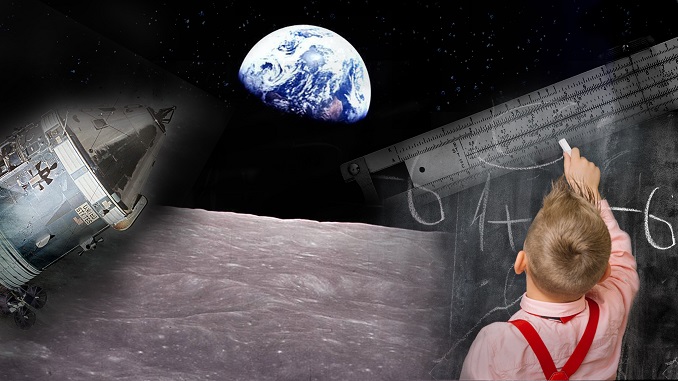
Some remember the live broadcast of Apollo 8 orbiting the moon on Christmas Eve 1968. Over 1/4 of the world’s population listened in, as the crew read from the Book of Genesis. The United States of America led in space exploration, and we were another step closer to man stepping onto the moon’s surface: an achievement requiring education, dedication, courage, and perseverance of thousands of men and women.
And yet it was a simple analog device called a slide rule that helped us achieve this goal. With over 5 million parts in the Apollo Saturn V spacecraft, astronauts, engineers, scientists, and students routinely used slide rules to make the Apollo program a reality while also allowing users to develop and enhance mental skills when calculating an answer.
We certainly don’t advocate revitalizing this nostalgic masterpiece of technology with the advances of graphing calculators and computers, but there’s something remarkable and important about continuously exercising our mental capacities as we become seemingly more dependent upon our newfangled digital world. Today, we need to simply ask Google, Alexis, or Siri to answer a question as waves of artificial intelligence increasingly sweep into our culture and educational system. But can we still aspire to achieve these national aspirations of new frontiers when our country is failing to educate the upcoming generation of students desiring to become medical professionals, scientists, or engineers? How can our nation excel in these fields if our students no longer understand the math and science behind the tools?
In Arizona the results are sounding the warning bells. Of all students statewide, 60% are failing English and 67% are failing math according to the 2022 assessment. And yet all we hear from a system incapable of teaching our children basic academics are demands for more money. The Arizona state budget for 2023-24 is $17.8 billion of which $9.3 billion is allocated to K-12 education. When do we stop giving money to a system that can’t do what it is paid to do?
Results are also discouraging when it comes to statewide science assessments. In 2018 and 2019, 50% of students statewide were not successful at passing the AIMs science assessment, and the 2021 and 2022 results from the new assessment AzSCI are yet to be made public.
And what about the educational rigor and curricula developed for K-12? Are we truly preparing students to become not only critical thinkers but also future scientists and engineers? While every student may not aspire to be a doctor, scientist, or engineer, is it unreasonable to expect that a graduate leave with at least a high school level understanding of these subjects in order to be an informed member of our society? Have Science, Technology, Engineering, and Math (S.T.E.M.) initiatives provided the needed reforms? Are our general educational and STEM dollars being directed to impactful programs or only those that merely mirror the political agenda? Comparing the two philosophies is like comparing the difference between environmental conservationists such as President Theodore Roosevelt versus environmental activists like Greta Thunberg.
We offer considerations that need to be coupled to reforms that don’t just nibble around the edges but take significant bites at improving our state’s educational system.
The following steps, we believe, offer a starting point.
- Focus on fundamentals of reading, math, and science. Just as phonics is the gateway to a good reader, a solid foundation in arithmetic is quintessential. Students need to know multiplication tables, how to divide without using a calculator, percentages, and the difference between fractions and decimals. In 2018, 79 countries administered the Programme for International Student Assessment (PISA) to more than 600,000 students in public and private schools measuring 15-year-olds’ ability to use reading, mathematics, and science knowledge and skills to prepare them for workforce and educational challenges. The U.S. students ranked 8th in reading, 30th in math, and 11th in science. These scores have remained stagnant for decades with no foreseeable improvements. This concern is perhaps best summarized by the words of the Apollo 13 Commander James A. Lovell, “Ah, Houston, we’ve had a problem here” when the spacecraft service module’s oxygen tank ruptured.
- Our big math problem with K-12. Competency in basic mathematics is not just the domain of students motivated to be scientists and engineers. Our society and individual freedoms function best and are protected when its members are educated. How many times have we visited a deli counter, and the worker does not know that 1/4 of a pound fractionally represents 0.25 on their digital scale. We fear the fundamentals of math are not being adequately practiced in too many of Arizona’s classrooms. Practicing and drilling mathematical concepts and calculations builds and strengthens the connections in our brains. Student athletes continuously practice skills of the game, pianists translate brain connections and movements into music. And while practicing math skills may seem boring and redundant it is nonetheless imperative for long-term learning. Perhaps a solution is to stop cramming in new curricula that may be interesting, but do not fortify long-term learning. Too often, incoming high school freshman lack the basic arithmetic skills to be successful in algebra. Like all endeavors requiring skills, math must be practiced over and over to ensure the necessary competencies.
- STEM education MUST be more than STEM entertainment. Most people are intrigued by science and exploration. Early on in primary education (K-4), it is important to capture interest in young minds. But as students progress in their interest in science careers, there is a necessity in STEM programs to introduce the rigors of math and science into the program’s curriculum. It may be a load of fun to fly a drone or launch a model rocket, but it should be accompanied with the key scientific principles and the underlying math that is age appropriate.
- Curriculums should NOT be reimagined from proven methods for science education. For example, as pointed out in a recent publication, “Science education needs to overcome its habitual biting reflex against ‘the’ Scientific Method and realize its potentials as well as its limitations….” The author continues, “Vetoing ‘the’ Scientific Method even from introductory science at the primary level might actually do harm…” (Science & Education (2021) 30:1037–1073). The article goes on to explain why scientific inquiry should not supplant the scientific method which provides a clear and easy to understand approach to scientific discovery in the natural world.
- Qualified S.T.EM. Teachers. We believe an effective teacher needs three things – a passion for the subject they teach, good communication skills, and knowledge of the subject they teach “inside-out.” But too often many of our teachers, while possessing the first two criteria, are deemed “Subject Matter Experts (SMEs)” in areas that were not their college major. We believe this is the most troublesome for high school science courses but also affects seventh and eighth graders. Moreover, we assert non-SME teaching results in omissions of fundamental scientific concepts, and in our opinion, leads students into adopting an “emotional science” curriculum that is often ideologically driven. Shouldn’t students be well-versed in the carbon cycle and its stages before adapting scenarios that our planet faces imminent catastrophic consequences in five years? Students need critical information to intelligently support or reject such hypotheses. We understand the problem of teacher shortages in Arizona — particularly in math and the natural sciences — but asking a teacher to teach without the academic background results in poorer learning outcomes as demonstrated by state assessment scores.
- Reinforce objective truth of science and emphasize academic excellence in Arizona K-12 classrooms. Our K-12 classroom curriculum needs to refocus on objective truths of scientific principles unfettered by personal beliefs or emotional activism. We are concerned that students are too often asked how they feel about a subject before teaching them the facts about the subject. If our students don’t understand basic underlying principles that are always true about the natural world, how can they engage in meaningful debate or constructive controversy on any topic when venturing into a complex world filled with YouTube experts. Let’s avoid spending our valuable educational dollars by putting the subjective activism cart before the horsepower of true knowledge. We need to better train teachers with the ability to deliver curriculum focused on the broader understanding of scientific principles and processes.
It is our hope that policymakers and those responsible for curriculum development will examine these considerations. It is sad to witness a college freshman with aspirations to become a medical doctor that doesn’t possess the basic skills to pass general chemistry. A student retorts, “I don’t understand why I’m failing; I got an A in all my high school science classes.” Such gaping disconnects between the knowledge and skills needed to succeed and the curricula being taught must be resolved.
The data is clear that our education system is not delivering for our students, and we should no longer abandon the scientific method of observing, hypothesizing, experimenting, and analyzing when it comes to our students. The predominate hypothesis has been that better education is achieved with accelerated funding and recently removing results-based metrics. The scholar Thomas Henry Huxley pointedly captures our concern, “The great tragedy of Science,” he wrote, is “the slaying of a beautiful hypothesis by an ugly fact.”
Will our educational system allow us to reach the next adventure and witness new planetary horizons? It is interesting that when James Lovell was an astronaut for both the Apollo 8 and Apollo 13 missions, being part of the triumph and first to leave Earth’s orbit and then confronting the challenges that Apollo 13 faced, he used a slide rule.
Diane Douglas is the former Arizona superintendent of public instruction; Peter Pingerelli is an associate adjunct in the College of Science, Engineering and Technology at Grand Canyon University. Ms. Douglas served on the Peoria U.S.D. governing board 2005-2012; president 2008 and 2009; Dr. Pingerelli serves on the West-MEC governing board 2017-present and is the current board chairman. Both are also on the Board of Directors for the Earth and Space Expedition Center in Phoenix, Arizona.
by Corinne Murdock | Oct 24, 2022 | Education, News
By Corinne Murdock |
It appears the costs of pandemic-era remote learning far outweighed the benefits, based on the average student’s comprehension in math and reading.
According to the latest National Assessment of Educational Progress (NAEP) data released Monday, Arizona students were middle of the pack in a nationwide decline. The state’s scoring revealed severe learning losses in math and nominal losses in reading.
READ HERE: ARIZONA REPORT CARD
Nationwide, the NAEP report revealed a negative correlation between remote learning and learning loss. Chalkbeat displayed the correlation through graphs. Public schools and large cities experienced the greatest decline in math scores.
READ HERE: 2022 NAEP FULL REPORT
In a press release, National Center for Education Statistics (NCES) associate commissioner Daniel McGrath warned that learning losses in math could limit STEM candidates.
“Eighth grade is a pivotal moment in students’ mathematics education, as they develop key mathematics skills for further learning and potential careers in mathematics and science,” said McGrath. “If left unaddressed, this could alter the trajectories and life opportunities of a whole cohort of young people, potentially reducing their abilities to pursue rewarding and productive careers in mathematics, science, and technology.”
The scores come after several years of Democratic leaders advocating for school closures amid the pandemic.
Julie Gunnigle, Democratic candidate for Maricopa County attorney, claimed in an August 2020 interview that remote learning would make kids smarter and stronger. Throughout the pandemic, she insisted that schools be restructured to prevent COVID-19 transmission before reopening.
“I think these kids are going to come out a lot stronger than, for example, my generation is. Like, having to cope with all of this. And a lot smarter, too,” said Gunnigle. “They’re going to be really prepared to brave this, well, brave new technological world.”
Last October, Education Secretary Miguel Cardona told NPR that the number of school age-youth with mental health issues rose from 13-22 percent to 80 percent over the course of the pandemic. Last December, Surgeon General Vivek Murthy reported that the pandemic caused a mental health crisis in the nation’s youth.
“The COVID-19 pandemic further altered [youth] experiences at home, school, and in the community, and the effect on their mental health has been devastating,” stated Murthy.
Kathy Hoffman, incumbent Arizona Department of Education (ADE) superintendent, advocated for remote learning as recently as January. Like Gunnigle, Hoffman insisted that preventing COVID-19 illness was more important than an in-person education.
Corinne Murdock is a reporter for AZ Free News. Follow her latest on Twitter, or email tips to corinne@azfreenews.com.
by Corinne Murdock | Aug 30, 2022 | Education, News
By Corinne Murdock |
Arizona State University (ASU) won’t disclose the full scope of its hiring decisions resulting in four women leading STEM-related schools and a department within the last 18 months.
ASU acknowledged a hiring pattern earlier this month when it published a feature article contextualizing the exclusively female appointments as “leading the charge for more diversity in STEM.” The hires were Tijana Rajh, made director of the School of Molecular Sciences; Donatella Danielli, made director of the School of Mathematical and Statistical Sciences; Patricia Rankin, made chair of the Department of Physics; and Nancy Manley, made director of the School of Life Sciences.
The article doesn’t mention the professional accomplishments of these women. Instead, the article focused on how the women felt undermined in STEM through a glass ceiling, an “old boys club,” bias, and the sexism of male colleagues doubting their abilities. The article did mention the women’s equity-related accomplishments such as organizing panels on women in math leadership and stocking female sanitary products in the bathrooms.
ASU expressed a goal of balancing the proportions of women and men leading and studying STEM-related subjects. However, ASU stated that gender didn’t play a role in their hires of Rajh, Danielli, Rankin, and Manley.
“ASU is out to change those numbers – and, as evidenced by the hirings of Rajh, Danielli, Rankin and Manley — in a meaningful way,” read the article.
When AZ Free News reached out to ASU, spokesman Jay Thorne said that the university doesn’t comment on individuals who weren’t hired.
“The four women noted in the story were hired, some of them quite some time ago, in an open competitive process, each from highly credible institutions. Not much else to say that wasn’t in the story,” said Thorne. “If there is another particular angle you are interested in, let me know. Otherwise, the story speaks for itself and the university has no comment about other candidates for these positions.”
When we requested further background on why the four women were chosen at the exclusion of other, possibly male candidates, noting that the entirety of the article focused on the women shattering glass ceilings and overcoming sexism without mentioning any of their accomplishments, this was the only response we received:
“Yep. Understood. Fair enough. Thank you,” wrote Thorne.
Although Thorne wrote that ASU doesn’t comment on those who weren’t hired, College of Liberal Arts and Sciences dean Patrick Kenney felt it necessary in the article to disclose that men were rejected.
ASU also revealed in the feature article that both tenure and non-tenure track female faculty increased in other STEM areas, namely the School of Molecular Sciences.
Corinne Murdock is a reporter for AZ Free News. Follow her latest on Twitter, or email tips to corinne@azfreenews.com.
Page 1 of 11