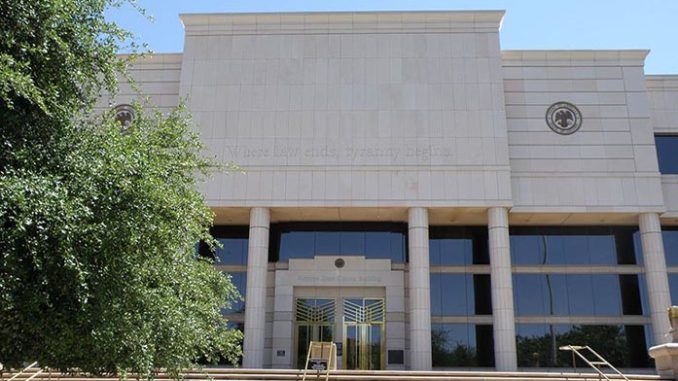
The Arizona Supreme Court has agreed to take on a case determining whether Arizona State University (ASU) can mandate diversity, equity, and inclusion (DEI) trainings for its employees.
Professor Owen Anderson sued the Arizona Board of Regents in 2024 after ASU required him to take a DEI training called “Inclusive Communities” (ASU referred to their version of DEI as “DEIB,” or “diversity, equity, inclusion, and belonging”).
ASU requires the Inclusive Communities training as a condition of employment upon hire and every two years.
The Goldwater Institute, a Phoenix-based public policy and litigation organization, filed on Anderson’s behalf. Goldwater Institute attorney Stacy Skankey said the case represented Arizonans’ right to hold government agencies accountable for violating the law.
Arizona law prohibits any mandatory trainings which impart “blame or judgment on the basis of race, ethnicity or sex.”
“No one should be forced to participate in divisive DEI training or endorse race-based ideology as a condition for holding a government job,” said Skankey. “That’s exactly why Arizona lawmakers banned mandatory trainings that teach discriminatory ideas about race, ethnicity, or sex. But a law without enforcement is no law at all.”
The Inclusive Communities training included materials which taught that white supremacy exists as a structural phenomenon, minority faculty don’t have authority or control due to structural inequalities like racism and sexism, white privilege and white fragility exist and impact communities, white people have a duty to combat their privilege, racism can be implicit even if not intended, and sexual identities yield power.
Transcript examples from the training materials were included in the Goldwater Institute’s filing within the Arizona Supreme Court.
Along with the training, ASU formerly required employees to pass an accompanying module quiz. This exam graded certain answers as correct which served to advance DEIB ideology; the Goldwater Institute argued this final test further proved the training served as an impermissible mandate for employees to accept blame or judgment on the basis of race, ethnicity, and sex.
Anderson said ASU’s mandate violated state law because the training assigned “race blame” based on skin color.
Anderson added that ASU’s training was rooted in a Marxist dichotomy reducing the world to oppressor versus oppressed, and that the training imparted impermissibly discriminatory teachings that conflicted with his religious and political beliefs. Anderson is a tenured faculty member who teaches philosophy and religious studies.
“Arizona State leaders broke the law when they forced me and every other employee to take part in an ideological training that taught that it’s okay to judge people on their race, ethnicity, religion, and sex. I simply refuse to do that,” said Anderson. “Ultimately, the question before the Arizona Supreme Court isn’t a left or right issue — it’s about whether a state employee has the right to hold their employer accountable when it violates the law.”
The Arizona Court of Appeals previously rejected Anderson’s lawsuit. The court ruled that the law doesn’t have a provision allowing individuals like Anderson to seek legal recourse.
AZ Free News is your #1 source for Arizona news and politics. You can send us news tips using this link.
Arizona State University (ASU) professor Dr. Owen Anderson has asked the Arizona Supreme Court to hear his case challenging mandatory diversity, equity, and inclusion (DEI) training after a lower court dismissed his lawsuit, according to a petition filed this week by the Goldwater Institute.
Anderson, a philosophy and religious studies professor at ASU, originally filed the lawsuit in 2024 against the Arizona Board of Regents. He argued that the university’s required “Inclusive Communities” DEI training violated an Arizona statute that prohibits public agencies from making employees participate in training that “presents any form of blame or judgment on the basis of race, ethnicity, or sex.” Arizona Senate President Warren Petersen (R-LD14) and then-House Speaker Ben Toma (R-LD27) filed an amicus brief in support of Dr. Anderson’s lawsuit.
According to the Goldwater Institute’s petition, Anderson objects to the DEI training materials, saying they include concepts about race and identity that he believes are unlawful under state statute.
“No one should be forced to participate in divisive DEI training or endorse race-based ideology as a condition for holding a government job. That’s exactly why Arizona lawmakers banned mandatory trainings that teach discriminatory ideas about race, ethnicity, or sex. But a law without enforcement is no law at all,” Goldwater attorney Stacy Skankey explained. “We’re asking the Arizona Supreme Court to correct the lower court’s error and restore Arizonans’ right to hold government agencies accountable when they violate the law.”
ASU forced a professor to take DEI training as a condition of employment.
Goldwater stated in a press release, “There’s no way around it—a law is meaningless if it can’t be enforced. If allowed to stand, the error by the Arizona Court of Appeals would eliminate an essential civil-rights safeguard for public employees and taxpayers. The ruling changes how Arizona laws are enforced by removing the ability of an ordinary Arizonan to ensure government officials obey the law.”
In its February filing, Goldwater said the Arizona Court of Appeals ruled that Anderson could not sue because it concluded the relevant law does not expressly provide an avenue for individuals to challenge such training in court.
The petition filed by the Goldwater Institute argues that allowing the Court of Appeals’ decision to stand would leave public employees without a means to enforce the statute and hold government employers accountable. It asks the Arizona Supreme Court to recognize an implied private right of action under the law, allowing employees to challenge alleged unlawful training mandates.
The case highlights a broader debate over DEI programs at public institutions. The previous lawsuit filed by the Goldwater Institute in March 2024 similarly challenged ASU’s DEI training and sought a court order preventing the Board of Regents from imposing or using public funds for the training, citing the same Arizona statute.
ASU has previously contested the Goldwater Institute’s claims, with university officials stating that its training reflects its commitment to inclusiveness and does not violate state law. However, as AZ Free News has previously covered, ASU lost 27 grants from the National Science Foundation (NSF) in 2025, worth approximately $28.5 million, in line with the NSF policy that ensures grants don’t prioritize certain groups or individuals.
Speaking of the ongoing lawsuit, Professor Anderson said in a statement, “Arizona State leaders broke the law when they forced me and every other employee to take part in an ideological training that taught that it’s okay to judge people on their race, ethnicity, religion, and sex. I simply refuse to do that. Ultimately, the question before the Arizona Supreme Court isn’t a left or right issue—it’s about whether a state employee has the right to hold their employer accountable when it violates the law.”
There is currently no set timeline for the Arizona Supreme Court to decide whether it will grant review of Anderson’s petition.
The Goldwater Institute has filed a lawsuit against Arizona Attorney General Kris Mayes, demanding the release of consumer records tied to the AG’s 2024 antitrust lawsuit against nine major residential landlords and RealPage, Inc.
Filed on November 12, 2025, in Maricopa County Superior Court, the suit accuses the Democratic attorney general’s office of violating Arizona’s public records law by refusing to disclose basic information about complaints, or lack thereof, that prompted the state’s allegations of an illegal rent price-fixing conspiracy affecting hundreds of thousands of renters in Phoenix and Tucson metros.
Skankey emphasized that Goldwater takes no position on the underlying antitrust claims. Instead, it seeks only aggregate data: the total number of consumer complaints received by the AG’s office regarding RealPage and the defendant landlords, including any unsolicited submissions.
The Goldwater Institute first requested the records in April 2024. After months of silence, the AG’s office issued a denial in January 2025. Follow-up attempts went unanswered, prompting Wednesday’s legal action.
“It should be very easy to comply with, and yet, you know, after this long, drawn-out process, here we are now having to demand that these be produced,” stated Skankey.
The Center Square reported that when it contacted the Attorney General’s Office, the agency responded that it had produced all documents required under state law.
Kris Mayes’ communications director, Richie Taylor, also told The Center Square, “Attorney General Mayes is proud to have taken on major corporate landlords and RealPage for allegedly orchestrating a price-fixing scheme that drove up rents for families across Arizona.”
Skankey responded, saying she and her team disagree with the statements made by the AG’s office, and there is no proof they complied with the state public records law.
Ethan Faverino is a reporter for AZ Free News. You can send him news tips using this link.
In October 2023, the U.S. Department of Education (DOE), under the Biden-Harris Administration, imposed a staggering $37 million fine against Grand Canyon University (GCU) in Phoenix, the largest privately owned Christian University in the nation. The fine came without revealing any serious complaint against the school. In February 2024, the Goldwater Institute announced that it advanced a lawsuit to determine why such a massive fine was levied. Now, a hearing has been scheduled in the case for April 18th.
Acoording to the Goldwater Institute, the DOE claimed that GCU “violated federal disclosure rules regarding continuing education courses for PhD students.” GCU leaders deny this outright. Further, in a press release regarding the fine, the DOE declined to include any complaints from students or members of the public to support its regulatory action.
When a federal judge in the U.S. District Court hears arguments in Goldwater Institute v. U.S. Department of Education, Goldwater hopes to compel the federal agency to disclose the alleged violation(s), which it believes are particularly suspicious. According to Goldwater, a public statement from Biden’s Secretary of Education Miguel Cardona vowed to “shut down” GCU.
Adding doubt to the DOE’s allegations, as Goldwater notes, GCU reportedly hasn’t raised tuition in over 15 years. The manner in which the fine was announced was also suspect with Goldwater noting, “The Department also announced its unprecedented fine with a widely reported press release that was heavy on rhetoric and bereft of any serious complaints from students or the public. It also appears that the fine was assessed in conjunction with suspicious coordination among various federal agencies.”
According to Goldwater, efforts through a Freedom of Information Act (FOIA) request to determine the motivation behind the fine have gone unanswered, leading up to the complaint.
“The request seeks emails between key individuals of the Department and other federal agencies that discuss the Department’s fine against GCU. The records may help inform the public about this extraordinary fine, as well as coordination between various federal agencies in what appears to be the intentionally targeting of a successful university based on extraordinarily thin allegations. However, the Department has refused to produce the records requested and has failed to otherwise comply with the FOIA.”
As reported by AZ Free News in February 2024, Goldwater staff attorney Stacy Skankey explained, “With its motto of ‘private, Christian, affordable’ and its track record of graduating students into high-demand and high-paying jobs, GCU is a success story by any metric. And it stands apart from universities across the country that are facing declining enrollment, that are indoctrinating students with radical politics, and that are under attack for failing to defend the First Amendment.”
In an op-ed for the Washington Times in December, Jon Riches, Goldwater Institute Vice President for Litigation, wrote, “As the Trump administration prepares to tackle an ambitious education agenda, ending the shameful attack on GCU should be a top priority. This would not only correct the injustice done to GCU but also make clear the broader principle that higher education should be a domain of innovation and student achievement — not a fiefdom for ideological conformity and bureaucratic rule.”
The initial action was brought by the Goldwater Institute during the Biden Administration and saw little to no response from former Secretary of Education Miguel Cardona. Though confirmed by neither party, the hearing had initially been delay and could be reflective of the whirlwind of changes at the DOE under Trump Administration.
The upcoming hearing could present a departure from the DOE’s previous position on the GCU fine, or at minimum provide transparency that was lacking under the previous administration.
The City of Phoenix has drawn the attention of the Goldwater Institute, earning a stern response from the conservative think tank to “Stop violating taxpayers’ rights.” The rebuke comes over a proposed tax increase on businesses that provide services that are precluded by the Arizona Constitution. A final city council vote on this proposal is set for March 18, 2025.
If the hike on Transaction Privilege (“TPT”) and Use Tax rates is approved, the rates go into effect July 1, 2025.
According to Goldwater, “The city of Phoenix has proposed a tax increase on businesses that provide services, claiming it needs the money because of a revenue shortfall. But the burden of the new tax increase will ultimately fall hardest on Phoenix businesses and consumers, raising the prices of services like construction contracting and lodging.” As Goldwater observes, the Arizona Constitution (Art. IX § 25) outright forbids “any county, city, town, municipal corporation, or other political subdivision of the state, or any district created by law” from creating any new or increasing any existing transaction-based taxes on the “privilege to engage in, or the gross receipts of sales or gross income derived from, any service performed in this state.”
Notably though, the prohibition on Section 25 “does not repeal or nullify any tax, fee, stamp requirement, or other assessment in effect on December 31, 2017,” and therefore allowed the pre-2017 taxes already in place. However, as Goldwater Attorney Stacy Skankey explains, the new rates would constitute a new tax under the law.
Skankey wrote succinctly, “New or increased taxation on services violates the Arizona Constitution.”
“The Arizona Constitution has a broad understanding of the term ‘service,’ and it includes a range of covered enterprises on anything that does not produce ‘goods.'”
“Service generally includes activities involving human effort like labor, skill, or advice. The term also covers businesses in the hospitality industry such as hotels, restaurants, and bars. Many of the business classifications subject to the proposed TPT tax increase are services as that term is used in the Constitution.
“The proposal by the Phoenix City Council is a tax increase on services, and therefore, is unconstitutional. Consequently, we urge the City to disapprove of the proposed TPT tax increase and any future proposed tax that may violate the Arizona Constitution.”
As reported by AZ Free News in January, the Goldwater Institute has already launched a lawsuit against the Town of Gilbert after municipal leaders unleashed a similar service tax on Town businesses including homebuilding and short-term rental properties.