Big Brother is alive and well in one Arizona town, where an entire department of city employees is paid to monitor the online speech of employees and elected officials — as well as control all government communications online — to enforce conformity with a progressive political agenda.
Though it may sound like a fictional invention of Orwellian fashion, there’s a real place in Arizona where that occurs. It’s an arrangement unlike any other in the state and, by all indicators, the first of its kind in the nation. It’s the Office of Digital Government (ODG) in the town of Gilbert.
At the helm is Dana Berchman, chief digital officer. For over a decade, Berchman has overseen an average of 10-12 employees who ensure that the 30 official government accounts—along with personal online postings of government-affiliated individuals—fall in line with a liberal political outlook: Black Lives Matter, LGBTQ+ ideologies, and the like.
For their work, ODG employees are amply compensated. Their annual salaries range from over $82,000 to nearly $138,000; only two of the employees make slightly under that range, earning well over $60,000. Berchman receives the highest salary by far: over $200,800 annually.
There were also two employees that left ODG within the 2023 fiscal year: their salaries amounted to about $188,300. Including those positions, all ODG salaries amount to over $1.15 million.
Public records revealed that under Berchman, ODG contacts various departmental leadership about employees’ online speech if it runs counter to progressive ideals or appears to be critical of their department. Leadership is then expected to confront employees about their speech.
Over the last few years of marked social political upheaval due to George Floyd’s death, the 2020 election, and the COVID-19 pandemic, ODG permitted public displays of support for issues like Black Lives Matter (BLM), vaccines, and mask-wearing, but sought out discipline for those whose speech was or appeared to be the least bit critical of those stances — or ODG.
Following George Floyd’s death, ODG led a unified response across all Gilbert departments to show solidarity with BLM: “blackout” posts, a video statement from the mayor, and pictures of first responders bending the knee to BLM protesters.
One former employee that we spoke with on the condition of anonymity said that they left their job in part due to ODG’s control over the other departments.
“When I worked there, they were pushing the chiefs of police and fire to be more liberal. Then there’s those emails about how excited they were about getting the chief to kneel to BLM,” said the former employee.
That former employee added that anything a department wanted to put out on social media had to receive ODG’s complete approval.
“It was difficult to get anything accomplished,” said the former employee. “Everything was so tightly managed. People on the ground there were upset because they couldn’t do anything.”
That could explain the delay in communications on the arguably biggest development to hit Gilbert in decades, one that has now made national headlines: the Gilbert Goons.
Independent investigative efforts by reporters indicated that similar teen-involved assaults in the East Valley go back as early as December 2022; Gilbert police initially claimed that they only discovered a pattern and the term “Gilbert Goons” last month, but later noted that victims referenced their assailants’ association with the violent group.
Other issues have sparked more immediate attention from Gilbert leadership. Public records revealed that departmental leadership would entertain ODG’s complaints about certain employees’ online speech to which they objected, such as a show of support for first responders.
In an August 2020 email obtained through public records, Berchman notified Gilbert Fire Department (GFD) leadership that one of their fire trucks drove by and turned on sirens to support Back the Blue protesters.
The implication was that GFD leadership would instruct its employees to not engage in similar behavior in the future, as they have regarding the displays of thin blue line flags symbolizing support for police. Gilbert fire and police leadership instructed personnel to not fly those flags due to their controversial message related to George Floyd’s death and the BLM riots.
Several days after Berchman’s complaint, Police Chief Michael Soelberg and then-Fire Chief Jim Jobusch issued a joint email and video to their employees directing them to not “choose sides” publicly concerning Black Lives Matter or Blue Lives Matter protests.
“Given the intensity of the debate and strong personal feelings some have about these gatherings, [we] thought it would be prudent to put out a consistent message to the members of both of our departments,” read a joint email notifying personnel of the video.
“We need to be aware not to choose sides and to not leave the perception that we’re choosing sides during large gatherings,” said Jobusch in the video.
Records also revealed that ODG would spend business hours documenting the nitty gritty of Gilbert employees’ social media activity, even down to when they “liked” posts critical of ODG. In another 2020 incident, ODG issued a post to the town’s Twitter (now X) page celebrating itself for winning an award. In an internal messaging group between team members, ODG discussed one employee who “liked” another local’s comment criticizing ODG as a “bloated team of Insta posters” funded by taxpayers.
“Yeah [this individual] has had a few bad tweets and likes the past 24 hours,” one ODG employee wrote in a group message.
Gilbert Digital is humbled to receive @GovernmentSM's 2020 Social Media Team of the Year Award! 🎉
2020 has been a challenging year, but your likes, shares and feedback (yes all of the feedback 😉) has made it all worth it. Thank you, #GilbertAZ!
The same day of the Jan. 6 breach at the Capitol, Berchman sent an internal group message tasking her employees with hunting down and tracking the personal social media posts of one town employee critical of them. In that same conversation, Berchman alluded that she maintained a dossier of other town employees’ social media posts.
“Do you all have a folder or compilation of all of [this employee’s] tweets? Or posts?” asked Berchman. “I just looked in my social media files and I had most of these [posts other ODG members sent]. It makes me sick to look at these [posts] especially TODAY.”
Yet, Berchman’s personal social media often delves into the political. Her posts over the years openly declared her support of Democratic candidates and progressive issues such as abortion, gun control, and same-sex marriage.
“A bunch of old white guys? Not interested,” wrote Berchman, in response to former President Trump’s potential cabinet selections.
“Today I feel hope, joy, and relief. To those who thought it couldn’t be that bad — it was worse than I ever imagined,” said Berchman on President Joe Biden’s inauguration day. “Watching the past four years and particularly the last one and explaining to my children the things they’ve seen and heard. Never again.”
Today I feel hope, joy & relief. To those who thought it couldn’t be that bad – it was worse than I ever imagined. Watching the past four years & particularly the last one & explaining to my children the things they’ve seen & heard. Never again. ❤️#InaugurationDay
“Every single word of this – especially ‘coming to grips with the reality that millions voted for a man so obviously willing to burn our democracy down for his own ego,’” said Berchman.
Every single word of this – especially “coming to grips with the reality that millions voted for a man so obviously willing to burn our democracy down for his own ego.” https://t.co/avvIOULMH8
Berchman reposted controversial tweets from then-presidential candidate Joe Biden urging people to vote out then-President Donald Trump, then a post from Biden announcing a mask mandate. Berchman also shared a post blaming parents for school shutdowns over COVID-19 case spikes.
Berchman was behind the new town logo that stoked controversy last year, with many left dissatisfied with the end product of a two-year process. Both Mayor Brigette Peterson and council noted they were kept out of the process for developing the logo, with Peterson receiving resistance from town manager Patrick Banger: a common pattern for ODG.
Public records revealed that those town employees who criticized the logo were the subject of ODG documentation and internal messaging.
This appeared to be a frequent exercise for Berchman and her ODG members, though relatively new for the department.
ODG didn’t exist until 2012, when Banger came up with the idea for the department: the first of its kind in the nation. Banger credited former Democratic New York Mayor Michael Bloomberg and his media empire for coming up with the idea. The year before, Bloomberg hired the nation’s first chief digital officer, Rachel Haot, and together they crafted the nation’s first digital roadmap.
“One of the things that I’d been doing for quite some time is following what Mayor Bloomberg was doing in New York,” said Banger in an early episode of the town’s now-defunct podcast, Government Gone Digital.
Haot’s oversight of online governmental communications resembled the centralized approach that ODG has undertaken. Haot identified her team as the authority on what was published online across city departments, in one interview using Hurricane Sandy as an example.
“24/7 we were working to ensure that all of those channels were working in lockstep,” said Haot. “Say the public housing agency had a new update they needed to get out to their constituents — we had a streamlined process to make sure the information was accurate and could get out there as soon as possible.”
Bloomberg is the liberal billionaire behind the nonprofit Bloomberg Philanthropies. What Works Cities (WWC) is a project of the nonprofit; Gilbert joined them in 2017. WWC’s Results for America awarded ODG in 2020 for public communications that facilitated community trust during COVID-19. Then-WWC Executive Director Simone Brody remarked that ODG exemplified the ideal approach for government communications.
“This recognition honors her life by celebrating cities like Gilbert that exemplify how governments and residents can collaborate to build a better future for us all.”
The following year, 2021, Brody became the senior advisor of Biden’s American Rescue Plan Implementation Team. The primary focus of the team was to ensure the trillions in federal relief funds were issued equitably, not equally.
Banger hired Berchman, a Gilbert native, in 2012. Like his inspiration, Berchman launched her career in New York, where she interned for Hillary Clinton’s 2000 Senate campaign before working for MTV and then MSNBC.
By 2017, ODG had gained significant control over which departments could have social media platforms and what they could share. In the town’s podcast, Berchman explained that ODG had centralized oversight but would give “social media ambassadors” the ability to post and share.
“We don’t just give every [department] a Facebook account because they want one. Who’s going to run it? What are you going to put there? Are you going to have someone monitor it 24/7?” said Berchman.
It wasn’t until 2019 that ODG revoked that limited autonomy and fully took over communications for every department. Berchman discussed the plan in the town’s podcast, in an episode that described the approach as “building the city of the future.”
“We are going to have a truly centralized communications team, we’re going to have people embedded in the other departments: parks and recreation, police, and fire, which is what’s really unique about this, I think, and economic development,” said Berchman. “It is important for us to be streamlined, all on message together, all on brand.”
We are so excited to open our Police Department PIO position. The PIO will be a key member of the Police Department and Town of Gilbert. To learn more about these positions check out @GovGoneDigital podcast (Episode 67) on iTunes. @GilbertPolice@GilbertYourTownhttps://t.co/w5LXz0acaZ
Public records indicate that 2019 was also the year that ODG began ramping up oversight of employee’s personal social media content.
Kelsey Perry — then ODG’s community engagement coordinator, now a public information officer — sent an internal message that August flagging the personal Instagram story of a town employee that “could be deemed culturally insensitive.” The video was passed on from ODG leadership to that employee’s superiors.
In a recent interview, Berchman alluded to her limiting input to those who agree with her perspective, calling those who have grievances “pitchfork people” that didn’t qualify as the average Gilbert resident.
“Let other people come in, invite them in and let them tell you what they think about what you’re doing,” said Berchman. “Not people that show up at council meetings or, I say, the pitchfork people that have a grievance, but the average person who’s busy living their lives.”
Corinne Murdock is a reporter for AZ Free News. Follow her latest on Twitter, or email tips to corinne@azfreenews.com.
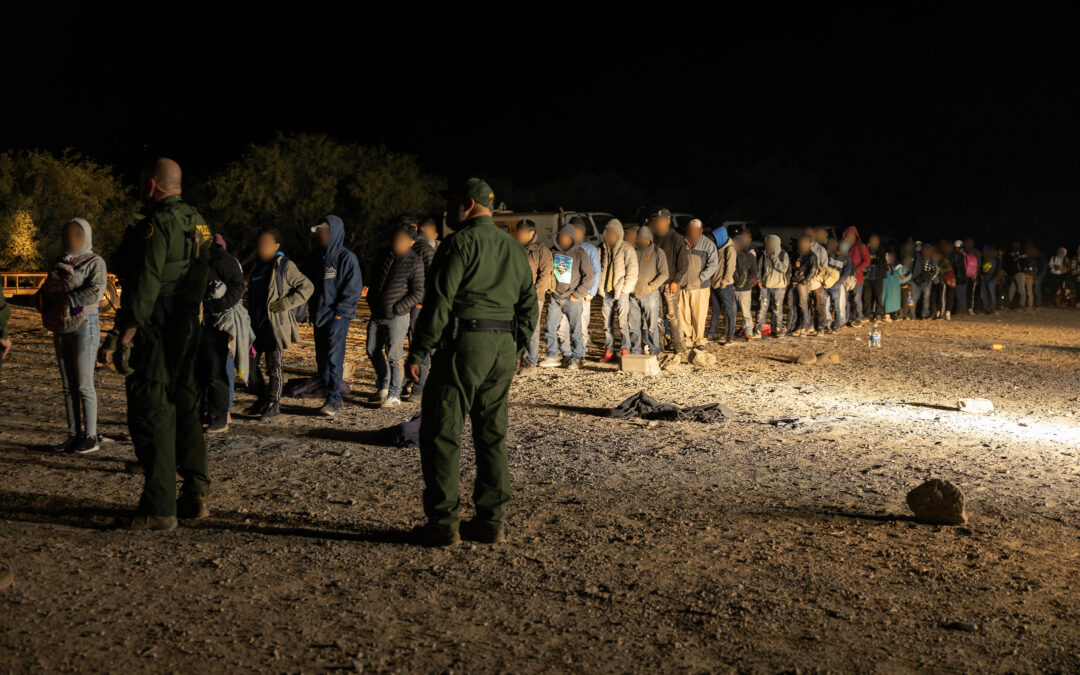
A major U.S. Border Patrol sector’s social media communication about the ongoing crisis on the ground has gone dark.
Last week, John R. Modlin, the Chief Patrol Agent of the U.S. Border Patrol’s Tucson Sector, posted to “X” that his sector’s “social media accounts will be paused until further notice in light of the ongoing migration surge.” Chief Modlin expressed his appreciation for viewers’ “understanding and continued support during this challenging time.”
NEW: The Border Patrol’s Tucson sector has “paused” its social media accounts due to “an ongoing migration surge” pic.twitter.com/NiBwI6qSdG
The post from Chief Modlin garnered significant attention – and subsequent outrage – as individuals opined on the reasons for the stoppage of the flow of weekly information from this sector on these accounts. Chief Modlin appeared to delete his post later, adding an update, writing, “Apologies for my earlier hastily written statement. To be clear, it is my intention to remain transparent.”
Apologies for my earlier hastily written statement. To be clear, it is my intention to remain transparent. pic.twitter.com/mktMFT8S5U
Chief Modlin explained that “in light of the ongoing migration surge, all Tucson Sector Border Patrol social media accounts will be temporarily reduced to maximize our available staffing in support of our current operational challenges. At this time, all available personnel are needed to address the unprecedented flow. The social media team will return once the situation permits.”
In light of the ongoing migration surge, all Tucson Sector Border Patrol social media accounts will be temporarily reduced to maximize our available staffing in support of our current operational challenges.
The CBP leader did reveal that his sector would “continue to post our Week in Review statistics, demonstrating the continued efforts of our agents and staff.”
We will continue to post our Week in Review statistics, demonstrating the continued efforts of our agents and staff.
The Tucson Border Sector has long been one of the nation’s most dangerous along the U.S.-Mexico boundary due to the proliferation of deadly drugs (such as fentanyl) and ‘gotaways.’ However, in the latter half of this year, this sliver of the border has become the busiest sector in more ways, attracting tens of thousands of individuals who are apprehended by agents. Chief Modlin’s regular posts on the work Tucson agents have done to triage the happenings on the ground have been extremely instructive for outsiders and stakeholders to understand the breadth of the crisis that continues to be exploited and exponentially grow with each passing month.
In the first month of Fiscal Year 2024, October, this sector reported over 55,000 encounters of illegal immigrants, which was a 140.8% increase over the previous year’s numbers for that month (22,938). Tucson Sector Officials recorded almost 374,000 arrests during the recently completed fiscal year.
These numbers, already significantly high for a portion of the U.S.-Mexico border, do not represent the number of ‘gotaways’ escaping detection and making their way around the interior of America’s homeland. Nor do these figures fill in another major gap of the border crisis, which is the rampant drug smuggling that occurs all throughout the border – but especially in the Tucson sector. Drug cartels and smugglers occupy the time of border agents with thousands of arrests per day, while running drugs and ‘gotaways’ through other unmanned corridors. These dangerous factors of the porous border continue to haunt law enforcement at all levels as they attempt to do everything they can to protect innocent men, women, and children from harm.
The skyrocketing numbers from the Tucson sector make it all the more important for government officials and agents on the ground to be as transparent as possible about the handling of this crisis.
Daniel Stefanski is a reporter for AZ Free News. You can send him news tips using this link.
The legislative session may be over for the duration of the year in Arizona, but lawmakers are still working on behalf of their constituents.
On Thursday, Arizona House Speaker Ben Toma “announced the creation of a new Ad Hoc Committee on Oversight, Accountability, and Big Tech to learn about emerging legal and constitutional issues surrounding censorship by government officials and social media interference, big tech manipulation of internet platforms, and the use of artificial intelligence.”
✅FOR IMMEDIATE RELEASE✅ New Interim Ad Hoc Committee on Oversight, Accountability, and Big Tech Will Examine Government Censorship and Conduct of State Executive Officials.
Freshman Republican Representative Alexander Kolodin was appointed by the Speaker to lead the interim committee as its chair. Speaker Toma also named Representative Neal Carter to the panel. At least one Democrat is expected to be added in the near future.
Kolodin released the following statement in conjunction with the announcement, saying, “Fighting for the First Amendment is an American’s highest calling. With this new committee, I am excited to have the opportunity to do so on behalf of the people of Arizona.”
According to the news release from the Arizona House of Representatives, “the Committee will hold its first public meeting on September 5, 2023, at the State Capitol to hear from leading experts in the fields of focus and to learn more about how potential legislation should be crafted to protect Arizonans’ constitutional rights, including their rights to free speech guaranteed by the U.S. and Arizona Constitutions. The Committee will also explore the proper role of state officials and conduct relevant investigations to ensure that executive officers are fulfilling their constitutional duties.”
The announcement about this new committee follows a report earlier that day from Arizona Capitol Oversight, which released government emails from then-Secretary of State Katie Hobbs’ Office, showing that she (and at least two staffers) sent communications to Twitter Support in hopes of the social media platform taking restrictive actions against other accounts with dissenting or unfavorable rhetoric. The Office was also requesting similar actions from the Center for Internet Security and Facebook on other posts.
🚨 Today Arizona Capitol Oversight is releasing exclusive emails from @KatieHobbs' office
Among many attempts to plead with social media platforms to censor opposing viewpoints, Hobbs’ Office took aim at one November 2020 Facebook post from Senator-elect Kelly Townsend over an election-related post, calling it “misinformation” in the subject line and transmitting screenshots and links of the lawmaker’s account. Facebook refused to remove the post, but the reviewers did place a banner below the post that linked to the platform’s Voting Information Center.
Arizona Capitol Oversight concluded its exclusive report by stating that “a number of items within the 100+ pages of emails obtained are auto-generated responses from social media companies confirming that they had received complaints and takedown requests from Hobbs’s government office. The specific demands made by Hobbs and her staff in those complaints/requests – likely submitted to Facebook and Twitter through a back-end portal – are unknown… for now.”
Arizona Republicans were quick to react to the breaking news about the Hobbs’ emails. Former Republican nominee for Attorney General in 2022, Abe Hamadeh, tweeted, “Katie Hobbs utter disregard for the rule of law didn’t just start with censorship. She withheld evidence from the court – and then sought sanctions against me for daring to contest the closest race in AZ history with 9,000 uncounted ballots. This is corruption & an abuse of power.”
Katie Hobbs utter disregard for the rule of law didn’t just start with censorship. She withheld evidence from the court — and then sought sanctions against me for daring to contest the closest race in AZ history with 9,000 uncounted ballots. This is corruption & an abuse of power https://t.co/nQXIPyx3C4
Kari Lake, the Republican’s nominee for Governor in 2022, said, “HUGE: Official emails EXPOSE Katie Hobbs’ corruption in the 2022 election. Not only did she run her own election, but she was actively using her office to CENSOR Kari Lake & the AZGOP. Hobbs attempted to silence our movement to manipulate the outcome of an election. She needs to be held accountable for it.”
HUGE: Official emails EXPOSE @KatieHobbs’ corruption in the 2022 election.
Not only did she run her own election, but she was actively using her office to CENSOR @KariLake & the @AZGOP
Hobbs attempted to silence our movement to manipulate the outcome of an election.
Attorney General Kris Mayes is fighting to continue government’s collusion with social media to control online speech.
Mayes joined a 21-state coalition of Democratic attorneys general to oppose a federal decision prohibiting federal officials from coordinating with social media companies to control speech. In a press release, the attorney general stated that control over free speech is paramount to public safety, implying that the government’s interest in maintaining this safety outweighed the constitutional right of speech.
“Social media companies and government officials must have open communication in order to ensure the safety of Americans online,” said Mayes. “A pillar of the U.S. government is to ensure the safety and wellbeing of its citizens. The lower court’s decision impedes on this protection and means federal, state and local officials cannot contact social media companies about dangerous online content.”
In an appeal led by New York, the 19 other attorneys general hail from California, Colorado, Connecticut, Delaware, Hawaii, Illinois, Maine, Massachusetts, Michigan, Minnesota, Nevada, New Jersey, New Mexico, New York, Oregon, Pennsylvania, Rhode Island, Vermont, Wisconsin, and the District of Columbia.
The coalition’s brief characterized speech control as “content moderation,” and argued that the federal government should maintain the ability to do so since it’s been doing it “[s]ince the advent of social media.”
“[I]n the experience of amici States, information-sharing and dialogue have not been coercive, but rather, helpful in ensuring that social media companies make fully informed decision about their own content moderation policies,” stated the brief.
The Louisiana Western District Court issued a preliminary injunction last month that barred the federal government from colluding with social media companies to regulate speech on their platforms.
Arizona leadership from both parties have either called for or participated in censorship.
Last March, Maricopa County Recorder Stephen Richer worked with the federal government on tactics to control online speech. Richer met with the Cybersecurity and Infrastructure Security Agency (CISA) Cybersecurity Advisory Committee (CSAC) Misinformation & Disinformation (MDM) Subcommittee, all under the Department of Homeland Security (DHS).
Last September, Maricopa County rolled out a press pass program to control which outlets and reporters could gain access to government proceedings and property. Last November, the county launched a disinformation center and further limited press access. In April, Maricopa County paid a $175,000 settlement for denying press credentials to a reporter under their press pass program because his work didn’t constitute truth in their eyes.
This past March, Sen. Mark Kelly (D-AZ) asked the Federal Reserve, Treasury Department, and the Federal Deposit and Information Corporation (FDIC) whether they could work with social media companies to censor information in order to prevent a run on the banks.
Gov. Katie Hobbs, while in her former capacity as secretary of state, used the Center for Internet Security (CIS) as a middle man of sorts to censor online speech. Although requests were made for an investigation into the relationship, the transition of power in the attorney general’s office effectively made those requests dead on arrival.
Arizona government workers have also been trained by the Aspen Institute: the liberal think tank behind the coordinated cover-up of the Hunter Biden laptop story. The institute launched its first Arizona-based leadership program last year with startup funding from Walmart.
Corinne Murdock is a reporter for AZ Free News. Follow her latest on Twitter, or email tips to corinne@azfreenews.com.
A Pew Research poll released July 20 found that 70% of Democrats think the government should restrict what appears on social media, a dramatic change from five years ago when a majority of Democrats supported a free marketplace of ideas.
It’s no wonder, considering the drumbeat of warnings from leftist politicians and their liberal media allies about “disinformation” and “misinformation.”
But be warned: Democracy cannot survive for long if one of the nation’s two major political parties wants to put blinders on the public, limiting their access to information and canceling political opponents. That’s a rigged system. Ask the Iranians, Russians or Chinese.
A House hearing on July 20 held by the Select Subcommittee on the Weaponization of the Federal Government showed that the Biden administration is already censoring social media on a massive scale, putting blinders on all of us.
Hearing witness D. John Sauer, special assistant attorney general for Louisiana, described preliminary findings by a federal judge that Biden staff in the White House, the FBI, the Department of Health and Human Services, and almost every other executive department meet regularly with social media executives and pressure them to remove or demote criticisms of Biden economic and energy policies, Biden family members, and even items that depict the first lady in an unflattering way. According to Sauer, “millions of American voices” have been silenced in violation of the First Amendment.
Sauer cited some 18,000 communications from Team Biden to tech executives orchestrating a vast ongoing censorship operation.
Yet Democratic lawmakers were unfazed by this shocking evidence, and hardly questioned the witness. The U.S. Constitution and the future of our democracy be damned.
Rep. Stacey Plaskett laid out the Democratic Party’s distorted interpretation of the First Amendment, insisting that not all speech is constitutionally protected and offering hate speech as an example.
Plaskett and like-minded Dems need a refresher course on the Constitution and American history. The Supreme Court has ruled again and again that all speech, especially speech we like the least, is protected. That includes Nazi marches and cross burnings, as odious as these are. Who needs a constitutional amendment to protect speech everyone likes?
In 2017, the Court ruled unanimously in Matal v. Tam that the First Amendment requires “we protect the freedom to express ‘the thought that we hate,’” citing Justice Oliver Wendell Holmes Jr.’s dissent in the 1929 case United States v. Schwimmer.
Rep. Gerry Connolly aimed his wrath at witness Robert F. Kennedy Jr., whose views on vaccines and other pandemic policies were censored. Connolly said this censorship “was not big brother government trying to exercise its will on an innocent population. It was public health measures to protect lives.”
Connolly’s wrong. Censoring scientific debate was a lethal mistake. If competing scientific viewpoints, especially about masking and lockdowns, had been considered, harm to schoolchildren, business owners, and many others might have been prevented. Turns out, official government policy was based on “misinformation” and “disinformation.”
During the hearing, Rep. Debbie Wasserman Schultz, battered Kennedy with accusations of antisemitism and racism for his outrageous comments about the disparate impact of COVID on different ethnic groups. But when he tried to respond, she barked “reclaiming my time” and “ask the witness to stop talking.”
Whether you think RFK Jr. is loony or a viable presidential contender, as a witness he should have been treated with civility. Wasserman Schultz’s abuse is reminiscent of how Sen. Joseph McCarthy browbeat witnesses during the Army-McCarthy hearings in 1954. Those hearings ended abruptly when McCarthy was asked, “Have you no sense of decency?” Wasserman Schultz should have been confronted with the same question.
The attacks on RFK Jr. were a sideshow. The main event was the Democrats’ concocted defense of censorship. The Democrats’ own witness — civil rights attorney Maya Wiley — testified that “the ability of every person to have access to accurate and reliable information is a cornerstone of our democracy.”
Wiley’s slippery language is meant to evade the real issue: Who decides what is accurate and reliable?
Wiley was asked directly by Rep. Chris Stewart, “Do you trust the government to determine what facts and views the American people are exposed to?” She replied, “I think I’m struggling with the question.”
Tell Democrats the answer is a resounding “no.”
Trusting government to be your eyes and ears is crazy.
Betsy McCaughey is a contributor to The Daily Caller News Foundation and a former lieutenant governor of New York and chairman of the Committee to Reduce Infection Deaths. Follow her on Twitter @Betsy_McCaughey. To find out more about Betsy McCaughey and read features by other Creators Syndicate writers and cartoonists, visit the Creators Syndicate website at www.creators.com.