by Staff Reporter | Nov 18, 2024 | Education, News
By Staff Reporter |
Scottsdale Unified School District (SUSD) will no longer be using X to stay engaged with the community, with the given reason being a lack of a “family-friendly” environment.
SUSD made the announcement last week, also alluding to board policy necessitating their ceasing the use of X. The district will remain on Facebook and Instagram instead.
“In line with board policy IJNDB and our commitment to safety, SUSD schools are stepping away from X to prioritize family-friendly engagement,” said SUSD. “For updates, find us on Facebook, Instagram, or visit http://susd.org. Let’s stay connected in spaces that uphold our values.”
IJNDB refers to policy on the use of technology resources in instruction. Per that policy, the district implements technology protections against visual depictions that are obscene, child pornography, or content which may be discerned as harmful to minors.
Yet, the district allows children access to sexually explicit books and content in its libraries and classrooms.
In stepping away from the use of X, the district also remarked that X failed to align with its values. In addition to protections for sexually explicit materials, SUSD holds values such as transgenderism in minors, social emotional learning, and critical race theory.
SUSD made their announcement a week after Election Day, when Donald Trump won the presidency and Republicans secured a trifecta.
Tech billionaire and Tesla CEO Elon Musk bought Twitter (now X) for the express purpose of preserving and supporting free speech following the 2020 election. During that election, the silencing of certain right-wing voices occurred under social media platforms such as Twitter and Big Tech companies.
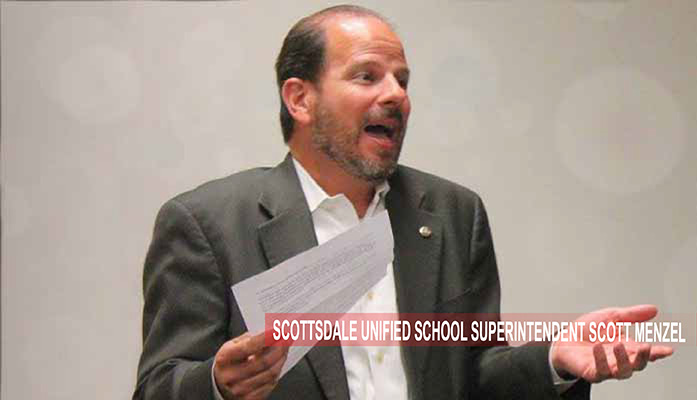
SUSD lost nearly 500 students over the course of this past year, amounting to millions in lost revenue. The auditor general has scored the district as “high risk” due to its continued decline in enrollment. Enrollment has declined 10 percent under the tenure of SUSD Superintendent Scott Menzel, and reports have emerged of record staff turnover.
Additionally, SUSD spending on classrooms and teachers have hit another historical low for this school year: 54 percent versus nearly 64 percent from 20 years ago, just over the lowest fiscal year (2017, which amounted to 53 percent).
Parent watchdog group Scottsdale Unites for Education Integrity said the nine percent decrease signified a $40 million redirection of funds from academic achievement.
Menzel also enjoyed a pay raise earlier this semester despite falling short of academic performance goals: achievements in math, English-Language Arts (ELA), and science fell below desired outcomes. Over 8,000 students weren’t proficient in ELA, over 9,000 weren’t proficient in math, and over 12,000 weren’t proficient in science.
The only goals which Menzel accomplished were nonacademic, and they amounted to less than half of the goals set: increases in attendance rates, student participation in extracurricular and cocurricular activities, and certified staff retention; an establishment of a baseline for work-based learning opportunities and hours completed using Major Clarity; and production of a decision-making matrix and at least one proposal for action by June.
AZ Free News is your #1 source for Arizona news and politics. You can send us news tips using this link.
by Mike Bengert | Oct 30, 2024 | Opinion
By Mike Bengert |
Can we truly take the American Association of School Administrators (AASA) seriously? They claim to be the premier association for school system leaders and the national voice for public education and district leadership. But do they speak for the majority of parents with children in public schools across America?
The AASA being the voice for public education on Capitol Hill might explain why public education has been failing our children for years. The education professionals who run the AASA and the Arizona School Administrators (ASA) seem more focused on promoting social-emotional learning, DEI, and gender identity rather than prioritizing academic excellence in public schools.
How else do you explain the prior selection of Dr. Donna Lewis as the superintendent of the year when she was the superintendent of a district where math and ELA proficiency were below 15%? And how do you explain the selection of Dr. Menzel as the 2024-2025 national superintendent of the year?
By selecting two failed superintendents for recognition, these organizations demonstrate that they are not concerned with academics.
Contrary to the Scottsdale Unified School District’s (SUSD) claims, Menzel has not enhanced educational outcomes; it is just the opposite. Last year, Menzel failed to meet his academic performance goals, and academic achievement in math, ELA, and science declined. In 2023, SUSD had over 8,000 students who were NOT proficient in ELA, over 9,000 who were NOT proficient in math, and over 12,000 students who were NOT proficient in science. Thirty-five percent of 3rd graders were not proficient in ELA in 2023. Being able to read by 3rd grade is critical to a student’s academic success. By continuing to promote them without being proficient, Menzel is setting them up for academic failure.
Despite these deficiencies, hundreds of SUSD students are promoted and graduate each year.
Under Menzel’s tenure, SUSD experienced a 10% drop in enrollment, with nearly half of the eligible students choosing not to attend SUSD. Additionally, the district has faced record staff turnover due to the fear-driven environment Menzel has created. Yet he is celebrated as the superintendent of the year.
Enough is enough. Scottsdale cannot afford another failed superintendent of the year.
Mike Bengert is a husband, father, grandfather, and Scottsdale resident advocating for quality education in SUSD for over 30 years.
by W.H. Williams | Oct 10, 2024 | Opinion
By W.H. Williams |
The Scottsdale teachers’ union has endorsed three candidates for the Scottsdale Unified School District (SUSD) Governing Board, emphasizing their extensive experience as education professionals. While their expertise may seem impressive to some, the pressing question remains: does SUSD need more so-called experts on the Board, or do we require individuals who prioritize common sense, academic excellence, and respect for parents’ rights?
Under the current leadership of Dr. Menzel, an education expert, the SUSD has experienced a troubling decline in academic performance and significant student and staff turnover. Despite promises by the experts that social-emotional learning (SEL) would improve academic educational outcomes, the reality has been disappointing. Not only has academic achievement not improved but it has declined during his tenure.
Dr. Menzel and the experts on the Board, who rubber stamp everything he wants to do, not only have a dismal academic record but have caused over 2,200 students to leave SUSD along with record-high staff turnover.
Some studies and reports suggest that SEL is harming the emotional and mental health of students. The shift in spending away from teachers and to more social workers and counselors further drives down academic performance.
The three endorsed candidates—Dr. Donna Lewis, Matt Pittinsky, and Michael Sharkey—have questionable records that raise concerns about their suitability for the Board, but they also promise to “protect SUSD” and Menzel, ensuring the continued disruption and dismantling of the District.
Dr. Lewis has highlighted her accolade as the national superintendent of the year during her time at the Creighton School District, claiming she improved schools from Cs, Ds, and Fs to As, Bs, and Cs. However, she conveniently omits that only 13% of students were proficient in English Language Arts (ELA) and just 8% in math during her celebrated year. Additionally, her leadership style has been criticized for creating a hostile and toxic environment, prompting a formal public apology from a school board member after her departure.
Matt Pittinsky, another candidate with 25 years in education, has been less than forthcoming about his business ties to SUSD. One of his companies provides services to the district, a fact he only revealed after being confronted publicly. This raises serious questions about his transparency and the potential conflicts of interest in his role as a board member. Furthermore, his acceptance of over $10,000 in out-of-state campaign contributions, primarily from CEOs of companies that sell to schools, adds another layer of concern. What motivations could these out-of-state contributors have for influencing a local election?
Michael Sharkey, who has over 20 years of experience in education, has publicly linked his candidacy to the rise of the parents’ rights movement, which he blames for many of SUSD’s current issues. Sharkey asserts that the “book bans, cultural wars, and dysfunction” that are plaguing SUSD are due to the parents’ rights movement.
He rejects the idea that parents are best positioned to make educational and healthcare decisions for their children, asserting that trained professionals know better. This stance is contrary to the Arizona Revised Statutes, which enshrine parental rights in the Parent’s Bill of Rights. Sharkey’s reluctance to recognize these rights suggests a troubling approach to governance that may not prioritize parental input nor respect their legal parental rights.
Despite Sharkey’s recent claims of wanting to engage with families and welcome their input, it’s important to note that initial statements often reflect true beliefs. His previous rhetoric implies a preference for limiting parental involvement and allowing “experts” to take charge of children’s education and healthcare.
You also must ask yourself why a school board member, who should be focusing on academics, would be involved in making healthcare decisions for the students. Again, Arizona law leaves it up to the parents.
This upcoming election presents a critical choice: we can either “protect SUSD” and continue down the path of endorsing more educational experts who have failed to deliver results and are harming children, or we can elect board members who demonstrate common sense, a focus on academics, and a commitment to respecting parents’ rights. Candidates like Gretchen Jacobs, Jeanne Beasley, and Drew Hassler embody these qualities, promising to be responsible stewards of our tax dollars while prioritizing the safety and educational needs of all students in SUSD.
It’s time for a change that puts our children’s future first.
Mr. Williams is a longtime Scottsdale resident, businessman, grandfather, and the parent of an SUSD graduate.
by Ed Steele | Sep 19, 2024 | Opinion
By Sharon Benson and Ed Steele |
In its heyday, Mesa Public Schools (MPS) was the district to attend; the envy of the East Valley. From academics to athletics, from artistic endeavors to award-winning music programs, Mesa provided excellent programming from kindergarten to graduation. So much so, that parents would often bring their own children back to Mesa Schools, often to the same school they attended as children.
In 2011, MPS students were achieving at levels in keeping with the stellar reputation that Mesa had always experienced. But between 2014 and 2015 achievement in MPS, as well as across the state, plummeted, and MPS hasn’t been able to break the 50% achievement rate since that time. There were a few ‘events’ that occurred during this time period, only one in which your school board would have had direct input; unless they were to be extremely courageous and decide to refuse federal education dollars.
The state assessment test switched from AIMS to AZMerit, there was a full implementation of Common Core across the state, and districts began to go down the road of developing a ‘Portrait of a Graduate’. As these took hold, publicly funded schools began to face steep declines in enrollment. MPS, for example, lost a total of 8,979 students as of the 2021/22 school year according to data located here. Consider that our 15-day student count for the school year 2024/25, is 54,339, a loss of 20,610 students since the 2011/12 school year. These trends are not exclusive to MPS, and this is where your vote for school board matters.
I have a friend who has said repeatedly that if an organization, which begins with conservative values, does not hold fast to those values, the organization will ultimately become liberal. The core conservative value which directed education in MPS, as well as many other districts across the state, was focused on developing a solid academic foundation upon which students could build. This value was supported by a few other core values such as individual responsibility, discipline, working hard, perseverance, and merit. These values have been eroding over time, often due to a lack of leadership from a district’s governing board.
The trend in education in Arizona, which has been in works since at least 2014, is the Portrait of a Graduate. This has become the framework upon which other elements have been built into our classrooms such as culturally relevant teaching and social emotional learning (SEL); here is just one example of new ‘science’ curriculum adopted by MPS last spring.
When you really take a look at the Portrait of a Graduate in most, if not all districts which have adopted this framework, there is no indication that we want our graduates to be academically sound in the basics needed in order to participate in society. School boards voted to adopt this framework to develop their strategic plan, and can vote to redirect the district using a different framework; one in which academics and solid, critical thinking is the foundation.
Curriculum adoption is another area in which your school board members are of critical importance. Many curriculum options available today are infused with elements incorporating ideas which are contrary to conservative American values. Rather than using quality literature, which incorporate timeless values, stories are selected that allow students to “see themselves” in the literature. Often the material brings in concepts regarding racism, “white privilege,” oppressed/oppressor, sex, sexuality, sexual orientation, or gender confusion issues. Many examples straddle the edge of pornography and reading the text or displaying the pictures would be deemed offensive and would not be allowed at a school board meeting. Forcing these themes and concepts upon children results in confusion and anxiety. This is clearly evident as we look at the “mental health crisis” within students across Arizona. A strong conservative school board is able to push back against district leadership, and remove that which is not beneficial for our students’ learning.
Policy development is another critical piece in the quality running of a school district over which your school board members have control. Drafting clear, quality policy, and procedures which are not contrary to federal or state law is critical to improving the education students are receiving as they attend our public schools. This is a statutory mandate for school board members, and should not ever be relegated to hired district leadership.
In MPS, there has been much controversy the last few years regarding this very issue as the community became aware of Transgender Guidelines, and the Checklist associated with the guidelines. Notice, these are guidelines, not policy; no MPS Governing Board has developed or voted on policy regarding gender dysphoria, yet the district has had guidelines in place since 2015. This fact went under the radar for several years, and only became visible because of the social contagion surrounding this topic since 2020. As a result of these guidelines, which in our humble opinion, violate ARS 1-602, and the First Amendment, teachers feel free to introduce concepts of sex and sexuality with minor students, planting seeds of confusion within young minds, which is not acceptable. Voting for a school board which will possess members who uphold parental rights, and the rights of all students will be the only way to reverse this trend, and protect all our students.
Finally, the school board is responsible for hiring the Superintendent, whose responsibility it is on a daily basis, to ensure the will of the elected board members is enacted with fidelity. This is critical, as the elected board members who represent the will of their voters, can do all things right and in alignment with their community, but if the district leadership undermines that, the degradation of our educational system continues. The Board must hire an ethical person of integrity who aligns with the values of the community, as represented by the elected members of the board.
Your vote for school board members may be the most important vote you cast this election season. Being a non-partisan race, it is important to engage with those people who are running and to investigate and research the candidates, so that you are casting an informed vote that represents your values. The future of public education, which still educates a majority of American children, depends upon it.
Sharon Benson and Ed Steele are candidates for Mesa Public School Board.
by Tamra Farah | Aug 22, 2024 | Opinion
By Tamra Farah |
The author of this opinion piece would like to clarify that the title refers to individuals like Aaron Dunton and does not apply to any other individuals named in this article. In addition, the reference to sexually grooming kids concerns encouraging LGBTQIA gender identity considerations. Further, the mention of sexualizing kids refers specifically to encouraging kids to access the specific library books indicated and not to anything else.
Concerns over sexual grooming in Arizona schools and inappropriate educational agendas have intensified. The use of grooming materials and activities by teachers, the Arizona Education Association (AEA) agenda, and the damning Department of Education’s Enforcement Action report on sexual misconduct in schools are telling.
Not in Our Schools recently outlined concerns over reported misconduct and the promotion of LGBTQ and social justice agendas in Arizona schools. There are also concerns about the growing influence of LGBTQ and social justice agendas in Mesa Public Schools (MPS) through the actions of teachers and organizations like GLSEN (Gay, Lesbian & Straight Education Network).
Some Mesa teachers reportedly use their roles to promote LGBTQ-related content and activities in the face of new district policies restricting teacher involvement in non-academic clubs. Activities cited by Not in Our Schools also reveal that Mrs. Tami Staas engages in “grooming” students for sexual behaviors and gender transitioning without parental knowledge, using platforms like Synergy to hide information from parents. Mrs. Staas is said to introduce pronouns and LGBTQ+ symbols in her classroom, causing concern among parents.
Not in Our Schools also reports that the AEA prioritizes social agendas over academic achievement and influences school board elections to further these goals. Allegations are made about the AEA’s involvement in supporting abortion access and pushing for laws that promote gender transitioning in schools. Parents must be cautious about the school system and the influence of organizations like the AEA, and should thoroughly research candidates before voting in the upcoming school board elections.
Another concern involves the social-emotional learning (SEL) framework, which is used to push LGBTQ agendas. Programs like “Everybody Matters” indoctrinate students into LGBTQ lifestyles, further eroding parents’ influence in the education system. Additionally, the involvement of organizations like GLSEN and the Arizona School Board Association (ASBA) promotes LGBTQ content and obscures it from parents. Finally, the Mesa Public Schools Governing Board has been called out for supporting programs that weaken family structures and increase LGBTQ influence in schools.
Not only are teachers identified as using sexualizing materials in school, but just a few years ago a flurry of news called out Aaron Dunton, a former teacher at Higley High School in Gilbert, Arizona, who was arrested after a months-long investigation revealed his alleged inappropriate relationship with a 14-year-old student. Dunton resigned after the allegations surfaced, having taught at the school since July 2021. During the investigation, another victim accused Dunton of inappropriate incidents in 2019 when he was a teacher at Power Ranch Elementary. The second victim was 11 years old at the time. Dunton was facing multiple charges, including aggravated assault, witness tampering, and contributing to delinquency and dependency, until the Maricopa County District Attorney dropped the charges. Speculation is that there was no law to convict Dunton at the time. Now, there is hope that the anti-grooming law will be implemented soon.
Dunton is just one teacher among many seeking to mistreat students sexually. The Arizona Department of Education 2023 Enforcement Action Report indicates an 184% increase in sexual teacher discipline-related cases from 2012 to 2023. Those are cases that were recognized and resulted in the discipline of perpetrators. Imagine how many more teachers, coaches, and other school officials may go unrecognized as sexual predators of students.
Some consider HB2310, referred to as the Child Enticement Bill or the anti-grooming bill introduced by Representative Travis Grantham, as a tool to prosecute sexual predators like Dunton. HB2310, which will go into effect next month, strengthens protections for children against enticement and grooming. Going into effect next month, the bill makes it a fourth or fifth-degree felony to intentionally lure, solicit, or entice a minor into committing illegal sexual acts or actions that could lead to sexual exploitation or abuse. It also includes provisions for offenses committed through electronic communications. The legislation increases penalties for these crimes, providing better legal protection for children in Arizona.
Beyond respect for this prosecutorial law, the governing boards in Arizona school districts and the Arizona Department of Education are responsible for ensuring guardrails and accountability in schools to protect children. But it doesn’t stop there. Parents are vital in guiding their children to make safe and responsible decisions at school and online. Parents can encourage their children to protect themselves and others, understand harmful behaviors, and report incidents to parents and school officials immediately.
Here are suggested steps parents can advise their kids to take at school:
1. Understand Consent and Boundaries: Encourage your child to be aware of the power they have not to consent and the legal consequences of inappropriate sexual conduct by an adult. Ensure your kids understand that boundaries matter in physical and digital communication. Reinforce this by having regular conversations about consent and why respecting their personal space and boundaries is essential.
2. Be Mindful of Online Behavior: Advise your child to think critically about how they interact online, particularly with social media or text messaging. Teach them never to share personal or explicit content with others and to be cautious when interacting with people they do not know well. They should also understand that even consensual acts, such as sharing inappropriate images, can have severe legal consequences. Parents can support this by discussing the real risks of digital communication and the importance of privacy.
3. Report Suspicious Behavior: Make sure your child knows that if they encounter inappropriate behavior, such as an adult or peer asking them to send inappropriate images or engage in risky sexual acts, they should report it immediately to a trusted adult at school, such as a counselor or teacher, or use an anonymous reporting tool if available. Reinforce that reporting these incidents is crucial for their safety and protecting others from potential harm.
4. Stay Informed About Friendships and Relationships: Parents should encourage their children to surround themselves with friends who respect boundaries and engage in safe, responsible behavior. Advise them to avoid risky situations or peer pressure and to feel confident in saying “no” to uncomfortable requests, whether in person or online. By fostering open communication with your child, you can help them navigate complex social situations and ensure they understand their rights and responsibilities in relationships.
5. Learn About the Law: Encourage your child to become familiar with the legal consequences outlined in the amended Arizona statutes, particularly regarding age differences in relationships and digital safety. Understanding the law can empower them to make responsible choices. Parents can help by discussing the specific legal consequences of child enticement, age proximity laws, and what qualifies as inappropriate behavior.
6. Practice Digital Safety: Advise your child never to share personal passwords, account details, or private information online. Reinforce that they should never engage with unknown people online, especially if the conversation turns inappropriate or uncomfortable.
By teaching children about consent, online safety, reporting suspicious behavior, and advocating for themselves, parents can help them align their actions with appropriate behavior and relationships and create a secure school environment that is in accordance with Arizona’s laws to protect minors.
Tamra Farah has twenty years of experience in public policy and politics, focusing on protecting individual liberty and promoting limited government. She has worked at the senior director and advisor level for Americans for Prosperity, FreedomWorks, Moms for America, and pregnancy centers. Tamra currently directs SMART Families Network at Arizona Women of Action.