Maricopa County Board of Supervisors sustained a loss in their ongoing court struggle against the recorder on Wednesday.
The Maricopa County Superior Court denied the board’s request to open up discovery based on the testimony they forced County Recorder Justin Heap to give last month. Judge Scott Blaney said the supervisors acted well outside of the proper proceedings and had attempted to influence the court.
“The Court further finds that the Court’s initial fear — that the Board of Supervisors was using its extra-judicial subpoenas in part to influence these proceedings — was well founded. The Court will not allow this gamesmanship to interfere with or jeopardize the integrity of these proceedings,” said Blaney. “Even if Defendants’ request actually constituted a proper use of the rule (it does not), the Court would still not reward such shenanigans by allowing this extrajudicial ‘evidence’ to taint the record in this case. The matter has already been taken under advisement for final determination.”
The supervisors forced Heap to testify last month on account of his allegedly “lying to the public,” among other very public accusations.
“He has been unreliable. He has been unprofessional. He has been untruthful. He has been unaccountable,” stated a press release from the board. “The Board cannot responsibly set a budget, make policy decisions, or oversee county operations, including an active election in Tempe right now, without complete and truthful information from Mr. Heap.”
That compelled testimony also required Heap to provide a massive report to the board on his office’s work within a week. Heap said during his testimony that it contained “thousands of pages of documents.”
Blaney also criticized the board’s decision to subpoena the recorder’s staff based on their court testimony.
“[The board] instead required witnesses to appear in front of the Board, under oath, in front of a hostile party and not a neutral arbiter, and without the protection of the rules of evidence,” said Blaney. “Upon learning of the Board’s compelled, extra-judicial discovery, the Court became concerned that the Board had issued the subpoenas in retaliation for the witnesses’ testimony at this Court’s evidentiary hearing and further, that the Board issued the extra-judicial subpoenas to improperly influence these proceedings.”
The court issued a temporary restraining order at Heap’s request that quashed the subpoenas. Heap accused the board of intimidating his staff in order to “unduly influence” the court ruling.
Based on this latest ruling, the board’s approach to any influence over the court seems unlikely.
The final ruling in the case between the recorder and board of supervisors could determine the balance of duties between the two. Heap is pushing for a complete restoration of the election duties his office lost under the Shared Services Agreement (SSA) put in place in the waning months of his predecessor and former supervisors.
The supervisors and recorder are presently at odds over plans to establish early voting locations. Supervisor Mark Stewart, who has expressed slightly more support for Heap than his fellow supervisors, said that the parties were nearing a resolution over this latest rift.
“Regardless of the back-and-forth or expressed frustrations from the Recorder’s office and the Board Chair, we are making progress and working together. It may not be perfect, but it is happening,” said Stewart.
AZ Free News is your #1 source for Arizona news and politics. You can send us news tips using this link.
The Arizona Republican Party is picking sides in the ongoing spat between the Maricopa County Board of Supervisors and County Recorder Justin Heap.
The party’s new chair, Sergio Arellano, issued a press release on Tuesday commending Supervisor Mark Stewart for speaking out against the rest of the board for their posturing to oust Heap from office.
“I appreciate those Republicans who are able to ignore the rancor being generated by those outside the process, and who are willing to listen to the voices of those of us who want a solution that unites Republicans behind the proposition that Arizona voters deserve a process that respects their choices, and that the power of the people, exercised through their vote, prevails and is honored,” said Arellano.
Arellano advised voters to focus on the merits of policy over the noise of personal conflicts in the matter; the chair agreed with Stewart that Heap should have full restoration of elections administration duties under the Shared Services Agreement (SSA).
“Ignore the fake news and those who are intent on whipping up hysteria to further their own personal ambition, but we as a Party must deliver on real and effective reform and restore full faith in our elections,” said Arellano. “Recorder Heap must be allowed to do his job and then he must do it properly. The same goes for our County Supervisors. I am grateful to Supervisor Stewart for seeking a path that accomplishes all of this and encourage everyone involved to follow his lead and reach an agreement of which we might all be proud.”
The board ordered Heap to appear on Wednesday to provide a report and testify on his administration and allegations of voter disenfranchisement made by his office.
It is the latest escalation in the public spat between the two over who has primary control over elections via the SSA. The current SSA, all but gutting the recorder’s office of elections duties, was put in place by a “lame duck” recorder, Stephen Richer, and board majority in their final months in office. After Heap failed to convince the board to reverse course on that SSA, Heap sued last summer.
Supervisor Stewart announced on Monday that he sought outside legal counsel to negotiate with Heap over the SSA, since the board and recorder’s office appear to have hit a stalemate.
Stewart retained counsel after failing to receive a response to his request to postpone Wednesday’s meeting from Chair Kate Brophy McGee. The supervisor said all members of the board ought to have additional time to consult with counsel about negotiations with Heap.
“My counsel requires additional time to fully evaluate the issues raised, assess the scope and legal basis for the required direct report, and advise me accordingly. Proceeding before that review is complete would not allow me to participate in the discussion or any potential vote with the preparation and confidence that such a consequential action demands,” said Stewart. “Out of respect for the institution, the Recorder’s Office, and most importantly, the residents we serve, I believe it is prudent to delay consideration of this item until all members of the Board have had sufficient opportunity to consult with counsel and fully assess the implications.”
A Call for a Pause and Clarity
This morning I sent a letter to the Board Chair requesting we postpone Wednesday’s discussion to allow time for full staff participation and so the Board can meaningfully review the sworn report, Shared Services Agreement, and signature… pic.twitter.com/ITiVfuK8Gx
— Mark Stewart Maricopa County Supervisor District 1 (@MarkStewart_AZ) February 14, 2026
Stewart also denounced the possibility of Heap’s removal should he refuse to show on Wednesday.
Maricopa County Recorder Justin Heap has announced that his office set a new speed record for processing Election Day ballot drop-offs, completing signature verification and curing ballots within 48 hours of the Nov. 4th elections. The matter was complicated when officials scrambled to process thousands of ballot envelopes discovered days later in a misplaced transport box.
In a Nov. 6 update on X, Heap wrote, “All calls to voters with signature inconsistencies have been completed.” He added that finishing both signature verification and voter calls “within just 48 hours of Election Day shatters all previous timeframes for elections with more than 100,000 Election Day drop-offs.”
RECORDER’S ELECTION UPDATE:
✅ All calls to voters with signature inconsistencies have been completed.
Finishing both signature verification and voter calls within 48 hours of Election Day shatters all previous timeframes for elections with more than 100,000 Election Day…
— Maricopa County Recorder Justin Heap (@azjustinheap) November 7, 2025
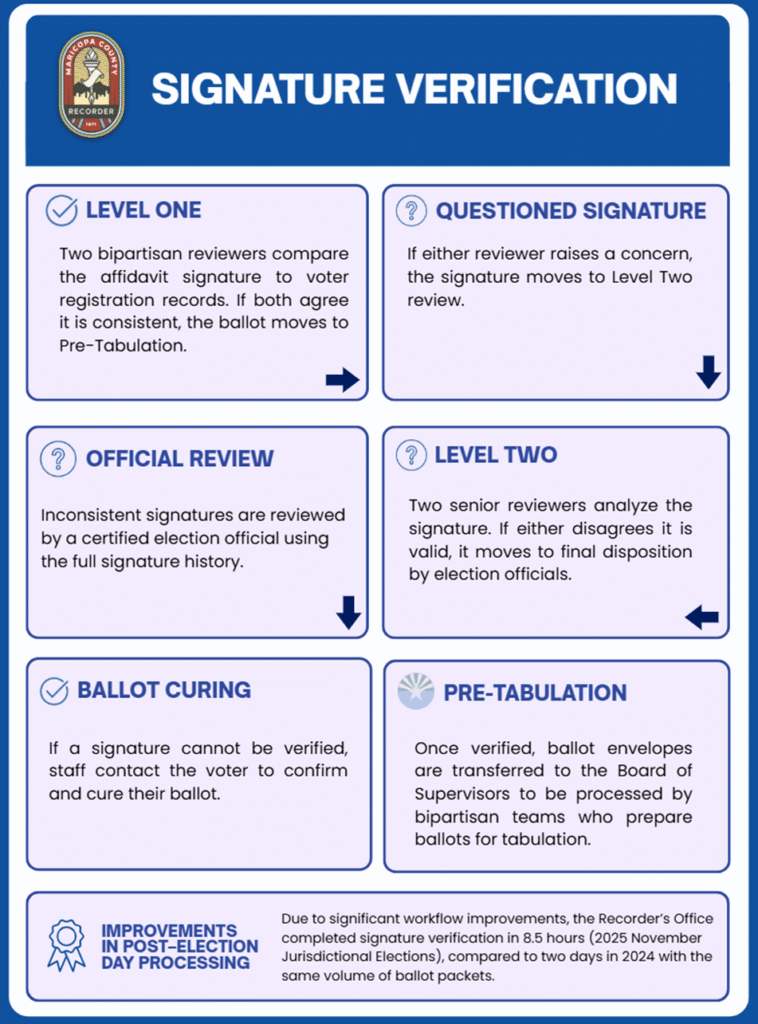
According to detailed metrics provided to AZ Free News by the Maricopa County Recorder’s Office, the November election included 117,664 ballot packets returned via mail or drop box on Election Day. Signature verification on those packets began at 6:00 a.m. on Wednesday, Nov. 5, and the office says the final file review was completed by 2:33 p.m., for an 8.5-hour turnaround on the Election Day returns.
For comparison, the Recorder’s Office pointed to the July 30, 2024, primary, when roughly 114,681 similar packets took about two days to clear signature review under then-Recorder Stephen Richer. In an emailed statement to AZ Free News, Maricopa County Director of Communications Judy Keane wrote:
“This represents a dramatic acceleration in post–Election Day processing: completing in 8.5 hours what previously required two days in the 2024 Primary, despite similar packet volumes. This outcome demonstrates the effectiveness of process improvements and the exceptional performance of the team.”
Two-Reviewer System and Quad-Screen Interface
Heap campaigned on tightening signature verification and has spent much of his first year in office overhauling the workflow while feuding with the Maricopa County Board of Supervisors over funding, control of election IT systems, and a controversial Shared Services Agreement now mired in litigation.
In response to written questions from AZ Free News, the county Public Information Office said that every early-ballot signature in the Nov. 4 election was reviewed by at least two human reviewers of different parties.
The office described the workflow this way:
Level One review uses a “quad-screen” interface on a single monitor:
Bottom left: the affidavit signature being reviewed
Above it: the voter’s latest signature on file
Upper right: second-latest signature
Middle right: third-latest signature
Bottom right: the voter’s registration signature
All signature exemplars can be rotated to the primary comparison position above the affidavit signature so reviewers can align shapes and slants.
According to the county, Level Two reviewers see the same layout. Still, they can also scroll through the voter’s full signature history when Level One reviewers either disagree or cannot comfortably verify a match.
County officials say that the combination of two reviewers of opposing parties and deeper access to a voter’s signature history at the second level was designed to increase both scrutiny and perceived neutrality, after years of partisan conflict over how Maricopa handles early ballots.
For voters whose signatures still couldn’t be confirmed, the office used multiple curing channels tied to identity verification: calls from election staff, text messages (for those who opted in), emails, and a secure online dashboard at BeBallotReady.vote, consistent with state guidance on signature curing windows.
Record Processing Claims Tested by Ballot Mishap
Heap’s announcement of “shattering” past performance landed just as Maricopa County was forced to acknowledge another election-administration black eye: the discovery of two sealed transport boxes with 2,288 returned ballot affidavit envelopes that had not been included in the initial post-Election Day processing.
On Nov. 7, county elections officials disclosed that poll workers had mistakenly placed the sealed transport boxes inside a blue drop box instead of returning them to the county’s election center on Election Night. Local outlets reported that the boxes bore intact tamper-evident seals and matched election-night serial numbers, but the ballots inside had not been counted, according to AZ Family.
Heap’s office responded with its own update, saying signature verification on all 2,288 ballot packets had been completed and that every voter whose signature needed curing had been contacted before the statutory deadline.
RECORDER'S ELECTION UPDATE:
The County Recorder’s Office has completed signature verification on all 2,288 of the missing ballot packets we received from the Board this morning. In the last hours, we have contacted all remaining voters with signatures requiring additional… pic.twitter.com/M1PGHj6Tkw
— Maricopa County Recorder's Office (@RecordersOffice) November 7, 2025
Jennifer Liewer, Deputy Elections Director, issued a statement following the report saying:
“Friday, Nov. 7, 2025: This morning, as part of standard post-election protocols, elections workers inspected equipment that had been returned from voting locations. This process includes unpacking and logging equipment.
“During this inspection, two sealed transport boxes of returned ballot affidavit envelopes were found inside a blue drop box. While the transport boxes did have tamper evident seals, ensuring the security of ballots, poll workers had mistakenly placed the sealed boxes inside a blue drop box rather than returning them on Election Night. Immediately after the discovery, a bi-partisan team of election staff took custody of the sealed bins and worked quickly to ensure chain of custody was followed. The green affidavit envelopes will now be signature verified and processed for tabulation.
“Per statute, green affidavit envelopes are to be counted at the close of voting on Election Night. Counted envelopes are then placed in a large bin, sealed, and returned to the Maricopa County Tabulation and Election Center.”
As previously reported by AZ Free News, Recorder Heap has been embroiled in a lengthy legal battle with the Maricopa County Board of Supervisors over funding to modernize and provide technical support for the county’s election equipment, and centered on the division of responsibilities created in a Shared Services Agreement (SSA) agreed to by Heap’s predecessor, Stephen Richer.
Heap sought a Temporary Restraining Order against the Board’s planned assessment of election systems and databases in early October, per KJZZ. However, on November 6th, Maricopa County Superior Court Judge Scott Blaney denied the motion, writing “The Recorder’s concerns regarding the assessment’s potential interference with the 2026 Primary Election are speculative at this point in the litigation,” according to the court order.
The legal fight between Maricopa County Recorder Justin Heap and the County Board of Supervisors escalated Monday. America First Legal filed two motions on Heap’s behalf, and Arizona’s legislative leaders submitted an amicus brief supporting him.
In a press release, the County Recorder’s Office stated that the motionsfiled by America First Legal “reveal how the County Board of Supervisors and County Attorney Rachel Mitchell have weaponized county government against duly-elected Recorder Justin Heap simply because he dared to fulfill his statutory duties and protect the sanctity of Arizona elections.”
Heap said in a statement, “It’s unfortunate that the Board’s unprofessional and bad faith actions have forced us to litigate this issue; however, it’s significantly more unfortunate that the Board continues to deny the voters of Maricopa County the positive, common sense election integrity reforms that they voted for last November when they elected me. As I’ve promised from day one, I am working to ensure honest, secure, and transparent elections for every voter in Maricopa County. I am not, and will not, waiver in my commitment to executing on this promise. I’m grateful to America First Legal for standing by my side in this battle.”
Recorder Justin Heap Refuses to Back Down in the Face of Unprecedented Attack on Election Integrity in Maricopa County ⤵️ pic.twitter.com/p9db5ODufm
— Maricopa County Recorder's Office (@RecordersOffice) August 25, 2025
America First Legal detailed Heap’s allegations in the first filing: “The Defendants — the members of the Maricopa County Board of Supervisors (‘BOS’) — have crossed from fiscal oversight into outright sabotage. Ignoring [state law] and decades of precedent, the BOS has refused to fund the Recorder’s ‘necessary expenses’ — from modern ballot-processing equipment to indispensable IT staff — while simultaneously seizing control of the very election functions its stonewalling endangers. The BOS’s obstruction is not mere bureaucratic foot-dragging; it is a calculated power grab that throttles the Recorder’s constitutional duty to administer secure, timely elections.”
🚨Arizona voters deserve elections run according to the law—not confusion or overreach.
Today Senate President @votewarren filed a brief in Heap v. Galvin making it clear: only the Legislature sets election duties, and they must be carried out by the officials elected for the… pic.twitter.com/CRGOFYIb34
In an amici filing in support of Heap, Arizona House Speaker Steven Montenegro and Senate President Warren Petersen’s legal representation call for a strict interpretation of state statutes which govern the responsibilities of the county recorder and board of supervisors. They argue that the “court should narrowly conclude that, based on the statutes’ plain language, when the statute authorizes ‘the county recorder or other officer in charge of elections’ to act, it is the recorder’s duty to ensure the statute is complied with unless the recorder expressly agrees to delegate that duty to another ‘officer in charge of elections.’”
As previously reported by AZ Free News, the months-long negotiations between Heap and the Board, led by Chairman Thomas Galvin, devolved steadily since Heap’s election and the replacement of Stephen Richer in January until finally collapsing into litigation in June.
The crux of the disagreement between the Board of Supervisors and County Recorder Heap rests upon a Shared Services Agreement (SSA) agreed to by Heap’s predecessor, Richer, who ardently opposed the election integrity efforts that Heap ran for office to enact. For nearly six months, the two county offices negotiated; however, Heap and the Supervisors were unable to reach an agreement, culminating in a lawsuit filed by Heap.
Since then, Heap has alleged that the Supervisors have “taken retaliatory actions” describing a series of measures that “make it impossible for him to do his job, including removing nearly all his election-related IT staff; seizing the servers, databases, and websites necessary to fulfill his duties; and restricting access to necessary facilities and equipment,” as reported by The Federalist.
In a second filing, Heap and America First Legal introduced allegations involving Maricopa County Attorney Rachel Mitchell, bringing a third County office into the fray in a dispute over who may represent the County Recorder, an attorney chosen by Heap or Maricopa County Attorney Rachel Mitchell. In the legal brief, they allege, “Attorney Mitchell originally appointed a criminal defense attorney to advise the Recorder; however, in April, America First Legal agreed to represent Heap pro bono, a move that Mitchell objected to.”
“When the Recorder complained that the original attorney appointed for him lacked sufficient subject matter expertise, County Attorney Mitchell appointed former Arizona Supreme Court Justice Andrew Gould to advise the Recorder only during negotiations with the Board. However, County Attorney Mitchell and the Board did not allow Justice Gould to litigate on the Recorder’s behalf,” the filing revealed.
But according to AFL, that wasn’t the end of it. “In May of 2025, Justice Gould specifically asked the Maricopa County Attorney’s Office for permission to litigate on Recorder Heap’s behalf but was not allowed to do so because the scope of his representation was limited to negotiation of the SSA and did not include litigation, and, accordingly, the County would not compensate him for litigation-related work.”
Mitchell responded by penning a letter to the AFL attorneys, writing in part, “This letter is to inform you that I am the Recorder’s attorney and that you do not represent the Maricopa County Recorder’s Office or Recorder Heap in his official capacity.”
Per The Federalist, AFL attorney James Rogers retorted that the “County Recorder is allowed to pick his own lawyer in litigation,” adding that Heap “is not subject to the whims of the county attorney.”
In the midst of the complex legal battle between the Recorder’s Office and the Board of Supervisors, which has drawn the attention of legislative leaders, the dispute with Mitchell adds yet another layer of infighting within the already divided county government, with the calendar counting down to the 2026 elections.
Maricopa County Supervisor Mark Stewart is hoping the latest Shared Services Agreement (SSA) approved unanimously this week by the Maricopa County Board of Supervisors wins approval by Maricopa County Recorder Justin Heap.
In a statement, Stewart wrote, “Yesterday, the Board of Supervisors voted unanimously to send a new draft of the Shared Services Agreement (SSA) concerning election responsibilities to Maricopa County Recorder, Justin Heap. This updated draft incorporates feedback from the Recorder’s Office. To be clear, this is not the final version of the SSA. The Recorder will now have the opportunity to review the document, propose additional revisions, and return it to the Board for further consideration.
He added, “Based on my discussions with Recorder Heap and members of the Board, we are 95% of the way towards finalizing the SSA. I am more optimistic about this process than at any point previously and am confident that we will reach a signed agreement in the near future.”
Board Chairman Thomas Galvin wrote in a statement Thursday, “For months, the Board and its staff have been negotiating details of a new SSA in good faith. It’s time the public knows the full story, and this latest agreement includes many concessions from our Board.”
In a statement released the same day, and later retracted, shared by several outlets, Heap wrote, “The Maricopa County Board of Supervisors presentation today was one side of an ongoing negotiation. Recorder Heap disagrees with some statements that were made; however, his focus remains on getting an elections agreement in place that best serves the voters of Maricopa County. The agreement put forth by the Board today represents the framework of a deal, but the devil is in the details, and those details still need to be ironed out. Recent delays in the negotiation stem from the Recorder’s need to secure more adequate counsel.
“With the appointment of former Arizona Supreme Court Justice Andrew Gould to assist in the negotiations, Recorder Heap anticipates and looks forward to a successful resolution and agreement in the near future.”
Under Arizona law, the responsibility for the management of elections falls between the County Boards of Supervisors and County Recorders. Ostensibly Shared Service Agreements delineate the responsibilities of each body to increase efficiency and prevent unnecessary spending.
Supervisor Debbie Lesko expressed herself as being “beyond frustrated,” with the process saying, “After the April 11th meeting between Recorder Heap and Supervisors Galvin and Brophy-McGee, Justin texted me saying the meeting ‘went very well, we seem to be in agreement on 95% and are only discussing minor details on how to effectively split the IT team.’ Our lawyer writes up the agreement based on the meeting and then, next thing I know, Justin fires his attorney and we seem to be back to square one.”
Supervisor Kate Brophy McGee laid the difficulties directly at the feat of the County Recorder saying, “Recorder Heap has not been a trustworthy partner in these negotiations. He doesn’t seem to know what he wants. He doesn’t seem to understand his statutory responsibilities. The only thing he seems to be really good at is threatening lawsuits. But there’s time for him to change. He can come back to the table and sign this agreement. I hope he does. Successful elections in Maricopa County depend on it.”
As of this report Recorder Heap has not released a revised statement, nor explained why the initial statement was taken down.