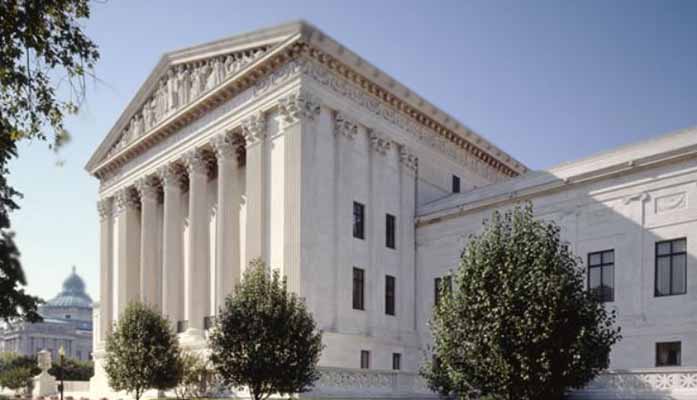
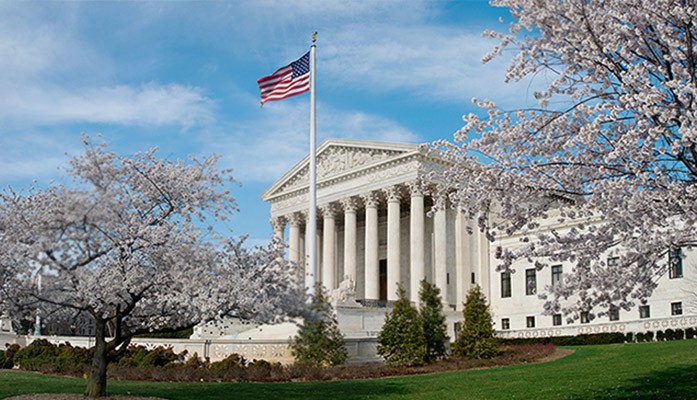
The Scottsdale legal nonprofit Alliance Defending Freedom (ADF) won a religious freedom case at the Supreme Court of the United States (SCOTUS).
SCOTUS ruled 6-3 at the end of June in 303 Creative v. Elenis against Colorado’s anti-discrimination law, Colorado Anti-Discrimination Act (CADA), as unconstitutional. The law would prohibit a Christian wedding website designer from refusing to create a same-sex wedding website.
The plaintiff, Lorie Smith, holds the Christian belief that marriage exists only between one man and one woman, and contests against the possibility that she either must produce content that “contradicts Biblical truth,” such as same-sex marriages, or cease business.
Ultimately, SCOTUS determined in a majority opinion written by Justice Neil Gorsuch that Smith’s creative expression constituted speech and that CADA therefore violated the First Amendment’s Free Speech Clause.
“Ms. Smith’s websites will express and communicate ideas — namely, those that ‘celebrate and promote the couple’s wedding and unique love story’ and those ‘celebrat[e] and promot[e]’ what Ms. Smith understands to be a marriage,” stated Gorsuch.
"This is a victory not just for me, but for all of us. Whether you share my beliefs or disagree with them, free speech is for everyone. And the government shouldn’t force anyone to say something they don’t believe. The Court’s decision means we are all more free today than we… pic.twitter.com/wXHqZgAWL2
— Alliance Defending Freedom (@ADFLegal) June 30, 2023
Gorsuch further criticized CADA for its fullest possible outcome: compelling speech of all manners and kinds from any commissioned person if their customer belongs to a CADA-protected class.
“Under Colorado’s logic, the government may compel anyone who speaks for pay on a given topic to accept all commissions on that same topic — no matter the message — if the topic somehow implicates a customer’s statutorily protected trait,” said Gorsuch. “Taken seriously, that principle would allow the government to force all manner of artists, speechwriters, and others whose services involve speech to speak what they do not believe on pain of penalty. The Court’s precedents recognize the First Amendment tolerates none of that.”
Smith does have LGBTQ clients; however, Smith won’t create content that runs counter to her beliefs.
After the SCOTUS ruling, ADF CEO and lead counsel Kristen Waggoner stated that differences of beliefs don’t constitute discrimination.
“Disagreement isn’t discrimination, and the government can’t mislabel speech as discrimination to censor it,” said Waggoner. “As the court highlighted, her decisions to create speech always turn on what message is requested, never on who requests it. [T]he government has never needed to compel speech to ensure access to goods and services.”
The U.S. Supreme Court has rightly reaffirmed that the government can’t force Americans to say things they don’t believe. The court reiterated that it’s unconstitutional for the state to eliminate from the public square ideas it dislikes, including the belief that marriage is the… https://t.co/9BtiPg0skn
Following the ruling, critics alleged that Smith fabricated a request for a same-sex wedding website after a news article insinuated she did. Colorado Attorney General Phil Weiser also derided Smith’s complaint as “a made-up case without the benefit of any real facts or customers.” ADF and Smith rejected those claims.
Corinne Murdock is a reporter for AZ Free News. Follow her latest on Twitter, or email tips to corinne@azfreenews.com.
Arizona elected officials found no shortage of material to react to from the U.S. Supreme Court’s latest term.
On Friday, the nation’s highest court released its opinion in Biden v. Nebraska, striking down the president’s student loan cancellation program. Chief Justice John Roberts authored the opinion, and he was joined by Justices Clarence Thomas, Samuel Alito, Neil Gorsuch, Brett Kavanaugh, and Amy Coney Barrett.
The majority opinion stated that “the ‘economic and political significance’ of the Secretary’s action is staggering by any measure. Practically every student borrower benefits, regardless of circumstances. A budget model issued by the Wharton School of the University of Pennsylvania estimates that the program will cost taxpayers ‘between $469 billion and $569 billion,’ depending on the total number of borrowers ultimately covered.”
State legislators were quick to respond to the momentous decision from the Supreme Court. Freshman Republican Representative Austin Smith tweeted, “Canceling student loan debt is and always will be an irresponsible and brainless ‘policy’ proposal. It deserved this fiery death at SCOTUS. Do not take out astronomically large loans for a career with a salary you will never be able to pay off.”
Cancelling student loan debt is and always will be an irresponsible and brainless “policy” proposal. It deserved this fiery death at SCOTUS.
Do not take out astronomically large loans for a career with a salary you will never be able to pay off.
Smith also parried an attack from the House Democrats Caucus, which took to Twitter to pin the decision on Republicans. This tactic didn’t sit too well with Smith, who said, “The Constitution did this. Cope and seethe.”
On the other side of the aisle, Senate Democratic Assistant Leader Juan Mendez released a statement shortly after news broke about the opinion, writing, “Today’s decision on Student Loan Relief is all the evidence we need to rule this court as corrupt. For generations this court as been playing favorites, taking sides and receiving undisclosed donations, all while Congress has been bailing out corrupt corporations, reckless Wall Street traders and forgiving PPP loans for the wealthy.”
Senator Mendez also called on President Biden to take further action, saying, “The Court’s biased decisions can not go unanswered. The President must do everything within his power to set student loan interest rates to 0%, set minimum monthly payments to $25, and revamp current repayment plans to accept volunteerism as payment.”
“But when the President acts within his powers to protect all of us from the economic fallout of borrowers not being able to survive payments during multiple global emergencies, now the Court cries foul?” -Senate Democratic Assistant Leader @mendezforazpic.twitter.com/k3QUBMVi4F
— Arizona Senate Democrats (@AZSenateDems) June 30, 2023
Earlier this year, Democrat Attorney General Kris Mayes announced that she had withdrawn the State from a lawsuit over the president’s actions on student loans, which was initiated by her predecessor, Mark Brnovich. Mayes told KTAR News that “we’re not going to be engaging in political lawsuits at the Attorney General’s Office anymore,” and that “suing the federal government over everything is not the answer and it’s not what the people of Arizona want.” The KTAR recap of the interview noted that the first-year attorney general “said the student debt lawsuit was inappropriate and unlikely to succeed.” Instead, Mayes joined a coalition of attorneys general from around the country to support a “federal proposal to create a more affordable repayment plan for student loan borrowers.”
Daniel Stefanski is a reporter for AZ Free News. You can send him news tips using this link.
On Wednesday, the 56th Arizona Legislature filed an Emergency Application to U.S. Supreme Court Justice Elena Kagan for a Vacatur of the Stay Pending Appeal Issued Sua Sponte by the United States Court of Appeals for the Ninth Circuit, involving the Biden Administration’s 2021 COVID-19 vaccine mandate for federal employees and contractors. Last week, the Ninth Circuit Court “reversed the district court’s order granting a permanent injunction and dissolved the President’s ‘Contractor Mandate’ Executive Order requiring federal contractors who worked on or in connection with federal government projects to be vaccinated against COVID-19.” The Legislature’s application seeks to reinstate that injunction, arguing that “because the Federal Respondents did not request a stay below, the Ninth Circuit overreached when it disturbed the status quo and stayed the district court’s injunction sua sponte.”
Senate President Warren Petersen issued the following statement to announce the filing spearheaded by him and House of Representatives Speaker Ben Toma: “We will not allow President Biden to blatantly undermine the will of the Arizona State Legislature in the protections we’ve provided for our citizens to prevent a COVID-19 vaccine mandate from dictating employment opportunities. The Biden Administration has made it clear that they are against any Americans who push back against this vaccine and will abuse their powers in order to force compliance as a stipulation of doing business with the federal government. Arizona will not tolerate this gross government overreach and intrusion of individual liberties. The Legislature’s intervention in this lawsuit against President Biden is critical in protecting the sovereignty of our state and the rights of all Arizonans.”
The case began as Brnovich v Biden, when former Arizona Attorney General Mark Brnovich filed the first lawsuit in the nation against the president’s COVID-19 vaccine mandates. At the time, Brnovich said that “the federal government cannot force people to get the COVID-19 vaccine,” and that “the Biden Administration is once again flouting our laws and precedents to push their radical agenda.” Brnovich’s suit was heard before U.S. District Court Judge Michael Liburdi, who later, in February 2022, issued a permanent injunction against the president’s mandate for federal contractors.
The Legislature’s application makes the case that this mandate is an abuse of President Biden’s authority, writing, “The Contractor Mandate is an unprecedented claim of presidential authority. Before September 2021, the federal government had never mandated vaccinations for the domestic civilian populace. Even as smallpox, polio, and influenza spread throughout the country, vaccine mandates were always viewed as an exercise of the general police power to be exercised by duly elected state legislatures and subdivisions of the States. See generally Zucht v. King, 260 U.S. 174, 176 (1922). Throughout those crises and the COVID-19 pandemic, even Congress with the full authority of Article I—has never mandated vaccination for anyone other than government personnel serving overseas or the military.”
The Arizona Senate Democrats Caucus quickly made it clear that its members were not supportive of this action taken by the Republican leaders, tweeting: “ARIZONA: The @AZSenateGOP changed the Senate rules in January 2023 to ensure that “The President is authorized to bring or assert in any forum on behalf of the Senate any claim or right arising out of any injury to the Senate’s powers or duties under the constitution or laws of this state.” Senate Democrats DO NOT support this & were not consulted about this frivolous use of state funds to take shots are our federal government. The COVID-19 vaccine is safe and saved countless American lives. This is wasteful and could have severe consequences.”
🚨 ARIZONA: The @AZSenateGOP changed the Senate rules in January 2023 to ensure that "The President is authorized to bring or assert in any forum on behalf of the Senate any claim or right arising out of any injury to the Senate's powers or duties under the constitution or laws… https://t.co/7PBGdfRMel
— Arizona Senate Democrats (@AZSenateDems) April 26, 2023
Daniel Stefanski is a reporter for AZ Free News. You can send him news tips using this link.
On Tuesday, Arizona succeeded in its effort to continue Title 42, a Trump-era activation of the policy enabling the rapid expulsion of illegal immigrants.
The Supreme Court (SCOTUS) on Tuesday blocked the D.C. District Court ruling last month ordering the Biden administration to lift Title 42 by Dec. 21. The policy will remain in place pending a hearing before the court on the question of whether states, including Arizona, may intervene to challenge the district court’s order.
Judge Emmet Sullivan, a Bush appointee, asserted that Trump’s initial implementation of Title 42 was unlawful. Although the Biden administration benefitted from the ruling, they appealed on Sullivan’s judgment of Trump’s use of Title 42.
BREAKING: The Supreme Court keeps the Trump-era Title 42 border policy in effect for now. The court says it will hear argument in February over whether red states can intervene in the litigation over the policy. The vote is 5-4, with Neil Gorsuch joining the three liberals.
Attorney General Mark Brnovich, who championed legal efforts to continue Title 42, said in a press release that this decision would ensure Americans’ safety where the Biden administration wouldn’t. Brnovich noted that Title 42 under the Biden and Trump administrations resulted in the expulsion of over 2.4 million immigrants.
“It’s disappointing [that] the Biden administration is willing to sacrifice the safety of American families for political purposes,” said Brnovich.
SCOTUS will fast-track the case for oral argument during its February session (Feb. 21 to March 1). Arizona and 18 other states petitioned SCOTUS last Monday to keep Title 42 in place, after the D.C. District Court denied their intervention.
One conservative-leaning justice, Neil Gorsuch, joined the liberal court’s opposition. Gorsuch wrote in his dissent, joined by Justice Ketanji Brown Jackson, that Title 42 should be done away with since the border crisis doesn’t quality as a “COVID crisis.” Justices Sonia Sotomayor and Elena Kagan also opposed the order, but didn’t join in Gorsuch’s dissent.
“[T]he emergency on which those orders were premised has long since lapsed,” wrote Gorsuch. “[The states] do not seriously dispute that the public-health justification undergirding the Title 42 orders has lapsed.”
Gorsuch rejected Arizona and the other states’ arguments that Title 42 should remain untouched since it was their only means of securing the border. He clarified that he found the states’ concerns about the border crisis valid, but repeated that Title 42 was meant only to curtail communicable diseases, not the other issues stemming from an unsecured border.
“[C]ourts should not be in the business of perpetuating administrative edicts designed for one emergency only because elected officials have failed to address a different emergency. We are a court of law, not policymakers of last resort,” wrote Gorsuch.
Title 42 of the Public Health Services Act has existed since 1944. The policy enables the Centers for Disease Control and Prevention the power to block illegal immigration into the U.S. to protect Americans from contagious diseases. This policy even applies to asylum seekers. Former President Donald Trump utilized the policy at the start of the COVID-19 pandemic.
A federal judge blocked the Biden administration from lifting Title 42 in May. However, requirements to keep the policy in place have curbed the border crisis little, with reports revealing that the Biden administration covertly subverts the policy regardless of court orders and public promises earlier this year.
Corinne Murdock is a reporter for AZ Free News. Follow her latest on Twitter, or email tips to corinne@azfreenews.com.
Arizona has two pathways for addressing abortion: an outright ban as old as the state itself, or the 15-week restriction codified in March.
On Friday, the Supreme Court (SCOTUS) ruled that Roe v. Wade invented a nonexistent constitutional right to abortion, wrongly forcing the states to surrender their authority on the subject. Arizona’s elected officials must decide whether to honor the state’s original outright ban on abortion or, instead, enforce the 15-week ban passed earlier this year. The latter will likely go into effect in the second-to-last week of September; the SCOTUS ruling will be effective near the end of next month.
The Senate’s Republican caucus declared in a press release that the original outright ban is in effect. However, the attorney general’s office hasn’t issued a formal statement of which law it will enforce. It explained in a statement that it’s conducting a legal review.
“This law, that is already on the books, bans most abortions, unless the procedure is necessary to save the life of a mother,” wrote the Senate majority. “Last year, the legislature amended this law, so that the mother who chooses to have an abortion will not face any punishment.”
FOR IMMEDIATE RELEASE: Arizona's Abortion Law Now in Effect in the Wake of Today's SCOTUS Ruling ⬇️ pic.twitter.com/kH4iCWHTIJ
Long before the legislature revised the ban, the Arizona Court of Appeals enjoined the law as unconstitutional in its 1973 ruling in Nelson v. Planned Parenthood Center of Tucson. That decision was directed by the SCOTUS precedent in Roe.
Insecurity over current law prompted Arizona’s abortion providers to suspend abortions until further notice. Chris Love, the chairwoman of Planned Parenthood Arizona’s advocacy arm who bragged about her husband assaulting a black Trump supporter at a pro-abortion rally last month, explained that they didn’t want providers to lose their licenses or police engaging with their patients.
I've been asked why we just don't keep going until we're stopped. The answer is simple. We don't want our providers to lose their licenses and we don't want our pregnant patients to have encounters with police.
Cathi Herrod, the president of the Center for Arizona Policy, spoke with “Conservative Circus” host James T. Harris about the viability of restoring Arizona’s original abortion ban.
Herrod opined that Arizona’s original abortion ban would stand because it preceded Roe v. Wade and that was never repealed after. Arizona outlawed abortion from 1901, prior to achieving statehood, up until it was required by the Supreme Court to allow abortions in 1973. The original ban is A.R.S. 13:3603, which only punishes abortion providers and not the pregnant women.
“I believe that is still good law and that it should be enforceable,” said Herrod.
Herrod clarified that the 1973 Arizona Court of Appeals decision rested on the SCOTUS decision at the time, indicating that the law was no longer enjoined as a result of Friday’s ruling.
Cathi Herrod, President of Center for Arizona Policy, discusses whether it is legal in Arizona to get an abortion a https://t.co/DKN3oQb8KQ
Herrod also noted that even the most recent limitation on abortion — SB1164 banning abortions after 15 weeks, signed into law in March — stipulated that it didn’t repeal the state’s original abortion ban.
“This act does not: […] Repeal, by implication or otherwise, section 13-3602, Arizona Revised Statutes, or any other applicable state law regulating or restricting abortion,” reads the latest law.
In a Facebook post, Herrod added that the state’s original ban had greater enforceability than the 15-week restriction, unless a court enjoins that ban. In that case, Herrod stated that the 15-week restriction would be enforceable.
In response to claims that the legal system would punish expectant mothers for obtaining abortions, Herrod clarified that no state laws extended punishment to mothers. She noted that Governor Doug Ducey codified a repeal of a pre-Roe law punishing women who received abortions with jail.
Herrod predicted that there would be lawsuits on Arizona’s abortion bans. Pro-abortionists undertook legal action on Saturday, a day after the SCOTUS ruling. ACLU of Arizona, the Center for Reproductive Rights, the Arizona Medical Association, and the National Council of Jewish Women Arizona filed an emergency motion in the Arizona District Court.
NEW: The ACLU + partners are urging the court to ensure that AZ's vague “personhood requirement” cannot be used to block access to abortion.
Until the court acts, the uncertainty in the law will cause providers to suspend abortion services & put lives of pregnant people at risk. pic.twitter.com/evpDW7DJ1g
According to the latest data from the Arizona Department of Health Services (AZDHS), there were nearly 13,300 abortions completed in 2020 — over 36 a day across the dozen facilities that provide abortions in the state. Over 85 percent of those who obtained abortions were unmarried. The greatest number of abortions occurred in women aged 20-24 years old: about 4,000. Over 1,200 of the abortions came from teenagers, from under 15 years old to 19 years old. Over 7,600 of the abortions came from women in the 20’s, and over 3,800 came from women in their 30’s.
Corinne Murdock is a reporter for AZ Free News. Follow her latest on Twitter, or email tips to corinne@azfreenews.com.