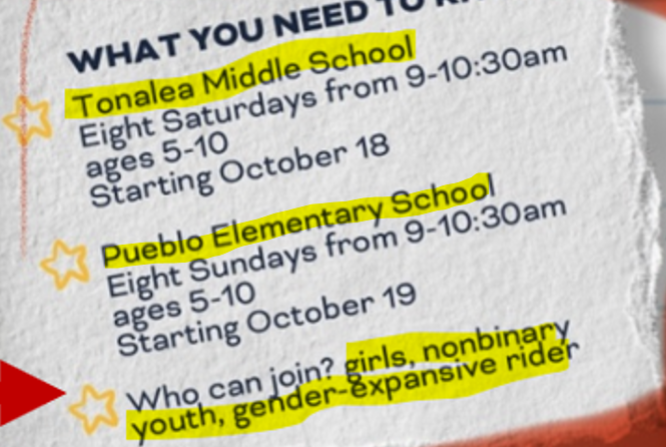
As enrollment dips and two schools are considered for repurposing, Scottsdale Unified School District (SUSD) is promoting a biking event for “girls, nonbinary youth, and gender-expansive” children in family-facing communications.
In an October 9th post to X, parental rights organization Scottsdale Unites for Educational Integrity (SUEI) wrote: “Parents confirmed @ScottsdaleUSD is using their district-wide communication system to promote an event for ‘nonbinary youth’ and ‘gender expansive’ children. Girls in Gear (and apparently boys, too) claims that these lessons are Social Emotional Learning. Email: GovBRD@SUSD.org.”
🚨SUSD is planning a "girls" event for "nonbinary youth" and "gender expansive" children.
— Scottsdale Unites for Educational Integrity (@ScottsdaleUnite) October 9, 2025
The “Girls in Gear” program, which focuses on cycling skills and social-emotional learning, includes participants who identify outside traditional gender norms, according to a district email sent to families. A post on X by SUEI shared the event flyer, which lists the inclusive criteria.
According to the Girls in Gear website, the event “is open to any rider who identifies as a girl. If a rider identifies as a girl, then the rider is welcome to participate in Girls in Gear.”
In a reply to the SUEI post, Arizona Women of Action drew attention to the contradiction that SUSD is continuing to focus on gender ideology despite reduced enrollment, school closures under discussion, and at-risk federal funding.
Arizona Women of Action wrote in its reply:
“1. Identifying as a gender that is not innate (boy or girl) is often the first step of the ‘trans’ path. By Scottsdale Unified recognizing these identities (non-binary, gender expansive) the district can contribute to a child’s ‘trans’ path. Change in pronouns and presentation are next, irreversible puberty blockers and hormones follow.
2. This is no longer a girls’ event if non binary or gender expansive youth can participate.
3. SUSD is closing schools. This kind of choice could be a contributing factor to low enrollment.
4. Isn’t there an EO about this? Yes. And schools can lose federal funding.”
The organization also called up on followers to call “the U.S. Department of Education’s Office for Civil Rights (OCR) at 1-800-421-3481 to report non-compliance.”
1. Identifying as a gender that is not innate (boy or girl) is often the first step of the "trans" path. By Scottsdale Unified recognizing these identities (non-binary, gender expansive) the district can contribute to a child's "trans" path. Change in pronouns and presentation… pic.twitter.com/iL7yUKiRPR
District reporting in February revealed that under SUSD Superintendent Dr. Scott Menzel, enrollment has consistently dropped. As of February 2025, enrollment stood at 19,367, a decrease of 390 students from 2024, down 355 from the previous year. Over the past seven years, enrollment has dropped precipitously by 13%, from 22,608.
In response to the enrollment trends, the SUSD governing board voted 3-2 on October 7th to advance a proposal to repurpose Echo Canyon K-8 School and Pima Elementary School for the 2026-27 school year, according to AZ Family. Menzel addressed the looming closures with families in a September message and cited under-enrollment at both schools.
The promotion of the program also comes amid federal policies addressing gender-related content in schools. President Trump’s Executive Order 14190, issued January 29, 2025, directs the withholding of federal funds from K-12 programs that promote gender ideology or other specified materials, and reestablishes the 1776 Commission for patriotic education. Additionally, a Department of Health and Human Services directive on August 26, 2025, requires states to certify that sex education programs do not reference transgender youth or gender ideology to receive funding, affecting 46 states and territories, including Arizona. Several Democratic-led states have filed lawsuits challenging the directive. Despite pending legal action, the Executive Order and HHS Directive both remain in effect at present.
SUSD has previously addressed transgender-related policies, including student transition plans and LGBTQ curriculum, and run afoul of the Arizona Department of Education and parents alike. In prior incidents, the district faced questions over notifications to parents and the use of school spaces for related activities, such as a “sexuality-safe-space” at Mohave Middle School, as reported by the Arizona Daily Independent.
Last month, a BrainPOP lesson on LGBTQ topics prompted review under state DEI restrictions, with Superintendent of Public Instruction Tom Horne citing potential violations.
Other community responses in the thread include comments from users expressing concern over the event’s inclusivity and district priorities.
Parents confirmed @ScottsdaleUSD is using their district-wide communication system to promote an event for "nonbinary youth" and "gender expansive" children. Girls in Gear (and apparently boys, too) claims that these lessons are Social Emotional Learning.
Over 1,500 individuals want the Scottsdale Unified School District (SUSD) to remove one of its board members for criticizing an overweight health official.
Board member and state senator Carine Werner made the comments during a presentation by Nutritional Services Director Patti Bilbrey at a board meeting last month. It appears Werner intended to make the comments to herself, but her remarks were caught on a hot mic. Werner was attending the meeting remotely.
“This is what I have to listen to,” said Werner. “She’s in nutrition services and she’s like morbidly obese.”
Werner also uttered the comment “chub” amid some indiscernible audio.
General Mills Foodservice has recognized Bilbrey as the only “trayblazer” in Arizona — one of around 40 nationwide — for her innovative approaches to feeding students.
A coalition of mainly progressive parents and community members say Werner, who chairs the Senate Education Committee, had committed fat-shaming in conflict with board policy. Werner has previously caught the ire of this coalition of parents for pushing to rid SUSD of books advancing DEI and LGBTQ+ ideologies.
An organization, Swing Left, organized a protest to demand Werner’s resignation during the September 9 board meeting. Around 50 individuals showed. Werner was absent, as was board president Donna Lewis.
Public comment focused on Werner’s remarks from last month’s meeting.
Shea Najafi, an SUSD parent and progressive activist organizer who founded Scottsdale Women Rising, has led efforts to recall Werner. Najafi is gathering signatures to hold a recall campaign, which would require around 4,000 signatures.
“It was deplorable. We couldn’t believe she called a beloved district employee ‘Chubs’ during a presentation in which she was speaking about how we can feed kids during the summer,” said Najafi.
Najafi and others seeking Werner’s recall plan to attend the October 7 meeting with TV crews in tow.
“You’re f****d, Werner,” wrote Najafi in a Facebook post.
SUSD governing board vice president Mike Sharkey, who Najafi and other progressives support, disclosed that he asked legal counsel whether Werner could be censured over the remarks. According to Sharkey, counsel advised the board couldn’t act in that manner.
Sharkey then read aloud a pre-written statement to the protesters.
“I do not condone the conduct of the board member given what I heard at the board meeting on August. 5. I know what I heard, but only the speaker can know why she said what she said,” said Sharkey during the September 9 meeting. “This behavior does not reflect the board member ethics as adopted in policy nor is it representative of SUSD’s core values.”
Yet, Sharkey later admitted in a statement to The Progress that he didn’t hear what Werner said at first. It was only after he reportedly received an email containing Werner’s remarks that he understood what had been said.
“I heard crosstalk at the original August 5 meeting but didn’t comprehend what was said,” said Sharkey.
Scottsdale Unites for Educational Integrity stated that an AI analysis of the board meeting audio compared to prior board meetings indicated the audio had been enhanced to make Werner’s comments audible. Those who attended the meeting in person reported not hearing Werner’s commentary.
AZ Free News is your #1 source for Arizona news and politics. You can send us news tips using this link.
A young Christian man named Charlie Kirk was shot—simply for speaking his mind. A husband, a father, a voice for the next generation. Lord, why did it happen this way? How dare they steal the breath from a faithful man?
Charlie was not a violent agitator, not a man bent on tearing down, but one who stirred the hearts of the young. He spoke boldly where others remained silent, reminding his peers that they were created for more. He gave them courage. And for that, he was silenced.
“How dare they?” we ask. Indeed. Yet the truth is more sobering: they dare because of the cultural environment we now live in—an environment shaped, in part, by radical ideologies that have seeped into our schools, our politics, and even our everyday conversations. And right here in Scottsdale, that environment has been nurtured by leaders like Superintendent Menzel, current and former board members, and others who have steered the Scottsdale Unified School District (SUSD) away from academic excellence and into ideological experiments.
The Shift Away from Education
SUSD leaders claim to promote critical thinking, yet what they push is a one-sided agenda built on misinformation and half-truths. Instead of focusing on the basics—reading, writing, mathematics, science—SUSD has embraced policies that undermine families and confuse students. Here are a few examples:
Telling children they can change their gender without parental involvement.
Promoting Social Emotional Learning (SEL) in place of foundational academics.
Teaching that America is a fundamentally racist nation.
Undermining parental rights while telling families to “trust the experts.”
Blocking parents from curriculum discussions while approving controversial materials, sometimes in violation of state law.
Replacing qualified teachers with social workers and counselors.
Conducting constant student surveys on mental health, sowing confusion rather than providing clarity.
This is not the recipe for a high-achieving school district. It is the foundation of a crisis.
The Failed Promise of Social Emotional Learning
Superintendent Menzel and his allies argue that focusing on student “emotional well-being” will, in turn, unlock academic achievement. This theory, rooted in social-emotional learning, posits that removing a child’s psychological “barriers” will allow them to thrive in the classroom.
But does it work? The evidence suggests otherwise. Independent researchers, particularly outside the U.S. educational establishment, have found little to no link between widespread, non-targeted mental health interventions and improved academic outcomes. In fact, research shows these programs may worsen student mental health.
In medicine, the term for this is iatrogenic harm: unintended damage caused by treatments meant to heal. In mental health, it refers to harm that arises from interventions that destabilize rather than stabilize. The endless surveys, the focus on fragility rather than resilience, and the substitution of therapy for instruction can actually make students more anxious, less confident, and less academically capable.
If SUSD’s policies worked, our students would be excelling. Instead, they are struggling.
The Numbers Don’t Lie
Let’s look at the hard data under Menzel’s leadership.
Instructional spending: Down to 54.4% in 2024, compared to 54.6% in 2023, and trending toward a historic low. Over the past five years, instructional spending has dropped 1.7%.
Student support spending: Up 2.6% over the past 5-year period.
Administrative spending: 15% higher per student than peer districts.
Enrollment: Down 8.4% over the past 5-year period.
Staffing: In FY24, the district cut 59 instructional positions but added 71 student support staff and 44 administrative positions.
Test scores: Math proficiency fell from 57% in 2019 to 55% in 2024. Science dropped from 64% to 41%. English Language Arts rose slightly, from 56% to 61%, but overall performance represents a 12% decline since 2019.
So: fewer teachers, lower academic spending, higher administrative costs, declining enrollment, and worse performance.
SUSD recently held its second mental health fair and sponsored a suicide prevention event. After 125 years of SUSD history, why is it only now that we need districtwide events to address student mental health and suicide? Could it be that the very programs meant to fix mental health are feeding the crisis?
The Culture War in the Classroom
The failures of SUSD are not isolated. They are part of a broader cultural radicalization. Across the nation, schools are less focused on knowledge and more focused on ideology. Students are taught to distrust their parents, question their identity, and view their country as irredeemably broken.
We see the results not only in academic decline but also in growing instability—emotional, social, and even violent.
This instability was on display here in Scottsdale when conservative board member Carine Werner was allegedly overheard making a disparaging comment, and leftist groups who celebrated Charlie Kirk’s death, seemingly collaborated to paint her in a bad light. Protesters immediately called for her resignation, parading signs that read “Protect Children: Werner Must Resign,” and “Ban Bigots, Not Books.”
But labeling Werner “ignorant” or “bigoted” ignores her record. As a state senator, she championed laws to make schools safer from predators and supported pay raises for law enforcement. As a board member, she pushed to remove sexually explicit material from schools, opposed social studies curricula that included anti-police rhetoric and glorified activism over academics, fought for stronger school security, introduced a common-sense policy that kept boys out of the girls’ bathroom, and even stood up to a transportation contractor after one of its employees sexually assaulted a student.
That’s not bigotry. That’s leadership.
The Consequences of Demonization
So how did we get here, where speaking truth—or even raising common-sense concerns—can cost you your reputation, your job, or even your life?
We’ve been told the problem is “radicalization on the dark web.” But you don’t need the dark web. Just watch mainstream media or scroll social media. From the highest levels of government on down, leaders tell us anyone who disagrees is a racist, a fascist, or a threat to democracy. Politicians openly encourage people to “get in their faces” and drive dissenters out of public life.
For someone already struggling with confusion, addiction, or emotional instability, this narrative can justify hostility—even violence—against those who dare to think differently.
That’s what happened to Charlie. He stood for free dialogue, for open exchange of ideas—values once core to American identity. For that, he was killed.
Diversity of Thought—or the Illusion of It
SUSD claims to celebrate diversity. But it is not diversity of thought. Instead, there is one sanctioned narrative: accept it, or be labeled hateful. We are told tolerance is a virtue, yet intolerance is practiced against anyone who challenges the prevailing orthodoxy.
We cannot allow this inversion of truth. Lies are not compassion. Half-truths are not education. And intolerance cannot be the foundation of a healthy community.
A Call to Parents
Superintendent Menzel and the SUSD Governing Board may not be directly responsible for Charlie’s death in Utah, but their policies contribute to the kind of environment where such tragedies become possible.
Parents, it is time to wake up. Our children are not experiments. Our schools are not laboratories for ideological reprogramming. The mission of education must return to the basics: truth, knowledge, critical thinking, and resilience.
We must demand accountability from school leaders. We must replace ideologically driven programs with proven academic strategies. We must protect our children—not only from physical threats but also from the corrosive cultural forces undermining their mental, emotional, and intellectual well-being.
Charlie’s voice has been silenced. But ours has not. If we remain quiet, more voices will be lost. If we speak boldly—as he did—we can reclaim truth, restore education, and protect the next generation.
The question is: will we dare?
Mike Bengert is a husband, father, grandfather, and Scottsdale resident advocating for quality education in SUSD for over 30 years.
The Scottsdale Unified School District (SUSD) is under criticism from parents and community members over a BrainPOP lesson taught to elementary students that compares the struggles of the Tuskegee Airmen, the first African American military aviators, to those of LGBTQ+ service members.
The lesson, part of BrainPOP’s supplemental curriculum, has sparked significant backlash due to its inclusion of a call to action and a cartoon depiction of a newspaper headline reading “LGBT Welcome in the Military,” showing protestors with a rainbow banner outside the White House.
In the video, it states, “Thanks to pioneers like the Red Tails, the armed services integrated shortly after the war. It was an early victory for the budding Civil Rights movement. In the decades to come, the federal government would expand its role in protecting the rights of African Americans and the rights of other marginalized groups. Injustice never ends overnight. It takes brave people to challenge it and show everyone else that there’s another way.”
People in the community have raised an alarm about SUSD’s approval of hundreds of supplemental resources, like BrainPOP, without any committee review or community input.
The online nature of these platforms allows publishers to update content at any time, limiting transparency. For example, in a course given to 2nd graders, a search for “gender” on BrainPOP yields topics such as Pride Month, personal pronouns, sex determination, women’s suffrage, and feminism, which push ideological agendas over academic focus.
BrainPOP, hosting over 1,000 animated films for K-8 students, has been controversial since introducing LGBTQ+ content in 2017 following the Pulse nightclub shooting.
Additional concerns stem from lessons like “Black Lives Matter Protests,” which discuss racism and cite the deaths of George Floyd, Trayvon Martin, and Michael Brown, ignoring essential facts, such as the reality that each of the men acted as the main aggressor in the events leading to their deaths. The character in this lesson speaks on the Black Lives Matter Movement, saying, “The protests we’re seeing today aren’t really about that sort of thing. They are about structural racism in our society. A built-in system of bias that makes life easier for white people and more difficult for black people and other people of color. It puts them at greater risk for poverty, unemployment, and disease.”
The growing dissatisfaction with these lessons taught to K-8 students has led to the creation of the Empower Hotline, a platform for reporting lessons that deviate from academic standards by focusing on race, ethnicity, gender ideology, social-emotional learning, or inappropriate sexual content.
The hotline’s goal is to empower parents to ensure education prioritizes individual merit and academic rigor.
Arizona law prohibits sex education before fifth grade, and the 2025 Supreme Court ruling in Mahmoud v. Taylor mandates parental notifications for materials addressing gender identity or sexual orientation.
Ethan Faverino is a reporter for AZ Free News. You can send him news tips using this link.
K-12 superintendents are the CEOs of public schools, spearheading a cabinet of professionals who manage district resources and implement safety and academic programs. Superintendent qualifications may include a doctorate of philosophy (Ph.D.) or education (Ed.D.) and some experience in finance, communications, and organizational leadership.
Superintendents are paid exorbitant salaries topping close to $1 million, depending on the district size. This amount does not include performance bonuses, work vehicles, mobile devices, or lavish vacation packages—er, I mean, “out-of-state professional development conferences.” Whether superintendents do good or evil, employment agreements stipulate that they receive full compensation and benefits, largely at the taxpayers’ expense.
Arizona public schools are home to some of the most ethically challenged and morally questionable high-level administrators. K-12 superintendents across the Valley primarily care about aesthetics and the “business of the district.” Below is an incomplete list of superintendents with controversial reputations, alongside the elected officials who bow to their almighty paper-pushing agenda.
Newly hired Higley USD Superintendent David Loutzenheiser now sits on the dais with governing board members, leaving his cabinet on the floor. This arrangement was approved by the purple-haired board president, Amanda Wade, who once advocated for striking the word “immoral” from teacher-student communication policies. Radical board member Tiffany Schultz—who once declared that professional dress codes “sexualize children’s bodies”—backed Wade’s decision to disrupt the chain of command. No one but Loutzenheiser benefited from this stunt. He set a bad precedent for what’s to come. Read more in AZ Free News.
Earlier this year, a resident in the Cartwright Elementary School District sued two board members for nepotism, citing A.R.S. 15-421. Cassandra Hernandez (elected at age 19) is the daughter of board president and state representative Lydia Hernandez (D). Despite using different addresses on their campaign applications, constituents cried foul and called for their resignations. The Hernandezes led a charge to install the disgraced former Maricopa County Superintendent Steve Watson as district superintendent. Watson is accused of fraud and leaving behind an infestation of financial deficits, lawsuits, and dysfunction in the county office. Cartwright residents have no reason to expect Watson will leave their district any better than he found it.
Deer Valley USD residents constantly complain across social media about Superintendent Curtis Finch’s dismissive “leadership” style. Residents are also suspicious of Finch’s camaraderie with board president Paul Carver, who once told a room full of conservatives that Finch is the best superintendent in the state. Both men support a twice-failed ballot measure that would allow the district to exceed its budget. Finch defended the 15% override, stating: “The anti-public school movement is growing here in Arizona, which is a crime against humanity.” Whether or not good things are happening in DVUSD is up for interpretation, but declining enrollment numbers are the telltale sign of a district in freefall. Go Parents!
No list of sketchy superintendents is complete without Scottsdale USD’s Scott Menzel. He is a freak show in his own right, accounting for the majority of the district’s media exposure. Menzel is widely known for shaming white people who don’t feel guilty about their skin color. Before vacating their seats, debased board members Zach Lindsay, Libby Hart-Wells, and Julie Cienawski extended Menzel’s contract through 2025. Under his “leadership,” SUSD chartered more student-led sexuality clubs, adopted an anti-police curriculum, and circulated hundreds of pornographic books in school libraries. As a result, in 2024, the Arizona School Administrators organization proudly named Menzel the National Superintendent of the Year (this title must be reserved for clowns).
Peoria USD has a slightly better handle on its administration problem since board president Heather Rooks removed Superintendent K.C. Somers from the dais. This establishes a clear separation of employer and employee while respecting the expertise each brings to the district. Unfortunately, though, Somers is developing a reputation for operating in subtle forms of manipulation and subversion, as if he’s trying to sabotage the board members he can’t control. I once attended a meeting where Somers yowled at board members when they ripped off the COVID-19 funding band-aid. Interestingly, before coming to Arizona, Somers was the superintendent of a Colorado school district steeped in scandal and cover-up. He would do well to note that PUSD residents won’t sit for that.
(Dis)honorable Mentions: Tolleson Union HS Superintendent Jeremy Calles morally and financially bankrupted his district. Former Mesa Public Schools Supt. Andi Fourlis oversaw an untold number of social gender transitions without parental knowledge. Tucson USD Supt. Gabriel Trujillo encouraged and attended a student-led drag show on campus, even after one teen was sexually abused by a high school counselor who organized the opening event. Chandler USD Supt. Frank Narducci declared a “week of kindness” and distributed 9-1-1 stickers after unchecked bullying led to one student’s murder and another student’s suicide. There’s more, but we’re out of time.
Those who can’t get elected apply for high-power jobs. Most K-12 superintendents have no campaign grit and no winning personality. Thus, they depend on compromised board members to execute their agenda. Superintendents don’t represent the whole community—they represent the educated community. They may be intellectual experts, but they don’t swear an oath to the U.S. Constitution, and they are not the final governing authority.
The board of education—elected officials who report to taxpayers (that’s you!)—hires the superintendent, and they ultimately decide what to approve or reject. No one is demanding perfection. Arizona families simply want integrity, transparency, and common sense. K-12 community members who experience dissatisfaction with bloated, overcompensated administrative teams should call, email, request meetings, alert the media, and speak at school board meetings. When superintendents refuse to operate within the scope and ability of their job description, expose them.