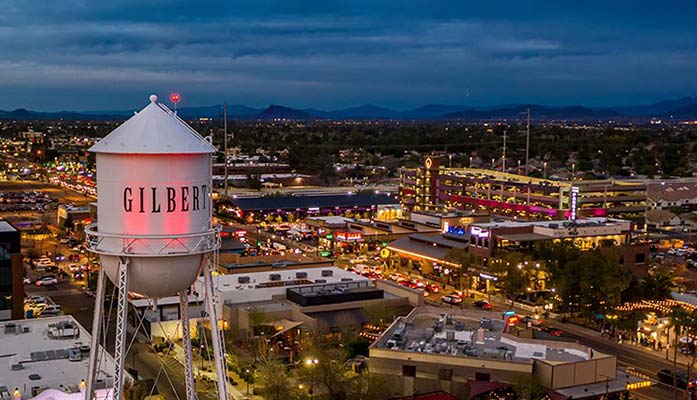
The citizens of Gilbert are bracing for a third water rate increase since 2024 on top of the 2025 sales tax increase that resulted in legal action against the town in January 2025. The new rate increase, following a 95% increase in the town’s utility wastewater rate, could see the town’s water rate jump up another 25%.
Gilbert Water Manager Rebecca Hamill revealed in a Town Council study session last week that the rate hike could be necessary based on Gilbert’s biannual utility rate analysis and adjustments, according to the Gilbert Sun News.
As previously reported by AZ Free News, there were no utility rate increases from 2019 to 2021, until a 29.6 percent jump in 2022, followed by a 48 percent increase in 2024 and a 25 percent increase in 2025, resulting in a staggering hike of 102.4 percent over 2021 rates.
“Arizona and Gilbert are facing uncertainty in water resources and providing a secure water supply is a top priority for our department,” Hamill told the council. “One of the main impacts on the budget is these increasing water resources costs, and we have seen since 2020 a 73% increase in the per acre-foot cost of CAP (Central Arizona Project) water, and we continue to see an increase in the percentage of the water resources as a component of the overall water budget,” she added.
Hamill explained that the Town of Gilbert’s water portfolio includes 40 percent of its potable water coming from the Salt and Verde Rivers, with 41 percent coming from the Colorado River via the CAP, 15 percent coming from the reclaimed recharge system water, and just four percent coming from groundwater. She described the town’s water sources as “diverse,” despite 81 percent of it being dependent on surface water and 41 percent subject to fluctuations in Colorado River water allocation.
As noted by the Gilbert Sun News, the town is in the early stages of reconstructing the North Water Treatment Plant to supply 70 percent of the town’s needs or approximately 60 million gallons per day, but it is only nearing the halfway point of its completion in October and is not expected to come online until 2028, according to the most current project update. This leaves the Town of Gilbert effectively at the mercy of a myriad of factors beyond the town’s control for at least the next two and a half years, with the town forced to defer $151 million in future water system improvements.
“The bill is typically made up of rates and fees for four lines of service, including water, sewer, solid waste, recycling and environmental compliance,” Hamill told the outlet. “We refer to each of these four lines of service as enterprise funds, which means that each fund operates as a self-sustaining business entity within the town. Revenue collected for each service is only used to fund that service.”
The increase is part and parcel to the cash/bond gradual approach the Town approved in February 2024.
“This is where we are now – we are working with our rate consultant to determine that 25% is the proper number for the fund,” Hamill told the council. “This option provided the (water) fund with sufficient revenue for critical capital projects, ongoing $5 million capacity in the operating fund, and an ongoing $66 million capacity in the repair and replacement fund starting in FY29.”
As a result of the delays in the Water Treatment Plant reconstruction, caused in part by an increase in the cost of chemical and electrical components, coupled with its dependence on sources susceptible to environmental and political factors, the Town government is turning to the public and conservation efforts in an attempt to stem the rising costs of the water system. Mayor Scott Anderson explained, “We have to remember it costs, and it’s going to cost more over time, to purchase the water, to transport the water, to treat the water, and to distribute the water. It’s going to cost more all the time – we can’t lose sight of that,” he emphasized. “Conservation is the key.”
Last Tuesday, hundreds of concerned Gilbert citizens enlivened a town council study session with vocal opposition to funding any rail project — not even a survey.
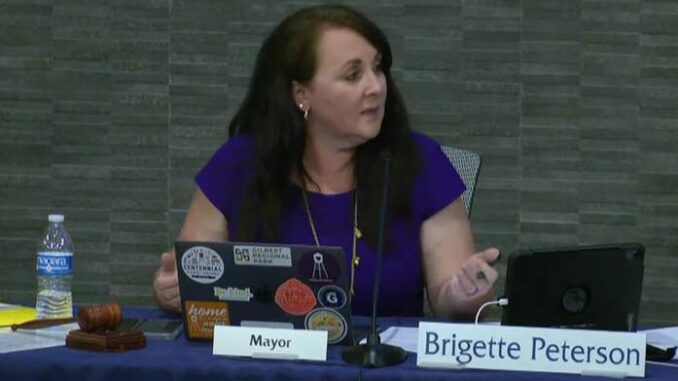
Most of the council expressed confusion about the citizens’ discontent, denying intent on establishing a commuter rail in the town. Councilwoman Kathy Tilque stated repeatedly that there were no plans to bring a commuter rail to Gilbert, and that it probably wouldn’t ever happen. Mayor Brigette Peterson and councilmembers Scott Anderson, Yung Koprowski, and Scott September echoed Tilque’s sentiment throughout the study session, which neared two hours.
“I’m just trying to figure out why we have so many upset people thinking we’re spending taxpayer dollars to bring a commuter rail here,” said Tilque.
Earlier this year, the council proposed a $289,000 consulting contract for a feasibility study on establishing a commuter rail. Council discussion on the subject revealed similar divisions that persisted in last week’s discussions.
When Peterson repeated that Gilbert hasn’t issued plans to build a commuter rail, the citizens shouted “Lies!” Peterson insisted she was telling the truth, further claiming that Gilbert wouldn’t have any say over the establishment of a commuter rail on existing rail lines. Vice Mayor Aimee Yentes rebutted that the town’s actions over the years conflicted Peterson’s claim.
Yentes told AZ Free News that the council’s denial of commuter rail planning was “semantics,” pointing out a February 2018 development agreement, Resolution No. 3955, that Peterson signed onto while a councilwoman. That development agreement described the possibility of a light rail as well as a commuter rail, further conflicting with another one of Peterson’s claims in a July statement that the term “light rail” was used by outside groups and individuals, and that “there are no plans, discussions, or any considerations to construct or extend a light rail” to Gilbert.
The development agreement further noted that the town of Gilbert would be responsible for the cost of future development of a transit station at Cooley Station Village Center. According to a 2018 study on commuter rails conducted by the Maricopa Association of Governments (MAG), nearly all commuter rails require a dedicated local sales tax to operate.
During the study session, Yentes asserted that the community’s discontent stems from the council’s unwillingness to take a definitive stance for or against a commuter rail, not a misunderstanding over the town’s role as one of several decision makers on establishing a commuter rail.
“Clearly they’ve been planning for it. They’ve done studies. They’ve dedicated transit stations. They’ve entered into a development agreement that tried to bind us to it. There’s lots of things that Gilbert can do to either plan to do it or be a thorn in their side,” said Yentes.
Yentes proposed an ordinance to prohibit the use of town resources for the furtherance of commuter and light rail development. That would also prohibit additional taxes and application of funds to carry out related studies. It will be voted on during next Tuesday’s town council meeting.
Yentes warned that the city of Phoenix’s commuter and light rails “cannibalized” their transportation budget to the extent that the city couldn’t fix potholes, prompting citizens to pass an additional sales tax in 2017 to cover those expenses.
Tilque called Yentes’ proposed ordinance “dishonest representation” since future councils may overturn it. However, that’s something that new leadership may do at any given time with any ordinance, which Yentes pointed out.
One citizen, Brandon Ryff, told AZ Free News that Tilque’s opposition to the ordinance came across as doubting citizens’ intelligence. Ryff expressed frustration over the conflict between Peterson’s remarks and actions concerning a commuter rail, citing the 2018 development agreement.
Ryff also criticized commuter rails as outdated, “19th-century” technology, pointing out the consistent drop in ridership throughout major cities in Arizona and other states. He contrasted the decline in ridership with the consistent uptick in crime. In Phoenix, crime rates have nearly doubled since 2016; a majority of those crimes were aggravated assault and drug offenses.
“We laugh at it and say that [a commuter rail] looks like a solution looking for a problem,” said Ryff. “For whatever reason and whatever motivation, our town council is defying all logic concerning crime statistics and progress. I can’t help but feel this is related to money from somewhere. Someone is influencing these people to behave this way. It just doesn’t make sense.”
Another citizen, Tyler Farnsworth, remarked to AZ Free News that their opposition was a positive example of engaged citizenry, yet most of the council portrayed it as a negative. Farnsworth commended Yentes’ proposed resolution barring their tax money from funding town rail projects.
“The Mayor and several members of the Council were visibly and vocally annoyed that citizens chose to show up and speak their mind,” said Farnsworth. “We just want to be heard. We want our tax money to be spent wisely. I hope the meeting was a wake up call to this Council. We are watching. Welcome to democracy in action.”
Watch the study session below:
Corinne Murdock is a reporter for AZ Free News. Follow her latest on Twitter, or email tips to corinne@azfreenews.com.