Gov. Katie Hobbs says public education is woefully underfunded, but fiscal reporting indicates districts are flush with cash.
According to the latest Arizona Department of Education annual financial report, public school districts carried forward more than $8.3 billion in unspent funds from the 2024-25 fiscal year.
That is nearly equivalent to total appropriations that the state allocated for public education in the 2024-25 fiscal year: $8.9 billion, which goes beyond K-12 schools to include the Board of Regents, community colleges, and universities.
That $8.9 billion accounts for 55% of total appropriations out of the state’s general fund, which amounted to more than $16.2 billion in the 2024-25 fiscal year.
Within the $8.3 billion carried over from the 2024-25 fiscal year:
$1.6 billion for bond building
$1.3 billion for maintenance and operations
$1.2 billion for “other” funding
$941,000 for the Classroom Site Fund and Instructional Improvement Fund
$884,000 for unrestricted capital outlay
$708,000 for federal projects
$672,000 for bond principal deduction
$393,000 for debt service
$248,000 for food service
$150,000 for adjacent ways
$147,000 for school plant
$41,000 for state projects
The emergency deficiencies correction, building renewal, and new school facilities funds had negative balances of approximately $395,000, $19 million, and $33 million, respectively.
Last fall, the Common Sense Institute estimated that school districts hold more than $20 billion in combined cash reserves and underutilized real estate.
Public school district enrollment has declined steadily since 2008, more so in recent years after the state allowed universal enrollment for the ESA program in 2022.
Hobbs has advocated for lawmakers to revive Proposition 123, which would take around $300 million every year from the State Land Trust Permanent Fund and give it to education. $300 million is equivalent to a drop in the public education fund bucket: approximately 3% of what the state allocated from its general fund in the 2024-25 fiscal year.
Hobbs credited Prop 123 as providing “critical funding” for districts and educators in her State of the State address earlier this year. The governor said the funding provided by the proposition curbed the budget shortfall and would enable teacher pay raises and prevent future tax hikes.
The governor and lawmakers have failed to reach a consensus on renewing Prop 123. The proposition expired in June 2025.
Teresa Leyba Ruiz, the Democratic nominee for superintendent of public instruction, wants to claw back another 3% from a potential funding source. As reported earlier this week, Ruiz proposed reverting the $350 million set aside in Empowerment Scholarship Account (ESA) program funds back to public schools.
32% of educators reported having an external job and 21% of educators indicated additional paid responsibilities and a second job outside their school, according to a 2024 report by Hobbs’ Educator Retention Task Force issued in partnership with the Arizona State University Morrison Institute for Public Policy.
That same report identified inadequate salary, unpaid duties and hours, pay differences, and salary compression as issues impacting retention. The report estimated that only 16% of educators agreed that their salary was satisfactory and motivated them to stay in their professions.
A more recent poll of more than 9,300 educators during the 2025-26 school year by the Arizona Department of Education also found that teacher pay was one of the biggest sources of dissatisfaction for educators.
AZ Free News is your #1 source for Arizona news and politics. You can send us news tips using this link.
Republican state lawmakers want to improve accountability for school superintendents.
Several packages of bills released Thursday would reform superintendent contracts and duties, school board governments, and school district leasing and financial arrangements.
The bill package was a result of the Tolleson Union High School District (TUHSD) scandal that emerged last year. TUHSD entered a controversial $25 million leaseback agreement with a failing school district, which began without an appraisal and in which TUHSD Superintendent Jeremy Calles operated as a consultant for the deal.
The lawmaker behind the proposed reforms, State Representative Matt Gress, said in a press release that some districts have strayed from their intended purpose of educating students.
“Public schools exist to serve students, not administrators or board members who disregard their responsibilities,” said Gress. “This legislative package sets clear rules and ensures education dollars stay focused where they belong — on instruction and students.”
Gress also stated that the events at TUHSD made it clear that additional oversight was needed.
“When school leaders control large public budgets with little oversight, taxpayers and classrooms pay the price,” said Gress. “Arizona families deserve confidence that education dollars are managed responsibly and that those in authority are held to clear, enforceable standards.”
Arizona lawmakers unanimously approved an audit of the district.
15/ 🚨MUST WATCH! Rep. @MatthewGress’ final comments summed it up well: “You are figuring out every possible loophole that you can legally finagle in order to advance your consulting company…this warrants further legislation…and I also believe it warrants further review by the… pic.twitter.com/yCeLD0Qcrc
— Arizona House Republicans (@AZHouseGOP) July 24, 2025
TUHSD has delayed sending its financial transaction records despite repeated legislative requests. The district insisted the legislature pay over $26,000 for the records.
During a hearing by the Joint Legislative Audit Committee over the summer, TUHSD Superintendent Calles admitted to using his superintendent office to conduct the business of his private consulting firm. Several district staff or governing board members also work for Calles’ consulting business.
Calles is the highest-paid superintendent in the state.
Tick-tock, Tolleson Union.
We’re not paying $26,000 for public financial records that the Legislature is entitled to. https://t.co/WhWbz4VAhd
This conflict between the district and legislature over the leaseback agreement and Calles’ conduct was a major influence on voters. They rejected two key funding measures proposed by TUHSD in this recent election.
The district faces a shortfall of $95 million at minimum, $200 million minimum more likely.
In 2024, TUHSD was busted for arranging “luxury vacations” for school board members and administrators.
The first bill package to reform superintendent contracts and duties contains House Bills 2387, 2386, 2381, 2382, 2377, and 2385. Reforms include limiting secondary employment for school district officials, raising standards for superintendents’ performance based-pay, limiting benefits and other perks given to superintendents like cell phone and vehicle allowances, and reducing the employment term for first-time superintendents to one year.
The second bill package to reform school governance contains House Bills 2318, 2380, and 2379. Reforms include establishing governing board member term limits, requiring convenient public venues for school board meetings, and requiring more training for school board members on governance, finances, policymaking, legal and ethical responsibilities, stakeholder and community engagement, and relevant professional development topics.
The third bill package to reform school district leasing and financial arrangements contains House Bills 2384, 2376, and 2383. Reforms include limiting allowed circumstances of leasing school property; excluding lease-purchase agreements for sites where charter or private schools operate; and limiting leases to 10 years without voter approval or 20 years with voter approval.
AZ Free News is your #1 source for Arizona news and politics. You can send us news tips using this link.
In a previous op-ed, I argued that Arizona’s district school system is no longer failing quietly or at the margins; it is failing in concrete, measurable ways that any citizen can see. Districts are sitting atop tens of millions of square feet of unused facilities, fleets of underutilized buses, and continued academic declines, even as families vote with their feet for charter schools, private schools, and homeschooling. I suggested that this mismatch between assets and enrollment is not primarily a failure of effort by teachers or even of management by principals and superintendents. It is, rather, a structural failure—a failure of the political governance model that was built for a different age and has now grown badly out of step with a landscape defined by choice and specialization.
That first piece only sketched the deeper questions. If Arizona’s district schools are governed by locally elected boards precisely so that they can respond to the public interest, why do they so consistently struggle to respond to the public itself? Why do boards that are supposed to safeguard public funds preside over billions of dollars in underutilized assets? Why does a structure designed to protect the common good now preside over persistent scandal, fiscal mismanagement, declining enrollment, and widespread frustration among teachers, administrators, and parents alike? To answer those questions, we must look beyond current headlines and follow the longer arc of how we came to equate “public” with “politically governed” in the first place.
A Short History
The political governance model that structures Arizona’s districts did not descend from heaven fully formed. It emerged in the early twentieth century as a particular way—one way—of securing community oversight of local schools. The assumption was simple: if citizens chose board members at the ballot box, then “the public interest” would be represented in school decisions. Over time, that prudential, albeit contingent, arrangement hardened into dogma. Political representation came to be treated not only as a means of protection, but as the necessary and exclusive guardian of the public good, public funds, and the formation of the next generation. To question the structure itself began to sound, in some ears, like questioning public education altogether.
Yet a careful look at both history and experience suggests that this is far too narrow a view. Arizonans know as well as anybody we must distinguish between the health of a society and the reach of the state. Our southwestern culture has long insisted that families, churches, associations, and voluntary institutions represent the public and serve the common good, often more effectively than formal political bodies. We know that political power is not the sole guardian of the public interest; it is one instrument among many and must be judged by its fruits. Therefore, we also know that if a particular form of political governance routinely frustrates educational excellence, wastes public resources, and subjects schools to the whiplash of partisan cycles, it is not sacrilege to reconsider it. It is an act of enlightened stewardship.
Arizona did not begin with today’s sprawling unified districts and five-member boards. In the territorial period, the basic unit of public education was the local school district, often consisting of a single schoolhouse serving one community. Territorial law in the late 1860s and 1870s required each district to elect a small board of three trustees, who oversaw the teacher, maintained the building, levied modest local taxes when necessary, and kept a simple census of school-age children. Early political governance of schools in Arizona was rudimentary and intensely local. The trustees were neighbors, the school was usually the only option for miles, and the questions before the board were concrete: hire a teacher, repair the roof, stretch a short budget a little further. And parents were close and connected to every operation of the school.
With statehood in 1912, the picture began to change. The Arizona Constitution established a State Board of Education and charged the new state with maintaining a system of common schools, while statutory law gradually formalized local districts as political subdivisions of the state. Over time, those simple boards of trustees evolved into today’s “governing boards,” recognized in Title 15 of the Arizona Revised Statutes as the governing body of each school district, typically consisting of three or five members serving staggered four-year terms and elected on the regular general-election ballot. What began as lay oversight of a single schoolhouse was thus absorbed into the broader machinery of state and county elections and invested with a much wider portfolio of powers.
Through the middle of the twentieth century, Arizona followed the national trend toward consolidation and unification. Numerous small districts were merged into larger common and unified districts, each with a single governing board responsible for K–8 and high school operations across multiple schools and neighborhoods. State law now gives these boards dozens of specific powers and duties—from hiring and evaluating the superintendent to adopting curricula and policies, issuing bonds, and managing the district’s substantial real estate portfolio. In effect, and by necessity, school boards shifted from being small committees of trustees to quasi-legislative bodies whose decisions shape complex organizations serving tens of thousands of students and stewarding hundreds of millions of public dollars. With this growth, parents became more like mere bystanders.
Political = Public?
From a legal standpoint, Arizona’s embrace of political representation as the default mode for “real” public education is baked into its constitutional and statutory architecture. Article XI of the Arizona Constitution charges the Legislature with creating a “general and uniform public school system” and vests the “general conduct and supervision” of that system in a State Board of Education, a state superintendent, county school superintendents, and locally established governing boards. District governing boards are thus conceived, from the outset, as political bodies—public offices filled by election, exercising delegated authority from the state to manage schools, steward funds, and set policy. Over the twentieth century, this framework was reinforced as boards took on larger consolidated districts, wider fiscal responsibilities, and explicit policy-making roles. In practice, “the public school system” came to mean the system supervised by these constitutionally recognized, electorally chosen officials.
Culturally and politically, this legal design was then wrapped in a powerful democratic narrative. State and national advocacy groups routinely describe elected school boards and district schools as the “cornerstone of democracy” and the essential vehicle for citizen oversight of government. In Arizona, governing-board candidates and education associations explicitly frame district schools—not charters—as the institution that embodies this democratic ideal and warn that parental-choice policies “attack public education” and threaten that cornerstone role. The result is that, in both rhetoric and policy debates, “public education” is habitually equated with electorally governed districts, while other public schooling arrangements (charters, open enrollment, and yes ESAs) are treated as exceptions or threats. Political representation by board election is no longer presented as one prudential way to secure the public interest; it is treated as the litmus test for whether a school is truly public at all.
The Results
Measured against its own stated aims, Arizona’s district governance model is not delivering. Start with the most basic metric of public confidence: whether families actually use the system they are taxed to support. Since 2011, district school enrollment in Arizona has fallen about 8 percent while charter enrollment has grown 87 percent; nearly all net growth in public-school enrollment over the past decade has come from charters, not districts. A recent analysis estimates that roughly 27 percent of Arizona’s 5- to 17-year-olds now do not attend a district school, and that close to 40 percent of incoming kindergarteners bypass their assigned district campus for charter, private, or home- and micro-school options. In other words, under the very governance structure meant to embody the “public interest,” a steadily shrinking share of the public is choosing the product offered—even before one considers the additional 7 percent (and growing) of students now educated via ESAs outside the district and charter systems altogether.
The picture is no more reassuring on fiscal stewardship. Arizona’s Auditor General recently warned that dozens of districts are on the verge of serious financial distress, and state financial investigators fielded 102 fraud-related allegations involving school districts and other public entities in 2024 alone. In the Isaac Elementary School District, mismanagement and budget overruns became so severe that the district could not meet payroll, prompting the State Board of Education to place it into formal receivership and triggering investigations by the Auditor General and Attorney General. The Nadaburg Unified School District has likewise drawn public accusations of “gross financial mismanagement” from the state treasurer, who urged an audit and potential receivership. All of this is happening in a system that, even as enrollment declines, continues to accumulate physical plant and capital costs: between 2019 and 2024, district enrollment fell 5 percent while gross square footage rose 3 percent, capital spending rose 67 percent, and square feet per student rose 9 percent, leaving districts operating at roughly two-thirds of their capacity while charter schools operate at about 95 percent. A governance model that presides over shrinking usage, growing fixed costs, and periodic fiscal crisis is, at a minimum, not obviously safeguarding public funds.
Nor is the system maintaining the confidence of its own professionals. A 2024 study from Arizona State University’s Morrison Institute found “deep dissatisfaction” among K–12 educators statewide, with nearly two-thirds reporting that they have considered leaving the profession. Separate reporting notes that more than half of Arizona’s public-school teachers say they may leave within two years if working conditions do not improve. Meanwhile, the Department of Education’s most recent survey shows the teacher shortage remains at a “catastrophic” level: since July 2025, more than 1,000 teachers have quit, over 4,000 positions are being filled by long-term substitutes or other stopgaps, and nearly 1,400 positions are entirely vacant. These are not merely human-resource headaches; they are evidence that the governance structure is failing at the elementary work of sustaining a stable, dignified professional environment for the adults on whom student learning depends.
Finally, academic results under this model are stubbornly mediocre. On Arizona’s 2024 statewide assessments, close to 60 percent of students were not proficient in English Language Arts and 67 percent weren’t proficient in math, essentially unchanged from the prior year despite significant pandemic recovery spending. On the National Assessment of Educational Progress, Arizona’s eighth-grade math score in 2022 was lower than in 2019 and not significantly different from its score in 2000; barely 18 percent of students reached “proficient,” and the share below “basic” was alarmingly high. Reading scores for fourth and eighth graders declined again in 2024, with only about a quarter of students proficient. After more than a century of elected-board oversight, the system is educating barely one in three students to grade-level standards in core subjects.
Taken together, these facts are not the story of a governance model quietly doing its job in a difficult environment. They are the record of a structure that has failed to retain families, failed to steward assets, failed to sustain its workforce, and failed to secure strong academic outcomes—even as alternative, non-political public models have expanded alongside it.
Beyond the Political Governance Model
The political cycle all but guarantees that Arizona’s district schools cannot build the kind of stable, long-horizon strategy that genuine educational excellence requires. Board elections, party primaries, and shifting legislative coalitions continually reset priorities, rewarding short term gestures that energize a partisan base rather than quiet, steady investment in students, families, and faculty. The incentives are clear: politicians and would-be board members gain more by fighting over the latest cultural controversy or signaling loyalty to party talking points than by aligning curriculum, staffing, facilities, and budgeting to a coherent, decades-long vision for student formation. In this environment, strategic plans are drafted to placate interest groups, messaging is crafted to survive the next news cycle, and superintendents are hired and fired according to political winds rather than educational competence. The result is a political strategic governance model, in which schools are treated as stages for ideological contest, rather than an educational governance model, in which decisions are anchored to evidence about what helps children learn, what sustains excellent teachers, and what builds strong, enduring school communities.
It is therefore time, not out of hostility to public education but out of love for it, that we rethink the political governance model that currently defines Arizona’s district schools. The interests of students, families, faculty, and staff are too precious to be chained to a structure that persistently frustrates their flourishing. If public education is truly a public good, then it must be governed in a way that safeguards that good by honoring scarce resources, attracting and retaining excellent educators, and treating children as persons to be formed rather than as data points in a political contest. Structures exist for the sake of these ends, not the other way around. To ask whether elected boards and partisan incentives remain the best guardians of our schools is not an act of heresy; it is an act of stewardship and, in a self-governing republic, a moral duty. A people that refuses to examine its institutions when they fail to serve their purpose is not defending the common good. It is neglecting it.
Erik Twist is the Principal Partner and President of Arcadia Education. He served as President of Great Hearts Arizona from 2017 to 2022.
School bureaucrats who have mismanaged their finances are hoping that voters will blame a convenient scapegoat: families using Empowerment Scholarship Accounts (ESAs) to educate their children. As usual, their allies in the legacy media are trying hard to help them shift the blame—but the numbers don’t lie.
Channel 12 recently ran a story titled “Deer Valley teachers self-fund or rely on classroom wish lists for basics, while ESA parents buy luxury items with state tax dollars.” Most of the article reads like a press release from Deer Valley Unified School District Superintendent Curtis Finch, who claims that the ESA program has “zero accountability,” “no oversight,” and is “out of control.” Meanwhile, the article quotes teachers in Deer Valley who are spending hundreds of dollars from their own pockets to cover school supplies for their students.
The implication is clear: district schools are financially starved while ESA families waste money on frivolous luxuries. But the reality is exactly the opposite.
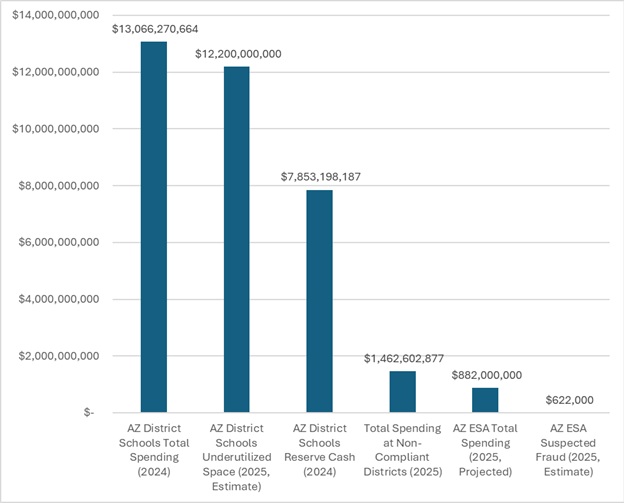
Misuse of the ESA program is vanishingly small. The Arizona Department of Education’s internal audit had turned up $622,000 in ESA funds that are “possible fraud or misuse.” That’s approximately 0.05% of total ESA spending over the past two years.
Misuse of funds in the ESA or any other public program must be detected, deterred, and punished. This is in fact happening in the ESA program, as the Arizona Department of Education had already found the misuse, suspended accounts of those responsible, and reports that it is “in the process of collecting more than $600,000” in improper spending. All of this makes the ESA program far more transparent and accountable than Arizona school districts, which do not post their purchases.
And while Deer Valley teachers may indeed purchase their own school supplies, it has nothing to do with the ESA program and everything to do with misplaced district priorities.
One of the oldest tricks in the school district advocate playbook involves pretending that teachers must buy their own classroom supplies because of a lack of funding. The Channel 12 story cites a Deer Valley biology teacher who said she “spends at least $500 of her own money every summer for her classroom.”
Days after the report aired, former Deer Valley school board candidate Tiffany Hawkins revealed that Deer Valley Unified had spent $560,407 to send students and staff on trips to Disneyland, Knott’s Berry Farm, Sea World, Universal Studios, and other destinations in Arizona, California, Hawaii, Indiana, and Texas. Apparently, the district leadership decided that these trips took precedence over classroom supplies for Deer Valley teachers.
Don’t hold your breath waiting for Channel 12 to cover that. Deer Valley Superintendent Finch—who recently faced charges of stonewalling public records requests and illegal electioneering on school grounds—attacked the ESA program for “out of control” spending with “zero accountability.” But his critiques of the ESA program much more accurately describe spending in his own district.
The Arizona Auditor General reports that Deer Valley spends $13,717 per pupil, meaning that a classroom of 25 students thus generates over $340,000 in total revenue. Where did this money go? Mainly not to teachers.
The Auditor General reports that Deer Valley average teacher pay is $2,163 below the state average. If Deer Valley is not prioritizing teachers, what is it prioritizing instead? The Auditor General report helpfully provides an answer: “high” and “very high” spending on administration and transportation, respectively, compared to a group of peer school districts.
The Goldwater Institute recently published a study of Arizona school superintendent compensation. Goldwater needed to use the open-records law to obtain this information, as districts compensate their superintendents in a variety of creative ways outside of their base salary, including providing either vehicles or “car allowances,” extra retirement benefits, and other perks.
The Goldwater Institute found that Deer Valley provides a total compensation package for their Superintendent of $290,505, including a car allowance of $10,000. This car allowance alone could have provided 20 teachers with $500 each for classroom supplies.
Even if one were to take the highly perverse view that students were the indentured servants of the school districts in which they reside, it would still be absurd for Deer Valley Unified officials to blame their problems on the ESA program. Arizona Department of Education reports show that 10,966 students lived within the boundaries of Deer Valley Unified but attended other public schools in 2024.
Deer Valley Unified meanwhile “drained” almost 3,000 students and their funding from other public schools. At the end of 2024, only 709 students had left a Deer Valley school to participate in the ESA program. Four different public schools outside Deer Valley Unified each have enrolled more students who reside in the district than the ESA program. Moreover 217 total public schools outside the district enroll Deer Valley Unified resident students.
Luckily, Arizona policymakers have decided that Arizona children are not merely funding units for their local school districts. Arizona families can use ESAs to choose the schools that are the best fit for the interests and aspirations of their children.
Arizona school districts have never had as much money as they have now, enough apparently to prioritize trips to California and perks for superintendents. If Deer Valley Unified officials hope to gain the enrollment of the thousands of resident students who have chosen to pursue their education elsewhere, a clear path forward would be to prioritize their funding.
Purchasing classroom supplies for teachers would be a great first step.
Matthew Ladner is a Senior Advisor for education policy implementation and Jason Bedrick is a Research Fellow at the Heritage Foundation’s Center for Education Policy.
Every year, a horde of school district officials and their lobbyists come before the state legislature, rattling their tin cups, begging for more money for their supposedly underfunded schools. They tell sob stories about crumbling buildings and underpaid teachers who had to pay for school supplies from their own pockets. Their schools, they say, are financially starved.
Hogwash.
School bureaucrats don’t want you to know it, but school spending is at an all-time high, and Arizona’s school districts are sitting on more than $20 billion in cash reserves and buildings they don’t need while student achievement craters. A new report from the Common Sense Institute (CSI) reveals the shocking scope of waste plaguing our traditional public school system, and it’s time taxpayers demanded answers.
The numbers are staggering. As has been documented, Arizona’s school districts are already hoarding $7.8 billion in cash reserves, up $1 billion since the prior fiscal year. Now we learn they’re also sitting on $12.2 billion worth of excess real estate—78 million square feet of unused and underutilized space that could house 630,000 additional students. Combined, that’s over $20 billion in resources that could be put to better use serving Arizona’s children.
Since 2019, district school enrollment has declined 5% statewide, yet these same districts increased their building space by 3% and boosted capital spending by a jaw-dropping 67% to $8.9 billion. As CSI has documented, districts have added 499 new buildings while losing 47,500 students. This isn’t just inefficient, it’s fiscally reckless.
The massive spending on new buildings might be justifiable if schools were overcrowded or expecting a huge influx of new students, but they’re not. In fact, Arizona’s district schools are already significantly overbuilt, operating at just 67% capacity while charter schools run at 95% capacity and private schools at 75%. CSI estimates that the excess space in district schools could accommodate 630,000 additional students—nearly half the current statewide district school enrollment.
The excess capacity comes at an enormous cost. CSI estimates that the market value of excess district space alone—$12.2 billion—could fund a decade of capital expenditures. Alternatively, eliminating maintenance costs for unused space would save taxpayers $1 billion annually. That’s real money that could reduce taxes, improve education, or address Arizona’s other pressing needs.
There are plenty of willing buyers. Indeed, the fastest-growing school systems—charters and private schools chosen by increasing numbers of Arizona families—struggle to find adequate facilities. Yet school districts often go to incredible lengths to avoid selling buildings to them, such as when Tucson Unified School District sold an unused building for 25% less than what a Christian school had offered, just so that a “competitor” wouldn’t have it.
In response to such cases, Gov. Doug Ducey signed a law requiring school districts to sell buildings to the highest bidder, even if it’s a private or charter school. Now, rather than comply, school districts are just letting their underutilized space languish and forcing the taxpayers to pay the bill.
The wastefulness is also a slap in the face to teachers and students alike.
As we noted previously, the districts have enough cash reserves to raise the average teacher pay from $64,420 to more than $80,000 for 10 years and still have funds left over. If they sold off all their underutilized space, they could raise the average teacher pay to $100,000 for a decade and still have billions left over.
There is no evidence that spending on buildings is contributing to student learning. As the buildings have gone up, math scores have gone down, plummeting 25% since 2019. As CSI documents, the lowest-performing schools have the most excess space, operating at just 19% capacity, while high-performing schools run at 70% capacity.
This isn’t about helping kids learn; it’s about protecting a bloated bureaucracy that puts institutional self-interest above student needs.
Fixing the problem will require realigning incentives. CSI recommends more transparency—including a “Facilities Condition Index” that would give policymakers and the public objective information about the quality of existing school facilities—and more state oversight of severely underutilized facilities. In the meantime, any funding requests from the school districts should be greeted by state lawmakers with a healthy dose of skepticism.
Arizona’s children deserve better than a $20 billion monument to government inefficiency. They deserve a system that puts their education first, not one that hoards resources while performance plummets. If local officials can’t or won’t deliver, then state lawmakers will have to step in.
Jason Bedrick is a Research Fellow and Matthew Ladner is a Senior Advisor for education policy implementation at the Heritage Foundation’s Center for Education Policy.