by Matthew Holloway | Nov 9, 2025 | News
By Matthew Holloway |
The Scottsdale City Council voted Monday to authorize Interim City Attorney Luis Santaella to ready counterclaims and other filings in its escalating court fight with Taxpayers Against Awful Apartment Zoning Exemptions (TAAAZE), the residents’ group challenging the state’s controversial “Axon Bill,” SB1543.
The authorization was granted in the event that the court upheld its original November 7th filing deadline in the case. However, the court subsequently granted an extension motion, according to Holly Peralta, Public Affairs Supervisor for the City of Scottsdale. Under the extended deadline of November 21st, the city council “will consider whether to bring forth such claims at its next regular meeting on Monday, Nov. 17.”
Former Scottsdale City Councilmember Bob Littlefield posted about the meeting on Monday morning, writing in part, “One of the items on tonight’s City Council agenda is the issue of whether or not the City will join my TAAAZE lawsuit against the ‘Axon Bill’ which cancels the right of referendum for Scottsdale citizens.”
Littlefield was critical of Mayor Lisa Borowsky, alleging that while supporting the suit, she has chosen not to take action.
He wrote, “This same question has been on the City Council agenda several times over the last few months, and the outcome has always been the same; Councilmembers Littlefield, Graham and Dubaskas have supported the idea while Councilmembers Whitehead, Kwasman and McAllen oppose it. That always leaves Mayor Borowsky as the swing vote. Lisa has repeatedly expressed support for the city joining the TAAAZE lawsuit against the Axon bill, yet every time it comes to a vote, she either votes against it or delays the vote, so no action is taken!”
Littlefield told AZFamily on Monday, “She wants to appear resident-friendly by saying she supports the lawsuit, but when it comes to push and shove, she votes in Axon’s interest by saying no.”
Borowsky responded, telling the outlet that she would prefer Axon keep its headquarters in Scottsdale. “Unlike former City Councilman Bob Littlefield, I want Axon to stay in Scottsdale,” she said. “Had Mr. Littlefield and his supporters not delayed the election until November 2026, Axon would not have gone to the Arizona Legislature, and we would not be in the legal predicament we are in today.”
She added, “Mr. Littlefield’s referendum was funded by an out-of-state labor union, which paid for 25,000 of the 27,000 signatures gathered. The 1,900 apartments at the Axon campus were hastily approved by the Lame Duck City Council on their way out the door. Let me be clear, I don’t support 1,900 apartments on that site. It is an outrage the Arizona Legislature passed a law to circumvent our control over zoning.”
As previously reported by AZ Free News, the Mayor held a town hall meeting in an open Q&A format to address citizens’ concerns in the ongoing controversy surrounding Axon’s headquarters expansion. During the town hall, the Mayor similarly called out former Councilmember Littlefield, saying, “I would have preferred to have this election much earlier, like May 2025 … the reason I pushed so hard to have an earlier election is because I believe the people should speak on this.”
Littlefield was unmoved, however, and told the Daily Independent, “For months, she’s told residents she backs our effort, but when it matters most, she blocks it. Her go to excuse? ‘Questions about the bill.’”
“Lisa, the bill passed six months ago,” he continued. “You’re a lawyer. You’ve had ample time to read it and get answers.”
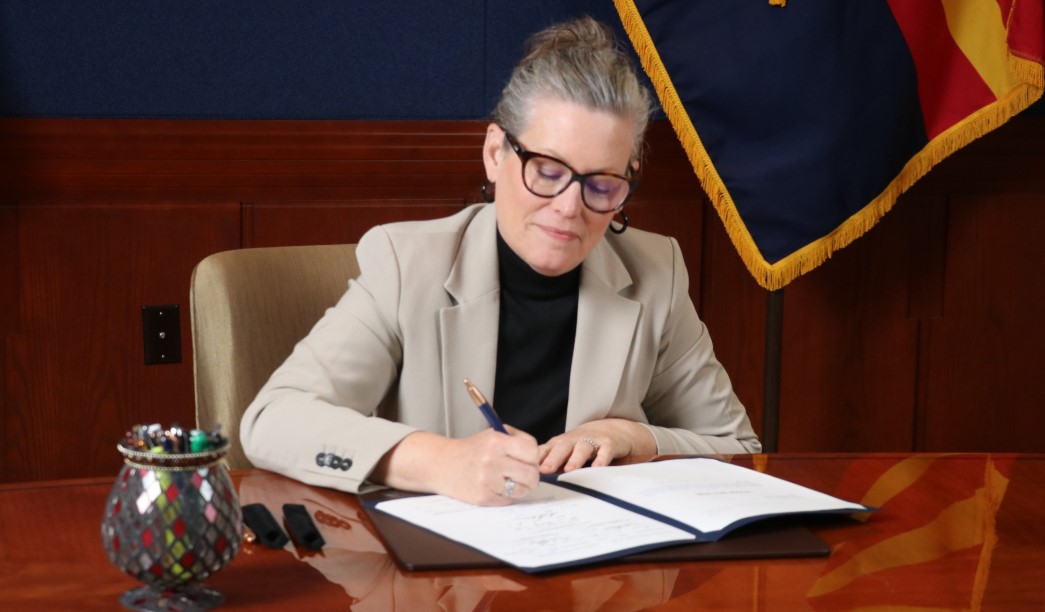
Governor Katie Hobbs signed SB 1543 into law in April, severely curtailing municipalities’ ability to refer zoning matters to a public ballot. The law retroactively nullified the TAAAZE referendum and earned a sharp rebuke from Borowsky and the council, who told the Governor the law “undermines the principles of local control that are foundational to Scottsdale’s governance” and “sets a dangerous precedent.”
As of this report, the council is expected to vote on whether to take legal action in the case during its Monday, November 17th meeting.
Matthew Holloway is a senior reporter for AZ Free News. Follow him on X for his latest stories, or email tips to Matthew@azfreenews.com.
by Matthew Holloway | Oct 23, 2025 | News
By Matthew Holloway |
The controversy surrounding Axon’s headquarters expansion has reportedly prompted Scottsdale Mayor Lisa Borowsky to call residents to a public town hall. During the meeting, Borowsky will take questions directly from Scottsdale citizens in an open Q&A format.
The event, set for Wednesday, October 29, at 5 p.m. at the Mustang Library in Scottsdale, is intended to “foster accountability and direct dialogue between the mayor and her constituents,” according to Borowsky.
“This town hall is about transparency and accountability,” Borowsky said in a statement. “I want to hear directly from residents. Your questions, concerns, and ideas matter acutely as I fight to put the interests of Scottsdale first.”
The mayor’s office is encouraging attendees to come prepared with their questions, which they’ll have the chance to pose directly to the mayor. Mayoral staff and volunteers will be available as well to offer background information and updates on various topics in an effort to ensure a well-rounded discussion.
The public event is slated to run from 5 p.m. to 6:30 p.m., providing Scottsdale residents a focused opportunity to get unfiltered insights from Borowsky on matters affecting the community. The announcement, shared via the city’s social media channels, has already sparked online chatter, with some using the platform to press for clarity on hot-button issues likely to surface at the town hall.
Bob Littlefield, a former city councilmember, took to X to highlight divisions over a proposed city lawsuit against state Senate Bill 1543—dubbed the “AXON bill” for its push on affordable housing developments. Littlefield, who supports joining the suit, called out Borowsky and Councilmembers Whitehead, McAllen, and Kwasman for voting against it, despite polls showing 70% of Scottsdale voters favoring the defeat of the project.
“The issue is on Tuesday’s City Council agenda so hopefully Borowsky, Whitehead, McAllen and Kwasman will see the light and vote with their constituents,” he wrote. The post underscores the transparency themes Borowsky is championing, potentially setting the stage for some tense Q&A exchanges to come.
As previously reported by AZ Free News, the City of Scottsdale could be moving toward shortening the timetable for a referendum on the Axon Headquarters project, or on the city’s reaction to the lawsuit from Taxpayers Against Awful Apartment Zoning Exemptions (TAAAZE).
Adding potential fuel, the local advocacy group Scottsdale Voter questioned Borowsky’s recent appointment of Lamar Whitmer as chief of staff. In a post to X, the group labeled him a “failed real estate developer” and “polarizing” figure. Such scrutiny could amplify resident concerns at the town hall.
For more details or to submit questions in advance, residents can contact the mayor’s office through the City of Scottsdale website.
Matthew Holloway is a senior reporter for AZ Free News. Follow him on X for his latest stories, or email tips to Matthew@azfreenews.com.
by Matthew Holloway | Oct 10, 2025 | News
By Matthew Holloway |
The ongoing disagreement between the City of Scottsdale and Axon Enterprise, Inc. has taken on a new dimension after the city issued a clarification of its position on last week. Regardless of whether the controversial “Axon Bill,” SB 1543, remains in effect, the city stated that Scottsdale City Code Section 2-5 requires a referendum to be placed on the ballot at the next general election, scheduled for Nov. 3, 2026.
In a statement issued October 3rd, the city stated that the timetable for a referendum could be shortened, noting, “The city could, if directed by the City Council, place that referendum question on a city election ballot before Nov. 3, 2026, by calling a Spring 2026 Special Election or placing the item on the Aug. 4, 2026, primary election ballot.”
Responding to the enactment of SB 1543 in April, the City Council voted to authorize filing a notice of claim/notice of unconstitutionality in a special meeting on September 12th. The claim filed on September 15th serves as formal notice to the State of Arizona that potential legal action from the city may follow. As reported by AZ Free News at the time, SB 1543 strips residents in cities of certain sizes, including Scottsdale, of their ability to challenge zoning decisions through ballot initiatives. The law applies retroactively and nullified a referendum effort by nearly 27,000 Scottsdale residents who had petitioned to challenge a city council-approved expansion of Axon’s Scottsdale headquarters, which included almost 2,000 multifamily residential units, over 400 hotel rooms, and approximately 47,000 square feet of retail and restaurant space.
City leaders pleaded with Governor Katie Hobbs to veto the bill, citing local concerns over increased traffic and infrastructure strain. They wrote in their plea, “These are not abstract issues—they impact the daily lives of our residents.”
Scottsdale Mayor Lisa Borowsky and the City Council warned that SB 1543 “undermines the principles of local control that are foundational to Scottsdale’s governance,” adding that it “sets a dangerous precedent.”
Borowsky told KTAR 92.3 host Mike Broomhead last week that, before “going to the state legislature,” Axon was negotiating with the city, and the 2000-apartment plan could have been reduced to 750. She added, “Let me be clear, I’m opposed to that high density of housing units,” referring to the initial 2,000 unit plan, but added there are three members of the council who are “vehemently” opposed to negotiation.
Public Affairs Supervisor Holly Peralta wrote, “The City Council’s vote did not authorize litigation, but that step could be taken by a separate Council action in the future.” She further added that a political action committee filed suit against the state and the city regarding Senate Bill 1543.
The lawsuit filed by Taxpayers Against Awful Apartment Zoning Exemptions, or TAAAZE, claims that SB1543 violates both the “special laws” ban in the Arizona Constitution, as well as the right of referendum enshrined there.
Alexis Danneman, a Perkins Coie, LLP, partner and lead counsel for TAAAZE, said in a statement. “This lawsuit is about two of our State Constitution’s most important principles. First, it’s about the right of Arizona voters to hold referenda and vote directly on legislation passed by their city councils but with which they disagree. Second, it’s about the Constitution’s ban on so-called ‘special laws,’ like the Axon Bill, that confer special privileges and benefits on a specific company or group. The Axon bill passed by the Legislature and signed by the governor is the very definition of special interest legislation and it is illegal in the state of Arizona.”
As a separate matter, the city is “evaluating that lawsuit,” according to Peralta.
Matthew Holloway is a senior reporter for AZ Free News. Follow him on X for his latest stories, or email tips to Matthew@azfreenews.com.
by Staff Reporter | Sep 29, 2025 | Economy, News
By Staff Reporter |
A series of new laws taking effect are anticipated to raise Arizona’s economic competitiveness.
The Arizona Chamber of Commerce & Industry (Arizona Chamber) highlighted six new laws as giving the state a beneficial boost in economic performance against other states.
These laws aim to make it feasible for international headquarters to build on-site workforce housing and support services (Senate Bill 1543), permit utilities to refinance infrastructure investments through securitization (House Bill 2679), allow Chase Field renovations without increasing taxes (House Bill 2704), make it feasible for advanced air mobility systems such as drone deliveries and air taxis (Senate Bill 1307), require utilities and public power entities to implement wildfire mitigation plans (House Bill 2201), and bars foreign entities from funding lawsuits while limiting outside funding to third-party litigation (Senate Bill 1215).
Dozens of states are working together to create a uniform approach to allowing advanced air mobility, along with the Federal Aviation Administration. Over 30 states are members of the Advanced Air Mobility Multistate Collaborative (AAMMC), formed in 2023 with eight to 10 member states. Arizona is member to the organization leading AAMMC, the National Association of State Aviation Officials.
In addition to raising awareness of the new laws it backs, the Arizona Chamber also releases public reports of failed bills it believed would harm the state’s economy. The chamber announced their 2025 report is forthcoming.
Arizona Chamber President and CEO Danny Seiden stated that the six featured laws would retain corporate interest in the state by implementing necessary reforms and new pathways to growth.
“As these laws take effect, Arizona employers can count on policies that reflect their priorities,” said Seiden. “From keeping vital economic drivers in Arizona, to passing commonsense energy reforms that will deliver long-term stability and affordability, to supporting global companies, these are the kinds of policies that keep Arizona competitive and attractive for investment.”
The legislature also passed other laws anticipated to boost the economy, some of which Governor Katie Hobbs also approved from the Republican-controlled legislature despite a historic veto record (nearly 200 bills this year, compared to her previous historic record of over 140 in 2023).
One such law promises to further protect Arizona from regulatory capture by monopoly-controlled utilities (House Bill 2518). The legislation prohibits Arizona Corporation Commission (ACC) members from accepting employment with the utilities under their regulation. Not all ACC members were pleased with the legislation, namely ACC Chairman Kevin Thompson.
Chair Thompson was the subject of an ethics claim filed by the Energy Policy Institute earlier this year, as first reported by the Arizona Republic. The institute alleged a conflict of interest regarding the relationship between Thompson’s consulting firm and utilities.
Another law will ensure construction crews may work in the early morning hours in the summers by prohibiting municipalities and counties from enacting or enforcing noise ordinances, rules, or regulations prohibiting general construction activities during certain summertime hours (Senate Bill 1182).
And another law requires municipalities to give affected businesses at least 60 days’ notice before voting on tax increases (House Bill 2119).
The legislature also chose to sunset the Low Income Housing Tax Credit program rather than renew. Critics of the program blame lax policies and procedures for the Department of Housing’s loss of around $2 million to a wire fraud scam in 2023.
AZ Free News is your #1 source for Arizona news and politics. You can send us news tips using this link.
by Jonathan Eberle | Apr 23, 2025 | News
By Jonathan Eberle |
Despite opposition from local leaders and community organizers, Governor Katie Hobbs has signed SB 1543 into law, a move that will significantly curtail the ability of residents in cities like Scottsdale to refer zoning decisions to the ballot. The legislation, which passed the Arizona Legislature along party lines earlier this month, takes aim at local control.
The law applies retroactively, nullifying a referendum effort by nearly 27,000 Scottsdale residents who had petitioned to challenge a city council-approved expansion plan by public safety technology company Axon. The referendum would have placed the matter on a future citywide ballot, giving voters the opportunity to weigh in on the project’s future.
In a letter sent to Governor Hobbs prior to her decision, Scottsdale Mayor Lisa Borowsky and the full City Council warned that SB 1543 “undermines the principles of local control that are foundational to Scottsdale’s governance” and “sets a dangerous precedent.” The city emphasized that the referendum effort was not a protest against development, but rather a call for public input on a high-impact zoning change.
The controversy began after the Scottsdale City Council voted in November 2024 to approve Axon’s expanded development plans. While the company’s previously approved headquarters from 2020 remains intact, the new proposal includes nearly 2,000 multifamily residential units; over 400 hotel rooms; and approximately 47,000 square feet of retail and restaurant space.
Many residents argued that the expansion warranted broader community input, prompting a grassroots petition drive that garnered tens of thousands of signatures. However, with SB 1543 now law, the referendum effort has been invalidated, and Scottsdale voters will not have the opportunity to decide on the matter at the ballot box.
SB 1543 removes the ability of residents in cities of certain sizes—including Scottsdale—to challenge zoning decisions. Supporters, including Republican legislative leaders, say the law clears the way for large-scale development projects and reduces delays caused by ballot initiatives. Critics, however, argue it silences community voices and weakens the checks and balances that local governments rely on.
City leaders have expressed concern that the legislation fails to address critical issues related to growth, including increased traffic and infrastructure strain. “These are not abstract issues—they impact the daily lives of our residents,” the city wrote in its plea to the Governor.
With the law now enacted, Scottsdale is weighing legal and procedural responses to preserve local authority, while other municipalities watch closely to see how the law will be implemented and challenged.
Jonathan Eberle is a reporter for AZ Free News. You can send him news tips using this link.
Page 1 of 11