The Republican National Committee is targeting Sen. Ruben Gallego (D-AZ) following reports that Rep. Jimmy Gomez (D-CA) is facing a House Ethics Committee investigation into allegations of sexual misconduct.
The attack comes after Gomez publicly acknowledged an extramarital affair following reporting by the New York Post and amid reports that House investigators are reviewing allegations involving his conduct toward congressional staffers. Gomez has denied violating House rules and has maintained that any relationships were consensual.
In a statement distributed Wednesday, RNC Western Regional Communications Director Nick Poche sought to tie Gallego to Gomez and other congressional Democrats who have faced controversy.
“Ruben Gallego’s sick freak friends prey on women and employees. You are the company you keep, so Gallego needs to answer for what he’s seen, and the people around Gallego need to answer whether or not he is part of the problem as well,” Poche said.
According to the New York Post, Gomez admitted to an affair after initially denying reports concerning his personal conduct. The outlet also reported that allegations involving Gomez’s interactions with congressional staffers prompted a House Ethics Committee investigation. Gomez has disputed allegations that he engaged in misconduct and has stated that he did not violate House ethics rules.
As discussion of the allegations spread online, Brian Anderson of Saguaro Group and Arizona Capitol Oversight highlighted a resurfaced 2018 X exchange involving Gallego, Gomez, and Swalwell.
The RNC statement also referenced former Rep. Eric Swalwell (D-CA), another California Democrat who has faced scrutiny in recent years. Poche argued that Gallego’s political associations with Gomez and Swalwell warranted additional questions about the Arizona senator’s judgment and political alliances.
Gallego served alongside Gomez during his tenure in the U.S. House before winning election to the Senate in 2024. The RNC did not allege that Gallego engaged in any misconduct.
The new scrutiny also follows controversy surrounding Gallego’s comments on allegations of sexual conduct involving Democratic Maine Senate candidate Graham Platner raised by a Fox News report.
FIRST ON FOX: Democratic Maine Senate candidate Graham Platner's deleted Reddit account reveals graphic posts about masturbating in portable toilets and praising explicit military restroom graffiti — the latest in a growing trail of vulgar comments that could define his race… pic.twitter.com/oejepVCv9y
— Fox News Politics (@foxnewspolitics) May 19, 2026
In May, Gallego defended Platner, arguing in a post to X that some of the conduct being criticized reflected experiences and attitudes common in military culture. The remarks drew criticism from Republicans and became a point of contention in Arizona political circles.
As of publication, Gallego’s office had not publicly responded to the RNC statement.
A year-long Freedom of Information Act (FOIA) battle has revealed over 1,000 pages of emails from the University of Arizona (U of A), exposing coordinated efforts between faculty and pro-Palestine groups to undermine condemnations of the Oct. 7th Hamas attacks on Israel. The documents, obtained through legal threats after an initial denial, detail attempts to soften U of A statements on terrorism and revise an anti-Semitism resolution to prioritize criticism of police responses to pro-Palestine protests.
Brian Anderson, founder of the Saguaro Group and Arizona Capitol Oversight, filed the FOIA request in May 2024 targeting communications post-Oct 7th when Hamas terrorists killed 1,200 Israelis, mostly civilians, and many children. U of A initially refused, forcing Anderson to retain attorneys and threaten litigation, costing thousands of dollars before the June 2025 release. He detailed the ordeal in an X post on November 1, 2025, linking to a 12-page report.
NEW 🚨 After a 1-year #FOIA fight, I have obtained 1,000 pages of internal emails exposing how @UArizona bent over backward for pro-Palestine activists after October 7
Former U of A President Robert C. Robbins condemned the “antisemitic hatred, murder, and atrocity” officially on Oct. 11, 2023, specifically criticizing Students for Justice in Palestine (SJP) for endorsing the attacks. Faculty backlash was swift. On Oct. 12th, an associate emailed Faculty Senate Chair Leila Hudson, accusing Robbins of “smears” against SJP and coordinating with Jewish Voice for Peace on protests, threatening a Palestine Legal report. Hudson, an associate professor in Middle Eastern and North African Studies, replied supportively and issued a statement on Oct. 13th condemning “illegal violent collective punishment” on Gaza civilians, equating it to Hamas terrorism.
Faculty emails poured in praising Hudson. One cited distress among Saudi, UAE, and Yemeni students. Another called her “courageous,” noting that “Kochs Off Campus” planned to attend a faculty meeting. Hudson privately noted shortening her draft to avoid “comparisons to ISIS tactics,” instead favoring words that would “bring people into dialogue.”
Pro-Palestine activity intensified on campus. On Oct. 26, 2023, the Coalition of Black Students and Allies emailed faculty, calling Oct. 7th a “powerful emblem of Palestinian resistance” against Israeli “apartheid.” Hudson spoke at a Nov. 6 Faculty Senate meeting on the “genocide” in Palestine, sympathizing with protesters against “occupation” and U.S. policy. An interim provost announced a Nov. 9 “Walkout for Palestine,” and United Campus Workers of Arizona issued a Nov. 20 open letter accusing pro-Palestine critics of “retaliation.”
Vandalism incidents included an Oct. 19, 2023, incident in which a swastika and “dirty Jew” graffiti were found on a student’s door, classified as bias-based. Professor Jean-Marc Fellous emailed on Jan. 14, 2024, about a prior swastika in his lab dismissed as “vandalism.” In April 2024, SJP’s “Israeli Apartheid Week” coincided with Passover, flagged as provocative. U of A’s Jewish fraternity Alpha Epsilon Pi was vandalized that month.
Faculty suspensions followed: Professors Rebecca Lopez and Rebecca Zapien were briefly removed in December 2023 for calling Hamas a “resistance group.” They were reinstated later. Hudson defended them, stressing teaching “causes and motivations of October 7th.”
An anti-Semitism resolution draft by Fellous on April 13, 2024, condemned fraternity vandalism as “virulent antisemitism.” Hudson emailed on May 3 to “adjust” it for “admin/police violence” against protesters. Colleagues protested, with Barry Goldman questioning the omission of violence against Jewish students. Fellous agreed to separate issues, noting “antisemitism and hate crime have nothing to do with police violence.” On May 5, another colleague accused Hudson of withholding the draft and warned of antisemitic implications.
At the May 2024 Faculty Senate meeting, Hudson declined the resolution, referring it to Diversity, Equity, and Inclusion for “further study.” She reaffirmed rejection of all biases, including those on “gender identity, reproductive status, and sexual orientation.” On Nov. 4, 2024, she reported ongoing feedback collection.
On Dec. 2, 2023, Hudson’s “State of the Faculty” message announced a Campus Climate response team for “incidents not meeting credible threats,” warning against labeling ceasefire calls or anti-Israel views as “pro-Hamas” or “antisemitic.” Law professors Toni Massaro, Tessa Dysart, and Mona Hymel then expressed concern, and distanced themselves with a fourth colleague whose name was redacted, adding, “I don’t think that a person with an understanding of antisemitism drafted or reviewed the part concerning hate speech.”
The Foundation for Individual Rights and Expression (FIRE) threatened legal action on Dec. 12, 2023, calling it a “deeply chilling and unlawful” act of “formalized government monitoring of protected speech.”
The Wall Street Journal editorial board highlighted the emails on Oct. 30, 2025, noting “anti-Israel and pro-Hamas bias among the faculty and student groups.” Anderson’s X thread amplified the report.
Anderson stated: “It took the University of Arizona an entire year to release these records to me, from my initial FOIA request in May 2024 until the final production in June 2025.” He added, “Multiple attorneys and thousands of dollars in legal fees were required to successfully reverse the university’s unnecessary delay (and, later, its formal denial) of my request, which it did only after a final warning that I would be filing a lawsuit within the next 48 hours. More importantly, its refusal to hand over these records denied students and faculty any semblance of transparency into the mechanics behind what was happening on their own campus—or what has happened in the year since.”
He concluded, “The best-case scenario is that UA succumbed to a culture dominated by over-thinking, whataboutism, and misplaced priorities that allowed hatred to flourish. But its extended fight against transparency suggests a broader institutional failure—one bordering on purposeful evasion of public records laws—with the intention of riding out the storm until Israel and Palestine were out of the news. We deserve better from this public university.”
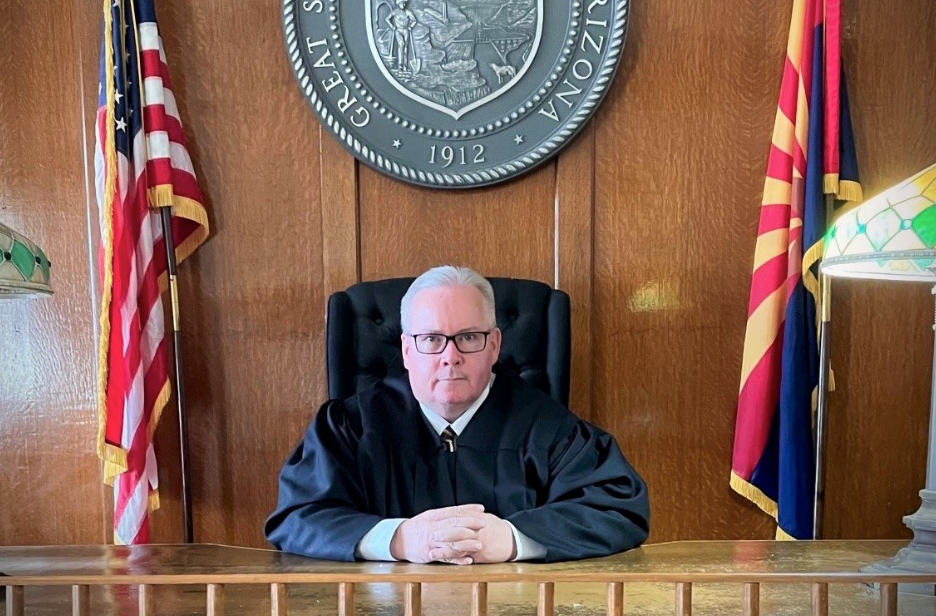
Republicans are hoping to field a candidate against Mohave County Superior Court Judge Lee Jantzen should he decide to run for re-election in 2026. Jantzen, who presided over the 2022 Arizona Attorney General election challenge by now-Congressman Abe Hamadeh, was accused in that case of gross incompetence by lawyers on both sides of the political aisle.
“Lee Jantzen reached levels of incompetence that I honestly did not know were possible,” tweeted Brian Anderson, a Republican influencer and owner of Saguaro Group. “Kept ‘forgetting’ to issue rulings, then ‘forgot’ to sign the rulings, then ‘accidentally’ labeled the AG race as the SOS race, etc. Historic miscarriage of justice.”
Lee Jantzen reached levels of incompetence that I honestly did not know were possible.
Kept "forgetting" to issue rulings, then "forgot" to sign the rulings, then "accidentally" labeled the AG race as the SOS race, etc.
In 2023, after a series of serious missteps, attorneys on both sides of Hamadeh’s election contest discovered that Jantzen signed what should have been a final order, but left matters pending, resulting in an “unfinal” final order. The judge’s failure delayed final judgment, leaving Hamadeh without the opportunity to file an appeal on the denial by Jantzen for a new trial.
At that time, Mohave County residents reached out to the Arizona Daily Independent, telling the outlet that they were “embarrassed and frustrated by the continued missteps by Judge Jantzen. Residents are concerned about Judge Jantzen’s history of malfeasance and how his conduct in this case could indicate issues with other more routine cases that he presides over.”
An X account operated by supporters of Congressman Hamadeh weighed in on the discussion started by Mohave County Republicans last week, asking:
“Do we have any brave attorneys in Mohave County who want to run to become a judge in Superior Court? ‘Judge’ Jantzen, who inexplicably ruled against @AbrahamHamadeh’s election lawsuit WITHOUT considering the evidence is up for election again in 2026. He helped disenfranchise THOUSANDS of voters. We have to uproot the corruption in Arizona. We can start with this judge.”
Jantzen’s repeated mistakes left court watchers wondering if he was intentionally slow walking the case, saying that it created an increased air of distrust in both the judicial system and the electoral process.
That distrust of the judicial system only worsened when nine months to the day after Jantzen denied Hamadeh’s election challenge did the Arizona Supreme Court issue an order to Jantzen to do his job “forthwith” and sign-off on two overdue judgments in the case, one of which dated back to Dec. 23, 2022.
Hamadeh’s case was not the first time Jantzen ran afoul of the Arizona Supreme Court. According to public records obtained by the Arizona Daily Independent through Hamadeh’s attorney, Jen Wright, Jantzen stipulated in May 2018 to a censure by the Arizona Supreme Court for “misconduct in office” following an investigation that showed the judge missed the 60-day deadline by more than one year.
Jantzen, who became a superior court judge for Mohave County in 2009, acknowledged as part of the censure that “he has previously received a warning from the Commission for similar misconduct involving a delayed ruling.”
He was also reprimanded in 2021 for the same problem.
A censure is one step down from a suspension and one step above a public reprimand. A censure can be imposed by the Arizona Supreme Court while a reprimand can be imposed by the Court or the Court’s Commission on Judicial Conduct (CJC).
The Arizona Judicial Branch has two check-and-balance systems in place in an attempt to guard against judges accidentally or intentionally ignoring the 60-day deadline.
“The 2018 censure noted Jantzen had, from June 2015 to September 2017, falsely signed statements pursuant to ARS 12-128.01 by certifying he had no matters outstanding more than 60 days,” according to the Arizona Daily Independent. “Jantzen’s 2021 Reprimand Order shows the judge signed his March 2020 payroll certification with a notation that a ruling in a 2020 case was overdue. The ruling was finally issued at 78 days.”
AZ Free News is your #1 source for Arizona news and politics. You can send us news tips using this link.