Arizona Land Department Prioritizing Construction Of Solar Panels Over New Homes
By Staff Reporter |
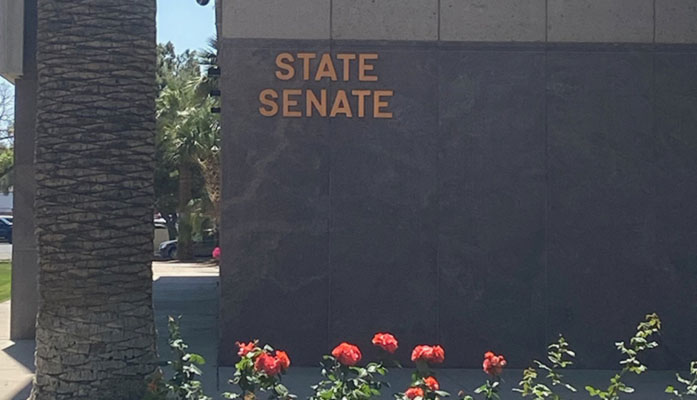
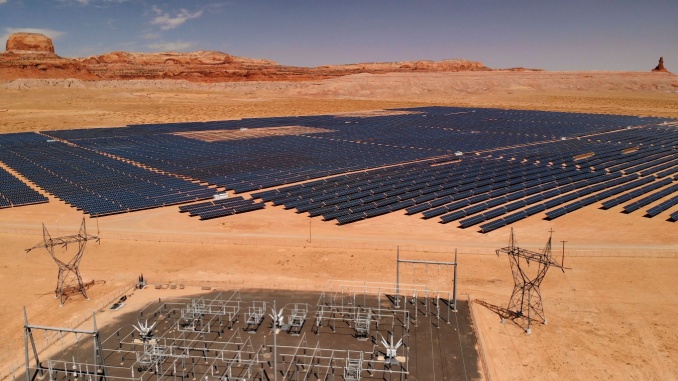
The Arizona State Land Department (ASLD) may be prioritizing the construction of solar panels over new home construction.
The agency maintains a unique map for “best” locations to put solar — but they don’t maintain similar maps for ideal locations for other industries, like housing, mining, and grazing for agriculture.
ASLD’s Land Parcel Viewer has a unique dataset for mapping existing and ideal spots for solar, complete with ratings: 0.0 to 0.9 for the best in green, all the way to 5.0 to 10.0 for the worst in red.
The map shows where parcels are for mineral and oil and gas, and whether those are unleased or permitted; the locations of rights of way and their perpetuity; and where grazing allotments exist. However, it does not offer any compatibility measure for the available land for each industry.
These industries would require knowledge to include resources, depth, size, and proximity to development for mining; animal unit month (the forage amount required for one animal per month), slope, and grass type and quality for grazing; soil conditions, water supply, and slope for agriculture; and path of development and slope for housing.
Spencer Kamps, vice president of the Home Builders Association of Central Arizona, said in a statement that the unique treatment of mapping land by ASLD may give the solar industry an unfair competitive edge in arguing for priority land use.
“In the absence of a similar map for other industries, some might say the solar map is serving functionally as a ‘presumptive highest and best use map,’ which gives solar a ‘rebuttable presumption’ of highest and best use in each parcel indicated in green,” said Kamps.
Last September, Gov. Katie Hobbs issued an executive order directing ASLD to outline proposals to streamline and expedite energy infrastructure projects on state land, as well as accelerate those energy-related projects already underway.
ASLD should have delivered the requested report last October.
The governor’s order also established a task force to come up with a strategic plan to “cut red tape related to the lease, sale, or other use of state lands in a way that advances the streamlined deployment of necessary generation and transmission projects.
That plan is part of three reports due by March 1 of this year. That task force, announced last November, includes ASLD Commissioner Robyn Sahid.
The two other reports include a policy framework for large energy users — data centers — to balance state interests in expansion with ratepayer costs, and an energy strategy plan to capitalize on technologies such as geothermal and advanced nuclear power.
Hobbs also directed her Office of Resiliency to use State Energy Program funding to fund one full-time staffer for ASLD to complete work on energy infrastructure projects.
ASLD doesn’t just have criticisms coming from the industries that sustained the state economy long before solar came on the scene. The state legislature believes the agency is in need of serious reform.
The House and Senate Joint Legislative Committee convened earlier this week to discuss ASLD’s scheduled sunset later this year.
In a significant departure from the standard renewal period of eight years for a state agency, the committee instead opted for a four-year continuation with conditions attached.
Official recommendations from the committee attributed their decision to “deep, longstanding issues” within the agency, describing its operations as an opaque, “unaccountable ‘black box’” per a press release issued on Wednesday.
Several of the committee recommendations outlined in the press release concerned solar leases and sales.
The committee advised the agency open additional investigations into intentionally vacant land, commissioner-initiated sales with only one bidder, solar leases and sales with only one bidder, reclamation of lands after solar leases, vacant land located within municipalities, vacant land location within five miles of urban areas, and vacant land located within 10 miles of urban areas.
Rep. Gail Griffin, committee co-chair, said in that press release the agency’s longstanding issues have worsened under Gov. Hobbs’ administration.
“Licensing timeframes, five-year disposition plans, and written policies and procedures are essential to upholding the best interests of the trust. These were the top issues,” said Griffin. “The Commissioner acknowledged these issues during her confirmation hearing and committed to fixing them, but they haven’t been fixed. The captain isn’t steering the ship.”
AZ Free News is your #1 source for Arizona news and politics. You can send us news tips using this link.