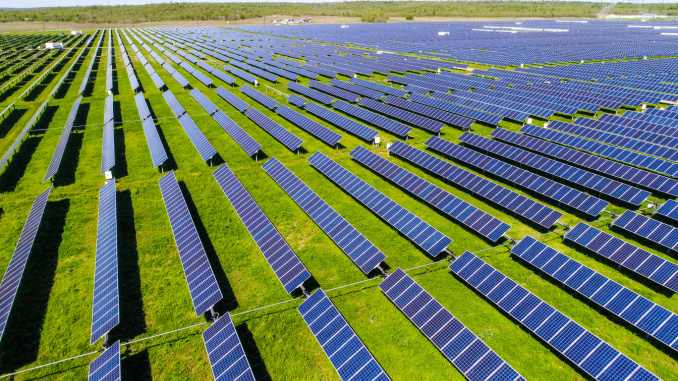
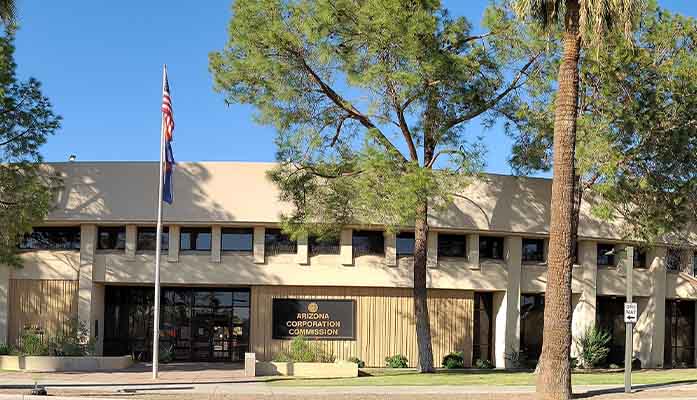
The Green New Scam got its start in Arizona two decades ago when a 5-0 Republican Commission (including then Republican Kris Mayes) adopted the Renewable Energy Standard and Tarriff Rules, or the REST Rules. Among other things, most significantly it ushered in the first “renewable” mandates in our state, forcing utilities to obtain at least 15% of their power from “renewables.” Ratepayers have been paying the costs (over $2 billion) ever since.
The REST Rules had a target date: 2025. Well, it’s now 2025, and the utilities have not only met that mandate, but they have also voluntarily exceeded it. Now our current 5-0 Republican Commission has started the process of repealing them.
Repealing the REST Rules is important, but the targets have already been met, and the price has already been paid. Substantively, the repeal won’t really affect ratepayers all that much. Why? Because mandate or no mandate, our utilities are completely committed to going “Net Zero” by 2050, and so far, they’ve been allowed to do it…
Arizona Corporation Commissioner (ACC) Rachel Walden brought an amendment during the commission’s Wednesday meeting to require detailed, extensive oversight over electrical utilities. Gaining unanimous approval in a 5-0 vote, Walden pushed to ensure Arizona’s electrical grid doesn’t become a ratepayer-funded venue for green projects.
At the October 15th open meeting, Walden pushed through an amendment demanding a more granular kind of report than the industry has provided for the past 26 years, exceeding what is required under Arizona Revised Statutes. Utilities like APS and SRP already owe the ACC their ten-year forecasts under state law, but Walden’s call for more detail: business confidential filings on line congestion, load-growth hotspots, and every grid-hardening method from reconductoring to storm-proofing—are a seismic departure from the more hands-off era that preceded.
Commissioners' Corner: The Commission voted unanimously in September 2025 to initiate the official repeal process for the state's mandatory energy efficiency rules, which were adopted 15 years ago. Commissioner Rachel Walden shares how her vote delivers her promise to ratepayers. pic.twitter.com/se9xwiwv4P
“Finding the least cost, most reliable model includes transmission, not just electricity generation. None of the answers from our state utilities today inspired any confidence in me that these issues are a priority,” Commissioner Walden told the meeting. “I am not convinced that additional build out of renewables, while also having to add firm capacity as well as back up generation, is saving Arizonans money. I know that Arizonans are concerned with these issues, especially as we head into accelerated growth in our state. The Commissioners, as elected by the public, are faced with these questions and comments almost daily, and our actions are held accountable to the public.”
The move from Walden and the ACC seems to have been carefully timed. The Thirteenth Biennial Transmission Assessment projects a 3 percent annual growth surge through 2033, significantly faster than previous forecasts, reflecting Arizona’s population boom colliding with a deluge of intermittent ‘renewable’ sources. With solar and wind flooding the system, utilities are rerouting power across state lines, inviting operational headaches from California’s aggressive decarbonization push.
“Arizonans will not bear the costs and impacts of supporting neighboring states’ Green New Deal policies,” Walden said.
Walden’s amendment mandates confidential reports on congestion and bottlenecks, where new solar farms fail to provide a consistent load or data centers increase demand, along with projections to gauge how interconnection requests ripple through the system. Supporting Commissioner Lea Márquez-Peterson’s additions, Walden is requiring complete disclosures on enhancement efforts, ensuring the ACC can vet if utilities are truly fortifying the state’s transmission system.
With major data centers like Microsoft and Google cropping up in Maricopa County, pulling gigawatts from an already strained grid, peak demand strains are a genuine concern. The disastrous 2023 heat wave that had Texas utilities scrambling is fresh in mind. Arizona is hardly immune to such issues. As renewables providers require load balancing and battery installations, the costs are passed on to ratepayers, and Walden is questioning the utilities’ math.
“Ensuring our utilities have sufficient generation capacity to serve our customers during peak demand along with a reliable transmission grid to handle that capacity is paramount,” she said. “The Commission must ensure that any transmission or generation solutions to mitigate grid concerns, such as line congestion created by the interconnections from new generation sources, or offtakes from the grid by large customers such as data centers and hyperscalers, are borne by the creators of those grid concerns, not Arizona ratepayers.”
Walden pledged to scrutinize future Biennial Assessments and Integrated Resource Plans in a distinct pivot from the ACC’s historically more hands-off stance.
“I will be watching the Biennial Transmission Assessments and Integrated Resource Plans closely, and investigating these issues in all future rate cases,” Walden concluded.
Arizona Public Service (APS), the state’s largest utility, has submitted a highly questionable new resource plan to the Arizona Corporation Commission, outlining a significant shift in its energy generation strategy through 2028.
The plan, detailed in a recent filing, reveals APS’s intent to disregard President Trump’s opposition to wind power. It will nearly double its generating capacity by adding 7,200 MW of new power, with 93% coming from expensive and unreliable renewable sources—solar, wind, and battery storage—while natural gas accounts for just 7%.
This marks a dramatic pivot toward renewables, with wind power additions matching gas over the next four years and solar outpacing gas by five times over the next three years.
The plan stems from APS’s 2023 “All Source” Request for Proposals (RFP), which initially sought 1,000 MW of new generation, with at least 700 MW from renewables. Surpassing expectations, APS contracted for 7,200 MW, transforming its energy mix.
By 2028, APS’s generation is projected to shift from 76% reliable dispatchable sources (55% natural gas, 14% coal, 8% nuclear) and 19% renewables (10% solar, 6% wind, 3% battery storage) to 46% reliable sources (35% gas, 6% coal, 5% nuclear) and 52% renewables (22% solar, 7% wind, 23% battery storage). This expansion is equivalent to building two new Palo Verde nuclear plants.
This renewable-heavy strategy comes despite recent emphasis by APS and the Commission on a new natural gas pipeline.
The plan has sparked controversy because it contrasts with President Trump’s criticism of wind energy, as APS doubles down on clean energy investments.
Regarding coal, APS’s filing remains vague on the closure of the Four Corners coal plant, projecting an exit between 2031 and 2038. This aligns with APS’s recent shift from “carbon-free” to a “carbon-neutral” goal by 2050.
The revised commitment addresses concerns about affordability and reliability while maintaining a focus on clean energy. Under carbon neutrality, APS must expand generation without increasing emissions, necessitating significant renewable and storage investments.
The Arizona Free Enterprise Club has expressed concerns over the delayed coal phase-out and questioned the cost of the renewable-heavy plan, estimating $42.7 billion over the next 15 years.
APS’s prior claims that renewables paired with storage could match the reliability and affordability of fossil fuels have faced skepticism that the transition may lead to higher rates and grid reliability challenges.
Ethan Faverino is a reporter for AZ Free News. You can send him news tips using this link.
As Americans enjoy their freedom — as they have a God-given right to do — they drive where they want in privately owned cars (gas powered, hybrid, or electric), live comfortably in heated-and-air-conditioned homes, and spend their evenings cooking dinner on gas (or electric stoves), and watching whatever television program or sporting event they choose. All of it brought to them by virtue of abundant and affordable energy.
According to 2024 data published by the U.S. Department of Energy, 82.16 percent of the energy consumed in the United States came from fossil fuels, including coal, petroleum and natural gas. Another 8.67 percent came from nuclear power plants.
In other words, more than 90 percent of the energy used in this country last year came from these sources.
Only 1.64% came from windmills; and only 1.17 percent came from solar panels.
As this nation’s economy and population has grown, so too has its power needs. Since 1960, in fact, the consumption of energy produced by fossil fuels and nuclear power has more than doubled.
But the consumption of nuclear energy peaked in 2019 — and has stagnated since then — while facing a campaign of opposition from liberal environmental groups.
This is ironic, however, because as the use of fossil fuels and nuclear power increased in recent decades, greenhouse gas emissions declined. From 1990 to 2022, for example, fossil fuel consumption increased by 8.64 percent, according to the Department of Energy. But during that same period, according to the Environmental Protection Agency, greenhouse gas emissions declined by three percent.
Nonetheless, groups including the Sierra Club, 350.org, and the National Resources Defense Council have sought not merely to stop the growth of this type of energy production, but to roll it back. In theory, they would replace the production lost from nuclear power and fossil fuels with energy produced from “renewable sources,” including windmills and solar panels.
They are particularly opposed to the development of nuclear power — even though nuclear plants don’t emit greenhouse gases.
“The Sierra Club,” says its website, “continues to oppose construction of any new commercial nuclear fission power plants.”
350.org also opposes the construction of new nuclear plants. “New nuclear,” its website says, “is a dangerous distraction in the race to solve climate change.”
The Natural Resources Defense Council (NRDC) argues that “expanding nuclear power is not a sound strategy for diversifying America’s energy portfolio and reducing carbon pollution.”
However, some progress has been made recently in resisting this campaign to foist renewable energy development upon the United States. In 2021, some of this nation’s largest banks — including Wells Fargo, Citi, Goldman Sachs, JP Morgan, Morgan Stanley and Bank of America — joined the Net Zero Banking Alliance. This alliance, said the Sierra Club’s magazine, “signaled a commitment by member institutions to develop voluntary targets that support a climate goal of 1.5C above preindustrial levels.” Since then, however, each of these banks has dropped out of the alliance.
Unfortunately, the ”renewables only” advocates have also achieved some victories in recent years.
Since 2001, the Sierra Club’s “Beyond Coal” campaign has supported the closing of more than 300 coal-fired power plants in this country. In 2021, construction of a liquid natural gas export terminal in Oregon was also canceled. Then, in 2023, a proposed gas-fired power plant in Connecticut was canceled, too. These groups also pressured California into nearly shutting down the Diablo Canyon nuclear plant, which provides 9% of the state’s electricity, before state energy commissioners voted to extend its operation to 2030.
The relentless campaign to force America away from fossil fuels and nuclear power and towards wind and solar is also driving America toward energy dependence on the People’s Republic of China.
The Heritage Foundation published a report last year by Diana Furchtgott-Roth and Miles Pollard that showed how this is happening. “China has succeeded in dominating the world’s supply chains in green energy products and components,” it said. “If America continues to require the use of these green energy products, it will cede economic power to China, giving China control of American energy security.”
Limiting how we produce energy in the United States will, as a matter of course, impose limitations on our freedom. Reliance on China for our energy supply chain will make our country susceptible to economic coercion. Limiting how we produce energy, means less of it and fewer choices about how to use it. This is of course baked into the climate activists’ view of world, one where experts tell us we must drive EVs, use electric stoves, and eat less meat, so that even the smallest of life’s details are predecided.
To preserve freedom, we must unfetter ourselves from ideologically driven restrictions on fossil fuels and overcome decades of naysaying about nuclear power. In so doing we can ensure a future where abundant affordable energy gives every American real choice, which is the heart of freedom.
Attorney General Kris Mayes has long fancied herself as a champion for ratepayers. After another round of rate hikes rolled in at the Arizona Corporation Commission (ACC), this time a proposed 14% increase by both APS and TEP, AG Mayes fired off a press release announcing that she will “vigorously oppose” these requests as “Arizona residents struggle to keep up with ever-increasing electricity bills.”
Setting aside the fact that the AG has little purview over ACC affairs, Mayes seems to think that her own time serving on the Commission back in the 2000s makes her uniquely qualified to stop what seems like an endless barrage of double-digit rate hikes by our public utilities. Unfortunately for ratepayers, having Kris Mayes involved will only pour fuel on the Net Zero fire currently raging at the Corporation Commission.
You see, Kris Mayes is the one that laid the foundation for the Green Scam rate hikes Arizonans are suffering through today. In fact, the biggest irony about having Kris Mayes jump into the rate hike fray is that it highlights the dangerous parallels between the Commission she served on in 2006 and the one that we have today…