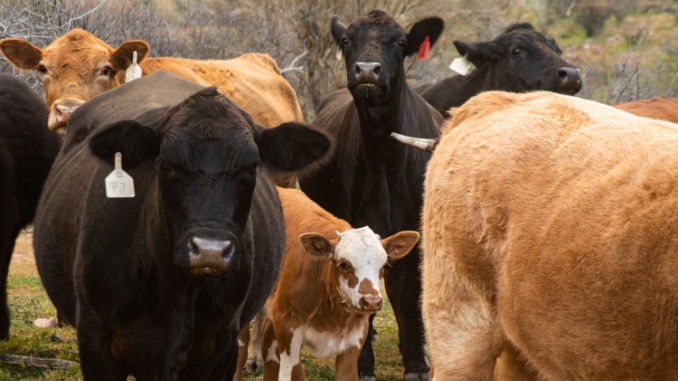
Arizona State Representative Chris Lopez (R-LD16) introduced legislation aimed at reducing costs for ranchers and, ultimately, consumers at the grocery store.
House Bill 2152, dubbed the “No Tax on Troughs” bill, would eliminate Arizona’s transaction privilege tax on water systems and infrastructure improvements on both public and private grazing lands.
The measure targets essential ranching expenses, including fence lines, fence posts, drinking troughs, water lines, and storage tanks, by exempting them from a tax that Lopez says unnecessarily raises operational costs for livestock producers.
Rep. Chris Lopez Introduces ‘No Tax on Troughs’ Bill to Support Arizona Ranchers and Ease Beef Prices
“Families are paying more for beef every time they check out at the grocery store. Ranchers are facing higher costs just to keep cattle fenced and hydrated, and Arizona is… pic.twitter.com/1oSedOBjjp
“Families are paying more for beef every time they check out at the grocery store,” Representative Lopez said in a press release announcing the bill’s introduction. “Ranchers are facing higher costs just to keep cattle fenced and hydrated, and Arizona is taxing those costs. That cost gets passed straight to consumers.”
Under current law, improvements to grazing infrastructure on federal grazing land, which become federal property once installed, remain subject to Arizona’s sales tax, with no reimbursement to ranchers after ownership transfers. Lopez’s proposal would end that tax treatment.
“At a time when federal land policies already make ranching harder, Arizona should not be adding another layer of cost,” he added.
The Arizona Farm Bureau has publicly argued that farms and ranches face substantial tax pressures, anticipating a potential $5,125 per year increase if federal agriculture tax provisions lapse. The Bureau added that these strains affect decisions on capital expenses like water systems and fencing.
The proposal comes as ranchers across Arizona continue to face rising operational pressures tied to drought conditions, water access, regulatory requirements, and higher input costs. Agricultural groups have warned that these factors have tightened margins for livestock producers and contributed to higher beef prices nationwide.
Arizona’s transaction privilege tax, which functions as a tax on the privilege of doing business rather than a traditional sales tax, has been the subject of multiple reform efforts in recent years as lawmakers debate exemptions and carve-outs for various industries.
Supporters of HB 2152 argue that reducing tax burdens on ranching infrastructure would help lower costs for producers, support wildlife habitat stewardship on public lands, and provide downstream relief for Arizona families at the grocery store.
Lopez represents Legislative District 16, which includes portions of Pinal and Pima Counties.
Arizona Ranchers are sounding the alarm and appealing to Cochise County Supervisors for help as the successful program to reintroduce Mexican wolves to the wild in Southern Arizona has begun to have consequences. The increasing number is creating problems for the ranchers, leading to calls to change their conservation status. As reported by KOLD-TV, Cochise County rancher Mike Wear, the owner of the Wear Ranch which covers an 18 square-mile area south of Willcox, told reporters, “Every cow that I lose hurts my bottom line. Immensely.”
Wear went on to explain that the wolves near his ranch have taken two cows in recent days as the 30-year effort to reintroduce the Mexican wolf to Southern Arizona has progressed. The rancher is not alone in Cochise County, and the County Supervisors have launched a dialogue to address potential changes in the federal listing of the species this week.
“It’s clearly, this deal, this wolf, Mexican wolf experimental population is on a definite runaway. They’ve had an immense amount of growth and in doing so, their primary prey base is our cattle,” Wear told KOLD.
“It’s very hard to find them. It’s created labor intensity on our ranches. I’d say ten-fold. We have to watch and check our cattle that much more because we only learn about the wolves after the kill,” Wear said.
According to Citizen Portal, during a recent meeting, the county outlined a series of requirements that must be met before delisting the Mexican wolf from the Endangered Species List would be considered.
Ranchers in Cochise County urged local officials to seek changes to federal protections for the endangered Mexican gray wolf due to livestock deaths.
— The Arizona Flyover (@TheAZFlyover) May 12, 2025
A slide from the Cochise County Supervisors Meeting obtained by Citizen Portal entitled “Compliant delisting” stated:
“The Mexican wolf will be considered for delisting when:
1) A minimum of two populations meet all abundance and genetic criteria as follows: United States
a) The population average over an 8-year period is greater than or equal to 320 wolves;
b) The population must exceed 320 wolves each of the last 3 years of the 8-year period;
c) The annual population growth rate averaged over the 8-year period is stable or increasing; and
d) Gene diversity available from the captive population has been incorporated into the United States population through scheduled releases of a sufficient number of wolves to result in 22 released Mexican wolves surviving to breeding age in the United States population. ‘Surviving to breeding age’ means a pup that lives 2 years to the age of breeding or an adult or subadult that lives for a year following its release.”
The outlet reported that the present U.S. population stands at 286 individuals just 34 shy of the cutoff. Furthermore, 21 of 22 successful gene insertions have already been achieved.
Arizona Game & Fish reported in March that the 2024 minimum count of Mexican wolves revealed an 11% increase over the minimum of 257 wolves counted in 2023. The new survey found that the population was distributed with a minimum of 162 wolves in New Mexico and 124 in Arizona. The wolves were spread across sixty packs at the end of 2024, 37 in New Mexico and 23 in Arizona with 164 pups born in 2024 and 79 surviving their first year for a 48% survival rate. At the reported rate, it appears likely the population will exceed the delisting criteria within two years.
“Each year, the wild Mexican wolf population numbers increase, and the areas they occupy expands. Genetic management using pups from captivity is also showing results. In total, 126 pups carefully selected for their genetic value have been placed in 48 wild dens throughout the recovery area since 2016 and some of these fosters have produced litters of their own,” Chief of Wildlife for the New Mexico Department of Game and Fish Stewart Liley said in a statement. “As we evaluate Mexican wolf recovery efforts, examining the last decade of data certainly provides confidence that recovery will be achieved.”
Clay Crowder, Assistant Director for the Arizona Game and Fish Department indicated that the 2022 Mexican Wolf Recovery Plan is exceeding expectations. He said, “The results of this year’s count reflect the hard work of many people and agencies that lead recovery. It also supports the recovery strategies in the 2022 Mexican Wolf Recovery Plan as we see both demographic and genetic objectives being exceeded this year.” He noted that the program has seen the ninth consecutive year of population growth saying the wolves are “knocking on the door of recovery.”
Greta Anderson, deputy director of Western Watersheds Project told KOLD, “Wolves inhabited this area until about 70 years ago when they were eradicated at the behest of the livestock industry by the federal government. So this is wolf habitat,. This is where wolves belong. This is their native wildlife in this area, and it’s really the humans that are the interlopers here.”
She added, “Livestock depredations that have occurred have all been pretty recent so this is kind of a new problem, but these wolves are not new.”
Anderson continued, pointing out that ranchers have options under the current conservancy status. “They’re allowed to lethally remove animals that are in the act, so to the extent that there’s already a difference in what you’re allowed to do on public and private land and I think one could say they have more flexibility because it is private land.”
The state declined to retry the case of George Alan Kelly, 75, the rancher charged with the deadly shooting of an illegal immigrant on his property.
Kelly faced the possibility of a retrial after a deadlocked jury resulted in a declared mistrial last week. As he walked out of the Superior Court building, Kelly said that he had faith God would protect him from those upset over the prosecutors’ decision.
“The nightmare’s over,” said Kelly. “God’ll look after me, like he always has.”
A small group of protestors awaited Kelly’s exit from the courthouse on Monday. A few shouted after Kelly as he walked away. Some of the protestors’ signs likened the shooting to a hate crime.
That illegal immigrant, Gabriel Cuen-Buitimea, 48, was found dead by Kelly last January after the rancher had allegedly fired warning shots above Cuen-Buitimea and the other illegal immigrants he was trespassing with on the property.
Accounts of Cuen-Buitimea crew differ, depending on who gave testimony. Authorities characterized the group as illegal immigrants evading Border Patrol during a typical illegal crossing. Kelly claimed the group’s presence was marked by a gunshot, and that the men were camouflaged and carrying assault rifles, one of which Kelly said was pointed at him.
Cuen-Buitimea had been deported for illegal entry into the U.S. at least three times from 2011 to 2016. According to a friend’s account to The New York Times, Cuen-Buitimea lived with his two adult daughters in Nogales. The pair met with the Mexican Consulate in Nogales and prosecutors after the declared mistrial last week.
One of Cuen-Buitimea’s travel companions, Daniel Ramirez, later served as the key witness against Kelly; Ramirez was imprisoned for drug smuggling nearly 10 years ago, though he falsely told the court that he had no prior drug-related convictions.
Ramirez’s testimony was later scrutinized for alleged editorialization and coaching by prosecution.
Santa Cruz County Attorney George Silva released the following statement after their decision to not retry Kelly:
“Because of the unique circumstances and challenges surrounding State vs. George Alan Kelly, the Santa Cruz County Attorney’s Office has decided not to seek a retrial in this matter. However, our Office’s decision in this case should not be construed as a position on future cases of this type. Our office is mandated by statute to prosecute criminal acts, and we take that statutory mandate seriously. We will review all the facts of each case as they are presented to our office, and we will continue to prosecute all criminal acts that occur within our jurisdiction when a factual and legal basis exists for prosecution. Nothing follows.”
Following a similar statement from the county attorney’s office in court on Monday, Judge Thomas Fink said the court would schedule a hearing to determine whether to dismiss Kelly’s case with or without prejudice.
The Arizona Superior Court declared a mistrial last week after the jury was unable to reach a verdict. Seven wanted to find Kelly not guilty, but one wanted to sentence him on the charge of second-degree murder.
AZ Free News is your #1 source for Arizona news and politics. You can send us news tips using this link.
On Monday, the Arizona Superior Court declared a mistrial in the case of George Alan Kelly, 75, the rancher who shot and killed an illegal immigrant trespassing his property.
The jury was unable to reach a verdict in Kelly’s case (CR-23-0026). Judge Thomas Fink scheduled a status reading for next Monday, April 29, to allow the state to determine whether it would request a retrial.
Fink read aloud a note from the jurors insisting that further deliberations wouldn’t resolve their deadlock.
The Santa Cruz County Attorney’s Office initially charged Kelly with first-degree murder for killing an illegal immigrant, 48-year-old Gabriel Cuen-Buitimea, trespassing Kelly’s property in Nogales last January. Cuen-Buitimea had previously been convicted and deported several times. The attorney’s office later lowered the charge to second-degree murder.
According to court documents, discovery of Cuen-Buitimea’s remains occurred after Kelly had called law enforcement twice: once in the early afternoon to report illegal immigrants possibly firing shots on his property, and once that evening to report the discovery of Cuen-Buitimea’s remains. Cuen-Buitimea was found unarmed.
Kelly’s co-counsel, Kathy Lowthorp, told NewsNation post-verdict that the jury was 7-1 for a “not guilty” verdict. Only one juror believed that Kelly was guilty of second-degree murder. Their defense team unsuccessfully fought the mistrial ruling and supported extending jury deliberation. The prosecution supported the declaration of a mistrial.
The jurors opted to maintain their deadlock over a unanimous decision on either reckless manslaughter or negligent homicide, which Fink suggested.
The Arizona Superior Court posted all videos of the 18-day trial to their YouTube page; they have also posted relevant case documents to their website, which includes the minute entries outlining the main events in the trial. The trial began exactly a month ago.
During court proceedings, Kelly’s other co-counsel, Brenna Larkin, testified that Cuen-Buitimea was one among a group of five men trespassing his land with large backpacks and rifles. Larkin clarified that Kelly shot in the sky above the men to ward them off after hearing a shot fired, ostensibly by the group of men.
Larkin stated in closing arguments that Cuen-Buitimea posed a very real threat to Kelly and his wife.
“Long story short, this is simply not somebody who’s looking for the American dream,” said Larkin. “There’s no evidence that this person is here for those kinds of benign purposes.”
The prosecution’s key witness against Kelly — Daniel Ramirez, another in the group that trespassed Kelly’s land on that fateful day — has falsely told the court he had no prior drug-related convictions, though he was previously convicted of drug smuggling nearly a decade ago.
Kelly’s counsel further claimed that the prosecution had coached, editorialized, and mistranslated Ramirez’s testimony.
“It is particularly disturbing that the State either failed to review the witness’s criminal history prior to putting him on the stand, or the State concealed the witness’s criminal history,” stated Kelly’s counsel.
AP News reported that Nogales’ consul general of the Mexican consulate, Marcos Moreno Baez, waited with Cuen-Buitimea’s daughters on Monday after the verdict to meet with prosecutors.
AZ Free News is your #1 source for Arizona news and politics. You can send us news tips using this link.