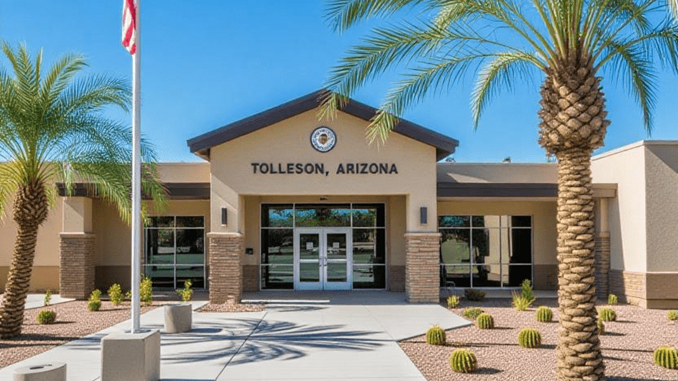
A community watchdog group is calling for a full stop to all major construction projects in the Tolleson Union High School District (TUHSD), citing overwhelming voter opposition and stark financial projections that point to a looming deficit that could reach into the hundreds of millions.
Citizens for Schools Accountability (CSA), a local 501(c)(4) organization focused on transparency and responsible spending, says the district should halt work on all ongoing and planned facilities including High School #8, a proposed domed stadium, and a new district office until an independent audit is completed and a clear financial plan is released.
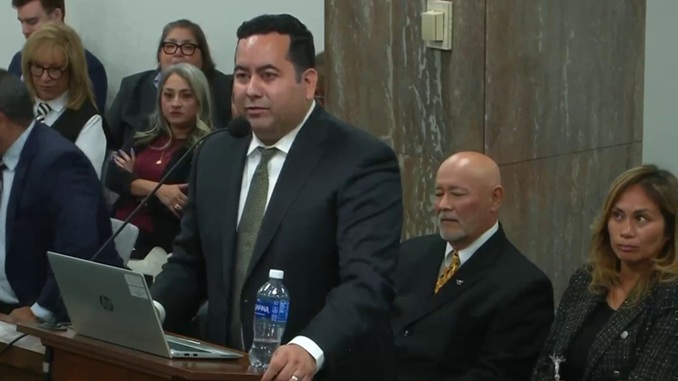
The group also criticized Superintendent Jeremy Calles and Governing Board President Steven Chapman for declining to follow a board directive requiring a full budget presentation before any further action on High School #8 is taken.
The warning comes just weeks after voters decisively rejected both a bond and an override sought by TUHSD, a dramatic reversal from past elections in which district measures routinely passed by wide margins. CSA leaders say the election outcome underscores widespread public concern over spending, transparency, and priorities within the district.
“Continuing construction without public support or a sustainable funding plan represents a dangerous breach of fiscal responsibility,” the group stated in its announcement. According to figures cited from district financial documents, TUHSD has approximately $294.6 million in bond, fund balance, and state School Facilities Board (SFB) resources available. Yet the projected costs of its construction plan far exceed that total.
Even under the lowest cost estimates, the district faces a minimum shortfall of $95 million. Under more likely scenarios, the deficit could approach $200 million. “This district is on the edge of a financial cliff,” said CSA Chairman Kino Flores. “Any organization facing a minimum $100 million deficit would hit the brakes immediately. Yet TUHSD is accelerating.”
Flores said that between the voter rejection, the cost projections, and the pending audit, continuing construction would be “reckless and irresponsible.”
CSA argues that until these steps are taken, any continued spending could jeopardize the district’s long-term stability. The organization says its concerns are not philosophical or political but grounded in the district’s own data and the unmistakable rejection voters delivered at the ballot box. “The voters said no. The math says no,” Flores said. “Fiscal responsibility demands the board stop every non-essential building project until the audit is complete, and a transparent financial plan is presented to taxpayers.”
CSA leaders say they will continue monitoring district actions and expect the board to respect both the financial realities and the community’s clear mandate.
Jonathan Eberle is a reporter for AZ Free News. You can send him news tips using this link.
Voters in the Tolleson Union High School District decisively rejected two funding measures last week, signaling a sharp reversal from past election outcomes and raising new questions about public trust in district leadership.
Both a proposed bond and budget override failed by wide margins, marking what state leaders are calling a significant shift in community sentiment. According to Arizona State Representative Matt Gress, who chairs the House Education Committee and co-chairs the Joint Legislative Audit Committee, the margin represents an estimated 40-point swing from the district’s last round of voter-approved measures.
“That kind of reversal doesn’t happen by chance,” Gress said in a statement. “It reflects taxpayers’ deep concern over how their money is being managed and the direction of district leadership.”
The vote comes as the district faces ongoing scrutiny from lawmakers over financial transparency. Gress first requested detailed financial transaction data from Tolleson Union on August 26 following a legislative audit hearing. The district declined to provide electronic records and instead issued an estimate exceeding $26,000 to fulfill the request. A follow-up clarification was sent on September 17, and as of last week the district had not complied.
Gress said the lack of cooperation has only fueled public skepticism. He pointed to delayed responses to official requests and continued planning for an $80 million domed stadium as examples of misplaced priorities, particularly as some governing board members face an active recall effort.
“When a school district refuses to provide basic financial records to the Legislature … public trust deteriorates quickly,” he said. “The Tolleson Union Governing Board should halt any further work on the stadium until transparency is restored and confidence is rebuilt.”
Supporters of the failed measures argued the additional funding was needed to maintain educational programs, address facility needs, and manage enrollment growth. But Tuesday’s results underscore a shifting climate in which voters appear more reluctant to approve additional spending without stronger fiscal assurances.
“The people of Tolleson have made their position clear: accountability must come before new spending,” Gress said. He added that lawmakers will continue to press for the financial records needed to assess how taxpayer funds are being used. School districts often rely on bonds to finance major capital projects and budget overrides to supplement operational funding. The rejection of both measures could force Tolleson Union to adjust spending plans or scale back initiatives in the months ahead.
Jonathan Eberle is a reporter for AZ Free News. You can send him news tips using this link.
“From the data on the class of 2025, college admissions officers and future employers can reasonably conclude that if the applicant is a graduate of Arizona schools, more likely than not, they cannot proficiently read, write, perform math, or understand science in comparison to their peers.”
A Legal Process also noted that a majority of Arizona’s 2025 graduates failed to meet one core academic benchmark. “55% of Arizona’s students can graduate high school and still not demonstrate college-ready level competency in a single core academic subject matter,” the publication said.
World Population Review published Public School Rankings by State 2025, which shows Arizona dead last overall in four categories: K-12 performance, school funding and resources, higher education quality, and safety. This is corroborated by Consumer Affairs, which rated Arizona number one on its list entitled, “Which states rank poorly for education?”
Arizona wastes between $10,000 and $14,000 per student, depending on the source. Meanwhile, the average ESA is estimated between $6,000 and $9,000 for students in 1st through 12th grade. Current trends also reveal that K-12 families are ditching government education at an impressive rate. Even if these calculations are off by 10 decimal points, my conclusion remains the same: The A-F School Letter Grade classification system is a complete joke, and school choice is the one good thing happening in Arizona education.
“Arizona school district superintendents receive high salaries. Yet, the true scale of that pay is often obscured by a triangle of complex contract provisions that school boards, and the superintendents themselves, deliberately design to mask the full measure of compensation from taxpayers…
These same school districts go to great lengths to block access to superintendent contracts—in some cases even from their own board members—shielding from the public how tax dollars enrich those who often are their community’s highest-paid public employees.”
Goldwater requested more than 40 superintendent contracts—official records that should be accessible to the general public—only to receive the documents after four months of repeated requests and warnings of potential litigation. The following information is also sourced from their report:
Not including health insurance or pension costs, Arizona superintendents’ base salaries average $215,000 a year, while taxpayers are charged up to $490,000 per superintendent after accounting for “lucrative perks.”
In addition to pension benefits, several school districts are double-charging taxpayers for superintendents’ retirement packages.
Taxpayers are funding superintendents’ personal and vacation leave to the tune of 15 weeks off, when combined with school holidays. When vacation days are unused, superintendents receive a payout in the form of additional compensation.
Goldwater rightly called attention to Tolleson Union High School District Superintendent Jeremy Calles, who makes off with roughly $500,000 a year. Although Tolleson ranks as the 16th largest district in the state, Calles earns at least $100,000 more than any other Arizona Superintendent. Not surprisingly, he was accused of financial misconduct and, according to ABC 15, the auditor general’s investigation into Calles is expected to be completed by January 2027.
Notably, Calles also stands accused of inflating enrollment numbers, loaning $25 million to the Isaac School District, and allowing one teacher to resign with full benefits after complaints that the former employee had an inappropriate relationship with a student. Regardless, Calles appears to have an explanation for everything. And, despite the embarrassing controversy, he still finds half a million reasons to show up for work.
“There are so many good things happening [in] our district right now that it is difficult to put them all into one newsletter…Our letter grades continue to rise…Success is not without consequence. If we are going to be the best district in the state, then we cannot get there by trying to do what everyone else is doing; we have to innovate.”
He signed off by stating that how Tolleson residents respond to a bond and override this November will “reveal how the community feels about the direction of the district.” I know how I would vote if I lived in Tolleson—it’s the same way I’m voting in Peoria.
If you’re anything like me, you’re a fish out of water when it comes to district finance. Simple is the only way I know how to be. Thus, maintenance and overrides (M&O) allow school districts to exceed their budget for salaries and daily operations by 15% in most cases. M&Os are marketed to the public as a means to “enhance student safety and special education programs.” Districts sell educators on increased pay, so (radical) teachers’ unions generally support overrides as well.
Tax increases are presented to homeowners in fractions and decimals and crumbs, rather than the sum total. Consequently, landowners must research their property value before they can know the full size of their “fraction.” Note that since overrides have literally been in place for decades, district representatives automatically expect taxpayers to honor the tradition of compliance as they’ve done in previous elections.
“Despite a 5% drop in district school enrollment since 2019, Arizona’s public-school districts have continued to expand facilities, increase capital spending by 67% to $8.9 billion, and boost transportation costs by 11.3% to $561.2 million, even as eligible bus riders plummeted by 45%…The fastest-shrinking districts have increased capital spending the most, with 20% of districts (serving 73% of students) receiving 81% of capital funding.”
Let’s be real. Taxpayers are not investing in gifted programs or sponsoring all-day kindergarten. This, my fellow proletariats, is what you call a bailout.
Rather than telling Arizonans how to vote in this election, I will instead refer you back to the information covered in this post. I encourage parents, property owners, and slighted educators to use sound judgment at the ballot box. Remember, the most basic definition of insanity is doing the same thing over and over again, expecting a different result.
Again, I’m no mathematician. But I’m willing to believe that at least a significant portion of the funds required to increase teacher salaries, enhance special needs programs, and implement cutting-edge safety plans can be found in the bank accounts of every district’s highest-paid employee.
Tiffany Benson is the Founder of Restore Parental Rights in Education. Her commentaries on education, politics, and Christian faith can be viewed at Parentspayattention.com and Bigviewsmallwindow.com. Follow her on socials @realtiffanyb.
Just two years after voters approved a $161 million bond in 2023, the Kyrene Elementary School District has unveiled a deeply unpopular, albeit long overdue, austerity plan to shutter nine of its 25 schools. Final decisions on which campuses will close remain in flux until December.
This should alarm not only Kyrene residents but also taxpayers in neighboring East Valley districts such as Chandler, Gilbert, and Mesa, which have likewise postponed needed consolidations despite data showing the urgency for school districts to “rightsize” to avoid future financial shocks.
Kyrene’s predicament shows what happens when district leaders, aided by special-interest boosters, ignore demographic realities and lean too heavily on bonds and overrides to prop up aging, half-empty facilities. Beyond the loss of schools and public trust, Kyrene’s crisis is a cautionary case study in how long districts can keep kicking the can on closures and restructuring before the math catches up.
For decades Kyrene ESD has fiercely defended its autonomy, resisting consolidation with Tempe Elementary School District, most notably in 2008, when Tempe voters approved a merger that Kyrene voters rejected by a 2-to-1 margin. The district has also resisted unifying with Tempe Union High School District, which serves most Tempe and Kyrene graduates. The result: three separate, duplicative bureaucracies servicing the same boundary zones of attendance.
That independence once seemed justified. By the 1980s and 1990s, Kyrene’s fortunes soared with population growth and rising property values following Phoenix’s annexation of Ahwatukee. A building boom beginning in the 1970s relieved Kyrene’s historic reliance on drawing students from outside its boundaries. That same appetite in housing translated to Kyrene’s expansion of schools, fueled by voter-approved bonds and overrides. Like many East Valley districts, Kyrene’s bond and override measures have passed easily, and typically without organized opposition.
Those glory days are long gone. Enrollment has fallen from 20,000 students in 2001 to roughly 12,000 today. That represents a 40 percent drop while the district continues operating 26 schools, a daunting figure considering it only serves grades K-8. Demographers project another 1,000-student decline within five years, equating to roughly $7 million less in state funding. Eight Kyrene campuses are less than half full, and three others are barely above that mark, culminating in the present restructuring effort.
Although Kyrene does have an override measure on the ballot for 2025, it remains to be seen if the drastic restructuring plan will have any impact on voter sentiment in the area for future bond requests. Given that Kyrene has spent millions from the recent bond request on schools now marked for closure, governing board members would be hard-pressed to make their case to residents for additional funding. Taxpayers who were told in 2023 by Superintendent Laura Toenjes that the bond would be “one more example of Kyrene’s commitment to fiscal responsibility” are right to demand answers about the gap between two decades of declining enrollment and the district’s continued inaction.
Kyrene is hardly alone. Large systems such as Chandler Unified remain locked in a perpetual bond-and-override cycle, masking structural enrollment declines with new debt and vague promises of an enrollment recovery effort that grows less plausible each year.
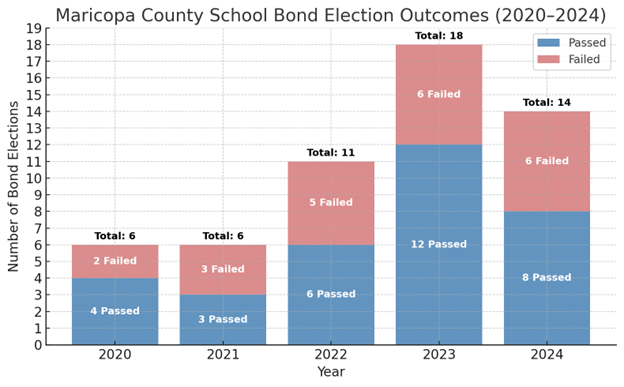
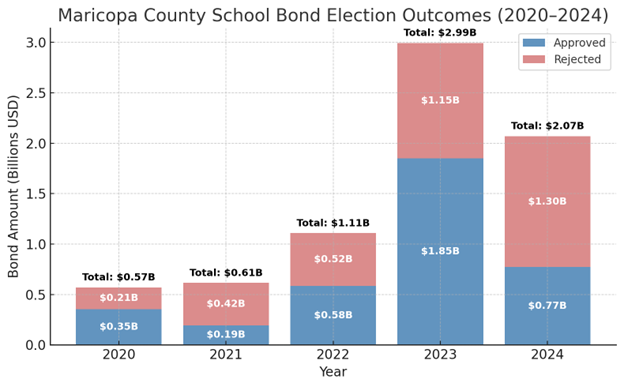
As seen in the chart below between 2020 and 2024, bond requests across Maricopa County have ballooned as pandemic stimulus dollars expired and districts turned back to property-tax financing. The pace of school bond elections far exceeds municipal ones, and the total amounts sought have surged as seen in the 2nd chart below. Inflation alone doesn’t explain the escalation, though it is often erroneously cited as the root cause of this growth.
The lesson isn’t that districts should never seek voter support, but that leaders must confront an uncomfortable truth: demand for traditional district schools is shrinking. Some causes, like rising housing costs and lower birth rates, are beyond their control. Others, like families choosing charters or ESAs, are the direct result of competition and consumer preference. Pretending otherwise guarantees more sudden, painful closures down the road, along with wasted opportunities adding up to hundreds of millions in taxpayer funds.
Kyrene’s crisis is neither the first nor the last domino of overbuilt school districts. Every district that keeps chasing bonds to prop up half-empty schools is writing the same ending. The can has been kicked far enough. It’s time to stop borrowing from tomorrow to preserve yesterday’s mistakes.
Arman Sidhu is a lifelong Arizona resident and educator who has served as a teacher and principal in both traditional public and charter schools. He is a doctoral student in education at Arizona State University’s Mary Lou Fulton Teachers College. His opinions are entirely his own.
Community members are questioning delays in Deer Valley Unified School District (DVUSD) releases of public records.
Tiffany Hawkins, a former board candidate and parent in the district, reported DVUSD “buried” about 3,000 emails in a public records request. Hawkins accused DVUSD officials of doing so to hide staff usage of school resources and time for electioneering.
DVUSD disgustingly buried 3k emails in a public records request to hide staff shamelessly hijacking school resources and time for election rigging, petition peddling, and political endorsements, flouting AZ law with reckless abandon! Taxpayers demand justice! @GoldwaterInstpic.twitter.com/Pvn6E2RSWB
DVUSD officials have previously faced accusations by parents of electioneering on school grounds. DVUSD Superintendent Curtis Finch was accused of doing so by placing political flyers on cars at school football games.
DVUSD is currently up for a budget override on the ballot this November. The 15 percent maintenance and operations (M&O) will cover approximately nine percent of all salaries, maintain maximum class sizes, pay for support services staff like counselors and nurses, and continue certain student programs such as free full-day kindergarten. This election is mail-in only.
Reporting from the Arizona Auditor General found that DVUSD spends more money on administrative costs in comparison to peer districts, ranking it as “high,” and noted that transportation spending per mile and per rider was “very high.” The report also noted that enrollments have declined steadily.
The auditor general also noted that the average teacher salary was over $2,000 less than the state average — even with the average teachers having over 12 years of experience. The district did apply its additional state monies intended to increase teacher salaries by 20 percent from the 2017 base fiscal year, which raised salaries by 35 percent.
Finch has blamed the state’s school choice program for their financial woes, manifesting as teachers struggling to come up with the funds for basic school supplies.
“Arizona has the most unusual (education) system in the nation. We have zero accountability,” said Finch in an interview with 12 News last week.
Hawkins also alleged that DVUSD denied 41 percent of her public records requests, along with withholding about 37,000 pages.
Arizona Women of Action (AZWOA), an affiliate of Hawkins, reported additional issues with public records requests being fulfilled in an untimely and incomplete manner.
AZWOA reported missing over 142,000 pages, collectively across multiple requests, and delays in responses taking anywhere from 100 to over 300 days.
A community member in Deer Valley Unified School District (@DVUSD) is exposing major delays and withholdings in public records requests, questioning compliance with Arizona’s public records law, which requires timely fulfillment.
DVUSD governing board member Kimberly Fisher said she has experienced “many games played” concerning public records retrieval. Fisher alleged “most” others wouldn’t speak up for “fear” of Superintendent Curtis Finch and his wife.
“Some excess redaction, some missing that suddenly show up, some taking over a year to receive, some they made me come in and scan myself if I wanted to see them only to find they already had them electronically,” said Fisher.
I, as an elected Governing Board member have had many games played with public records. Some excessive redaction, some missing that suddenly show up, some taking over a year to receive, some they made me come in and scan myself if I wanted to see them only to find they already…
Hawkins said she filed a complaint alleging “discrimination and retaliation.” The board dismissed the complaint.
Earlier this year, parents expressed concerns with DVUSD compliance with President Donald Trump’s orders to end Diversity, Equity, and Inclusion (DEI) teachings and programs.
AZ Free News is your #1 source for Arizona news and politics. You can send us news tips using this link.