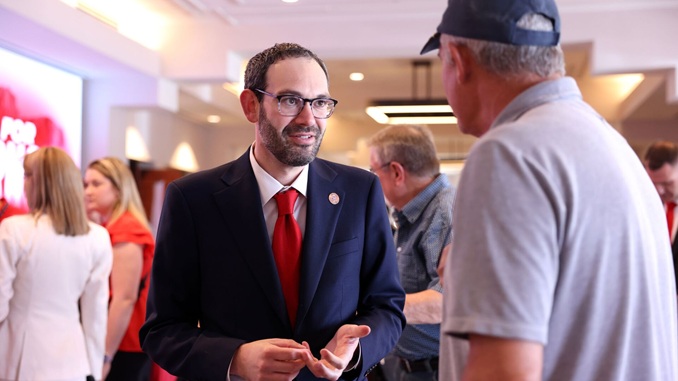
Republican State Rep. Alex Kolodin (LD3) is one of two contenders vying to unseat incumbent Secretary of State Adrian Fontes.
Kolodin, a longtime election lawyer, has been in the Arizona legislature since 2023.
Kolodin has previously defeated Fontes under different circumstances.
In 2020, Kolodin won an Arizona Supreme Court case against Fontes which determined the latter, while Maricopa County Recorder, had wrongly told mail voters that crossing out votes wouldn’t spoil their ballots. That ruling allowed Arizonans to further challenge election officials on unlawful actions.
In 2024, Kolodin again defeated Fontes in court, securing a requirement for the latter to comply with duties under the National Voter Registration Act.
Earlier this year, Kolodin successfully passed an election integrity bill (HB 2022) to ensure Arizona’s election timeline aligned with federal requirements and protected military members overseas from disenfranchisement.
Kolodin also led on HCR 2001, the Arizona Secure Elections Act, which promises to strengthen voter ID requirements through an amendment to the Arizona Constitution. The measure passed the Arizona Legislature and is now headed to the statewide ballot. If approved by voters, the amendment would mandate voter ID, declare citizenship as a mandatory qualification for registering and voting in elections, ban foreign funding in elections, and limit ballot acceptance times to Election Day.
Facing off against Kolodin in the primary is former Arizona Republican Party Chair Gina Swoboda.
Kolodin and Swoboda debated last month, with PBS moderating. Both said voters desire more reasons to trust their elections: competence, transparency, reliability, and experience.
Swoboda acknowledged that many voters believe elections have been rigged in recent years, but that the state has addressed issues with the administration, Elections Procedures Manual (EPM), and equipment through legislation and court challenges.
“The way I say it is, when people say, ‘Was it stolen?’, they were stolen fair and square,” said Swoboda.
Swoboda said issues with the EPM would always exist, but that the only issues that matter are those that affect the outcome of the election.
“We just won everything that was winnable in [20]24,” said Swoboda.
Kolodin disagreed with Swoboda’s view that the issues with the elections system, namely the EPM, have been resolved. He pointed to the Pima County GOP lawsuit against Fontes which alleges that Fontes’ EPM threatens voters’ free speech.
“The voters of Arizona are ready to move forward and have an elections system that we can be proud of,” said Kolodin.
Kolodin also questioned why Swoboda continues to defend the exclusion of political party observers in the EPM. Swoboda said she was merely backing what the law was at the time.
Swoboda criticized Kolodin for his 2023 admonishment by the State Bar of Arizona. Kolodin was punished for participating in lawsuits challenging the 2020 election.
Kolodin defended mail-in voting as the right of Arizona voters, and said that his efforts in the legislature have been to make that voting method more secure.
“Arizonans love our mail-in voting. Most Arizonans use mail-in voting, and nobody is coming to take that away,” said Kolodin.
Similarly, Swoboda said that Arizona has used mail-in voting for a while and does it well, and indicated that Arizona has further to go to secure the voting method against potential fraud.
The two contended whether the ballot referral under HCR2001 would “crush” mail-in voting. Kolodin claimed Swoboda was “misleading” voters on the referral, which he said was measures to improve the security of mail-in voting. Swoboda claimed the county recorders stand opposed to the referral.
“The voters of Arizona are the only stakeholders that I care about,” replied Kolodin.
Kolodin said it was “extremely important” to boost voter participation, especially in rural areas. However, Swoboda said it wouldn’t be her job as the secretary of state to ensure voter turnout was high.
In closing statements, Kolodin said his focus was on restoring public perception of integrity in Arizona’s elections.
“What the voters have been waiting for is elections that we can be proud of again,” said Kolodin.
AZ Free News is your #1 source for Arizona news and politics. You can send us news tips using this link.
This week, the Department of Justice (DOJ) asked the Supreme Court to uphold Arizona’s proof-of-citizenship requirements for voting.
The DOJ filed a brief in Republican National Committee, et al. v. Mi Familia Vota, et al. (case Nos. 25-1017, 25-1019, and 25-1022).
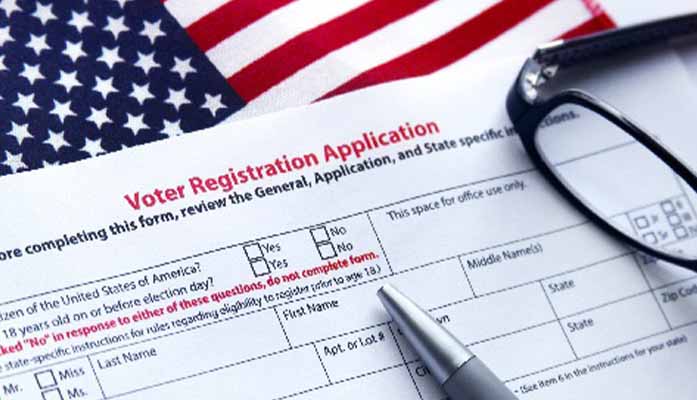
The case will determine whether the National Voter Registration Act (NVRA) prohibits states from: removing noncitizens from voter rolls within 90 days of an election, requiring individuals to provide documentary proof of citizenship when registering to vote in federal elections using the state registration form, and denying individuals the ability to vote by mail if they don’t provide documentary proof of citizenship.
These questions emerged from House Bills 2243 and 2492; both passed in 2022. Together, these bills require the secretary of state and county recorders to regularly review voter rolls, mandate registrants using the state registration form provide proof of citizenship, and prohibit vote by mail for federal-only voters.
The Ninth Circuit Court of Appeals ruled that the NVRA does preempt that legislation, impacting any similar citizenship proof measures taken by other states concerning their voting laws.
The federal court ruled the provisions in the Arizona laws amounted to unlawful voter suppression and were therefore unconstitutional. The court determined that voters must be allowed to vote federal ballots at least, even when they fail to provide proof of citizenship.
The respondents in the present litigation — Mi Familia Vota, Voto Latino, Arizona Asian American Native Hawaiian and Pacific Islander for Equity Coalition, Democratic National Committee, and the Arizona Democratic Party — want to preempt Arizona and other states from imposing proof-of-citizenship limitations on voting.
Jesus Osete, principal deputy assistant attorney general for civil rights, said in the DOJ announcement that the NVRA doesn’t prohibit states from removing noncitizens from voter rolls.
In its filing, the DOJ argued the lower court’s ruling conflicted with the NVRA since it would effectively render state forms into mere replicas of the federal form. States would lack the flexibility afforded by the NVRA, said the DOJ.
The DOJ filing argued that proof-of-citizenship requirements were harmonious with NVRA requirements to increase the number of eligible citizens registered to vote and ensure the maintenance of accurate and current voter rolls.
“When noncitizens with no right to shape American government vote in American elections, the ballot box no longer speaks for the People, because its tally no longer reflects their voice,” argued the DOJ.
Senate President Warren Petersen (R-LD14) said he was “thrilled” by the Trump administration’s intervention.
“Only U.S. citizens should vote in our elections,” said Petersen. “Excited for SCOTUS to take up this important case.”
Thrilled the Trump DOJ is backing Arizona’s proof-of-citizenship requirements! Only U.S. citizens should vote in our elections. Excited for SCOTUS to take up this important case. https://t.co/xWBiciTxjV
The Supreme Court has already overruled the Ninth Circuit Court of Appeals on one of the issues in 2024. The Supreme Court allowed Arizona to enforce its proof-of-citizenship requirement for state voter registration forms, but refused to allow enforcement of the requirement for those registering with federal forms.
That follows the precedent set in 2013, when the Supreme Court ruled that the NVRA prohibited Arizona from requiring proof of citizenship of those voters registering to vote with the federal voter registration form.
AZ Free News is your #1 source for Arizona news and politics. You can send us news tips using this link.
A federal judge dismissed the Trump administration’s lawsuit against Secretary of State Adrian Fontes over his refusal to turn over voter registration records.
The Arizona District Court ruled in United States v. Fontes on Tuesday that the federal government didn’t have justification under federal law to force Fontes to turn over the records.
The court dismissed the claim with prejudice, calling the federal government’s claim on the law “[an] amendment [that] would be legally futile.”
District Judge Susan Brnovich, widow to former Arizona Attorney General Mark Brnovich, found “unconvincing” the DOJ’s argument that the Civil Rights Act of 1960 (52 U.S.C. § 20702) gave the federal government authority to request state voter records and documents. Brnovich said this interpretation conflicted with the National Voter Registration Act (NVRA) and Help America Vote Act (HAVA).
“[T]he Attorney General’s interpretation places § 20702 in conflict with multiple provisions of the NVRA and HAVA,” said Brnovich.
The Department of Justice (DOJ) filed the lawsuit against Fontes in January. Then-Attorney General Pam Bondi sought Arizona’s entire statewide voter registration list, which would include a registered voter’s full name, date of birth, residential address, and driver’s license number or last four Social Security Number digits.
At the time, Bondi said voter registration database transparency between the states and federal government fulfilled a “basic obligation of transparency.”
— Arizona Secretary of State (@AZSecretary) April 29, 2026
Fontes said the court ruling represented a victory for preserving the security of voter privacy.
“Looks like your personal data is safe yet again because the case against me and the Department of Justice’s illegal requests to grab that voter registration have been dismissed,” said Fontes. “I will continue to protect your personal identifying information from these illegal requests no matter what.”
BREAKING: A federal judge dismissed the DOJ’s case against my office.
Arizonans’ personal identifying information is safe and I will continue doing everything in my power to protect your privacy. pic.twitter.com/sPbqpkGiry
— Arizona Secretary of State (@AZSecretary) April 28, 2026
The DOJ requested records from Fontes twice last summer and once last winter. Fontes denied all requests. He has maintained that state and federal privacy laws preempt him from turning over voter records.
Attorney General Kris Mayes supported Fontes’ refusal from the start.
In a statement released on Wednesday, Mayes said the ruling was a rightful dismissal and a vindication of Fontes’ actions.
“That database contains the sensitive personal information of millions of Arizona voters — home addresses, dates of birth, and Social Security and driver’s license numbers. But the Court was clear: Title III of the Civil Rights Act does not authorize this demand,” said Mayes.
Today, Judge Susan Brnovich's dismissed the DOJ's lawsuit demanding our voter registration rolls. @AZSecretary and I will continue to defend the privacy of voters against federal overreach.
— AZ Attorney General Kris Mayes (@AZAGMayes) April 28, 2026
Five other federal courts in California, Oregon, Michigan, Massachusetts, and Rhode Island have rejected this Civil Rights Act argument by the Trump DOJ.
The DOJ has 25 lawsuits on their claim of Civil Rights Act authority pending in Colorado, Connecticut, Delaware, Georgia, Hawaii, Idaho, Illinois, Kentucky, Maine, Maryland, Minnesota, Nevada, New Hampshire, New Jersey, New Mexico, New York, Oklahoma, Oregon, Rhode Island, Vermont, Virginia, Utah, Washington, West Virginia, and Wisconsin.
Earlier this month, Arizona Senate leadership referred Fontes to the DOJ for allegedly obstructing justice and tampering with a witness concerning a federal probe into Arizona election records.
AZ Free News is your #1 source for Arizona news and politics. You can send us news tips using this link.
Arizona state lawmakers requested the U.S. Supreme Court to take up an appeal on the state’s proof of citizenship for voter registration.
Last February, the Ninth Circuit Court of Appeals struck down two laws which established proof of citizenship requirements. That court declared Arizona’s laws attempting to add more requirements on voter registrations were preempted by the simpler registration requirements of federal voting rights laws under the National Voter Registration Act (NVRA) and were therefore invalid.
Those laws, passed in 2022 under then-Gov. Doug Ducey, restricted mail-in voting for registrants lacking citizenship verification in addition to requiring recorders to check federal citizenship databases and applicants to provide documentary proof of citizenship and residence. These pieces of legislation emerged following the Supreme Court’s 2013 decision against an Arizona law requiring proof of citizenship when registering to vote in federal elections.
Several years later, in 2018, the state entered into a consent decree requiring county recorders to search Arizona Department of Transportation (ADOT) records for state registration forms lacking proof of citizenship. Those applications without verifiable citizenship proof through ADOT would only be allowed to cast ballots in the federal election, otherwise known as “federal-only voters.”
A number of progressive activist organizations joined in a lawsuit to challenge these laws: Mi Familia Vota, Voto Latino, Living United for Change in Arizona, League of United Latin American Citizens, Arizona Students Association, ADRC Action, Arizona Coalition for Change, Poder Latinx, Chicanos Por La Causa and their affiliated action fund, Democratic National Committee, Arizona Democratic Party, Arizona Asian American Native Hawaiian and Pacific Islander for Equity Coalition, Promise Arizona, and the Southwest Voter Registration Education Project.
The Inter-Tribal Council of Arizona, San Carlos Apache Tribe, Tohono O’odham Nation, and Gila River Indian Community also were among the challengers to proof of citizenship laws, citing concerns with challenges tribal members face to obtain proof of residency. Several tribal members were named independently in the lawsuit: Keanu Stevens, Alanna Siqueiros, and LaDonna Jacket.
The leaders of the Republican-led Arizona legislature filed their petition with the Supreme Court this week.
Sen. President Warren Petersen (R-LD4) issued a press release announcing the Supreme Court petition in which he accused the Ninth Circuit judges of having “rewrote” federal law and ignored Supreme Court precedent.
“For more than two decades, Arizona has required proof of citizenship to register to vote, because only American citizens should decide American elections,” said Petersen. “This case is about whether states still have the power to enforce commonsense safeguards to ensure only eligible voters participate in our elections. Arizona is standing up not just for our state, but for every state’s constitutional authority to secure its own elections.”
The filing argues that the Ninth Circuit ruling against Arizona law stretches federal voting law far beyond its allowable interpretation.
“This case, which comes to the Court on a non-expedited basis and underpinned by a comprehensive evidentiary record, offers an ideal vehicle for clarifying the NVRA’s preemptive scope, affirming that federal consent decrees cannot perpetually paralyze state legislative bodies, and vindicating the presumption of legislative good faith,” read the filing.
AZ Free News is your #1 source for Arizona news and politics. You can send us news tips using this link.
The Arizona Republican Party is calling a recent court ruling a major victory for election integrity, but how much the decision will actually change voter roll maintenance remains an open question.
In a statement released this week, Arizona GOP Chair Gina Swoboda announced that the Arizona Court of Appeals, in Petersen, et al. v. Fontes, upheld an Arizona law that requires counties to begin the cancellation process when a voter swears on a jury questionnaire that they no longer live in the county. Swoboda described the ruling as a necessary correction that will help ensure clean voter rolls ahead of future elections.
“This ruling is a major victory for our state and for every Arizona voter,” Swoboda said in the update, framing the ruling as part of a broader effort to restore public confidence in the state’s elections.
“Cleaner rolls protect voters. That’s the bottom line. No more dodging the law, no more loopholes, and no more games with Arizona’s voter rolls. Republicans in Arizona are fighting to ensure our elections are secure and stopping extreme leftist policies that would have thrown our elections into chaos. This is a huge step forward, but our work continues. We’ll keep working to restore trust, enforce the law, and deliver an election system every Arizonan can count on.”
In the AZGOP statement, the party referred to the ruling as “a significant defeat for Secretary of State Adrian Fontes,” noting that the state’s second-highest-ranking Democrat was “forced to abandon his extreme rule that would have allowed counties to toss out every vote cast if a canvass was submitted late,” describing the policy as “reckless,” and saying it “jeopardized lawful ballots and undermined public confidence.”
Republicans are celebrating the decision as a significant victory for structural reform; however, the ruling itself paints a more nuanced legal picture.
On the jury-questionnaire issue, the court held that federal law does not preempt Arizona’s statute, A.R.S. § 16-165(A)(9)(b), which directs county recorders to cancel a voter’s registration if the voter fails to respond to a mailed notice after telling a jury commissioner they no longer reside in the county. The opinion explains that the National Voter Registration Act (NVRA) allows removal when a voter “confirms in writing” that they have changed residence and does not require that confirmation go directly to the county recorder. Instead, the court found that a signed juror questionnaire can qualify as that written confirmation:
“Because the Seventh Circuit precedent does not conflict with A.R.S. § 16-165.A.9, the NVRA does not preempt that Arizona statute. … Here, the county recorder sends the notice only when a person signs (under penalty of perjury) a written juror questionnaire saying the person no longer resides in the county. A.R.S. § 16-165.A.9(b). That notice satisfies the NVRA.”
Under the statute, the juror form does not lead to automatic cancellation. Instead, it triggers a process: the recorder must send a notice by forwardable mail warning that, if the voter does not respond within 35 days, “the county recorder shall cancel the person’s registration.” The 2023 Elections Procedures Manual had directed counties to move such voters to an inactive list instead of canceling their registrations, but the court concluded that approach conflicted with the statute and therefore exceeded the Secretary of State’s authority.
Swoboda and other GOP leaders also highlighted language in the 2023 manual that would have instructed the Secretary of State to proceed with a statewide canvass without counting any county whose official canvass arrived late. The appeals court, however, declined to rule on that provision, finding the challenge moot because Fontes had already replaced it in the draft of the 2025 manual with language committing to use “all available legal remedies” to compel a county board of supervisors to complete its canvass and “protect voters’ right to have their votes counted.”
While the ruling clearly reinforces that the Secretary of State’s election manual authority is bounded by statute, the judges also sided with Fontes on a key question involving the active early voting list. Upholding the superior court, the panel agreed that a separate statute governing removal notices for the active early voting list, A.R.S. § 16-544(H)(4), is not retroactive and applies starting with the 2024 election cycle:
“The 2023 Manual thus has the removal notice statute process start with the 2024 election cycle. The 2024 election cycle started on January 1, 2023. The superior court agreed with the Secretary. We thus affirm.”
Arizona counties regularly maintain their voter rolls using multiple data sources, including death records, address changes, and federal databases. Several prominent Republicans have argued that those procedures remain insufficient. The jury-form issue addressed in this case represents a narrow slice of that broader process. The practical number of registrations affected by the ruling is not yet known.
Arizona GOP leaders, including Swoboda, Arizona House Speaker Steve Montenegro, Senate President Warren Petersen, and former Speaker Ben Toma, have pursued multiple legal challenges over election procedures and voter-roll maintenance in recent years. Some of those efforts have succeeded in forcing procedural changes, while others have been dismissed on standing or jurisdictional grounds.
That track record makes this latest ruling politically significant even if its technical impact proves limited. For election integrity activists, it represents steady, gradual progress toward tightening controls. Critics, meanwhile, characterize them as partisan attempts to re-litigate election processes long after votes have been cast.
Swoboda’s update also criticized past election-related deadlines and procedures that Republicans argue undermined public trust, particularly citing disputes over ballot processing timelines and late canvassing.
Supporters of the ruling argue it restores a basic principle: if a voter swears they’ve left a county, that sworn statement can be used, under existing law, to start the notice-and-cancellation process so the registration does not remain active indefinitely, akin to voters trying to leave “the Hotel California,” as Swoboda quipped in a video posted to X. Opponents counter that aggressive roll maintenance must be handled carefully to avoid mistakenly removing eligible voters.
Arizona had a MAJOR WIN for election integrity, thanks to the Arizona Legislature’s lawsuit.
For now, the ruling directs how counties must treat sworn jury-form declarations moving forward, reaffirming the statutory process: notice, a waiting period, and eventual cancellation if there is no response. Whether that translates into large-scale voter-roll changes or simply a modest administrative correction will depend on how often such declarations occur and how county recorders opt to implement the ruling.