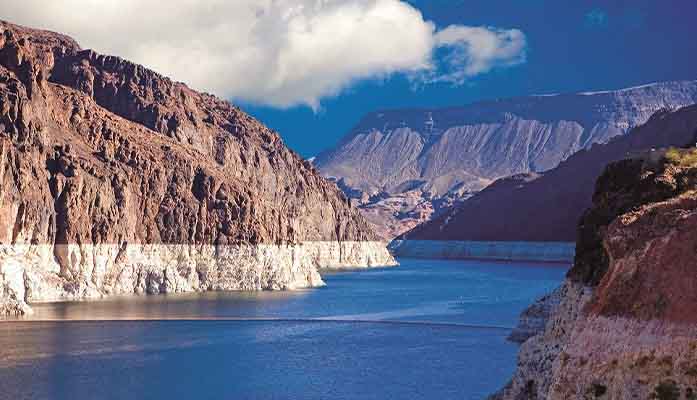
Congressman Andy Biggs (R-AZ-05) introduced legislation this week aimed at increasing water supplies and accelerating infrastructure projects across the Colorado River Basin. The legislation comes as the region faces historically low reservoir levels and new reductions in Lower Basin water deliveries.
The Colorado River Basin Water Security and Infrastructure Act would direct federal resources toward water augmentation, storage, desalination, recycling, treatment, and conveyance projects while changing federal permitting requirements for certain water infrastructure.
Today, I introduced the Colorado River Basin Water Security and Infrastructure Act to expand water supplies, accelerate critical infrastructure projects, and strengthen long-term water security throughout the Colorado River Basin.
The legislation comes amid continued uncertainty over the Colorado River’s long-term management.
The seven Basin states did not reach consensus on a long-term post-2026 operating framework earlier this year. The Department of Interior subsequently finalized operating guidelines for 2027 and 2028 in August.
Those guidelines call for 1.25 million acre-feet in annual reductions to Lower Basin deliveries during each of the next two years.
“The goal of this legislation is simple: add new water, strengthen the Basin, and protect the farms, communities, and military installations that depend on the Colorado River,” stated Congressman Biggs.
Under the bill, certain water-supply projects would be exempted from requirements under the National Environmental Policy Act (NEPA).
Federal agencies would also face deadlines for reviewing project applications, including 30 days to determine whether an application is complete and 180 days to issue a final decision.
The legislation would also allow project sponsors to rely on a broader range of existing feasibility and impact studies rather than repeating previous engineering work. Major federal projects included in the legislation would receive congressional pre-authorization in an effort to shorten the time between planning and construction.
Another major component of the proposal is the creation of a Basin-wide Water Augmentation Fund. The program would provide a 2-to-1 federal cost share for eligible projects pursued by states, tribes, municipalities, utilities, and private partners.
Projects eligible for funding would include desalination, water reuse, storage and conveyance infrastructure, aquifer recharge, and salt cedar removal, among other efforts intended to increase available water supplies.
The legislation would also authorize or accelerate several large infrastructure projects throughout the Basin, including restoring the Yuma Desalting Plant to full capacity and pursuing binational desalination projects with Mexico.
Other provisions would support capturing ocean discharges in California for potential water supply, augmentation projects in Arizona and Nevada, and new Upper Basin development projects.
Biggs argued that increasing the Basin’s overall water supply should play a larger role in addressing the region’s water challenges.
“My bill offers a path forward by investing in new water, modernizing critical infrastructure, and removing unnecessary federal barriers that can delay projects for years,” said Biggs. “Increasing the amount of water available to the Basin will bolster our single-family housing market, and strengthen food security, economic security, and national security throughout the American Southwest. Congress and the people we serve cannot simply wait for relief from the drought or conserve our way out of this crisis.”
The Colorado River provides water to more than 40 million people, supports approximately 5.5 million acres of farmland, and serves 30 tribes. The river also supplies hydropower and water resources across seven U.S. states and Mexico.
Conditions across the system have deteriorated during the prolonged drought. The Bureau of Reclamation reported in August that the combined contents of Lake Powell and Lake Mead had fallen to levels not seen since Lake Powell began filling in the 1960s.
The agency said the Basin has experienced an unprecedented drought for the past 26 years, with conditions worsening in 2026.
Biggs has been involved in several other Colorado River-related efforts this year.
In March, he led Arizona Republican members of Congress in raising concerns about the Bureau of Reclamation’s draft environmental review for post-2026 operations at Lake Powell and Lake Mead.
In April, Biggs joined Arizona Congressman Greg Stanton (D-AZ-04) in urging federal officials to release funding for drought-related projects across the Basin. Biggs later partnered with Nevada Congresswoman Dina Titus in seeking additional Colorado River funding as part of an emergency funding package.
The most recent legislation places an emphasis on expanding water supplies and infrastructure throughout the Basin. Biggs said the proposal is intended to provide greater long-term certainty for communities and agriculture rather than relying solely on reductions in existing water use.
“We must think big, be leaders, and deliver real solutions that will bring relief for decades to come,” said Biggs. “I urge my colleagues to act quickly and send this legislation to the President’s desk.”
Ethan Faverino is a reporter for AZ Free News. You can send him news tips using this link.
The city of Surprise now has a webpage to monitor the Immigration and Customs Enforcement (ICE) detention facility planned for their area.
The page offers a chronicled outline of the actions undertaken by the city and the Department of Homeland Security (DHS), as well as the current knowns, unknowns, and courses of action the city may take.
Last month, DHS and ICE entered into an agreement with Attorney General Kris Mayes to pause the conversion of a purchased West Sweetwater Avenue warehouse into a detention facility pending an environmental review in accordance with the National Environmental Policy Act (NEPA). Mayes sued to halt the property conversion in April.
ICE had originally estimated its initial intakes to occur around the end of May.
According to the DHS-Mayes agreement, DHS failed to engage in a proper environmental review. That concession by the federal government appears to conflict with earlier communications DHS had provided to city officials following a March meeting in Washington, D.C.
In those communications, DHS reported that ICE had completed a NEPA analysis in addition to a site history assessment, existing facility condition report, environmental due diligence audit, engineering assessments, and site feasibility assessments.
DHS had initially told Surprise that its warehouse conversion would have a negligible environmental impact and was therefore in compliance with NEPA.
“ICE processing centers share key operational and physical characteristics with industrial facilities, including a similar footprint and traffic patterns. Zoning conformity reports were conducted for all sites,” stated the DHS response. “Based on this analysis, DHS determined that the facility’s functional use remains consistent with the industrial use category and that the acquisition and modification do not introduce significant new environmental impact.”
City of Surprise officials stated that they weren’t made aware of the detention facility prior to the purchase of the warehouse for about $70 million in late January. The Surprise warehouse was one of multiple warehouse purchases across several states for similar conversion plans totaling more than $1 billion.
Mayor Kevin Sartor asked then-DHS Secretary Kristi Noem in a February letter for more information about the planned detention facility and its potential impacts on the community. DHS staff met with Sartor and other Surprise officials the following month, and provided a four-page response with information on the planned facility.
According to those communications, the facility would contain 500 to 1,500 beds for the temporary intake and transfer of illegal aliens undergoing removal proceedings. DHS estimated that those aliens would remain in the facility for a week or less, and then they would be removed to a larger detention center.
It is unclear when, if ever, the Surprise detention facility will become operational.
After Markwayne Mullin succeeded Noem as secretary of DHS in March, the fate of the Surprise facility and others grew murky. Mullin expressed skepticism of Noem’s approach to immigration enforcement proceedings. The new secretary told The New York Times that he would like “lightning speed” deportations using existing detention space, not additional processing pathways at the expense of taxpayers.
DHS advised in court proceedings earlier this summer that it would offload or sell off seven of the warehouses purchased for more than $700 million collectively, though the Surprise warehouse wasn’t named among them.
AZ Free News is your #1 source for Arizona news and politics. You can send us news tips using this link.
The planned opening of a new Immigration and Customs Enforcement (ICE) facility in Arizona has been delayed.
The Department of Homeland Security (DHS), ICE, and Attorney General Kris Mayes have entered an agreement to pause the conversion of a property in Surprise into an immigration detention center pending an environmental review.
Mayes sued to halt the property conversion in April, claiming DHS and ICE failed to comply with the National Environmental Policy Act (NEPA) and the Immigration and Nationality Act (INA).
The agreement reached on Tuesday acknowledged the Trump administration’s duty to adhere to the former through an environmental analysis, but didn’t address the latter allegation pertaining to the federal government’s duty to arrange for “appropriate” places for immigration detention.
Mayes described the agreement as a “significant win” in a press release issued on Wednesday.
“Federal agencies must complete the environmental review process required by federal law before moving forward with these types of projects,” said Mayes.
This agreement is a significant win for the people of Surprise and for the rule of law. Federal agencies must complete the environmental review process required by federal law before moving forward with these types of projects.
— AZ Attorney General Kris Mayes (@AZAGMayes) July 1, 2026
Similar legal challenges alleging NEPA noncompliance have impacted other immigration detention facility projects in other states: Maryland, Michigan, and New Jersey. The Trump administration initially attempted to argue its conversion projects were exempt from the NEPA, but after losing to a challenge in Maryland the administration pivoted on its approach to the Michigan and New Jersey challenges to agree to environmental reviews.
Environmental reviews take typically months, if not years, to complete. However, the Trump administration has recently made a point of expediting environmental reviews in other politically pressing situations.
Last spring, the Department of the Interior announced it would accelerate the review process to be completed in under a month in order to meet the demands of President Donald Trump’s declaration of a National Energy Emergency.
No reports have emerged indicating that the Trump administration plans to undertake similar expediting measures to get the Surprise or other planned immigration detention facilities up and running.
There may not be much of a desire for an expedited turnaround given another recent development.
New leadership within the Trump administration has indicated plans to reverse course on the national buildout of additional detention facilities. ICE announced last month that it would be selling or passing along to other agencies seven of the 11 facilities it had initially purchased to convert into detention facilities. The Surprise facility wasn’t among the seven facilities identified for offloading.
Kristi Noem, former DHS secretary, had directed the facility purchases and guided the conversion plans. The new DHS secretary, Markwayne Mullin, said in a statement to The New York Times that ICE would be prioritizing plans that facilitated the expedited removal of illegal aliens, not prolonged “hous[ing of them] on American soil at the taxpayer’s expense.” Instead, DHS will maximize the use of existing detention space through state and county partners.
At present, ICE has four facilities in Arizona: the Central Arizona Florence Correctional Center in Florence, the Florence Service Processing Center in Florence, the Eloy Detention Center in Eloy, and the San Luis Regional Detention Center in San Luis.
AZ Free News is your #1 source for Arizona news and politics. You can send us news tips using this link.
Arizona manufacturing and business groups can claim a policy win in Washington, D.C., after the U.S. House of Representatives passed a major federal permitting reform bill they had urged Congress to advance.
On December 18, the House approved the Standardizing Permitting and Expediting Economic Development (SPEED) Act, H.R. 4776, in a 221–196 vote. The legislation is designed to streamline environmental reviews and speed federal permitting for large energy infrastructure projects, data centers, factories, and other major developments.
The bill, sponsored by House Natural Resources Committee Chairman Bruce Westerman (R–AR) and Rep. Jared Golden (D–ME), amends the National Environmental Policy Act (NEPA) to shorten review timelines, clarify when NEPA applies, and limit how long lawsuits can delay projects. A committee summary says the measure is intended to “modernize NEPA,” reduce permitting backlogs, and curb what supporters describe as “abusive litigation” that has slowed infrastructure and energy projects nationwide.
In a press release on the day of the vote, Westerman called the SPEED Act’s passage “a win for America” and urged the Senate to move quickly. The committee noted that more than 375 organizations nationwide backed the bill.
The House vote followed a coordinated push by national and Arizona manufacturing advocates in early December, when congressional leaders signaled they would take up permitting reform over a two-week stretch.
In a December 10 article, Chamber Business News reported that the National Association of Manufacturers (NAM) and Arizona business groups were urging Congress to act on what NAM branded the “12 Days of Permitting Reform.” NAM called on lawmakers to move several bills — including the PERMIT Act and the SPEED Act — to simplify federal reviews and shorten timelines for major infrastructure, energy, and industrial projects.
NAM President and CEO Jay Timmons said at the time that Congress had an opportunity “over the next 12 days to demonstrate strong, bipartisan momentum on comprehensive permitting reform,” and encouraged policymakers to make it easier and more cost-efficient for manufacturers to advance job-creating projects.
For Arizona, business leaders framed the debate as directly tied to the state’s ability to keep pace with growth in sectors such as power generation, semiconductor fabrication, aerospace and defense manufacturing, and AI-driven data centers, all of which depend on predictable federal approvals.
Arizona Chamber of Commerce & Industry President and CEO Danny Seiden said modernizing federal permitting is critical for Arizona’s economic future, arguing that “manufacturers can’t meet demand, onshore supply chains, or power new AI and data-center growth without a permitting system that works.”
“Arizona’s economy depends on major projects moving on predictable timelines. Congress should advance the PERMIT Act and the SPEED Act so companies can build the infrastructure and capacity our economy requires,” Seiden added.
Grace Appelbe, executive director of the Arizona Manufacturers Council, told Chamber Business News that long, unpredictable federal reviews create significant challenges for small and mid-sized manufacturers trying to expand, upgrade equipment, or bring new technologies online, and said reforms could lower costs and improve Arizona’s competitiveness for new investment.
The House Natural Resources Committee describes the SPEED Act as a structural update to NEPA’s review process. Key provisions include:
Shorter, defined timelines for environmental reviews on major federal actions.
Clearer triggers for NEPA, by defining “major federal action” more narrowly.
Streamlined documentation, intended to reduce the length and complexity of NEPA analysis.
Limits on litigation, including a 150-day window for filing NEPA challenges, to reduce long-running court delays.
External reporting has noted that industry groups, such as energy and infrastructure advocates, welcomed the bill as the first significant federal permitting reform effort since NEPA was enacted in 1969, while environmental organizations have urged the Senate to reject or significantly revise the measure, warning that looser standards could weaken environmental protections and public participation.
With House passage secured, the SPEED Act now moves to the U.S. Senate, where lawmakers in both parties are working on broader permitting legislation and have signaled potential changes to the House bill, Axios reports.
Arizona manufacturers and business groups, which spent early December calling for action on the SPEED Act and related measures, are expected to continue pressing for a final package that delivers the permitting certainty they say is needed for long-term investment and for meeting the state’s projected load and infrastructure demands.